Bhutan

Elements area

Taxonomy

Code

Scope note(s)

    Source note(s)

      Display note(s)

        Hierarchical terms

        Bhutan

        Equivalent terms

        Bhutan

          Associated terms

          Bhutan

            419 Archival description results for Bhutan

            419 results directly related Exclude narrower terms
            John Anthony collection
            GB 235 ANT · Collection · 1910 - 1972

            GB 235 ANT/1 - photo album including photographs of John Anthony and his family, Edinburgh views and photos relating to World War One, including the Edinburgh University Officers Training Corps at Peebles in 1915 showing Cadets Brown, Purves, Mills, Anthony, Smith, Hatton and Wallinck; Anthony with the Royal Welch Fusiliers in Oswestry and Llangollen (Anthony, Evans, Edwards, Gavin, Richards and Mitford) and Capt J Anthony M.C. and Capt J.H. Dick M.C. on the Somme in 1916.
            GB 235 ANT/2 - Transcripts of 'The Identification of British Trees, Shrubs and Under Shrubs by means of the Microscopic Structure of their Wood', including photographs - 2 copies, loose sheets.
            GB 235 ANT/3 - Original Manuscript for Flora of Sutherland, c.1970 - comparison with the published version shows the extent of J.B. Kenworthy's editing, as described in his introduction (right click, open link in new tab): http://www.botanical-society-scotland.org.uk/John_Anthonys_Flora_of_Sutherland

            Anthony, John
            LSH/1/1/8/1/43 · Part · 1947-01-13
            Part of The Ludlow & Sherriff Collection

            SUMMARY:
            Entries for January 6–9 describe a snowy halt, peak angle measurements from a Dzong, and marches to Layoting and Camp Namdi. The writer disputes Ward and Bailey on the visibility of Gyala Peri, notes friendly villages, a nearby peak Gelung Jokpo, forests transitioning from pine to dense broadleaf, and observations of birds, clematis, and abundant Lilium giganteum.

            CONTENT:
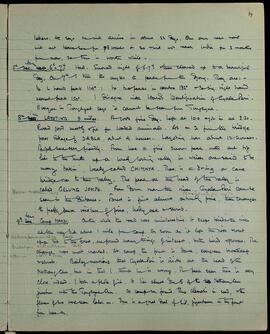
            letters. He says he will arrive in about 22 days. Our own next mail will not leave here for 7 or 8 weeks or so until we reach India in 3 months from now, so this is worth while.

            Jan 6th & 7th Halt. Snowed night of 6-7th then cleared up to a beautiful day. On 7th I took the angles to peaks from the Dzong. They are: - to left-hand peak 114° : to two peaks in centre 132° to big right-hand nearest peak 150°. I disagree with Ward's identification of Gyala Peri. Everyone in Tongkyuk says it cannot be seen from Tongkyuk.

            Jan 8th LAYOTING. 9 miles. A good fine day. Left at 10.0 got in at 3.30. Road good mostly fit for loaded animals. At mile 2 from the bridge pass village of DABLA, about 4 houses. Layoting has about 12 houses. People here very friendly. From here a fine snow peak with cut top lies to the South up a bleak looking valley in which are said to be many 'takin', locally called CHIMNYA. There is a sling or cane bridge over to this valley. The peak at the head of the valley is called GELUNG JOKPO. From down near the river, Gyala Peri can be seen in the distance. Forest is first almost entirely pine, then changes to pretty dense mixture of pine, holly oak & shrubs.

            Jan 9th Camp NAMDI. On the whole the road was uninteresting. It keeps beside the river all the way till about 1 mile from camp. As soon as it left the river & went up a bit to the forest, we found many things of interest, both birds & flowers. The change was most marked. At camp the forest is dense, evergreen broadleaf & shrubs. Bailey mentions that Gyala Peri is visible at the head of the Netrang Chu, but in this I think he is wrong. The peak seen there is very close indeed. I took a photo of it. It lies almost due S of the Netrang Chu junction with the Tongkyuk Chu. At camp we found three clematis in seed, the flowers of two were seen later on. There is a great deal of Lilium giganteum in this forest from here on.

            LSH/1/1/3/3/188 · Part · 1936-06-13
            Part of The Ludlow & Sherriff Collection

            SUMMARY:
            Notes outline movements of party members: S goes to Chickchar while L and K cross Pembo La into the Tsangpo basin toward Tsomechi/Tsemachi. Subsequent entries record a halt at Tsemachi and stages to Sumbatze, Kyimdong Dzong, and Taktsa.

            CONTENT:
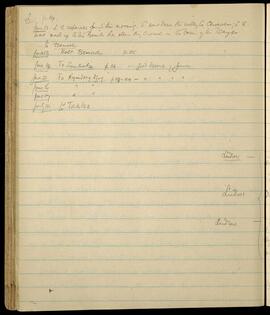
            L p. 114.
            June 12 - L & S separated from S this morning. S went down the valley to Chickchar; L & K went north up to the Pembo La where they crossed in the basin of the Tsangpo to Tsomechi.
            June 13 Halt Tsemachi p. 115
            June 14 To Sumbatze p. 116 - good description of journey.
            June 15 To Kyimdong Dzong p. 118-119 - " " " "
            June 16 " "
            June 17 " "
            June 18 To Taktsa.

            Ludlow
            Ludlow
            Ludlow

            LSH/1/1/1/1/130 · Part · 1933-08-12 - 1933-08-18
            Part of The Ludlow & Sherriff Collection

            SUMMARY:
            Page lists bird specimens 2228–2237 dated 12–13 Aug 1933 and describes the route from Kulong Chu to Khoma Chu via the Pang La after returning from Me La to Tobrang and crossing the Dong La Range. Notes record finding Heteroxenicus stellatus near the Pang La, additional species near Tosumani, and key birds at Narim Thang and on the Kang La, with arrival at Narim Thang on 18 Aug and a 10-day halt.

            CONTENT:
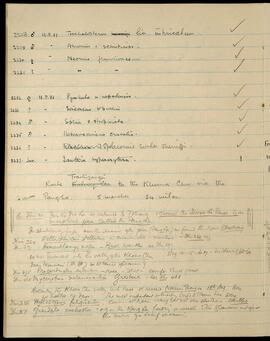
            2228 ♂ 12.8.33 Trochalopteron lin. imbricatum.
            2229 ♂ 12.8.33 Abrornis schisticeps.
            2230 ♀ 12.8.33 Neornis flavolivaceus.
            2231 ? 12.8.33 Neornis flavolivaceus.

            2232 ♀ 13.8.33 Pyrrhula n. nepalensis.
            2233 ? 13.8.33 Seicercus burkii.
            2234 ♂ 13.8.33 Siphia s. strophiata.
            2235 ♂ 13.8.33 Heteroxenicus cruralis.
            2236 ? 13.8.33 Spelaeornis souliei sherriffi.
            2237 Juv. 13.8.33 Ianthia hypererythra.

            Trashiyangsi
            Route Kulong Chu to the Khoma Chu via the Pang La.
            5 marches 34 miles.

            & Itin 10. From the Me La we returned to Tobrang & crossed the Dong La Range by an unexplored pass called the Pang La.
            In rhododendron jungle near the summit of the pass (Pang La) we found the rare Shortwing Heteroxenicus stellatus in considerable numbers - Itin 265 see.
            Itin 271. Homochlamys major - Bush Warbler see Itin 271.
            We now descended into the valley of the Khoma Chu - Aug 14-15-16-17 - see Itin 65-69
            Near Tosumani (Itin 65) we obtained specimens of
            Itin 475. Procarduelis nipalensis - rose-finch in conifer thick forest.
            Itin 468 Mycerobas melanoxanthos Grosbeak - see Itin 468
            Ascending the Khoma Chu valley, to its head we reached Narim Thang on 18th Aug. Here we halted 10 days. The most important birds obtained here were
            Itin 286 Phylloscopus fuligiventer. Common at Narim Thang but not seen elsewhere. Warbler.
            Itin 277 Grandala coelicolor - only on the Kang La feeding on insects & the glaucous indigo-blue berries of a dwarf vaccini.

            LSH/1/1/1/1/10 · Part · 1933-05-05 - 1933-11-06
            Part of The Ludlow & Sherriff Collection

            SUMMARY:
            Notes the 1933 traverse across Bhutan via the central highway, leaving Gangtok and being delayed at Changu on 5 May due to snow on the Natu La. Records bird observations across Changu, the Chumbi and Ha valleys, and the Tibetan plateau, including a Wood Snipe sighting by Sherriff near Mago.

            CONTENT:
            3a

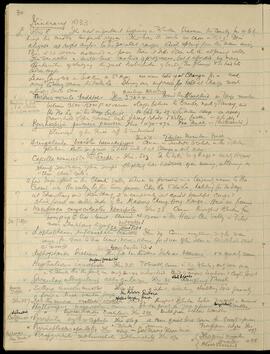
            Itinerary 1933.

            Ibis 6. The most important highway in Bhutan traverses the country from W. to E. through the middle temperate region. This was the route we chose in 1933. It is aligned at right angles to the parallel ranges which spring from the main axis, thus it soon ascends a pass then it dips down into an adjoining valley. This was rather a switchback method of progression but it afforded so many opportunities of studying the zonal distribution of birds (and flowers) & it had its advantages.

            Leaving Gangtok in Sikkim, on 5th May we were held up at Changu for a week owing to heavy snow on the Natu La. During our enforced halt at Changu most interesting birds were:

            Himalayan Blackbird
            Turdus merula buddhae. Ibis 273-4. Found the Blackbird in large numbers between 13,500-15,000 ft at various stages between the Bum La, north of Tawang, and the Tse La in the Mago District. Confined to S.E. & S.W. Tibet at 12,500 and over. On 6th Nov. it is often seen on rocky grassy hill slopes covered with dwarf rhododendron bushes, etc. etc.

            Pyrrhospiza punicea punicea. Ibis 470-472. Red-breasted Rose Finch. Plumage of the female difficult to understand.

            Ibis 478. Tibetan Mountain Finch
            Fringalauda brandti haematopygia. Common in suitable localities on the Tibetan plateau. Rather surprised to meet with it at Changu in early May.

            Capella nemoricola. Wood Snipe - Ibis 503. In the hills W. of Mago in early August Sherriff saw many of this snipe flighting like woodcock of an evening, uttering a "Chur, Chur" call.

            A few days spent in the Chumbi Valley, whence we proceeded in a leisurely manner to Ha. Crossed into Ha valley by the twin passes Chele La & Ha La, halting for 10 days at Sharithang and Damthang, 2 encampments set amidst beautiful conifer & rhododendron forest on either side of the Massong Chung Dong Range. Here we found:

            Nucifraga caryocatactes hemispila. Ibis 22. Nutcracker! Common throughout Bhutan from 6,000 ft up to tree-limit. Observed at 12,000 in the Hamo Chu valley in Tibet near Lhakhang Dzong. (See p 19a)

            Lophophanes rufonuchalis beavani. Ibis 24. S.K. Black Tit. Common everywhere, S. of the main range, from 9,000 to tree limit, seen above, for it was often seen in low rhododendron scrub at 14,000 ft.

            Lophophanes dichrous. Black-browed Crested Tit. This bird has the same distribution as beavani and is equally common.

            Aegithaliscus iouschistos rufiventer. Ibis 25. Tolerably common in W. Bhutan; only seen once in E. Bhutan though the party was one of 30-40 individuals. Birds of mixed deciduous & conifer forest.

            Garrulax albogularis albogularis. Ibis 31. White-throated Laughing Thrush.

            Suthora unicolor unicolor. Ibis 26. The Brown Suthora. A silent, sedentary, skulking bird generally found in thick bamboo jungle.

            Ianthocincla ocellata ocellata. Ibis 32. Spotted Laughing Thrush. Throughout Bhutan between 7-11,000 ft in summer.

            Phylloscopus magnirostris. Large-billed Warbler. Common on plateau forest from 7,000 upwards.

            Trochocercus trochiloides. Ibis 288. Dull green Willow Warbler.

            Pyrrhula erythrocephala. Ibis 469. Red-headed Bullfinch. A tame quiet bird common from 9,000 ft upwards in Bhutan.

            Pyrrhoplectes epauletta. Ibis 469. Gold-headed Black Finch.

            Propyrrhula subhimachala subhimachala. Ibis 470. Red-headed Rose Finch.

            Tragopan satyra. Ibis 497.

            Ithaginis cruentus cruentus. 498. Blood Pheasant.

            LSH/1/1/9/1/123 · Part · 1937-08-12
            Part of The Ludlow & Sherriff Collection

            SUMMARY:
            After an early start, Tasho and his man led the diarist to Codonopsis aff. vinciflora, and there are notes on discussing with HH the organization of medical work in Bhutan, including a hospital at Tongsa and rest houses. On 23 August at Isalunape heavy rains had altered the river and plants were later than in 1937, with the Zimpon improving the lodging. On 24 August at Tahudu the party reached camp early despite washed-out paths, noting large patches of Lilium wallichianum, finding Luculia pinceana, and collecting old seed of Streptocarpus simplex.

            CONTENT:
            After 6:00 am Tasho rode up the first mile. Here one of his men pointed out Codonopsis 'aff. vinciflora', the one I was looking for when we last passed. It was just where we had been looking, but then it was not in flower, all mixed up in the holly oak foliage. Now we saw about a hundred plants, all just coming into flower, so it must be about a fortnight later this year. Tasho was nicer and showed more life this time. He appears to have been talking to Jigme Dorji about various things in the country - hospital at Tongsa, getting the doctors going, and medicine organised etc. I am going to talk to HH about it all, and see if HH will give Tasho the job of organising all medical work now in Bhutan, also putting the rest houses in order.

            23rd August. Isalunape. 5:30 to 10:00. Mist and some rain, but just fine all day. It is obvious that there has been exceedingly heavy rain lately. The river is quite different now and it is over the path in 3-4 places and much discoloured. This certainly seems the wetter month in Bhutan. I notice all plants here are later than in 1937. P. capitata and crispata are just coming into flower now, and in '37 they were in full flower by 12 August. Ceratostigma also is just becoming a fine sight. The Zimpon met me here, and has obviously taken great trouble to make this place better than before. Beds are made, curtains hanging (!) and all sorts of improvements. All I'm afraid of are fleas and bugs.

            24th August. Tahudu. Fine most of the day, but misty and damp. There has been terrific rain everywhere lately, and the path is washed away in very many places. We were all in camp by 2:45 or 3, after 5:15 start. The only interesting things were the sight, across the valley here, of 2 patches of each of about 100 Lilium wallichianum. And I found Luculia pinceana. It is a beautiful tree, with very fine big flowers. Got (old) seed of Streptocarpus simplex.

            LSH/1/1/3/3/44 · Part · 1934-03-10
            Part of The Ludlow & Sherriff Collection
            • SUMMARY:
              Notes record securing a Himalayan Goldcrest on March 11, the first time L. has seen the species in Bhutan. Observations detail habitats and elevations across Sakden, Pumbi La, Reyimpu, Chungkar, and Tro Shika near the Teboba plateau. Brief logistical notes mention P. Whiler and arrivals dated 26–28.

            CONTENT:
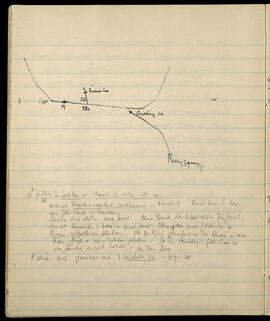
            E 140° M 170 280 Sissin La
            Choling La W
            Rumzang

            L p. 25 - to Sakden - March 11, 12, 13, 14
            28:
            Secured Regulus regulus sikkimensis - March 11. First time L. has seen Goldcrest in Bhutan.
            Sakden bird from Oak forest. Others Pumbi La - 6 Sept shown Fir forest; one at Reyimpu (6000) in birch forest. Chungkar bird (11,000) in a Pinus nepalensis plantation. On 20 April got a bird at Tro Shika in buckthorn jungle on edge of Teboba plateau. So the Himalayan Goldcrest is very partial as to its habitat - see Ibis 204.
            P. Whiler 12-15. grass sp. 1216.

            • arrived 26. - 27 - 28
            LSH/1/1/1/1/136 · Part · 1933-08-16
            Part of The Ludlow & Sherriff Collection

            SUMMARY:
            Notes Heteroxenicus cruralis on 16 August 1933 and describes July 1933 route conditions as bad up to Singhi Dzong. The Kangha (Gongha) pass is very steep with a knife edge summit and a small glacier on the N side; ponies could cross only with great difficulty though the rest of the route was passable for laden animals.

            CONTENT:
            2255 ♂ 16.8.33 Heteroxenicus cruralis.

            11800

            In July 1933 this route was bad as far as Singhi Dzong. The Kangha (Gongha) is a very steep rocky pass with a knife edge summit and a small glacier on the N side. Ponies could only cross the pass with great difficulty, though the rest of the route is passable for laden animals.

            LSH/1/1/9/1/63 · Part · 1949-06-01
            Part of The Ludlow & Sherriff Collection

            SUMMARY:
            High-altitude collecting around 14,000 ft yielded several small plants and a lake, with monal and burhel observed. The diarist notes mail delays, sends letters and parcels to H.H., Raja Dorji, and Betty during a halt, then crosses the Hubsing La to reach Kantanang in wet monsoon weather.

            CONTENT:
            very steep indeed. At first we found little, but at the highest altitude, about 14000, found a good many little things, including P. glabra (19011), P. sapphirina (19025), P. hopeana (Lud. Sherriff 19030), P. macrophylla, a good Aster and one Mec. paniculata (Lud. Sherriff 19019) in flower, but not elongated. Plec. simplicifolia is everywhere, but a miserable thing. Saw a few monal, and a pair with 3 young. Also some heads of burhel lying about. It was lovely up at 14000, and we found a nice lake there, the which may be worth visiting again later on. But I think almost every stream starts in a lake up here. Although the weather was so good, we did not see anything very much in the way of a view, but a press of flowers was worth more.

            Still no mail. It is a good long time since I heard from Betty now, and I hope she is alright. Her last letter came very quickly to me, written on 13th and reached me 15th at Menjisi. I have sent her 2 or 3 letters since then, but I feel perhaps the dak may be slowing up now with all the work it has to do. In 1937 I had bigger mails, but not so often, and all except one came through alright. That one was found later abandoned by the roadside - no harm done, but just left there.

            1st June. Halt. Our last day here. We leave some boxes behind, and calculate that we will be back in 3 weeks at most. A poor day, with a good deal of rain. I sent off a mail today - a letter to H.H., a parcel to Raja Dorji and a parcel of books and a letter to Betty. They reach Bumthang tomorrow, but I wonder when they will be sent on from there. There seems to be some delay now in the mails, which at first came so quickly.

            2nd June. Kantanang. There was heavy rain all last night, and although little rain today, it is very monsoonish and misty and wet. A pity as we came over a hellish pass, the Hubsing La, of about 14500 I should say, and would have had a very fine view on a good day.

            LSH/1/1/3/3/13 · Part · 1936-02-09
            Part of The Ludlow & Sherriff Collection

            SUMMARY:
            The diarist halts while Tobgye departs to meet Gould at Rangiya and then proceed to Shillong regarding Bhutan boundary matters, expressing concern over Gould’s treatment of Tobgye amid unsettled weather. Plans are made to go to Chungkar after hearing rhododendrons are out, a fishing trip is undertaken, and a wire from Mary reports the diarist’s mother has died; the Trashigong Dzongpon also departs.

            CONTENT:
            19th Feb. Halt. Tobgye stayed up till this afternoon, when he went off about 2.0 pm. He has to meet Gould at Rangiya & then go to Shillong to discuss Bhutan boundary questions. I don't much like what I hear about Gould, as he treats Tobgye rather like a 3rd grade clerk. We have queer kind of weather, thunder every day & night, some rain & some sun.

            20th Feb. I hear that rhododendrons are out in Chungkar. We have decided to go on there on 22nd. I wonder if any other flowers will be out too. Here there is nothing. We went down this morning to the river NW of here & fished with the spoon, catching several fish which resemble mahseer, & which played quite well. It thundered & rained all night, & today has been more or less fine till 4.30 pm, when very heavy hail & rain with thunder came on. We returned at 2.0 pm & heard from Mary wire to say Mother had died. She must have been glad to get away from all her pain at last. Yesterday the Trashigong Dzongpon went off too. He wanted to meet us in his district, but we