Bhutan

Elements area

Taxonomy

Code

Scope note(s)

    Source note(s)

      Display note(s)

        Hierarchical terms

        Bhutan

        Equivalent terms

        Bhutan

          Associated terms

          Bhutan

            419 Archival description results for Bhutan

            419 results directly related Exclude narrower terms
            LSH/1/1/1/1/141 · Part · 1933-08-17
            Part of The Ludlow & Sherriff Collection

            SUMMARY:
            The writer describes a steep, tiring march to Singhi Dzong, noting a small monastery, shelter, fir wood, water, and grazing, as well as river confluences from Khuma Chu and the Kangha–Narim Thang direction. They dispute an official route description from 1907 and mention that without road work the approach would have been difficult. Singhi Dzong is noted as a puja center, with special ceremonies ordered due to Dorji’s illness, attended by the Maharaja’s brother and the Lhuentse zimpon.

            CONTENT:
            69
            East
            miles there is a precipitous cliff on the right hand side. At Singhi Dzong there is a small monastery & a small pukka built shelter of sorts. The main Khuma Chu river comes in from a valley to the North West, while another smaller river enters from the Kangha - Narim Thang direction. There are plenty of fir wood at Singhi Dzong & water, & fair grazing. This was a longish day & a steep tiring climb. We walked most of it although we have two mules of the Lhuentse zimpons. A Tibetan proverb says "A horse is no horse unless it can carry a man up hills, & a man is no man unless he gets off his horse & walks downhill". But we could hardly blame any animals for not carrying a man up today's march. The funny thing is that the official route book says "There is an excellent riding path the whole way to Narim Thang". That was written from White's description in 1907, when it may possibly have been true. If we hadn't had the road "made" for us, I don't know how we should have reached here. Singhi Dzong is a place of some importance as a centre of puja (worship). With Dorji's illness, orders have come here for special puja to be made. A brother of the Maharaja's is also here for puja; & the zimpon of Lhuentse has come too, with that as his excuse. It is a bleak, desolate place, with huge
            LSH/1/1/5/1/5 · Part · 1937-04-01
            Part of The Ludlow & Sherriff Collection

            SUMMARY:
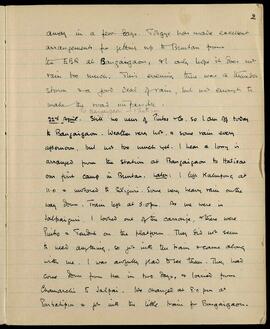
            Arrangements are made to reach Bhutan from Bongaigaon, with a lorry planned onward to Hatisar. The diarist departs Kalimpong, motors to Siliguri, and travels by train via Jalpaiguri and Parbatipur to Bongaigaon, meeting Pintso and Tenduk en route; weather is very hot with afternoon thunderstorms.

            CONTENT:
            2

            away in a few days. Tobgye has made excellent arrangements for getting up to Bhutan from the EBR at Bongaigaon, and only hope it does not rain too much. This evening there was a thunderstorm and a good deal of rain, but not enough to make the road impassable.

            22nd April. Still no news of Pintso and Co, so I am off today to Bongaigaon. Weather very hot, and some rain every afternoon, but not too much yet. I hear a lorry is arranged from the station at Bongaigaon to Hatisar, our first camp in Bhutan. Later: I left Kalimpong at 11:00 and motored to Siliguri. Some very heavy rain on the way down. Train left at 5:00 pm. As we were in Jalpaiguri, I looked out of the carriage, and there were Pintso and Tenduk on the platform. They did not seem to need anything, so got into the train and came along with me. I was awfully glad to see them. They had come down from Ha in two days, and lorried from Chamarchi to Jalpai. We changed at 8:00 pm at Parbatipur and got into the little train for Bongaigaon.

            LSH/1/1/3/3/101 · Part · 1933-04-09
            Part of The Ludlow & Sherriff Collection

            SUMMARY:
            Diary notes describe travel down the Loro Chu valley from Zotang toward Chayul Dzong, with locals urging the party beyond Sanga Shika to complete about 17 miles in a day. The route, taken in strong up-valley wind, included riverbank changes and a crossing near mile 15, with observations of pollarded trees, buckthorn near camp, peaches in cultivation, birds, a solar halo, and barley 3–4 inches high near Chayul Dzong.

            CONTENT:
            Loro Chu valley. Zotang
            Salix babylonica 1317, Prunus persica 1318, Populus ciliata 1319 — all 3 pollarded
            48

            that whereas we should normally have changed transport three times, we did not do so at all, but came on 2 miles beyond the usual stage. This is a pretty place with a fine view of the main range downstream. There is quite a forest of buckthorn by our camp, & some good birds in it (3 Laughing Thrushes). Yesterday I saw rather a curious halo round the sun, shown opposite.

            21st April To Chayul Dzong. BP. Temp. Time Approx.
            (See entry 23rd April)

            ht. = 17 miles. We meant to go only to Sanga Shika which is about 11 miles, but the locals pushed us on here. A perfect day again, but with a very strong wind in the afternoon, straight up the valley as usual. Road is quite good, down the valley, which is pretty wide with sheep tracks. Cross to R bank & change transport at about m 4.5. Continue down R bank to Sanga Shika at m 11, which is high up on R. bank. Thence through more cultivation (Peaches), & among many peach trees gradually down to the River which is crossed at m 15 & path follows L bank to Chayul Dzong, where there is considerable cultivation (the barley in the fields was 3-4 inches high), but hills quite dry still, although

            LSH/1/1/2/1/42 · Part · 1933-07-08
            Part of The Ludlow & Sherriff Collection

            SUMMARY:
            The party leaves Sakden, crosses the Se La Range via the Nyang Sang La, endures leeches at Muktur, then crosses the Tawang Chu by an iron suspension bridge and ascends to Tawang, which they recall unfavorably. They proceed via Shao to Tsona, noting rich alpine flora and exceptionally large numbers of Turdus merula buddhae between Bum La and the Tse La in the Mago district.

            CONTENT:
            Ibis 15.
            We left Sakden on 11 July, crossed the Se La Range by the Nyang Sang La, and descended through silver birch, fir, and rhododendron forest to MUKTUR where we were almost eaten alive by leeches. The following day (July 12) we crossed the Tawang Chu by a striking iron suspension bridge, and ascended to the monastic town of Tawang (July 12), the only place in either Tibet or Bhutan of which we do not retain pleasant memories.

            From Tawang to Tsona (15 July) via Shao (14 July). The passes between Tawang and Tsona held a rich flora, and at Shao, the intermediate stage, we passed through acres of Primulas and saw larger numbers of Turdus m. buddhae than I ever remember having seen before.

            Ibis 273 Turdus merula buddhae. We saw this Blackbird in large numbers between 13,500 and 15,000 ft at various stages between the Bum La, north of Tawang, and the Tse La in the Mago district etc. etc. Ibis 274

            LSH/1/1/1/1/43 · Part · 1933-05-25
            Part of The Ludlow & Sherriff Collection

            SUMMARY:
            The diarist describes traveling down to Rinchengong and then leaving the Amo Chu to climb into a forested valley, noting irises, rhododendrons (including R. chowsii), and berberis. They reach Sharithang (Charithang), encounter helpful Bhutanese with yaks, and settle in a large wooden hut, assisted by a man appointed by Tongsa.

            CONTENT:
            Guldenstaedtia uniflora (L.D. 32) 69
            Anemone trullifolia (L.D. 29)

            in the evening. Saw nothing new all the way down to Rinchengong in the Amo Chu valley. Many more flowers out there, including several more rhododendrons (R. chowsii (L.D. 30)) and berberis. Four miles down the valley the track leaves the Amo Chu and zigzags very steeply up the left bank into this valley. The country there is lovely, densely forested, with the track going up and down over shoulders, in and out of beautiful glades in the forest. The irises (stuartii) were just out at the mouth of the valley. Six miles up this valley we reached Sharithang (Charithang). A number of Bhutanese are here with their yaks. They are exceedingly dirty, dirtier even than Tibetans, but all seem cheery, and all are ready to help in any way they can - even to shoot birds and find their nests. It is exceedingly difficult to know which are women and which men. Their clothes are the same, and their hair also - both wear it short. We have a man appointed by Tongsa to help us, and he is most willing and helpful. We live in a large wooden hut, with open windows along the south side - very dirty of course, but useful as it is so big. We can spread ourselves and our birds and flowers. The country is pretty, but rather shut in.

            2

            LSH/1/1/3/3/9 · Part · 1936-02-09
            Part of The Ludlow & Sherriff Collection

            SUMMARY:
            The diarists travel from Lahore to Calcutta, meet friends, shop in the New Market, lunch with Collins, and see the film 'The Mutiny on the Bounty.' They continue by the Assam mail, receive a telegram from Chris about Mother at Parbatipur and Kumarikhata, reach Rangiya early, drive to Darrang Mela, find large crowds, and meet the Dzongpen of Trashigang and Shangia.

            CONTENT:
            Nine people in the carriage, besides a great deal of kit. However this only lasted till Lahore, where we changed to the mail and had a compartment to ourselves. It was nowhere too hot, a very pleasant change to last time we came down where it was 117° in Lahore. The Ellvers and Miss Cameron came down to see us at the station. Calcutta reached on 12th morning, and we had a busy day shopping there, getting a few extra presents, including a dozen felt hats in the New Market, which was great fun. Collins came to lunch and we dined in his chummery then went on to the cinema - "The Mutiny on the Bounty", one of the best films I have ever seen. Next day at 1.0 pm we left by the Assam mail. At Parbatipur I got Chris' telegram about Mother, and later on another one at Kumarikhata. We reached Rangiya about 5.45 am and after a shave and breakfast, came on in a car to Darrang Mela. Unlike last year, this only took about 1 1/2 hours on a dry road. There was a huge crowd at the mela - half Bhutan seems to be there just now. We met the Dzongpen of Trashigang and Shangia.

            LSH/1/1/5/1/51 · Part · 1933-05-09
            Part of The Ludlow & Sherriff Collection

            SUMMARY:
            Travel from Kyi La to Chendebi via Tangsebi, with steep ascents and a crossing of the Chendebi Chu; coolies were changed at Tangsebi and a pony was used for one climb. Weather was sunny and hot after light rain the previous night, and notes mention rhododendrons along the Chendebi - Trongsa road, with R. arboreum common and a large white rhododendron noted.

            CONTENT:
            25

            replaced by rice.

            8400ft 11th May. To Chendebi. 16 miles. BP. 197.6 Temp. 60° Time 3.0pm. Ht. Map Ht. 7500'

            Left Kyi La at 5.30 am, in at Chendebi at 4.15pm, having changed coolies at Tangsebi. Leaving Kyi La the path drops gradually for a mile, then ascends and finally drops very steeply at m 3 to the Chendebi Chu, which is crossed at m 3 1/2. Ascent on the north side is very steep indeed, for 2 miles, when the first houses of Tangsebi are reached. Here coolies are changed if one is going to Chendebi. From here the ascent is again very steep indeed for 2 miles till the main Chendebi - Trongsa road is reached at m 7. A path, unfit for anything but coolies, goes more direct towards Chendebi, meeting the main path at about m 8. Thence the path is good and more or less level, rising gradually the last mile or so to Chendebi. A fine sunny hot day. It rained yesterday evening and some of the night, but not much. It was nice to get up from the hot Mangde Chu valley, almost straight to 7000ft. I had a pony today for the first time, but only used him for that climb. Rhod. arboreum is very common along the main road, but nearly all over. But another rhod. a fine big white one, which I don't yet know,

            R. arboreum on Chendebi - Trongsa Road
            R. griffithianum 3.26

            LSH/1/1/1/1/60 · Part · 1933-06-08
            Part of The Ludlow & Sherriff Collection

            SUMMARY:
            The party, joined by Mr. F. Williamson and Raja S.T. Dorji at Ha, traveled via Chele La to Paro en route to Bumthang, receiving such hospitality from the Paro Penlop that collecting was not possible. Notes describe local archery equipment and a drive for serow and musk deer.

            CONTENT:
            Ludlow Iris 9.
            At Ha we were joined by the late Mr. F. Williamson C.I.E. Political Officer in Sikkim
            & Raja S.T. Dorji, together we journeyed to Bumthang, the summer residence
            of His Highness the Maharaja.

            Lud Iris 9
            We left Ha on 21 June, ascended the Chele La dropped down into the wide
            open valley in which Paro is situated. We stayed here a week as the guests
            of the Paro Penlop, during which time we were treated with such lavish
            hospitality that collecting was out of the question.

            Ludlow June 15
            Archery - the bow is a 6ft bamboo
            bow; the bowstring appears to be
            made from the fibres of a nettle.
            Targets placed at a distance of
            150 yards. One sees leather &
            finger stalls & a forearm pad
            otherwise finger tips & forearm
            get very sore.

            Ludlow June 16th
            Describe a drive for serow
            & musk deer.
            Serow - Himalayan Goat-antelope.

            LSH/1/1/5/1/7 · Part · 1937-04-01
            Part of The Ludlow & Sherriff Collection

            SUMMARY:
            After a night of heavy rain, the party departed early with a lorry driven by Chhong Dorje, struggling through muddy roads from Bongaigaon and reaching Hatisar at noon before walking to a prepared camp. On 24 April they marched to a ridge 4 miles south of Surelakha through heavy evergreen forest, with the coolies arriving later and in weak condition.

            CONTENT:
            During the night, there was more very heavy thunder rain, but it was fine when we got out at 2:00 am, and the lorry with Chhong Dorje was waiting. We loaded up at once, but did not leave Bongaigaon till 5:00 am, just after sunrise. The drive was not much fun. We stuck completely a dozen or more times in the first 10 miles and more in the second. It was awfully hot too, and we were all soon soaked through with sweat, pushing the beastly thing along, and laying hundreds of branches to keep the lorry from sinking too far. I suppose it is 30 miles or so to Hatisar, just inside the Bhutan border, and we reached that at 12:00 noon, seven hours going. A good deal of the road lay through sal forest. Just North of Hatisar we left the lorry and walked another 1 1/2 miles to a prepared camp. Coolies were waiting, and all arrangements were good.

            24th April. Ridge 4 m S of Surelakha. Left at 6:00 am, in at 1:30 pm 10 miles. Coolies took from 6:00 till 2:30 to reach here, but a good many are pretty weak. We went through heavy evergreen forest the whole way, and

            LSH/1/1/3/3/27 · Part · 1937-02-27
            Part of The Ludlow & Sherriff Collection

            SUMMARY:
            From Jonpuda near Trashigang the party proceeds 5 miles to Puntsogong, noting widespread jhooming fires and good wireless reception. Lumsden deals with many medical cases, while Ludlow collects three Pyrrhula erythaca. The Trashigang Dzongpen provides generous hospitality, including a new guest house; the party listens to a recording of the King's speech in the evening.

            CONTENT:
            the North. The three main peaks seen bear 356° 40', 358° & 1° 20' by compass from camp. Lumsden has a good deal to do now, many cases coming in. Today there were a few with leprosy but he cannot undertake treatment except for their sores. There is obviously no time for more. "Jhooming" is in full swing, at night one can see large patches of hillside ablaze, the valleys are always smoky, which rather spoils the views of the snows. The wireless has been very good lately.

            Jonpuda near Trashigang
            2nd March. Puntsogong 5 miles. Another beautiful day. Ludlow shot 3 Pyrrhula erythaca, very valuable birds. Trashigang Dzongpen has been very kind indeed to us, making every arrangement possible. He has built a magnificent guest house, in which we each have a room & there is a guest room as dining room. My place has a fine altar with 17 images of Buddha in it. There is a w.c. of Bhutan modern standard at one end—just a slit with a chute below to a hole in the ground—not too easy. We listened in to a record of the King's speech this evening at 7.0 pm, & heard