
Zona de identificação
Código de referência
Título
Data(s)
- 1933-08-17 (Produção)
Nível de descrição
Dimensão e suporte
1 page
Zona do contexto
Nome do produtor
Entidade detentora
História do arquivo
Fonte imediata de aquisição ou transferência
Zona do conteúdo e estrutura
Âmbito e conteúdo
SUMMARY:
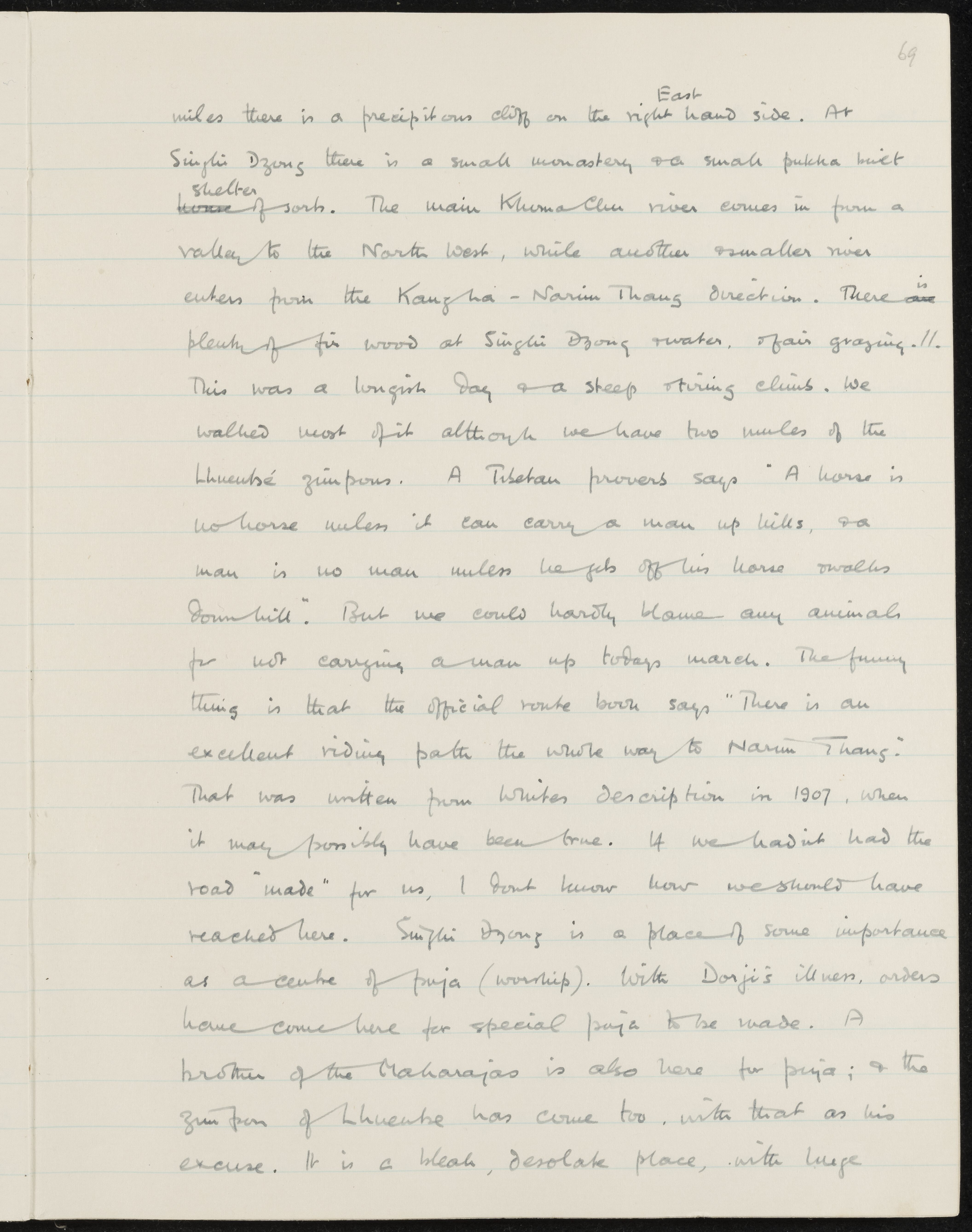
The writer describes a steep, tiring march to Singhi Dzong, noting a small monastery, shelter, fir wood, water, and grazing, as well as river confluences from Khuma Chu and the Kangha–Narim Thang direction. They dispute an official route description from 1907 and mention that without road work the approach would have been difficult. Singhi Dzong is noted as a puja center, with special ceremonies ordered due to Dorji’s illness, attended by the Maharaja’s brother and the Lhuentse zimpon.
CONTENT:
69
East
miles there is a precipitous cliff on the right hand side. At Singhi Dzong there is a small monastery & a small pukka built shelter of sorts. The main Khuma Chu river comes in from a valley to the North West, while another smaller river enters from the Kangha - Narim Thang direction. There are plenty of fir wood at Singhi Dzong & water, & fair grazing. This was a longish day & a steep tiring climb. We walked most of it although we have two mules of the Lhuentse zimpons. A Tibetan proverb says "A horse is no horse unless it can carry a man up hills, & a man is no man unless he gets off his horse & walks downhill". But we could hardly blame any animals for not carrying a man up today's march. The funny thing is that the official route book says "There is an excellent riding path the whole way to Narim Thang". That was written from White's description in 1907, when it may possibly have been true. If we hadn't had the road "made" for us, I don't know how we should have reached here. Singhi Dzong is a place of some importance as a centre of puja (worship). With Dorji's illness, orders have come here for special puja to be made. A brother of the Maharaja's is also here for puja; & the zimpon of Lhuentse has come too, with that as his excuse. It is a bleak, desolate place, with huge