Bhutan

Elements area

Taxonomy

Code

Scope note(s)

    Source note(s)

      Display note(s)

        Hierarchical terms

        Bhutan

        Equivalent terms

        Bhutan

          Associated terms

          Bhutan

            419 Archival description results for Bhutan

            419 results directly related Exclude narrower terms
            LSH/1/1/9/1/134 · Part · 1933-09-01
            Part of The Ludlow & Sherriff Collection

            SUMMARY:
            At Haat, the author stayed near camp while Tundru and Pasang collected flowers, noting scarce seed and planning routes toward Waitang, Marlung, Chu doen, Sin La, Dhen, and an arrival at Bumthang, with shifting weather. The next day they made a long excursion from Haat; Tundru collected Allardia glabra near Tolepong Tso, and they found P. umbellata and a wine-purple Gentiana on screes, though seeds were mostly unripe.

            CONTENT:
            138

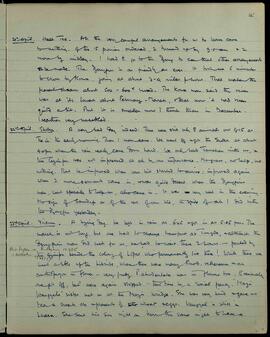
            9th Sept. Haat. I stayed near camp today, Tundru and Pasang went off to the N.E. They got some flowers, but seed again were difficult. Seed of P. sphaerostachyum was all eaten by bugs. Also a very fine Polygonum (Polygonum griffithii 19715) had no seed - I got 14 seed out of at least 1000 flowers! I spent some time in making out dates from here to Waitang, Marlung and across to the Chu doen and the Sin La to Dhen. Our real movement will start on the 19th and we will have a very full Oct 7th when we reach Bumthang. Today was the same as the last three days - a lovely morning, and heavy rain in the afternoon. But it does not look like the monsoon rain. No doubt we'll get lots more rain, but I don't think it will be the same as before.

            10th Sept. Haat. Fine all day except for a short shower at midday. This was a good day on the whole, though few seeds were got. We left at 5.30 and returned at 5.0pm. At the first drogpa above the forest there is masses of the fine Aconite found yesterday, and we should get roots of it if not seed. The two best flowers found were both high altitude ones, from about 15000' or above. Tundru got a very nice wine coloured Allardia (Allardia glabra 19716) from the left hand valley after turning R. at Tolepong Tso. I did not see this myself anywhere. We went up the right hand valley, as before, and on the same scree found a good many Sax's of course P. umbellata. This is the almost white one. Seed was not ripe, though it should be by 1 Oct. want to go again. This scree is at the right hand end of the big cliff facing one, as one leaves the Tolepong Tso. Away behind this in a cup to the right there are some more screes, and in one of them we found a fine Gentian (Gentiana amoena 19721). This is G. amoena or near it, but grows only in sand scree, which amoena doesn't. Also it is not blue, but a deep wine or wine purple, rather a nice, or more unusual
            LSH/1/1/10/1/18 · Part · 1933-10-01
            Part of The Ludlow & Sherriff Collection

            SUMMARY:
            The diarist reports severe infestation of P. umbratilis seed capsules by caterpillars, difficulty finding other seeds, snow melted up to about 15,500 ft, and the drogpas leaving the high pastures. On 2nd October at Ha-chu, after clear frosty weather, they observed a large herd of burhel, finished work in the Tsampa area (Bumthang Chu watershed), planned to cross to the Dhur Chu to meet Pasang and Yundon, and reflected on concluding Himalayan trips first planned with Ludlow in 1929 at Kashgar.

            CONTENT:
            From among the seeds of P. umbratilis which I collected today, I extracted 67 caterpillars, which shows the difficulty with seed. Practically every capsule I take now has worms or caterpillars. I can't find any seed of a big Swertia. All capsules have 3-4 red worms in them. None of the aconites were ready yet, and I have had to take roots of some. Snow is not now lying here. It has all melted up to 15500' or so. The drogpas have all gone down from these high grazing grounds, I am surprised to see. They come in the 5th month (July) and leave in the 7th or 8th (Sept). It is a very short season. I sympathize with them going down now, but I think they should come up much earlier, when the grass is good.

            2nd October. Ha-chu. This is the best day we have had. There was rain and some snow last night, but it cleared up to a beautiful morning and there was hard frost. Up till midday today there was lovely bright sun, and then huge clouds collected, but it has not snowed, and I should think we will now have several similar days. I got a little more of the same seed today, but nothing special. We walked onto a huge herd of 58 burhel on our way back. And now we have finished with the area called Tsampa, which includes the watershed of the Bumthang Chu, but not the Dhur Chu. Tomorrow we cross to the head of the Dhur Chu, and there meet Pasang and Yundon. It is difficult now to think that we have practically finished our work this year, and that there are now but 5 more days left. In a month I will be in Sikkim. And this is the last of our Himalayan trips, which Ludlow and I started planning in 1929, sitting in front of the fire in the drawing room of the Consulate General in Kashgar.

            LSH/1/1/3/3/37 · Part · 1937-02-27
            Part of The Ludlow & Sherriff Collection

            SUMMARY:
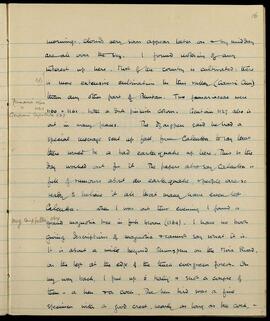
            The writer notes extensive cultivation in the Ha-chu valley of Bhutan and few interesting finds, recording Fumaria (1160, 1161) and Gentiana capitata (1127). The Dzongpen reports a fast message from Calcutta warning of an impending earthquake amid widespread rumors. A grand magnolia in bloom is noted beyond Shungphu on the Hira Road, and two kalij pheasants are shot.

            CONTENT:
            16

            mornings, clouds very soon appear later on and by midday
            are all over the sky. I found nothing of any
            interest up here. Most of the country is cultivated: there
            is more extensive cultivation in this valley (Ha-chu)
            than any other part of Bhutan. Two Fumariaceae were
            Fumaria 1160, 1161; Gentiana capitata 1127: 1160 and 1161, both a dull pinkish colour. Gentian 1127 also is
            out in many places. The Dzongpen said he had a
            special message sent up fast, from Calcutta, to say that
            there would be a bad earthquake up here. This is the
            day worked out for it. The papers also say Calcutta is
            full of rumours about an earthquake, and people are so
            ready to believe it all that many have even left
            Calcutta. When I was out this evening I found a
            Mag. campbellii 1164: grand magnolia tree in full bloom (1164). I have no book
            giving descriptions of magnolia and cannot say what it is.
            It is about a mile beyond Shungphu on the Hira Road,
            on the left at the edge of the thick evergreen forest. On
            my way back, I put up 6 kalij and shot a couple of
            them - a hen and a cock. The hen bird was a fine
            specimen with a good crest, nearly as long as the

            LSH/1/1/8/1/91 · Part · 1938-04-09
            Part of The Ludlow & Sherriff Collection

            SUMMARY:
            The diarist reports failed transport arrangements at Haet Tse, a visit to the Dzong, and a river crossing by kowa, noting river levels and unsettled weather. On moving to Shoka in heavy rain, there were still shortages of pack animals and help; conditions improved as more servants and a helper from the Dzongpon arrived, though Samdup and much of the kit were still missing.

            CONTENT:
            21st April. Haet Tse. All the very careful arrangements for us to leave came to nothing. Of the 15 ponies ordered, 2 turned up by 9.0 am and 2 more by midday. I had to go to the Dzong to see that other arrangements be made. The Dzongpon is as friendly as ever. It took me 6 minutes to cross by Kowa, going at about 3-4 miles per hour. That makes the present stream about 500 - 600 yards broad. The Kowa man said the river was at its lowest about February - March, and that now it had risen quite a bit. But it is smaller now I think than in December. Weather very unsettled.

            22nd April. Shoka. A very bad day indeed. There were still only 8 animals out of 15 at Tse in the early morning. Then 1 more came. We went off for the Shoka at about 4.0 pm when the rain really came down hard. We only had Tamchen with us, and the Gyimpu was not impressed at all by our importance. No grass, no help, no nothing. But he improved when our kit started to arrive; improved again when 2 more servants came in, and was quite decent when the Dzongpon's man, sent specially to help us, also came in. It was very wet in the evening. No sign of Samdup or of the rest of our kit, in spite of all I did with the Dzongpon yesterday.

            23

            LSH/1/1/2/1/239 · Part · 1969-04-29
            Part of The Ludlow & Sherriff Collection

            SUMMARY:
            At Hala Sahden the diarist records a hard frost and makes an early ascent toward Warga La and Nyuk-sang La, noting views of the Mayo peaks and Kulu Kangri and a spoiled film pack. They describe Ha people making tea from maple leaves and wood-ash water. On 26 October they march to Taktoo in perfect weather with a porter group composed mostly of women and children.

            CONTENT:
            118

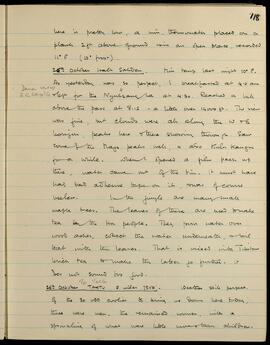
            here is pretty low, a min. thermometer placed on a plank 2 ft above ground in an open place, recorded 11° F (19° frost).

            25th October Hala Sahden. Min temp last night 10° F.

            As yesterday was so perfect, I breakfasted at 4.0 am. Dawa went up to the Warga La. Left for the Nyuk-sang La at 4.30. Reached a hill above the pass at 8.15 - a little over 14000 ft. The view was fine, but clouds were all along the W & E horizon, peaks here & there showing through. Saw some of the Mayo peaks well, & also Kulu Kangri for a while. When I opened a film pack up there, water came out of the tin. It must have had bad adhesive tape on it, & was of course useless. In the jungle are many small maple trees. The leaves of these are used to make tea for the Ha people. They pour water over wood ashes, collect the water underneath, & boil that with the leaves. That is mixed with Tibetan brick tea to make the latter go further. It does not sound too good.

            26th October To Taktoo TAKTU 5 miles 7800'. Weather still perfect.

            Of the 30 odd coolies to bring us down here today, three were men, the remainder women, with a sprinkling of what were little more than children.

            LSH/1/1/8/1/98 · Part · 1947-05-06
            Part of The Ludlow & Sherriff Collection

            SUMMARY:
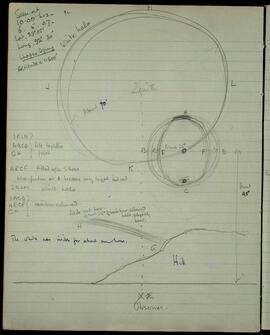
            Seen at 10.00 hrs at Lhapso Dzong (Lat. 29° 05', Long. 92° 30', Altitude c 11500'), a white halo and rainbow coloured arcs near the zenith (about 70°) were recorded, with segments noted as JKLM (white halo), ABCD and AECF (rainbow coloured), and GH. The display was visible for about one hour and faded to about 25° of slightly bent, rainbow coloured halo; a hill was about 45°.

            CONTENT:
            Seen at
            10.00 hrs - 9½

              1. 47
                Lat. 29° 05'
                Long. 92° 30'
                Lhapso Dzong
                Altitude c 11500'

            White halo
            Zenith
            About 70°

            JKLM }
            ABCD } All together
            GH } first

            AECF Added after ½ hour
            When portion at A became very bright indeed

            JKLM white halo

            ABCD }
            AECF } rainbow coloured.
            GH }

            fade out here:
            about 25° of rainbow coloured halo, slightly bent.

            The whole was visible for about one hour.

            Hill
            About 45°

            Observer.

            LSH/1/1/4/1/115 · Part · 1933-09-24
            Part of The Ludlow & Sherriff Collection

            SUMMARY:
            Notes mention fruit drying in Charme and Bhutanese support to Sangacholing, including a Bhutan lama. Lumsden is withdrawn and his night-time injection missed a vein, causing his patient fever. On a halt day at Charme, the diarist walked toward Dayul, observed migrant birds from the north, shot a Button quail at notable elevation, and collected seeds (crab apple, jasmine, cotoneaster).

            CONTENT:
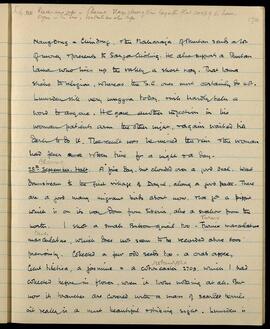
            L.S. 188 Peaches were ripe in Charme. Many stacks of them lay on the flat roofs of the houses, drying in the sun; walnuts are also ripe. 170

            Nang Drug and Chindrug, the Maharaja of Bhutan sends a lot of money and presents to Sangacholing. He also supports a Bhutan lama who lives up the valley a short way. That lama sticks to religion, whereas the S.C. ones most certainly do not.

            Lumsden still very un-gay today, will hardly talk a word to anyone. He gave another injection in his woman patient's arm the other night, and again waited till dark to do it. The result was he missed the vein and the woman had fever and a rotten time for a night and a day.

            28th September. Halt. Charme. A fine day, but clouded over a good deal. Went downstream to the first village of Dayul, along a good path. There are a good many migrant birds about now, saw for a pipit which is on its way down from Siberia, also a swallow from the north. I shot a small Button quail too - Turnix suscitator suscitator, which does not seem to be recorded above 6000' previously. Collected a few odd seeds too - a crab apple, Creut tibetica, a jasmine and a cotoneaster 2709, which I had collected before in flower, when it looks nothing at all. But now its branches are covered with a mass of scarlet berries and it really is a

            LSH/1/1/9/1/46 · Part · 1933-05-07
            Part of The Ludlow & Sherriff Collection

            SUMMARY:
            The diarist halts at Dungkar, plans to cross the Rudo La, and writes to HH, Wangmoo, and Lhuntse about arrangements. Botanical notes mention a primula (18846) from Tim resembling earlier Lo La material and a likely Cochlearia (18847) previously seen in 1937 at Tang Chu, Central Bhutan. Yundru, servant of the Nyerchen Trepa, arrives from forced labour at Sam Choling monastery and is taken on permanently for the journey to Tomtem.

            CONTENT:
            I must now write to HH & give him the new programme, & to Wangmoo to say I will see her on the way, & to Lhuntse to say I want transport.

            11th May. Halt Dungkar. Another fine day after rain at night, but only a little. It is nice to think that, all being well, we should be over the Rudo La before having to halt again. It would be nice to halt on the pass itself, but coolie difficulty makes that out of the question. Now there are five days to get through as best we may before anything of interest is likely to be seen. At Tim we got one interesting primula 18846, which will no doubt be put down as P. atrodentata, but which is more like one of the ones put aside last year for discussion, & which is like my 3636 from the Lo La. With the primula was one other plant 18847, which I have only seen once before, & that in Bhutan. I think it was number 3209, taken in Cent. Bhutan, Tang Chu, in 1937. I rather think that was probably a sp. nov. of Cochlearia but has not yet been named. Unfortunately there was but one specimen here to be found, & it, like the primula, had come down from a good deal higher, near 13-14000'.

            Today the Nyerchen Trepa's servant, Yundru, arrived. He was one of the many forced labourers at Sam Choling monastery, the new monastery being built by Ashe Wangmoo where Tasho Haku died. One man per household from this area has to go, & has been there for months. I got him leave to get away from that, so as to come to Tomtem with me. Now we are in fact there, I have not been sure what to do, but decided to take him with us as permanent.

            LSH/1/1/2/1/109 · Part · 1933-07-18
            Part of The Ludlow & Sherriff Collection

            SUMMARY:
            The writer arranges for a Bhutanese married lama to collect seeds of Thalictrum chelidonii, planning to send a man from Sahden in October to obtain them. A Maharaja’s sepoy mistakenly traveled via Dirang Dzong–Poshing La–Tse La instead of the Luguthang route, causing delay; on 7 August at Dyuri (Mago) the party had fine weather, collected a few birds, wrote to Bumthang, prepared to return to Tsona, and encountered Abors who dropped their loads.

            CONTENT:
            It is only ignorance and conservatism. I am trying to make arrangements here for a married lama (!) — a Bhutanese — to collect seeds of the beautiful Thalictrum chelidonii for me. He will be bribed with butter and tankhas, and I will send a man in October from Sahden for the seeds from him. At first I thought of his taking them to Sahden, but being married, he will of course not put in an appearance that way again. The Maharaja's sepoy who came yesterday was told in Sahden not to go by the high road but the 'low'. By that was meant presumably not by Tsona but by Luguthang. But not knowing the country, the poor man went not by Luguthang, but by Dirang Dzong — Poshing La — Tse La. And so he took eleven days from Sahden instead of three!

            7th August. Halt at Dyuri (Mago). Probably the finest day we have had since leaving Lahore. With the exception of a half hour's shower at 4.0 pm, no rain all day to 6.0 pm, and bright sun nearly the whole time. Collected a few birds, wrote letters to Bumthang and prepared for the return to Tsona tomorrow. This evening some Abors arrived, seeing our camp, dropped their loads. We have ordered them to appear.

            LSH/1/1/3/3/111 · Part · 1933-04-09
            Part of The Ludlow & Sherriff Collection

            SUMMARY:
            Route described from the right bank past Dotrang to Natrampa, with notes on dense, Bhutan-like jungle and a good camp site. At Natrampa they halt and collect several notable plants, including rhododendrons, a yellow primula, Paraquilegia, and Diapensia, and later find unusual rhododendrons near a cascade along the Lung road.

            CONTENT:
            The road keeps pretty high over the Right bank, up and down, till about mile 3, when it is 800 ft or so above the valley bed. Here a ridge is crossed, where the path used to go down a ladder. Two miles further on a fair sized village is passed, called Dotrang. The path keeps below this, crosses a small side stream, and leads on more or less level for a while, then down hill to Natrampa. A good Camping Ground just beyond. The jungle gradually becomes thicker and more wet zone-like, till here it is just like Bhutan, on the North face, but dry, except for small watercourses, mostly high falls, where vegetation is dense. On Left bank at a waterfall I saw rhododendron 1346 and a yellow sikkimensis primula 1348, while looking for these found a Paraquilegia 1350 in flower. Lumsden found one or two rhododendrons, and Pinko and Tsongpen came in with a lovely mass of rhododendrons and a Diapensia, from the North face cliff. There is any amount of stuff here, so we stop a day.

            27th April. Halt at Natrampa. A really good day. We went out along the Lung road to the first cascade, about a mile downstream. There we found a most unusual red rhododendron 1352, a beautiful mauve one 1354, and an unusual yellow one.