Tibet

Elements area

Taxonomy

Code

Scope note(s)

    Source note(s)

      Display note(s)

        Hierarchical terms

        Tibet

          Equivalent terms

          Tibet

            Associated terms

            Tibet

              192 Archival description results for Tibet

              192 results directly related Exclude narrower terms
              LSH/1/1/9/1/46 · Part · 1933-05-07
              Part of The Ludlow & Sherriff Collection

              SUMMARY:
              The diarist halts at Dungkar, plans to cross the Rudo La, and writes to HH, Wangmoo, and Lhuntse about arrangements. Botanical notes mention a primula (18846) from Tim resembling earlier Lo La material and a likely Cochlearia (18847) previously seen in 1937 at Tang Chu, Central Bhutan. Yundru, servant of the Nyerchen Trepa, arrives from forced labour at Sam Choling monastery and is taken on permanently for the journey to Tomtem.

              CONTENT:
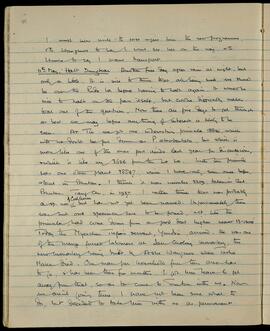
              I must now write to HH & give him the new programme, & to Wangmoo to say I will see her on the way, & to Lhuntse to say I want transport.

              11th May. Halt Dungkar. Another fine day after rain at night, but only a little. It is nice to think that, all being well, we should be over the Rudo La before having to halt again. It would be nice to halt on the pass itself, but coolie difficulty makes that out of the question. Now there are five days to get through as best we may before anything of interest is likely to be seen. At Tim we got one interesting primula 18846, which will no doubt be put down as P. atrodentata, but which is more like one of the ones put aside last year for discussion, & which is like my 3636 from the Lo La. With the primula was one other plant 18847, which I have only seen once before, & that in Bhutan. I think it was number 3209, taken in Cent. Bhutan, Tang Chu, in 1937. I rather think that was probably a sp. nov. of Cochlearia but has not yet been named. Unfortunately there was but one specimen here to be found, & it, like the primula, had come down from a good deal higher, near 13-14000'.

              Today the Nyerchen Trepa's servant, Yundru, arrived. He was one of the many forced labourers at Sam Choling monastery, the new monastery being built by Ashe Wangmoo where Tasho Haku died. One man per household from this area has to go, & has been there for months. I got him leave to get away from that, so as to come to Tomtem with me. Now we are in fact there, I have not been sure what to do, but decided to take him with us as permanent.
              LSH/1/1/2/1/163 · Part · 1933-08-30
              Part of The Ludlow & Sherriff Collection

              SUMMARY:
              Camped at Tobrang in the Bashiyang Valley, the party plans a seven-day stay, dismisses the coolies, and notes leech problems and severely disorganized mail. Pimbo goes to T'gong to investigate the missing mail, while the diarist spends the day birding near camp and reports Ahmed Sheikh’s quick recovery. Heavy Bhutan–Tibet barter traffic is observed, and plant collections are listed.

              CONTENT:
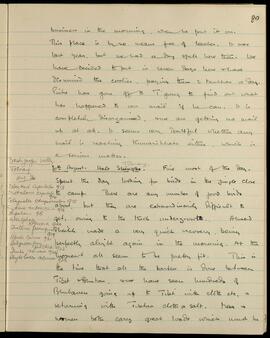
              business in the morning, when he put it on.
              This place is by no means free of leeches. It was last year, but we had a dry spell here then. We have decided to put in seven days here & have dismissed the coolies, paying them 2 tankhas a day. Pimbo has gone off to T'gong to find out what has happened to our mail if he can. It is completely disorganised, & we are getting no mail up at all. It seems very doubtful whether any mail is reaching Kumarikhata either, which is a serious matter.

              Bashiyang Valley.
              Tobrang
              Aug. 30
              Osbeckia capitata 913
              Crotalaria capitata 914
              Selaginella chrysocaulos 915
              Erythrina arborescens 916
              Impatiens 918
              Adenophora khasiana 920
              Shuteria ferruginea 919
              Apios carnea 921
              Didymocarpus pulchra 923
              Inula nervosa 924
              Phytolacca acinosa 926

              30th August. Halt Tobrang. Fine most of the day.
              Spent the day looking for birds in the jungle close to camp. There are any number of good birds about, but they are extraordinarily difficult to get, owing to the thick undergrowth. Ahmed Sheikh made a very quick recovery, being perfectly all right again in the morning. At the moment all seem to be pretty fit. This is the time that all the barter is done between Tibet & Bhutan, & we have seen hundreds of Bhutanese going up to Tibet with cloth etc, & returning with Tibetan cloth & salt. Men & women both carry great loads which must be

              LSH/1/1/1/1/177 · Part · 1933-09-05
              Part of The Ludlow & Sherriff Collection

              SUMMARY:
              On 7th September the party halted at Towa, met and lunched with the local jongpen, and confirmed plans to take the Lalung–Munda–Ling route. On 8th September they marched to Lalung, describing the good path, the Lhobrak valley, and a camp near the monastery, and discussed hopes for the Tashi Lama’s return to Tibet, a matter Williamson is expected to raise at Lhassa.

              CONTENT:
              getting pay. When a jongpen travels, he pays nothing on
              the way, but has free transport wherever he goes.

              7th September. Halt at Towa. We lazed in the morning waiting
              for the summons to eat with the jongpen. He came himself
              about 11:30, and after his visit we went up to the Dzong to
              lunch. It was the usual pleasant meal of gyatu with
              Chang - very excellent and satisfying. The jongpen is a nice
              young man of 32, and was very obliging to us. I think
              he would let us go by any route we wanted to. At any
              rate the Lalung - Munda - Ling route is decided on.

              8th September. To LALUNG 13,250' 8 miles. The path is good and
              direct the whole way to Lalung. For the first 3 1/2 miles it
              is through the Towa cultivation, then across stony waste land
              to m 5 1/2 where the Lhobrak valley narrows to a gorge. At
              m 7 the valley again broadens out and cultivation
              is met. Lalung monastery lies on the left bank, and the
              river is crossed by a bridge opposite the monastery. A very
              good camping ground is in a willow garden in front of the
              monastery. Water and fuel ample. Yesterday during
              lunch we asked the jongpen whether he thought the
              Tashi Lama would return to Tibet. This is one of the
              things Williamson will certainly have to discuss at
              Lhassa. The jongpen was full of hope, as a great
              number of Tibetans are. One of the reasons he gave

              LSH/1/1/8/1/35 · Part · 1933-12-23 - 1933-12-24
              Part of The Ludlow & Sherriff Collection

              SUMMARY:
              Notes on pine species near the river and collection of Ward's lily bulbs; very cold by the bridge below Trongchu Dz. Halt days are spent in camp developing photos and unpacking a working thermograph, with views toward the Sobhe la; awaiting Ludlow and Elliot while the Dzongpon, a monk, is present, and more animals and kit arrive with a note from Ludlow.

              CONTENT:
              Pinus tabuliformis 12028
              Armandii 12029
              Tsuga dumosa 12030
              P. whitei 12021

              More of yesterday's Primula (12021). Ward's lily had a few seeds left and we took about a dozen bulbs. About one mile below Trongchu Dz, the local river is crossed by a bridge. It is very cold indeed down there, as only a very little sun reaches the river. Just before reaching the river, the same pine is met with as in the Tsangpo valley. The pine all the way down the Rong Chu is different, having 4 leaves in a sheath, instead of 2.

              23rd Dec. Halt. Another perfect day, which we spent in camp doing odd things, developing photos and so on. No sign of Ludlow and Elliot, but a little more help has come in. The views everywhere here are really wonderful. We looked up the valley today, and caught a glimpse of the valley coming down from the Sobhe la. The Dzongpon is here and does not really take over till tomorrow. He is a monk. I unpacked the thermograph today, and was relieved to find that it worked. So many things have become broken in the last months, that I feared the worst.

              24th Dec. Halt. Fine and clear still. Ten more animals in with kit and a note from Ludlow to say he does not expect to be here for a few days yet. We went up the

              LSH/1/1/2/1/59 · Part · 1933-07-08
              Part of The Ludlow & Sherriff Collection

              SUMMARY:
              The party halts at Tsona, moving from an unsuitable hovel to a happier campsite above the village, drying gear in rare sunshine. They exchange visits with two accommodating dzongpens, discuss a possible trip to Lhasa, arrange to go to Mago on the 19th, and note Dawa’s and the ailing but recovering Kuntup’s arrival. Botanical observations include new primula, saxifrage, and gentian, with dwarf pink rhododendron on bare hills and snowy peaks west of Tsona.

              CONTENT:
              28

              5:30, some at 6:30, some not at all. Again the flowers were good, but as usual there was no time to collect. It was too cold and wet, and we were very late. But we got a new primula, a new saxifrage, and a new gentian. Hills are bare but for the dwarf pink rhododendron (R. hypenanthum). Obviously we are in a transition zone, though at the moment it is anything but dry. This is a queer place to have a dzong, but it is rich in sheep and yaks, as the grazing is excellent.

              Ludlow 44. There are fine snowy peaks overlooking Tsona to the west.

              16th July. Halt at TSONA. We could not live in the hovel provided for us, so as soon as possible, moved off to a camping ground above the village. Here we pitched tents, and are perfectly happy. There has been quite a lot of sun today, the first we've seen for a long time, so everything was put out to dry. The two dzongpens came to call at 7:30 am, and we returned the call at 1:00 pm. Both are very nice, and would do anything we asked. They even asked if we'd like to go to Lhasa. All arrangements will be made for us to go to Mago, and we will leave on the 19th. Dawa and Kuntup came on today. Poor Kuntup is not well, but I hope will now soon recover. His fever is over anyway. Returning from the dzong we passed a cliff to the north of the path—

              LSH/1/1/5/1/117 · Part · 1870-03-15
              Part of The Ludlow & Sherriff Collection

              SUMMARY:
              The diarist records abundant Primula species near camp between two passes on the way to Wangchelabh, noting P. stirtoniana (No. 3258), P. obliqua (3257), and others, with P. umbratilis not yet flowering and a small nivalis primula of special interest. During a halt at Tsophu and Dungchewang they experienced rain and thunder with brief views of snow mountains toward Tibet.

              CONTENT:
              Rhododendron Primulas 57

              ...stream falls down to camp. I found Primula stirtoniana growing well No. 3258. Later on, very close to camp, we saw masses of P. obliqua, which really is a beauty 3257. It is pure white, with a yellow eye. I see one this evening which is quite definitely pink tinged. P. umbratilis (?) is coming on, but will not be in flower for a month at least. P. strumosa is everywhere, as are P. roylei, P. macrophylla and P. glabra. P. hopeana is just coming into flower. On the whole a very good day. This camp is between the two passes on the way to Wangchelabh.

              17th June. Halt. Tsophu. Dungchewang. Rain and thunder most of the night, and cloudy all day, but fine except for a few showers. Rain and thunder again at 6:00 pm. We were just clear of clouds early this morning, and could see the white line of snow mountains to the N for an hour or two. They looked perfectly wonderful, but were not in sunshine. The sky was clear in Tibet, but clouded up to the main range. Rather a disappointing day. Primulas there are, in masses. The following are common: P. hopeana, P. roylei, P. macrophylla, P. glabra, P. strumosa, P. stirtoniana (3258), P. atrodentata, P. obliqua and P. pusilla (3270). P. umbratilis (not in flower, 3213). The only thing of real interest, was a very small nivalis primula,

              LSH/1/1/3/3/223 · Part · 1936-07-01
              Part of The Ludlow & Sherriff Collection

              SUMMARY:
              The diarist struggles to collect flowers due to a shortage of paper, sending Tenduk to seek supplies, and observes local dances with animal costumes while taking limited film and a color photo. On 1 July, departure is delayed by lack of transport amid movements of people from Lhasa and Dzongpens, so they explore up the valley south of Sangacholing, finding it dry and unpromising.

              CONTENT:
              very serious, as I cannot collect many flowers with that. And when 80 are collected, I can do no more. I have sent poor Tenduk to worry people all day long but cannot manage to get people to find the paper now. Watched the dancing for half an hour in the morning and again in the evening. The evening's one was one I had never seen before - an eagle, leopard and two unknown beasts all prancing about, being led by strings, quite amusing in parts. Took some cine film and one Dufaycolour only as the sun went in. It is hot here in the day, too hot for photography really. The girl came again resplendent in her finest, and asked for a photo, so I took a coloured one, but it is not good. I shall be thoroughly glad to get away from here again, and hope all will be ready for tomorrow. It will not be an easy job getting people to move from here in the morning.

              1st July. Halt. As I feared, we were unable to get off today. So many people from Lhasa, Dzongpens and so on were to move today, that transport was not available. So I went off up the valley to the South of Sangacholing in the morning. There was not very much to be seen there, it is rather too dry. But we

              LSH/1/1/1/1/10 · Part · 1933-05-05 - 1933-11-06
              Part of The Ludlow & Sherriff Collection

              SUMMARY:
              Notes the 1933 traverse across Bhutan via the central highway, leaving Gangtok and being delayed at Changu on 5 May due to snow on the Natu La. Records bird observations across Changu, the Chumbi and Ha valleys, and the Tibetan plateau, including a Wood Snipe sighting by Sherriff near Mago.

              CONTENT:
              3a

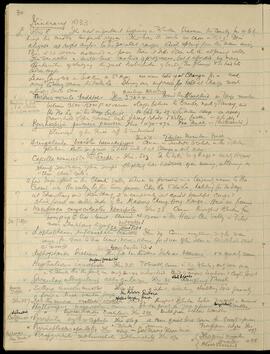
              Itinerary 1933.

              Ibis 6. The most important highway in Bhutan traverses the country from W. to E. through the middle temperate region. This was the route we chose in 1933. It is aligned at right angles to the parallel ranges which spring from the main axis, thus it soon ascends a pass then it dips down into an adjoining valley. This was rather a switchback method of progression but it afforded so many opportunities of studying the zonal distribution of birds (and flowers) & it had its advantages.

              Leaving Gangtok in Sikkim, on 5th May we were held up at Changu for a week owing to heavy snow on the Natu La. During our enforced halt at Changu most interesting birds were:

              Himalayan Blackbird
              Turdus merula buddhae. Ibis 273-4. Found the Blackbird in large numbers between 13,500-15,000 ft at various stages between the Bum La, north of Tawang, and the Tse La in the Mago District. Confined to S.E. & S.W. Tibet at 12,500 and over. On 6th Nov. it is often seen on rocky grassy hill slopes covered with dwarf rhododendron bushes, etc. etc.

              Pyrrhospiza punicea punicea. Ibis 470-472. Red-breasted Rose Finch. Plumage of the female difficult to understand.

              Ibis 478. Tibetan Mountain Finch
              Fringalauda brandti haematopygia. Common in suitable localities on the Tibetan plateau. Rather surprised to meet with it at Changu in early May.

              Capella nemoricola. Wood Snipe - Ibis 503. In the hills W. of Mago in early August Sherriff saw many of this snipe flighting like woodcock of an evening, uttering a "Chur, Chur" call.

              A few days spent in the Chumbi Valley, whence we proceeded in a leisurely manner to Ha. Crossed into Ha valley by the twin passes Chele La & Ha La, halting for 10 days at Sharithang and Damthang, 2 encampments set amidst beautiful conifer & rhododendron forest on either side of the Massong Chung Dong Range. Here we found:

              Nucifraga caryocatactes hemispila. Ibis 22. Nutcracker! Common throughout Bhutan from 6,000 ft up to tree-limit. Observed at 12,000 in the Hamo Chu valley in Tibet near Lhakhang Dzong. (See p 19a)

              Lophophanes rufonuchalis beavani. Ibis 24. S.K. Black Tit. Common everywhere, S. of the main range, from 9,000 to tree limit, seen above, for it was often seen in low rhododendron scrub at 14,000 ft.

              Lophophanes dichrous. Black-browed Crested Tit. This bird has the same distribution as beavani and is equally common.

              Aegithaliscus iouschistos rufiventer. Ibis 25. Tolerably common in W. Bhutan; only seen once in E. Bhutan though the party was one of 30-40 individuals. Birds of mixed deciduous & conifer forest.

              Garrulax albogularis albogularis. Ibis 31. White-throated Laughing Thrush.

              Suthora unicolor unicolor. Ibis 26. The Brown Suthora. A silent, sedentary, skulking bird generally found in thick bamboo jungle.

              Ianthocincla ocellata ocellata. Ibis 32. Spotted Laughing Thrush. Throughout Bhutan between 7-11,000 ft in summer.

              Phylloscopus magnirostris. Large-billed Warbler. Common on plateau forest from 7,000 upwards.

              Trochocercus trochiloides. Ibis 288. Dull green Willow Warbler.

              Pyrrhula erythrocephala. Ibis 469. Red-headed Bullfinch. A tame quiet bird common from 9,000 ft upwards in Bhutan.

              Pyrrhoplectes epauletta. Ibis 469. Gold-headed Black Finch.

              Propyrrhula subhimachala subhimachala. Ibis 470. Red-headed Rose Finch.

              Tragopan satyra. Ibis 497.

              Ithaginis cruentus cruentus. 498. Blood Pheasant.

              LSH/1/1/2/1/42 · Part · 1933-07-08
              Part of The Ludlow & Sherriff Collection

              SUMMARY:
              The party leaves Sakden, crosses the Se La Range via the Nyang Sang La, endures leeches at Muktur, then crosses the Tawang Chu by an iron suspension bridge and ascends to Tawang, which they recall unfavorably. They proceed via Shao to Tsona, noting rich alpine flora and exceptionally large numbers of Turdus merula buddhae between Bum La and the Tse La in the Mago district.

              CONTENT:
              Ibis 15.
              We left Sakden on 11 July, crossed the Se La Range by the Nyang Sang La, and descended through silver birch, fir, and rhododendron forest to MUKTUR where we were almost eaten alive by leeches. The following day (July 12) we crossed the Tawang Chu by a striking iron suspension bridge, and ascended to the monastic town of Tawang (July 12), the only place in either Tibet or Bhutan of which we do not retain pleasant memories.

              From Tawang to Tsona (15 July) via Shao (14 July). The passes between Tawang and Tsona held a rich flora, and at Shao, the intermediate stage, we passed through acres of Primulas and saw larger numbers of Turdus m. buddhae than I ever remember having seen before.

              Ibis 273 Turdus merula buddhae. We saw this Blackbird in large numbers between 13,500 and 15,000 ft at various stages between the Bum La, north of Tawang, and the Tse La in the Mago district etc. etc. Ibis 274

              LSH/1/1/4/1/113 · Part · 1933-09-24
              Part of The Ludlow & Sherriff Collection

              SUMMARY:
              The party traveled from Sanga Choling to Charme with 30 pony loads, encountering delays and afternoon rain. They visited an old lady, Ayelmu, who served tea and arranged for them to sell 12 musk pods in Calcutta and buy cloth with the proceeds; she had been married to a trader and later to the now-deceased Drugpa Rimpoche, and the writer notes that Pantan and Sanga Choling share the Drukpa religion.

              CONTENT:
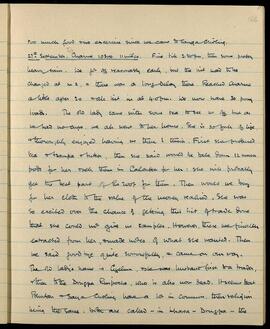
              Too much food and no exercise since we came to Sanga Choling.

              27th September. To Charme 10300 11 miles. Fine till 2.30 pm, then some pretty heavy rain. We got off reasonably early, but the kit had to be changed at m 2, and there was a long delay there. Reached Charme a little after 2.0 and all kit in at 4.0 pm. We now have 30 pony loads. The old lady came with some tea to see us off, but as we had no cups, we all went to her house. She is so full of life, and thoroughly enjoyed having us there I think. First she produced tea and tsampa and butter, then she said would we take down 12 musk pods for her and sell them in Calcutta for her: she will probably get the best part of Rs 200/- for them. Then would we buy for her cloth to the value of the money realized. She was so excited over the chance of getting this bit of trade done that she could not give us samples. However, these we finally extracted from her, and made notes of what she wanted. Then we said goodbye quite sorrowfully, and came on our way.

              The old lady's name is Ayelmu, and she was married first to a trader, then to the Drugpa Rimpoche, who is also now dead. It seems that Pantan and Sanga Choling have a lot in common, their religion being the same: both are called - in Lhasa - Drugpa - the