India

Elements area

Taxonomy

Code

Scope note(s)

    Source note(s)

      Display note(s)

        Hierarchical terms

        India

          Equivalent terms

          India

            Associated terms

            India

              176 Archival description results for India

              176 results directly related Exclude narrower terms
              LSH/1/1/3/3/9 · Part · 1936-02-09
              Part of The Ludlow & Sherriff Collection

              SUMMARY:
              The diarists travel from Lahore to Calcutta, meet friends, shop in the New Market, lunch with Collins, and see the film 'The Mutiny on the Bounty.' They continue by the Assam mail, receive a telegram from Chris about Mother at Parbatipur and Kumarikhata, reach Rangiya early, drive to Darrang Mela, find large crowds, and meet the Dzongpen of Trashigang and Shangia.

              CONTENT:
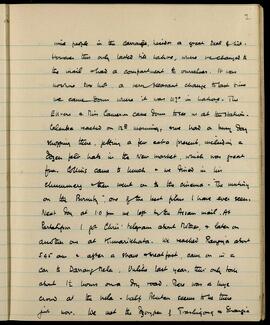
              Nine people in the carriage, besides a great deal of kit. However this only lasted till Lahore, where we changed to the mail and had a compartment to ourselves. It was nowhere too hot, a very pleasant change to last time we came down where it was 117° in Lahore. The Ellvers and Miss Cameron came down to see us at the station. Calcutta reached on 12th morning, and we had a busy day shopping there, getting a few extra presents, including a dozen felt hats in the New Market, which was great fun. Collins came to lunch and we dined in his chummery then went on to the cinema - "The Mutiny on the Bounty", one of the best films I have ever seen. Next day at 1.0 pm we left by the Assam mail. At Parbatipur I got Chris' telegram about Mother, and later on another one at Kumarikhata. We reached Rangiya about 5.45 am and after a shave and breakfast, came on in a car to Darrang Mela. Unlike last year, this only took about 1 1/2 hours on a dry road. There was a huge crowd at the mela - half Bhutan seems to be there just now. We met the Dzongpen of Trashigang and Shangia.

              LSH/1/1/1/1/60 · Part · 1933-06-08
              Part of The Ludlow & Sherriff Collection

              SUMMARY:
              The party, joined by Mr. F. Williamson and Raja S.T. Dorji at Ha, traveled via Chele La to Paro en route to Bumthang, receiving such hospitality from the Paro Penlop that collecting was not possible. Notes describe local archery equipment and a drive for serow and musk deer.

              CONTENT:
              Ludlow Iris 9.
              At Ha we were joined by the late Mr. F. Williamson C.I.E. Political Officer in Sikkim
              & Raja S.T. Dorji, together we journeyed to Bumthang, the summer residence
              of His Highness the Maharaja.

              Lud Iris 9
              We left Ha on 21 June, ascended the Chele La dropped down into the wide
              open valley in which Paro is situated. We stayed here a week as the guests
              of the Paro Penlop, during which time we were treated with such lavish
              hospitality that collecting was out of the question.

              Ludlow June 15
              Archery - the bow is a 6ft bamboo
              bow; the bowstring appears to be
              made from the fibres of a nettle.
              Targets placed at a distance of
              150 yards. One sees leather &
              finger stalls & a forearm pad
              otherwise finger tips & forearm
              get very sore.

              Ludlow June 16th
              Describe a drive for serow
              & musk deer.
              Serow - Himalayan Goat-antelope.

              LSH/1/1/8/1/43 · Part · 1947-01-13
              Part of The Ludlow & Sherriff Collection

              SUMMARY:
              Entries for January 6–9 describe a snowy halt, peak angle measurements from a Dzong, and marches to Layoting and Camp Namdi. The writer disputes Ward and Bailey on the visibility of Gyala Peri, notes friendly villages, a nearby peak Gelung Jokpo, forests transitioning from pine to dense broadleaf, and observations of birds, clematis, and abundant Lilium giganteum.

              CONTENT:
              letters. He says he will arrive in about 22 days. Our own next mail will not leave here for 7 or 8 weeks or so until we reach India in 3 months from now, so this is worth while.

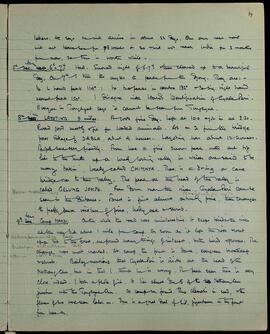
              Jan 6th & 7th Halt. Snowed night of 6-7th then cleared up to a beautiful day. On 7th I took the angles to peaks from the Dzong. They are: - to left-hand peak 114° : to two peaks in centre 132° to big right-hand nearest peak 150°. I disagree with Ward's identification of Gyala Peri. Everyone in Tongkyuk says it cannot be seen from Tongkyuk.

              Jan 8th LAYOTING. 9 miles. A good fine day. Left at 10.0 got in at 3.30. Road good mostly fit for loaded animals. At mile 2 from the bridge pass village of DABLA, about 4 houses. Layoting has about 12 houses. People here very friendly. From here a fine snow peak with cut top lies to the South up a bleak looking valley in which are said to be many 'takin', locally called CHIMNYA. There is a sling or cane bridge over to this valley. The peak at the head of the valley is called GELUNG JOKPO. From down near the river, Gyala Peri can be seen in the distance. Forest is first almost entirely pine, then changes to pretty dense mixture of pine, holly oak & shrubs.

              Jan 9th Camp NAMDI. On the whole the road was uninteresting. It keeps beside the river all the way till about 1 mile from camp. As soon as it left the river & went up a bit to the forest, we found many things of interest, both birds & flowers. The change was most marked. At camp the forest is dense, evergreen broadleaf & shrubs. Bailey mentions that Gyala Peri is visible at the head of the Netrang Chu, but in this I think he is wrong. The peak seen there is very close indeed. I took a photo of it. It lies almost due S of the Netrang Chu junction with the Tongkyuk Chu. At camp we found three clematis in seed, the flowers of two were seen later on. There is a great deal of Lilium giganteum in this forest from here on.

              LSH/1/1/1/1/10 · Part · 1933-05-05 - 1933-11-06
              Part of The Ludlow & Sherriff Collection

              SUMMARY:
              Notes the 1933 traverse across Bhutan via the central highway, leaving Gangtok and being delayed at Changu on 5 May due to snow on the Natu La. Records bird observations across Changu, the Chumbi and Ha valleys, and the Tibetan plateau, including a Wood Snipe sighting by Sherriff near Mago.

              CONTENT:
              3a

              Itinerary 1933.

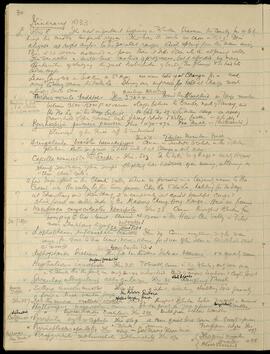
              Ibis 6. The most important highway in Bhutan traverses the country from W. to E. through the middle temperate region. This was the route we chose in 1933. It is aligned at right angles to the parallel ranges which spring from the main axis, thus it soon ascends a pass then it dips down into an adjoining valley. This was rather a switchback method of progression but it afforded so many opportunities of studying the zonal distribution of birds (and flowers) & it had its advantages.

              Leaving Gangtok in Sikkim, on 5th May we were held up at Changu for a week owing to heavy snow on the Natu La. During our enforced halt at Changu most interesting birds were:

              Himalayan Blackbird
              Turdus merula buddhae. Ibis 273-4. Found the Blackbird in large numbers between 13,500-15,000 ft at various stages between the Bum La, north of Tawang, and the Tse La in the Mago District. Confined to S.E. & S.W. Tibet at 12,500 and over. On 6th Nov. it is often seen on rocky grassy hill slopes covered with dwarf rhododendron bushes, etc. etc.

              Pyrrhospiza punicea punicea. Ibis 470-472. Red-breasted Rose Finch. Plumage of the female difficult to understand.

              Ibis 478. Tibetan Mountain Finch
              Fringalauda brandti haematopygia. Common in suitable localities on the Tibetan plateau. Rather surprised to meet with it at Changu in early May.

              Capella nemoricola. Wood Snipe - Ibis 503. In the hills W. of Mago in early August Sherriff saw many of this snipe flighting like woodcock of an evening, uttering a "Chur, Chur" call.

              A few days spent in the Chumbi Valley, whence we proceeded in a leisurely manner to Ha. Crossed into Ha valley by the twin passes Chele La & Ha La, halting for 10 days at Sharithang and Damthang, 2 encampments set amidst beautiful conifer & rhododendron forest on either side of the Massong Chung Dong Range. Here we found:

              Nucifraga caryocatactes hemispila. Ibis 22. Nutcracker! Common throughout Bhutan from 6,000 ft up to tree-limit. Observed at 12,000 in the Hamo Chu valley in Tibet near Lhakhang Dzong. (See p 19a)

              Lophophanes rufonuchalis beavani. Ibis 24. S.K. Black Tit. Common everywhere, S. of the main range, from 9,000 to tree limit, seen above, for it was often seen in low rhododendron scrub at 14,000 ft.

              Lophophanes dichrous. Black-browed Crested Tit. This bird has the same distribution as beavani and is equally common.

              Aegithaliscus iouschistos rufiventer. Ibis 25. Tolerably common in W. Bhutan; only seen once in E. Bhutan though the party was one of 30-40 individuals. Birds of mixed deciduous & conifer forest.

              Garrulax albogularis albogularis. Ibis 31. White-throated Laughing Thrush.

              Suthora unicolor unicolor. Ibis 26. The Brown Suthora. A silent, sedentary, skulking bird generally found in thick bamboo jungle.

              Ianthocincla ocellata ocellata. Ibis 32. Spotted Laughing Thrush. Throughout Bhutan between 7-11,000 ft in summer.

              Phylloscopus magnirostris. Large-billed Warbler. Common on plateau forest from 7,000 upwards.

              Trochocercus trochiloides. Ibis 288. Dull green Willow Warbler.

              Pyrrhula erythrocephala. Ibis 469. Red-headed Bullfinch. A tame quiet bird common from 9,000 ft upwards in Bhutan.

              Pyrrhoplectes epauletta. Ibis 469. Gold-headed Black Finch.

              Propyrrhula subhimachala subhimachala. Ibis 470. Red-headed Rose Finch.

              Tragopan satyra. Ibis 497.

              Ithaginis cruentus cruentus. 498. Blood Pheasant.

              LSH/1/1/8/1/170 · Part · 1933-06-02
              Part of The Ludlow & Sherriff Collection

              SUMMARY:
              List of supplies and equipment including hams, tarpaulins, various tinned foods (mushrooms, beans, fruits), staples such as flour, dhal, tea, spirits (gin, whiskey, rum), cigarettes, nails, and 12-gauge cartridges. Quantities are recorded for each item, with some noted in tins or pounds. 'Delhi flour' is specified among the staples.

              CONTENT:
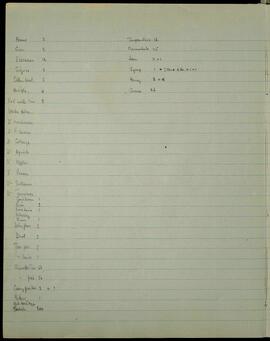
              Hams 2. Tarpaulins 16.
              Gun 2 Marmalade 25
              Essences 12. Jam 11 + 1
              Sigris 3. Syrup 1 + 7 lbs + 4 lbs + 1 + 1
              Cotton Wool. 3 Honey 2 + 4
              Antiflo. 4 Cheese 26
              1" + 2" nails tins 3
              Whalen Valves ..
              Do. Mushroom
              Do. Fr beans
              Do. Cabbage
              Do. Apricots
              Do. Apples
              Do. Prunes
              Do. Sultanas
              Do. Tomatoes
              Cornbean 1
              Gin 2
              Lime Juice 1
              Whiskey 1
              Rum 1
              Delhi flour 2
              Dhal 2
              Tea pkts 7
              " brick 1
              Cigarettes tins 56
              " pkts 50
              Curry powder 2 + 1
              Bitters 1
              12 G. cartridges 200

              LSH/1/1/9/1/137 · Part · 1933-09-01
              Part of The Ludlow & Sherriff Collection

              SUMMARY:
              Plans are made for visits to Kantanang, Tolgang, and the Chachhu La route while hoping for improving weather. On 12th Sept. they halt in camp; mail arrives from H.H. along with his cook Namgye, whom the writer reluctantly keeps, and letters from T. Bagge and Betty report on Betty’s arm x-rays and her safe arrival in Calcutta, while a hoped-for house falls through.

              CONTENT:
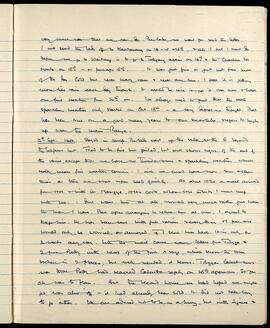
              very much now that we can do. The later we wait for seed the better. I will send the lads off to Kantanang on 14-15 or 16th, and all I feel I must do before we go to Waitang is to go to Tolgang again on 14th and the Chachhu La route on 18th - or perhaps 16th. It was just fine or just not fine most of the day. Cold but never heavy rain and never any sun. I fear it is getting more like rain each day though. It would be nice to get it over now and have our fine weather from 20th on. We always used to find that the real sparkling weather only started on Oct. 18th - a very depressing thought. That has been true on a good many years to our knowledge, refers to high up near the main Range.

              12th Sept. Halt. Stayed in camp. The lads went up the valley to the E beyond the Serpens hut. Tried to be fine but failed, but still shows signs of the end of the rains, except that we have no thunderstorms and sparkling weather, which really mean fine weather coming. I wish we could have more sun and clear skies, as these are what ripen seed quickly. At about 10.30 a mail arrived from H.H. and with it Namgye, H.H.'s cook, whom H.H. insists I must keep with me. I don't want him at all, would very much rather just have the man I have. But after arranging to return him at once, I agreed to keep him. He has been sent with full rations nevertheless and I fear H.H. would only be worried, or annoyed, if I sent him back. It is only for 3 weeks anyway. With the mail came many letters from T. Bagge and 2 from Betty with news of the first x-rays, which show the arm broken in 2 places, but well mended, it seems. T. Bagge's latest news was that Betty had reached Calcutta safely on 26th afternoon. So far all was to plan. But the second house we had hoped we might get, was also 'off' - it had already been sold. It did not take long to go either. We are advised not to be in a hurry, but with Tinnie and

              LSH/1/1/10/1/14 · Part · 1949-09-27
              Part of The Ludlow & Sherriff Collection

              SUMMARY:
              The writer notes a woman's injury has healed and mentions the drokpas marking the first frost. On 27 Sept. they halt in misty weather, collecting good seed of several plants and observing Polygonum vaccinifolium, with plans to take roots. On 28 Sept. heavy continuous rain makes it difficult to dry collected seeds.

              CONTENT:
              see that it has healed well, she can use it perfectly. I must confess I am also very surprised, because the splinting I did was not good. There was some white frost on the ground this morning, which the drokpas seemed pleased about, because their calendar said this would be the first day of frost.

              27th Sept. Halt. This evening one would think we were in the middle of the worst part of the rains. It dawned sparklingly bright, yet within two hours we were in thick mist, & we haven't seen the sun since. A most disappointing day. But we got what we wanted, good seed of P. tenardinii, sapphirina & Waddellii, & one or two other things. I should think there will be a good deal of snow high up tonight. Many plants have no ripe seed yet, notably P. unistabilis, which is not nearly ready yet. There is quite a lot of Polygonum vaccinifolium up here, which I never suspected before, but it is not in profusion as it is on the Hala-Kyu la, in Sikkim, near Changu. What a beautiful thing it is though, why doesn't one see more of it at home I wonder. We have managed to get a few - very few - seed, & if we can get more will take roots for the Hala.

              28th Sept. Halt. Heavy rain all night, & rain without a stop today, much to our disgust. It is very hard to get seeds dry in this atmosphere. Anything we take is naturally soaking. I

              LSH/1/1/9/1/32 · Part · 1949-05-06
              Part of The Ludlow & Sherriff Collection

              SUMMARY:
              A wet halt day spent scrambling on a steep rock slope near Rip la to observe rhododendrons, notably Rhododendron edgeworthii, anthopogon, and lindleyi, with signs of bear and musk deer but no sightings. Men later brought in masses of R. edgeworthii, and the diarist began a letter to Betty before receiving mail from Kalimpong.

              CONTENT:
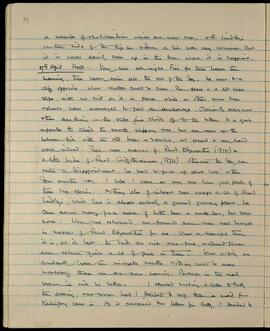
              a number of rhododendrons which are now over, and R. lindleyi
              on the side of the Rip la and down a bit was very common. But
              it is never easily seen up in the trees where it is happiest.
              27th April. Halt. Very wet all night. Fine for three hours this
              morning, then heavy rain all the rest of the day. We went to a
              cliff opposite, where Rhodos. could be seen. The place is a 45° rock
              slope, with no soil on it in places, while in others some trees
              and shrubs have managed to find an anchorage. Obviously every now
              and then anything on the slope just shoots off to the bottom. It is quite
              impossible to climb the smooth slippery rock, but we went up the
              between bits with the odd trees and bamboo, and found it very hard
              work indeed. There were masses of Rhod. edgeworthii (18777) and
              a little higher of Rhod. anthopogon (18776). Otherwise the day was
              rather a disappointment. We had to go on up above 2000' and then
              down another way. I hope I have at any rate some good photos of
              these two species. Nothing else of interest seen, except a lot of Rhod.
              lindleyi, which here is almost entirely a ground growing plant. We
              came across many fresh marks of both bear and musk deer, but saw
              none. When we returned, we found some men had brought
              in masses of Rhod. edgeworthii for me. What a beautiful thing
              it is, at its best: the buds are rich rose pink, and opened flowers
              even retain quite a lot of pink in them. What a pity we
              constantly have this miserable weather. Nothing could be more
              monsoony than we are now having. Perhaps in the real
              season it will be better. I started writing a letter to Betty
              this evening, and no sooner had I decided to stop than a mail from
              Kalimpong came in. As it contained two letters for Betty, I decided to

              LSH/1/1/2/1/127 · Part · 1933-07-18
              Part of The Ludlow & Sherriff Collection

              SUMMARY:
              The party halts at Dongkar amid showers, hosts the Tsona Dzongpon who enjoys cigarettes and Cointreau, and arranges to send him a Rhoorki chair from Calcutta. Notes mention Bhutanese traders from Trashiyangsi, glacier views near the Gorpa La with a route to Gor, and botanical finds including a notable gentian (Lomatogonium spathulatum) and other species.

              CONTENT:
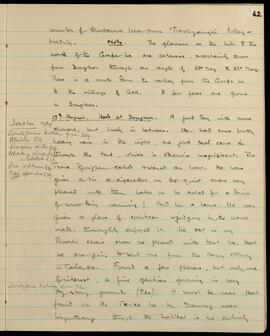
              62

              number of Bhutanese here from Trashiyangsi today - trading.

              Note. The glaciers on the hills to the north of the Gorpa La are extensive, and certainly show from Dongkar through an angle of 68° Mag to 98° Mag. There is a route down the valley from the Gorpa La to the village of Gor. A few peas are grown in Dongkar.

              17th August. Halt at Dongkar. A good day with some showers, but lovely in between. We had some pretty heavy rain in the night, and a good deal came in through the tent, which is otherwise magnificent. The Tsona Dzongpon called and stayed an hour. He was given a tin of cigarettes on the quiet and was very pleased with them. Later on he asked for a drink of something warming! And he a lama. He was given a glass of Cointreau, and judging by the noise made, thoroughly enjoyed it. He sat in my Rhoorki chair and was so pleased with that too, that we are going to send one from the Army & Navy in Calcutta. Found a few flowers, but only one of interest, a fine gentian growing in very dry stony ground. (834). It must be near that found on the Thuka La by Dansey near Lingmathang, though the habitat is so entirely...

              [Margin Notes:]
              Donkhar 17/Aug
              Lomatogonium spathulatum sp. nov. 834
              Potentilla 835.
              Adenophora smithii 836
              Pedicularis rhinanthoides var. labellata 837
              Primula sikkimensis 838
              Picris spinulosa 839

              Lomatogonium spathulatum sp. nov. 834