Bhutan

Elements area

Taxonomy

Code

Scope note(s)

    Source note(s)

      Display note(s)

        Hierarchical terms

        Bhutan

        Equivalent terms

        Bhutan

          Associated terms

          Bhutan

            419 Archival description results for Bhutan

            419 results directly related Exclude narrower terms
            LSH/1/1/1/1/75 · Part · 1933-06-30
            Part of The Ludlow & Sherriff Collection

            SUMMARY:
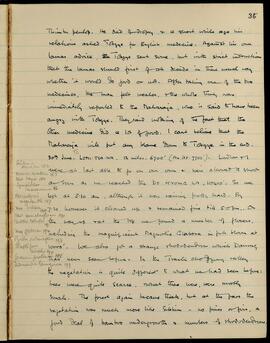
            Notes on the death of the Thimbu penlop and Tobgye’s sending of English medicine, causing concern with the Maharaja. On 30th June Ludlow and the author travelled to Lomi-Tsa-wa via Do Kyong La in clearing weather, collecting flowers including Magnolia globosa and observing that vegetation in the Trashi-cho-dzong valley and at the pass resembled Sikkim.

            CONTENT:
            35

            Thimbu penlop. He died of dropsy & a short while ago his
            relations asked Tobgye for English medicine. Against his own
            lamas advice, Tobgye sent some, but with strict instructions
            that the lamas should first of all decide in their usual way
            whether it would do good or not. After taking one of the two
            medicines, the man felt weaker, & the whole thing was
            immediately reported to the Maharaja, who is said to have been
            angry with Tobgye. They said nothing of the fact that the
            other medicine did a lot of good. I can't believe that the
            Maharaja will put any blame down to Tobgye in the end.

            30th June. TO LOMI-TSA-WA. 12 miles - 6700' (An. Ht. 7700'). Ludlow & I
            Embelia oleracea 182
            Anemone rivularis 183 were at last able to go on our own & were allowed to shoot
            Rhod. Keysii 184
            Symplocos ramosissima 186 as soon as we reached the DO KYONG LA, 10410'. So we
            Pedicularis megalantha 187
            left at 5.30 am, although it was raining pretty hard. By
            Meconopsis villosa 189
            Rhod. camelliaeflorum 190 7.30 however it cleared up & remained fine till 5.0 pm. On
            Berberis celestina 191
            the way up & at the top we found a number of flowers,
            Mag. globosa 192
            Pyrola rotundifolia 193 including the magnificent Magnolia Globosa in full bloom at
            Streptopus simplex 194
            10000'. We also got a strange rhododendron which Dawang
            Geranium pratense 198
            Didissandra lanuginosa 199 has never seen before. In the Trashi-cho-dzong valley
            the vegetation is quite different to what we had seen before:
            trees were quite scarce, & what there were, were mostly
            small. The forest again became thick, but at the pass the
            vegetation was much more like Sikkim - no pines or firs, a
            good deal of bamboo undergrowth & numbers of rhododendrons.
            LSH/1/1/9/1/88 · Part · 1933-06-11
            Part of The Ludlow & Sherriff Collection

            SUMMARY:
            The author reports rapid wear of shoes, sends mail, and has Pasang and Mundra go to Shasjebang, expecting their return on 1 July; letters from Betty include Chuni’s quip about B.J.’s impending child. On 29 June a halt is kept with some rain; photos are developed, stores rearranged ahead of moving toward Bumthang, Lhakpa washes clothes, fleas are dealt with using DDT, and observations are made on late flowering and snow conditions near Me La.

            CONTENT:
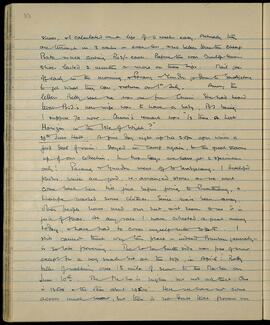
            shoes, I calculated on a life of 6 weeks easy. Actually they are through in 3 weeks or even less, and better than the cheap Bata muck costing Rs 2/- each. Before the war Dunlop tennis shoes lasted 2 months or more on these trips. Mail went off early in the morning, Pasang & Mundra go down to Shasjebang to get what they can, return on 1st July. Among the letters Betty sent me was one from Chuni. She had heard that B.J.'s new wife was to have a baby, B.J. being I suppose 70 now. Chuni's remark was "Is there a Lost Horizon in the Isle of Wight?"

            29th June Halt. A fine day right up till 2.0pm, after which a good deal of rain. Stayed in camp again, to the great showing up of our collection. In two days we have got 2 specimens only! Pasang & Mundra went off to Shasjebang. I developed photos, which are good, re-arranged stores, as we won't come back here till just before going to Bumthang, & Lhakpa washed some clothes. Since we've been away, other people have used our hut, so it seems to me it is full of fleas. At any rate I have collected a great many today, & have had to cover myself with DDT. I still cannot think why this place - indeed Bhutan generally - is so late flowering. The Lola Smith side was free of snow except for a very small bit at the top, in April. Betty talks of walking over 1 1/2 miles of snow to the Me La on June 10th. The Me La is higher, but not all that. One is 13500 & the other about 14500'. Here we have not come across much snow, but there is no doubt that flowers on

            LSH/1/1/1/1/111 · Part · 1933-07-28
            Part of The Ludlow & Sherriff Collection

            SUMMARY:
            Notes on shelters for heavy rain and severe midges, followed by a route from Sana to Trashiyangsi. The path descends through jungle and cultivated land, crosses the Dongde Chu and Trashiyangsi Chu by bridges, passes CHOTEN KORRA, and reaches camp around 13.5 miles at about 8000 feet.

            CONTENT:
            made of slit plaited bamboo, with roofs of the same or of
            thin, long pieces of pine, are most useful, as they keep
            out most if not all of the rain. When rain is heavy, we
            usually put tarpaulins over the top. Midges awful here, as
            were flies to midges at Gori Pimi.

            28th July. TRASHIYANGSI. 13 1/2 m. 8000'. Leaving the clearing at
            Sana path drops into gorge and crosses stream, thence descent
            steady over very bad path to m 3. where another side
            stream is crossed by a bridge. After this the path
            ascends gradually, is better and at m 5 emerges from
            the dense jungle to partly cultivated more open land.
            Descent then fairly steep to m 8 where the main river
            Dongde Chu, is crossed. Path follows close to river, ascending
            and descending along R. bank to m 11, where it recrosses
            over a bridge and climbs steeply up to a spur 500' further
            on, where Trashiyangsi Dzong is situated. Passing this,
            path drops immediately over the spur to the Trashiyangsi Chu
            which is crossed by a massive covered bridge at m 11 1/2. Thence easy
            path up left bank of Trashiyangsi River, passing a large
            chorten (CHOTEN KORRA) at m 13 to camp at 13 1/2. Water fuel ample

            LSH/1/1/1/1/103 · Part · 1933-07-24
            Part of The Ludlow & Sherriff Collection

            SUMMARY:
            Arrival at Lingtsi was marked by a musical welcome, with songs contrasted to those of Ha Paro; the landscape is compared to Trunza with the Kuru Chu below the Dzong, in very hot but fine weather. The page details the route from Lingitse down to the Kuru Chu with bamboo bridges over the Kuru Chu and Khoma Chu (ponies possible), passing the Ngarigong Chu, and includes notes on views of Tangnam, Lingtsi road, Lingtsi Dzong, and the Kuru Chu bridge.

            CONTENT:
            old men with trumpets, & two equally comic young boys with a drum & a gong. With them were six women, & the whole troupe accompanied us in, the women singing the while. The songs here are quite different to the Ha Paro ones, but equally pleasing. Lingtsi is somewhat like Trunza with the huge Kuru Chu running in a gorge below the Dzong. But the hills here are steeper & bigger. We had a pleasant glimpse of the snow hills this morning. For three days now, it has been fine. I wonder what that means. It is very hot indeed here, not a place either of us will stay in longer than absolutely necessary -

            24th July. LINGITSE (LINSI of map.) 8 miles. 6400'. Path drops pretty steeply downstream below the Dzong to the Kuru Chu river, which is about 1000' below the Dzong. At m 1 it meets the river, which is crossed by a bamboo bridge about 50 yards long. This was in good condition in July 33, & ponies could be taken over with care. Route continues down left bank for 500 yards, where the Khoma Chu enters. This river is also unfordable in summer, & is crossed by a bamboo bridge 100x above the junction with the Kuru Chu. Ponies can be taken over with care. Path then follows close to the left bank of the Kuru Chu & is easy. At m 5 the Ngarigong Chu enters from the left. This is the only river entering the Kuru Chu after the Khoma Chu (the map is wrong). It is

            B.21. Contd.
            Views on Tangnam
            Lingtsi road. Coolies
            in forest.
            Lingtsi Dzong
            from Tangnam
            road. Lingtsi Dzong
            from below. Bridge
            over Kuru
            Chu. Ponies crossing
            B.22. Bridge over

            LSH/1/1/1/1/101 · Part · 1935-07-22
            Part of The Ludlow & Sherriff Collection

            SUMMARY:
            Notes describe receiving naive letters and small gifts from Ashe Wangmo, including permission to use her garden at Lingtsi. The page details the route from Takyela to Lhuentse Dzong (Lingtsi), terrain and mileage, mentions that the Kuru Chu route to Lhakang Dzong is impassable in summer and that mapped hot baths are unknown, and remarks on a very hot camp and being met by the zumpin's son.

            CONTENT:
            49

            on rocks about 1 1/2 miles this side of Shukang. It is big, a
            creamy white, rather larger than the Bhutan lily. We each
            had letters from Ashe Wangmo today. Poor girl, she seems to
            be rather lost after the amusing times we had together. The
            letters were very naive. It must be dull for them after
            so much excitement. She sent us both small presents, & told
            us to make use of her garden at Lingtsi - a very kind
            thought.

            Lendraw says "to Leightse Dzong"
            (5) 23rd July. To LHUENTSE DZONG (LINGTSI) 6 miles. 5000' 6900. Path on leaving the ridge
            at Takyela ascends gradually, first through pine forest, then through
            rice fields & cultivation to m 3. After this the descent is at
            first easy, then pretty steep to Lingtsi at m 6. Throughout, the
            path is easy for animals. At Lingtsi there is a large
            Dzong, with about 50-60 soldiers. Above the Dzong is a village
            & some cultivation. Below the path from Tangmasu to
            Lingtsi there is a great deal of cultivated land, mostly belonging
            to the Maharaja. "Hot baths" marked on the map just
            east of the bridge over the Kuru Chu are unknown.
            The route from Lhuentse direct up the Kuru Chu to
            Lhakang Dzong is impassable in summer, but is used by traders
            in winter. // A very hot day & a very hot
            camp, nicely built for us, but in a corner of a side
            nala where no wind can reach it. We were met by
            the zumpin's son some miles out, others by two comic

            LSH/1/1/4/1/45 · Part · 1936-04-28
            Part of The Ludlow & Sherriff Collection

            SUMMARY:
            In camp above Trün after a misty morning, the diarist notes finding Gentiana waltonii, a Ceratostigma (possibly the same as at Lhakhang in 1933), Codonopsis convolvulacea, Delphinium gyalanum, and Briggsia aurantiaca, and mentions sending old seeds to Edinburgh. Traveling by the high road from Drotang to Trün through forest, they encountered about 15 Lopas who inspected the diarist’s gun with interest.

            CONTENT:

            1. Natrampa
              Pedicularis corydaloides 2408. Allium prattii 2409. Cornus macrophylla 2410.
              Quercus semicarpifolia 2411. Dryopteris xanthopennata 2412. Polystichum wilsonii 2413.
              Leucosceptrum clarkei 2414.

            was almost always a wind with the mist or rain.

            22nd July. In camp above Trün. 6 miles. 10500'. Another lovely day,
            but misty all up the valley in the early morning till about
            8.0 am. I came across three things I have been looking
            for today. First the gentian which was seen on the dry,
            (but south) side of the river on our way down in May. It is
            Gentiana waltonii 2416
            now just coming into flower, and a fine sight 2416. I
            sent a few of last year's old seeds to Edinburgh before, under
            Ceratostigma minus 2422
            no number. Then I found a little Ceratostigma 2422,
            just coming into bloom. I hope it is the same as the
            Codonopsis convolvulacea 2423
            one we got at Lhakhang in 1933, a new sp. And 2423
            Delphinium gyalanum 2421.
            Briggsia aurantiaca 2420
            the same creeper (vinca blue) which we got quite near
            the Ceratostigma at Lhakhang, a beautiful flower,
            but only just coming out. I took the high road
            this time from Drotang to Trün, and it is very much
            pleasanter than the riverside path, easier, more level,
            and through forest for most of the way. We passed a
            body of about 15 Lopas, both men and women, and had quite
            good fun with them. I took some photos of them, and
            then they inspected my gun with much interest, and

            LSH/1/1/9/1/80 · Part · 1933-06-19
            Part of The Ludlow & Sherriff Collection

            SUMMARY:
            A halt day with damp conditions; the diarist photographed and tended drying flowers, and noted Tibetans trading salt, wool, and cloth at Pangstang with rice sent to Towa Dzong. On 20th June they crossed the river to inspect west-side cliffs, where few plants were in flower; Pasang collected P. muscoides, and P. strumosa was confirmed with notes on its hybridization with P. calderiana.

            CONTENT:
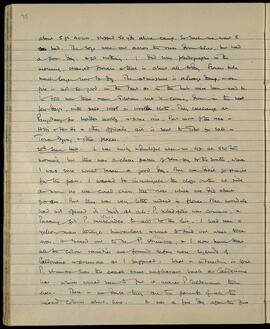
            about 5 feet across, stopped 50 yards above camp. So back we went to bed. The boys were out across the river down below, but had a poor day, got nothing. I did some photographs in the morning, changed flowers and that is about all today. Flowers take much longer now to dry. The atmosphere is always damp, and our fire is not so good in the tent as in the huts we've been used to. I'm told now that many Tibetans will be coming down in the next few days, with salt, wool and woollen cloth. They exchange at Pangstang for madder mostly, and some rice. But more of the rice is H.H.'s and Her H.'s and other officials, all is sent to Tibet for sale in Towa Dzong and other places.

            20th June Halt. It was misty and doubtful when we got up at 5:30 this morning, but there was a clear patch of blue sky to the south, which I was sure would mean a good day. But we didn't go straight for the pass. I wanted to investigate the cliffs on the West side as soon as we could cross the river which we did about 9:00 a.m. But there was very little indeed in flower. Mec. horridula had not opened its buds at all. P. bellidifolia was common, and Pasang got P. muscoides (19303) to add to the list. I had seen a yellow mass through binoculars and went to find out what that was. It turned out to be P. strumosa (19304), and I now know that all the colour varieties we found before were hybrids of Calderiana and strumosa as I supposed. What is interesting is that P. strumosa has the exact same unpleasant smell as Calderiana has, which would seem to put it nearer P. Calderiana than ever. There is no doubt they are the parents of all the mixed colours around here... It was a fine day after the first

            LSH/1/1/6/1/151 · Part · 1938-10-22
            Part of The Ludlow & Sherriff Collection

            SUMMARY:
            Rained overnight but the party traveled about 7 miles to Öla, facing major disputes with transport coolies allegedly stirred up by the Noro Gyumpu's brother; the diarist struck a man who threatened a woman with a knife. Kesang, having taken mail to Kyindong Dzong where the Dzongpen refused to forward it, was sent back to have it sent on to Tsari Chunchar, leaving Taylor unlikely to receive it until his return.

            CONTENT:
            troubles
            77

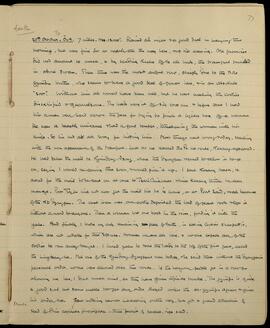
            20th October. ÖLA. 7 miles. App. 13000'. Rained all night & a good deal early this morning, but was fine for us nearly all the way here, up till evening. All promises did not amount to much, & by sending Kucho off to all huts, the transport started in about 8:00 am. Then there was the most awful row, chiefly due to the Noro Gyumpu's brother, who seems to have a good deal of power here, & is an absolute "soor." Without him all would have been well, but he was making the coolies dissatisfied & quarrelsome. The loads were not off till 10:00 am & before that I had hit a man very hard across the face for trying to pinch a lighter box off a woman. He was a beastly nuisance & had a foul temper, threatening the woman with his knife, so I'm not at all sorry for hitting him. Most things went wrong today, starting with the non-appearance of the transport. Just as we reached the Pa La route, Kesang appeared. He had taken the mail to Kyindong Dzong, where the Dzongpen refused to allow it to go on, saying I would be coming there soon, & would pick it up. I sent Kesang back, & asked for the mail to be sent on at once to Tsari Chunchar, which Kesang thinks he can manage. Poor Taylor will not now get the mail till he is home, or

            LSH/1/1/1/1/77 · Part · 1933-07-01
            Part of The Ludlow & Sherriff Collection

            SUMMARY:
            The party splits as W and Mrs W go to Punakha while the diarist and Ludlow, on Tobgye's advice, take a dense leech-infested jungle path from below Lomitsawa towards Wangdupotrang. They avoid shooting due to sensitivities in the late Shabdrung’s area near Thimbu, collect some birds, butterflies, and plants, and after a tiring nine-hour trek reach the Punakha Chu/Mo Chu; camp conditions are filthy with flies, mud, and fleas.

            CONTENT:
            36

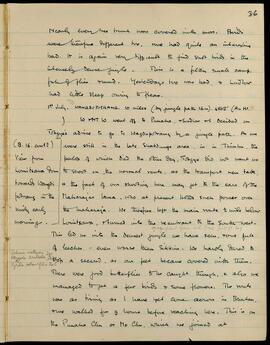
            Nearly every tree trunk was covered with moss. Birds were therefore different too, and we had quite an interesting bag. It is again very difficult to find shot birds in the intensely dense jungle. This is a filthy small camp, full of flies and mud. Yesterday too was bad, and Ludlow had little sleep owing to fleas.

            70
            1st July. TO WANGDUPOTRANG. 10 miles (by jungle path 16 miles). 4508' (An Ht. ). W and Mrs W went off to Punakha, and Ludlow and I decided on Tobgye's advice to go to Wangdupotrang by a jungle path. As we

            (B. 16. contd) View from Lomitsawa down towards Wangdi Potrang in the misty early morning.

            were still in the late Shabdrung's area, in Thimbu, the Penlop of which died the other day, Tobgye did not want us to shoot on the normal route, as the transport men talk, and the fact of our shooting here may get to the ears of the Maharaja's lama, who at present holds such power over the Maharaja. We therefore left the main route ½ mile below Lomitsawa, and turned into the re-entrant to the South West.

            magnificent fern with fronds 3-5 ft long
            This led us into the densest jungle we have seen, and full of leeches - even worse than Sikkim. We hardly dared to stop a second, as our feet became covered with them.

            Schima wallichii 201
            Polygala arillata 202
            Pyrola rotundifolia 203

            There were good butterflies to be caught though, and also we managed to get a few birds and some flowers. The route was as tiring as I have yet come across in Bhutan, and we walked for 9 hours before reaching here. This is on the Punakha Chu or Mo Chu, which we joined at

            LSH/1/1/2/1/4 · Part · 1934-06-13 - 1934-06-29
            Part of The Ludlow & Sherriff Collection

            SUMMARY:
            Notes quote Ludlow’s plan to work the Tawang Chu and Nyam Jang Chu basins in Tibet and revisit the Trashi Yangsi Valley. Permission was granted by the Maharaja and late-May sanction came from the Tibetan Government, prompting a rapid approach via the Dewangiri–Tawang Trade Route through the eastern Duars. The itinerary records travel from Srinagar to Dewangiri and onward to Trashigong in late June 1934.

            CONTENT:
            10

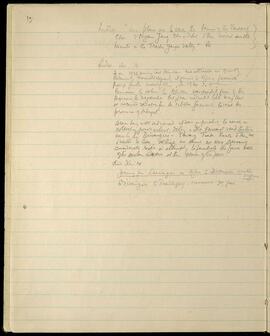
            Ludlow: "our plans are to work the basins of the Tawang Chu & Nyam Jang Chu in Tibet & then revisit our old haunts in the Trashi Yangsi Valley." P. 8

            Ludlow. Ser. 13
            In our 1933 journey East Bhutan had attracted us greatly. Botanically & ornithologically it seemed to offer a favourable field for further investigation. In 1934 ...
            Permission to return to Bhutan was readily given by His Highness the Maharaja but it was not until late May that we received sanction from the Tibetan Government to cross the province of Mönyul.

            Season being well advanced it was imperative to reach our collecting grounds without delay. The quickest road thither was by the Dewangiri - Tawang Trade Route & this we decided to take although we knew we were running considerable risks in attempting to penetrate the fever belt of the eastern Duars at this season of the year.

            Lud. Ser. 14
            Journey from Srinagar on 13 June to Dewangiri reached 22 June.
            Dewangiri to Trashigong - reached 29 June.