Bhutan

Elements area

Taxonomy

Code

Scope note(s)

    Source note(s)

      Display note(s)

        Hierarchical terms

        Bhutan

        Equivalent terms

        Bhutan

          Associated terms

          Bhutan

            419 Archival description results for Bhutan

            419 results directly related Exclude narrower terms
            LSH/1/1/8/1/85 · Part · 1938-03-31 - 1938-04-09
            Part of The Ludlow & Sherriff Collection

            SUMMARY:
            Heavy spring rain at Tongkyun with peach blossom in Pasha; several halt days used to repack for a two‑month return journey while letters were exchanged rapidly with Ludlow via Dzeng. Tsungpen and Akong visited Trulung; plans were made for Ludlow to go to Pemakochung and the Yigrong Range, possibly leaving Suowa to Tsungpen, and Henry may accompany the diarist to Tromda. The writer, feeling heart trouble, decides to return to India amid persistently dull, rainy weather.

            CONTENT:
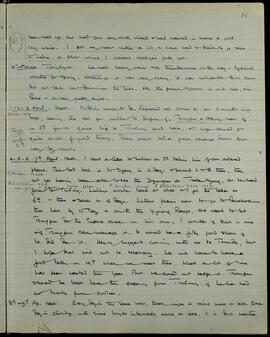
            been held up, but had gone very slowly indeed & had waited in Lhasa a very long while. I felt my heart rather a lot, & have had to decide to go back to India, a blow which I haven't realized fully yet.

            31st March. Tongkyun. We had heavy rain & a thunderstorm on the way - typical weather for spring. Although it was very heavy, it was noticeable that snow did not fall low down on the hills. All the peach blossom is out here, in Pasha - a very pretty sight.

            1-2-3 April. Halt. Nothing much to do. Repacked all stores for our 2 months trip back, leaving the rest for Ludlow to dispose of. Tsungpen & Akong went to Trulung on 3rd for a quick trip to Trulung and back, & hope secured for quite a lot of good things. There must be a great change down that way by now.

            4-5-6-7th April. Halt. I sent a letter to Ludlow on 3rd telling him of our altered plans. The lad took it to Dzeng in 2 days & found L & S there, they not yet having been able to see the Dzongpen at Tsola Dzong, as he had gone to Trulung. Ludlow wrote back at once & I got the letter on 6th - there & back in 4 days. Ludlow plans now to go to Pemakochung, then here by 15 May & on to the Yigrong Range. He wants to let Tsungpen do the Suowa area on his own. I wonder if that is wise & if Tsungpen can manage it. It would be a jolly good show if he did do it. Henry suggests coming with me to Tromda, but I hope that will not be necessary. We will have to have a good talk on 14th when we meet there. What a lot of time has been wasted this year. But we could not help it. Tsungpen should be back here this evening from Trulung, if he has had no trouble from coolies.

            8th & 9th Ap. Halt. Every day is the same now. Each night it rains more or less. Each day is cloudy, with some bright intervals, more or less. It is dull weather,
            LSH/1/1/1/1/175 · Part · 1933-09-05
            Part of The Ludlow & Sherriff Collection

            SUMMARY:
            The party halts at Towa, where the Jongpen, newly returned from Lhasa, invites them to stay another day for dinner. They plan to travel to Nangartse by the route between Pomo and the Yamdrok Tsos, arrange transport changes at Lalung, Monda La, Ling, and Nangartse, and note local transport rates between Singhi Dzong, Lala, and Towa.

            CONTENT:
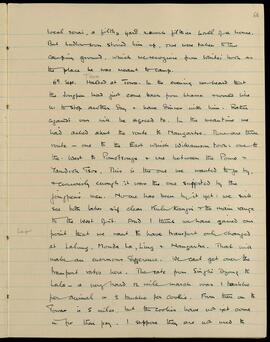
            local serai, a filthy yard and much filthier hovel of a home. But Ludlow soon stirred him up, and we were taken to this camping ground, which we recognize from White's book as the place he was meant to camp.

            6th Sept. Halted at Towa. In the evening we heard that the Jongpen had just come back from Lhasa and would like us to stop another day and have dinner with him. Rather against our will we agreed to. In the meantime we had asked about the route to Nangartse. There are three routes — one to the East which Williamson took: one to the West to Pomotsongo and one between the Pomo and Yamdrok Tsos. This is the one we wanted to go by, and curiously enough it was the one suggested by the Jongpen's men. No one has been by it yet: we will see both lakes and if clear Kulu Kangri and the main range to the West of it. And I think we have gained our point that we want to have transport only changed at Lalung, Monda La, Ling and Nangartse. That will make an enormous difference. We can't get over the transport rates here. The rate from Singhi Dzong to Lala — a very hard 12 mile march was 1 tanka per animal or 1/2 tanka per coolie. From there on to Towa is 5 miles, but the coolies have not yet come in for their pay. I suppose they are not used to

            LSH/1/1/4/1/187 · Part · 1933-11-09
            Part of The Ludlow & Sherriff Collection

            SUMMARY:
            Notes on difficult porters at Sakden, a visit from a Maharaja-affiliated veterinary doctor, and arrival at Trashigang with mail. Plant collections are recorded from Rungzyung, Samri Chu, and the Trimo sector, and local intrigues are mentioned including a Dzongpen’s servant running off to Bumthang.

            CONTENT:
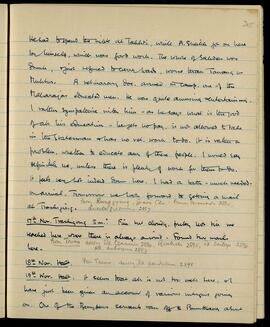
            He had to spend the night at Tahliti, while A. Sherriff got on here by himself, which was good work. The whole of Sakden was drunk, and just refused to carry loads, worse than Tawang or Muktur. A veterinary doc. arrived in camp, one of the Maharaja's educated men. He was quite amusing and entertaining. I rather sympathise with him - as he says what is the good of all his education - he gets no pay, is not allowed to take in the Statesman and has no vet. work to do. It is rather a problem, whether to educate any of these people. I would say definitely no, unless there is plenty of work for them to do. It feels very hot indeed down here. I had a bath - much needed - on arrival. Tomorrow we look forward to getting a mail at Trashigang. From Rungzyung, Samri Chu - Primula ceresoides 2865, Luculia gratissima 2867.

            17th Nov. Trashigang 8 m.? Fine but cloudy, pretty hot till we reached here where there is always a wind. Found two mail here. From Trimo sector Rh. tsariense 2894, R. wallichii 2895, Rh. baileyi 2896. Rh. arboreum 2893.

            18th Nov. Halt. From Trimo sector Rh. pendulum 2898.

            19th Nov. Halt. It seems that all is not too well here, and I have just been given an account of various intrigues going on. One of the Dzongpen's servants ran off to Bumthang about

            LSH/1/1/2/1/219 · Part · 1934-10-14
            Part of The Ludlow & Sherriff Collection

            SUMMARY:
            The author reports that missing mail appears irretrievable after a visit from the cheerful Dzongpon, and notes differing beliefs among companions about a mantra causing a Tibetan companion’s illness. On 15 October they travel to Rungzyung in persistent rain, carrying the ailing Tibetan by stretcher, while also listing several collected plants.

            CONTENT:
            lost mail is not to be found. I'm afraid it must be regarded as a complete loss, not to be traced anywhere. The Dzongpon was very cheerful and kind, though he took up a lot of our time, when we wanted to read our mail soon. But he's a good soul. The poor Tibetan is in a bad way again. He has quite recovered from the original abscess in the shoulder, but now has an even worse one near the artery in the thigh. We will carry him by stretcher with us and hope the thing will come to a head soon. Poor man he has had a rotten time. He says, as usual, that someone has put a mantra on him and is rather fatalistic. Purbo & Co rather favour that idea. They all believe in it, even Pinto, educated though he is.

            Trashigang
            Strobilanthes glutinosus 1061
            Leptodermis 1062
            " steppiana 1063
            Oxyspora paniculata 1064
            Daphne Shillong 1065

            15th October. To RUNGZYUNG. 8 m. 4050'. Rained all day. The foul weather has again come just as we start up to a collecting area, as usual. Carried the Tibetan on a stretcher, much to the locals' astonishment. His new abscess will I think come to a head tomorrow evening. It's pretty bad now. The air is simply soaking wet here - all day, in or out

            LSH/1/1/2/1/25 · Part · 1924-06-23
            Part of The Ludlow & Sherriff Collection

            SUMMARY:
            Notes describe an old dzong near a suspension bridge with traces of fortifications, said to be the oldest after Paro’s destruction, with the dzongpen planning repairs. The party marches to Rungzyung along the left bank of the Gamri Chu through hot conditions, noting conifer woodland, multiple bridges, and some rice cultivation.

            CONTENT:
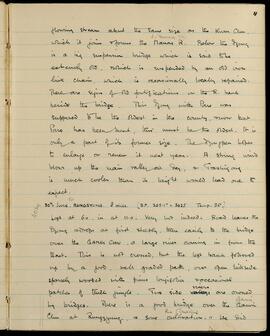
            flowing stream about the same size as the Kuru Chu, which it joins and forms the Manas R. Below the dzong is a big suspension bridge which is said to be extremely old, which is suspended by an old iron link chain, which is occasionally locally repaired. There are signs of old fortifications on the right bank beside the bridge. This dzong with Paro was supposed to be the oldest in the country, and now that Paro has been burnt, this must be the oldest. It is only a part of its former size. The dzongpen hopes to enlarge or renew it next year. A strong wind blows up the main valley all day, and Trashigong is much cooler than its height would lead one to expect.

            To 30th June. RUNGZYUNG. 8 miles. (B.P. 205.1" = 3625' Temp. 85°.)

            Left at 6.0, in at 11.0. Very hot indeed. Road leaves the dzong and drops at first steeply, then easily to the bridge over the GAMRI CHU, a large river coming in from the East. This is not crossed, but the left bank followed up by a good, well graded path, over open hillside sparsely wooded with Pinus longifolia and occasional patches of thick jungle. Two side river valleys are crossed by bridges. There is a good bridge over the Gamri Chu at Rungzyung, and some rice cultivation. We did

            LSH/1/1/2/1/217 · Part · 1934-10-13 - 1934-10-14
            Part of The Ludlow & Sherriff Collection

            SUMMARY:
            Notes places linked to Guru Rimpoche near Chunhara and records several flowering plants; camera shutter failed during three colour photos. On 13 October the party travelled to Trashigong Dzong via the Gamri Chu and Chahzam Bridge; film was sent to Kodak, and on 14 October they halted at Trashigong to pack specimens and prepare mail, with no word from Tobgye.

            CONTENT:
            Guru dapon Rimpoche
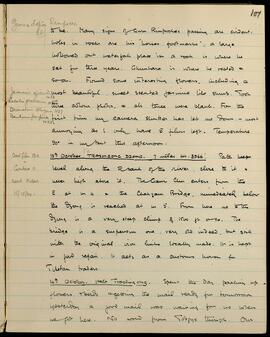
            to be. Many signs of Guru Rimpoche's passing are evident: holes in rocks are his "horse's footmarks"; a large hollowed out waterfall place in a rock is where he sat for three years. Chunhara is where he rested so soon. Found some interesting flowers, including a most beautiful, sweet-scented jasmine-like shrub. Took three colour photos, & all three were blank. For the first time my camera shutter has let me down — most annoying as I only have 5 films left. Temperature 90° in my tent this afternoon.

            Jasminum officinale 1058
            Luculia gratissima 1059
            Desmodium oblongum 1057
            Bauhinia purpurea 1055

            13th October. TO TRASHIGONG DZONG. 7 miles Ht. 3966'. Path keeps level along the R bank of the river, close to it, never high above it. The Gamri Chu enters from the E at m 4 & the Chahzam Bridge, immediately below the Dzong is reached at m 5. From here up to the Dzong is a very steep climb of 1500 ft or so. The bridge is a suspension one, very old indeed, but still with the original iron links locally made. It is kept in good repair. It acts as a customs house for Tibetan traders.

            One film 13c
            Contax II
            sent Kodak
            15/10/34.

            14th October. Halt Trashigong. Spent the day packing up flowers & birds & getting the mail ready for tomorrow. Yesterday a good mail was waiting for us when we got here. No word from Tobgye though. Our

            LSH/1/1/2/1/22 · Part · 1924-06-23
            Part of The Ludlow & Sherriff Collection

            SUMMARY:
            The party reached Trashigong on 29 June and proceeded east up the Gamri Chu valley to Sakteng, arriving in four stages by July 3rd. Most members, except Sherriff, the interpreter, the cook, and the diarist, fell ill with malaria; after taking quinine for about ten days they recovered enough to continue.

            CONTENT:
            His. 14. We reached Trashigong on 29 June & found ourselves in a dry part of the Manas Valley very much like that of the Mo Chu at Wangdi Phodrang. From Trashigong we branched off eastwards up the unexplored Gamri Chu valley to Sakteng, which we reached in 4 stages (July 3rd). Here a calamity befell us which appeared at one time as if it would wreck our plans. This was malaria. With the exception of Sherriff, our interpreter, the cook, and myself, the remainder of the party collapsed with malaria. We flew to the quinine bottle, and after about 10 days were sufficiently recovered to continue our journey.

            LSH/1/1/2/1/209 · Part · 1933-10-09
            Part of The Ludlow & Sherriff Collection

            SUMMARY:
            Kuship and Damong rejoined the party; Damong reported seed collections from the Mela and brought two gentians (Nos. 1001, 1002). The diarist treated a wounded Tibetan while moving him toward Sana hut, stayed in the Dzong, paid coolies, and noted rain overnight and fleas despite the building being relatively new.

            CONTENT:
            103

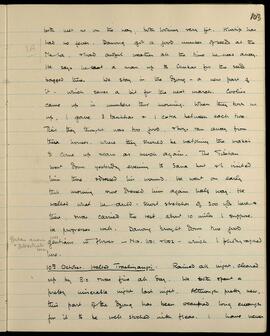
            both met us on the way, both looking very fit. Kuship has had no fever. Damong got a good number of seeds at the Mela, and had awful weather all the time he was away. He says he sent a man up to Chukas for the seed bagged there. We stay in the Dzong - a new part of it - which saves a bit for the next march. Coolies came up in numbers this morning. When they took us up, I gave 3 tankhas and 1 extra between each two. This they thought was too good, and boys ran away from their houses, where they should be watching the makki to come up and earn as much again. The Tibetan went down yesterday evening to Sana hut and I visited him there and dressed his wound. He went on early this morning and we dressed him again half way. He walked what he could - short stretches of 200 yards here and there, and was carried the rest, about 10 miles I suppose. He progresses well. Damong brought down two good gentians in flower - Nos. 1001 and 1002 - which I photographed here.

            (Gentiana amoena 1001 "silvostriata" 1002)

            10th October. Halted Trashiyangsi. Rained all night, cleared up by 8.0 and was fine all day. We both spent a pretty miserable night last night. Although pretty new, this part of the Dzong has been occupied long enough for it to be well stocked with fleas. I have never

            LSH/1/1/1/1/113 · Part · 1933-08-04
            Part of The Ludlow & Sherriff Collection

            SUMMARY:
            Camped near the Trashiyangsi river by the CHOTEN KORRA chorten, with locals preparing the site; routes planned to reach Shingbe in four days, near Me La, with a possible crossing to Singhi Dzong. On 29–30 July they halted at Trashiyangsi to arrange rations and dry bird skins (sent to Bumthang), while bridge repairs were ordered; on 31 July they moved toward Shapang.

            CONTENT:
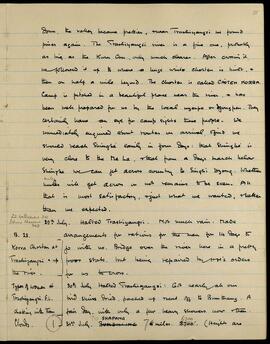
            Down, the valley became prettier, near Trashiyangsi we found pines again. The Trashiyangsi river is a fine one, probably as big as the Kuru Chu, only much clearer. After crossing it we followed it up to where a huge white chorten is built, & then on half a mile beyond. The chorten is called CHOTEN KORRA. Camp is pitched in a beautiful place near the river, & has been well prepared for us by the local nyerpa or dzongpen. They certainly have an eye for camp sites these people. We immediately enquired about routes on arrival, & find we should reach Shingbe easily in four days: that Shingbe is very close to the Me La, & that from a day's march below Shingbe we can get across country to Singhi Dzong. Whether mules will get across or not remains to be seen. All that is most satisfactory, & just what we wanted, & better than we expected.

            Lil wallichiana 341
            Schema khassiana 343
            29th July. Halted Trashiyangsi. Not much rain. Made arrangements for rations for the men for 14 days to go with us. Bridge over the river here in a pretty poor state, but being repaired by H.H.'s orders for us to cross.

            B. 23.
            Korra Chorten at Trashiyangsi & up the river.

            Types of women at Trashiyangsi. F.L. chatting with them
            30th July Halted Trashiyangsi: Got nearly all our bird skins dried, packed up & sent off to Bumthang. A fair day, with only a few heavy showers now & then.

            Clouds. (1)
            31st July. TO SHAPANG 7 1/2 miles. 6700'. (Heights are

            LSH/1/1/1/1/112 · Part · 1933-07-29 - 1933-08-04
            Part of The Ludlow & Sherriff Collection

            SUMMARY:
            Notes describe reaching Trashiyangsi and traveling north up the Kulong Chu River to the Me La on the Tibetan frontier, with dates in late July and early August. The page lists numerous bird species observed around Trashiyangsi with remarks on abundance and elevation, and includes specimen entries for Seicercus xanthoschistos (dated) and Molpastes cafer bengalensis.

            CONTENT:
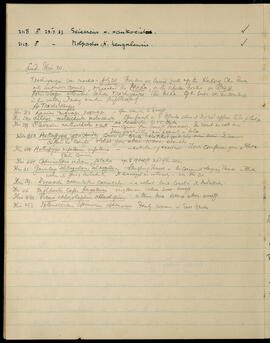
            2118 ♂ 29.7.33 Seicercus x. xanthoschistos.
            2119 ♂ - Molpastes c. bengalensis.

            Lud. Ibis 20.

            Trashiyangsi was reached on July 26. From here we turned north up the Kulong Chu River, into unknown country, & reached the Me La, on the Tibetan frontier, on Aug 4. Four stages intervene between Trashiyangsi & the Me La. Of the birds we encountered in the valley I may mention the following:
            At Trashiyangsi

            Ibis 283 Lanius nigriceps nigriceps - Open country to 6000ft.
            Ibis 284 Lalage melaschista melaschista. Open forests in E. Bhutan where it did not appear to be plentiful.
            Ibis 287. Seicercus xanthoschistos xanthoschistos - no records from W. & C. Bhutan. Common from 6000ft downwards. In scrub as well as in dense forest - the most frequent in Bhutan.
            Ibis 483 Aethopyga ignicauda. Common in Bhutan & S.E. Tibet south of the main axis. In deciduous & coniferous forests. In this zone above 10,000, etc etc.
            Ibis 484 Aethopyga nipalensis nipalensis - inhabitant of deciduous & lower coniferous zone in Bhutan. Quite common.
            Ibis 285. Caprimulgus indicus jotaka. up to 9000ft. Not often seen.
            Ibis 31. Garrulax albogularis albogularis. - Laughing Thrush - the commonest Laughing Thrush in Bhutan within its zone of distribution. It occurs in colonies - see Ibis 31.
            Ibis 29. Dryonastes caerulatus caerulatus - a silent bird local in its distribution.
            Ibis 46. Molpastes cafer bengalensis very common below 5000-6000ft.
            Ibis 485. Picus chlorolophus chlorolophus a tame bird scarce above 4000ft.
            Ibis 493 Sphenocercus sphenurus sphenurus Fairly common in East Bhutan.