Zone d'identification
Cote
Titre
Date(s)
- 1924-06-23 (Production)
Niveau de description
Étendue matérielle et support
1 page
Zone du contexte
Nom du producteur
Histoire archivistique
Source immédiate d'acquisition ou de transfert
Zone du contenu et de la structure
Portée et contenu
SUMMARY:
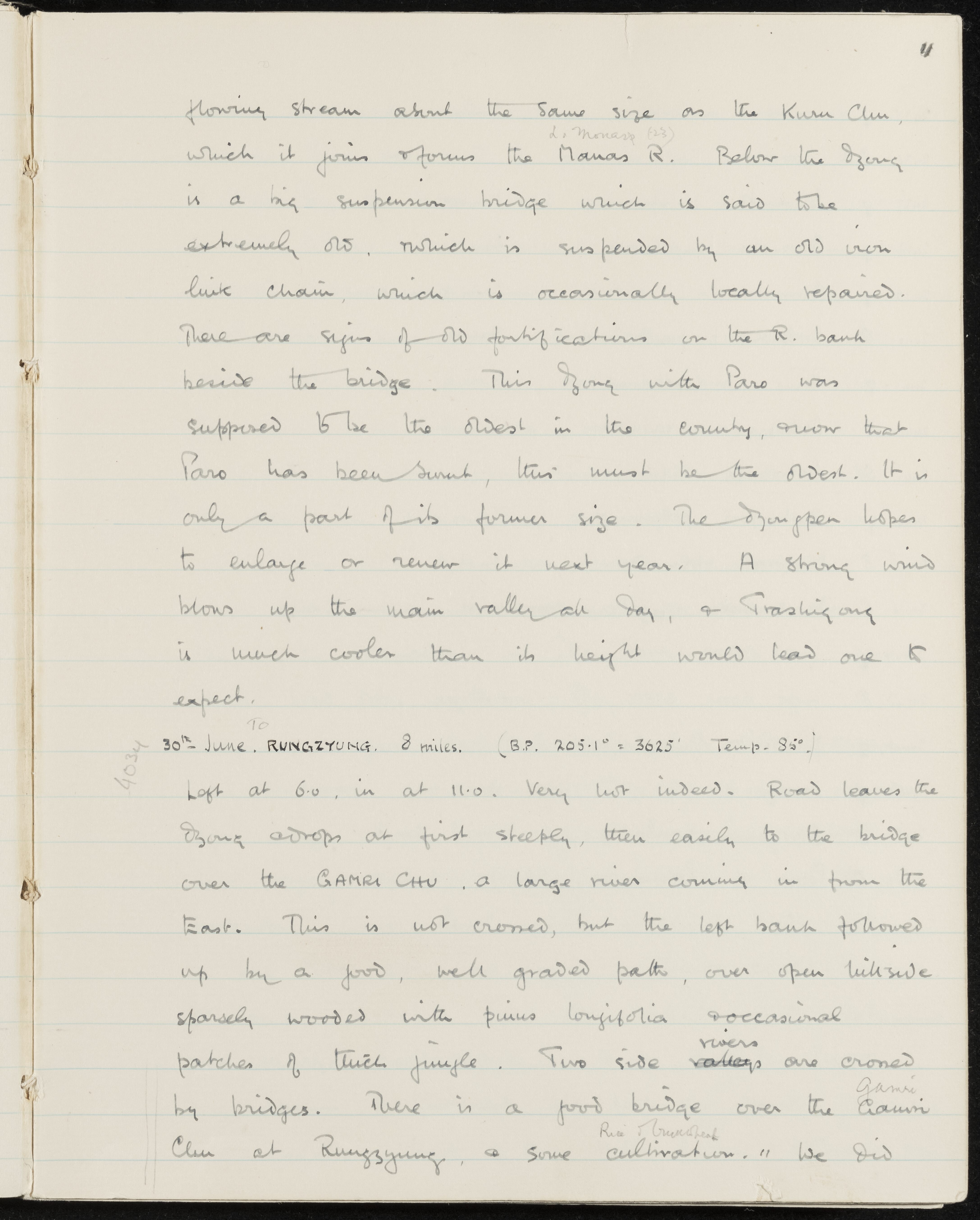
Notes describe an old dzong near a suspension bridge with traces of fortifications, said to be the oldest after Paro’s destruction, with the dzongpen planning repairs. The party marches to Rungzyung along the left bank of the Gamri Chu through hot conditions, noting conifer woodland, multiple bridges, and some rice cultivation.
CONTENT:
flowing stream about the same size as the Kuru Chu, which it joins and forms the Manas R. Below the dzong is a big suspension bridge which is said to be extremely old, which is suspended by an old iron link chain, which is occasionally locally repaired. There are signs of old fortifications on the right bank beside the bridge. This dzong with Paro was supposed to be the oldest in the country, and now that Paro has been burnt, this must be the oldest. It is only a part of its former size. The dzongpen hopes to enlarge or renew it next year. A strong wind blows up the main valley all day, and Trashigong is much cooler than its height would lead one to expect.
To 30th June. RUNGZYUNG. 8 miles. (B.P. 205.1" = 3625' Temp. 85°.)
Left at 6.0, in at 11.0. Very hot indeed. Road leaves the dzong and drops at first steeply, then easily to the bridge over the GAMRI CHU, a large river coming in from the East. This is not crossed, but the left bank followed up by a good, well graded path, over open hillside sparsely wooded with Pinus longifolia and occasional patches of thick jungle. Two side river valleys are crossed by bridges. There is a good bridge over the Gamri Chu at Rungzyung, and some rice cultivation. We did
Évaluation, élimination et calendrier de conservation
Accroissements
Mode de classement
Zone des conditions d'accès et d'utilisation
Conditions d'accès
Conditions de reproduction
Langue des documents
Écriture des documents
Notes de langue et graphie
Caractéristiques matérielle et contraintes techniques
Instruments de recherche
Zone des sources complémentaires
Existence et lieu de conservation des originaux
Existence et lieu de conservation des copies
Unités de description associées
Zone des notes
Identifiant(s) alternatif(s)
Mots-clés
Mots-clés - Sujets
Mots-clés - Lieux
Mots-clés - Noms
- Dzongpen (Sujet)
- pinus longifolia (Sujet)