Bhutan

Elements area

Taxonomy

Code

Scope note(s)

    Source note(s)

      Display note(s)

        Hierarchical terms

        Bhutan

        Equivalent terms

        Bhutan

          Associated terms

          Bhutan

            419 Archival description results for Bhutan

            419 results directly related Exclude narrower terms
            LSH/1/1/10/1/43 · Part · 1933-10-10
            Part of The Ludlow & Sherriff Collection

            SUMMARY:
            Travel from Chumpithang to Karponang and then on to Kalimpong in fine but cold weather, with extensive seed collecting including Meconopsis superba and Gentiana depressa. Transport was arranged at Rinchengang for Danang and Tseringpen; Betty was met near Gangtok before reaching Kalimpong, where coolies were paid off and a lorry arranged. Plants were later sent by air from Calcutta via BOAC.

            CONTENT:
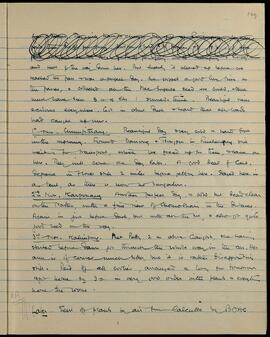
            and most of the way down here. But luckily it cleared up before we reached the pass and was a perfect day. We stopped a good long time on the passes, and collected all the Meconopsis superba seed we could, there must have been 3 or 4 lbs I should think. Beautiful views of clouds everywhere. Got in about dusk and heard that all loads had caught up now.

            1st Nov. Chumpithang. Beautiful day, very cold and hard frost in the morning. Found Danang and Tseringpen in Rinchengang still waiting for transport, which we fixed up for them, and came on here. They will come one day later. A good deal of Gentiana depressa in flower still 2 miles before getting here. Stayed here in a tent, as there is now no bungalow.

            2nd Nov. Karponang. Another perfect day, and cold but dead clear on the Natu, with a fine view of Chomolhari in the distance. Again in just before dusk, but with all the kit, and also got quite good seed on the way.

            3rd Nov. Kalimpong. Met Betty 2 miles above Gangtok, she having started before dawn for through the whole way in the car. Her arm is of course much better, but it is rather disappointing still. Paid off all coolies, arranged a lorry for tomorrow and got home by 3:00 in very good order with plants and everything none the worse.

            Later. Sent off plants by air from Calcutta by BOAC.
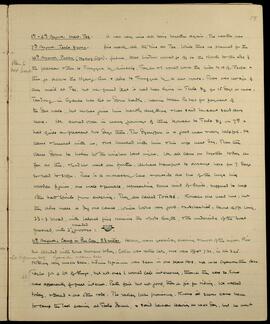
            LSH/1/1/6/1/117 · Part · 1933-07-27
            Part of The Ludlow & Sherriff Collection

            SUMMARY:
            The party halted at Tse, planned routes with Ludlow going north toward the plateau and then to Trongsa, while Taylor and the diarist would work NW of Tsela and cross the Nyang Chu to reach Trongsa by a new route. They found delayed mail at Tsela Dz, traveled by coracle to Tsela Dzong, and then on to Puchu (Nyang Chu); there was a dispute with Tendong in Gyantse over dak payments, cordial visits with the Dzongpon and his wife, and Sherriff visited to hear the wireless, after which Ludlow went on ahead while transport was arranged.

            CONTENT:
            58

            1st - 6th August. Halt. Tse.
            It was very nice all being together again. The weather was fine nearly all the time at Tse. While there we planned for the future, that Ludlow would go off to the North to the edge of the plateau then to Trongsa by himself. Taylor and I would work the hills NW of Tsela and then go across the Nyang Chu and also to Trongsa by a new route. There was no sign of any mail at Tse, but we found that it had been lying in Tsela Dz for 15 days or more.

            7th August. Tsela Dzong.

            10th August. Puchu (Nyang Chu).
            Plans for next month.
            Tendong in Gyantse has let us down badly, having taken Rs 240 for payment of the dak wala, but he has given him hardly anything and has said he cannot send any more. We came over in many journeys of three coracles to Tsela Dz on 7th and had quite a pleasant two days there. The Dzongpon is a good man and very helpful. He came and lunched with us, and we lunched with him and his wife next day. Then Sherriff came down to listen to the wireless last night. We all came on together today as far as this, then Ludlow went on further. We have transport to arrange here for 7 days so had to stop. There is a monastery here and outside are two of the huge big wooden figures, one male and female, representing

            LSH/1/1/1/1/93 · Part · 1933-11-02
            Part of The Ludlow & Sherriff Collection
            • SUMMARY:
              The party took group photographs in Sikkim clothes, then visited the Dzong for tea and saffron rice with H.H., following a pleasant lunch the previous day. After farewell exchanges and gifts from Ashe Paldan Wangmo and Ashe Wangmo, they departed, with Tobgye and Dorji accompanying them over the river toward the Bada La.

            CONTENT:
            44

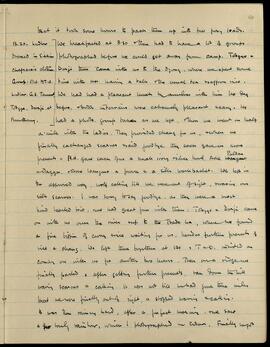
            that it took some hours to pack them up into two pony loads.

            B. 20. Ludlow

            • We breakfasted at 8.30 then had to have a lot of groups
              dressed in Sikkim
            • photographed before we could get away from camp. Tobgye and
              chaprasis clothes.
            • Dorji then came into us to the Dzong, where we spent some
              Group: F.W. H.W.
            • time with H.H. having a talk and the usual tea and saffron rice.
              Ludlow. G.S. Tenzing
            • We had had a pleasant lunch by ourselves with him the day
              Tobgye, Dorji at
            • before, and both interviews were extremely pleasant and easy. He
              Bumthang.
            • had a photo group taken as we left, and then we went on half
              a mile with the ladies. They provided chang for us, and when we
              finally exchanged scarves and said goodbye, they each gave us more
              presents — H.H. gave each of us a small ivory and silver bowl, Ashe Paldan Wangmo
              a dagger, Ashe Wangmo a purse and a silk workbasket. We left in
              the approved way, wolf calling till we were out of sight, waving our
              silk scarves. I was sorry to say goodbye, as they were a most
              kind hearted trio, and we had great fun with them. Tobgye and Dorji came
              on with us over the river and up to the Bada La, where we found
              a fine tiffin of
            LSH/1/1/8/1/89 · Part · 1938-04-09
            Part of The Ludlow & Sherriff Collection

            SUMMARY:
            Entries describe travel from Dzong with snow conditions and a stay at Latsa, reports that Ludlow and Elliot spent 24 days shooting waterfowl, and notes of increased rain in the Tsangpo valley pleasing the Tsala Dzongpon. After halts and cold weather, Ludlow and Elliot depart on the 18th with Lepchas, Ramzana, and Balbahadur, while Samdup and Kancha remain with the diarist. On the 20th at Tse, the river level and wind patterns are observed, and a brief botanical note records rhododendrons in flower.

            CONTENT:
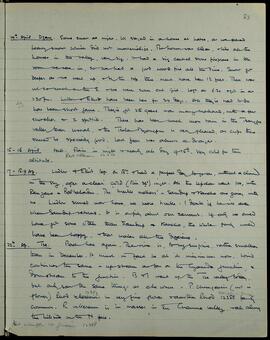
            14th April. Dzong. Some snow at night. We stayed in a house at Latsa, as we feared heavy snow which did not materialize. The house was clean, like all the houses in the valley, very big. It had a big central stone fireplace in the room we were in, so we had a good wood fire all the time. Snow got deeper as we went up over the top; there must have been 1 1/2 feet. There was not so much on the S. & we were soon out of it. Left at 6.30 & got in at 1.30 pm. Ludlow & Elliot have been here for 24 days. All they've had to do has been shoot game. They've got 25 geese & as many mallard, with a few shoveller & 2 spotbill. There has been much more rain in the Tsangpo valley than usual, & the Tsala Dzongpon is very pleased, as crops there should be specially good. Last year was almost a drought.

            15-16 April. Halt. Rain in night & nearly all day of 15th. Very cold for this altitude.

            17-18-19 Ap. Ludlow & Elliot left on 18th & had a perfect day to go on, without a cloud in the sky, after a clear cold (min 24°) night. All the Lepchas went too, with Ramzana & Balbahadur. The 'trouble makers' - Samdup & Kancha are going with me. Ludlow should now have no more trouble: I doubt if he will even when Samdup returns. It is a pity about our servants. If only we could have got some other than Samdup & Kancha, the whole party would have been happy, that makes all the difference.

            20th Ap. Tse. Back here again. The river is, to my surprise, rather smaller than in December. It must in fact be at its minimum now. Wind continues the same - upstream as far as the Gyamda junction, & downstream to the junction. B & I went up the Tse valley today, but only saw the same things as elsewhere. P. chungensis (not in flower) Rhod. vellereum 12393 in very fine flower & another Rhod 12388 fairly common. R. vellereum is in masses in the Gyamda valley, & all along the hillside on the N face.

            LSH/1/1/1/1/195 · Part · 1933-09-14
            Part of The Ludlow & Sherriff Collection

            SUMMARY:
            The diarist plans a future journey from Nangartse east down the Brahmaputra, notes being asked to show a passport for the first time, and declines a proposed double march over the Karo La. On 14th September they reach Dzara (14 miles, 15,400 ft), admire views of the Dzong and Nangartse, note the peak Nodzinkantsa, film bar-headed geese, and collect several birds including Himalayan black birds.

            CONTENT:
            96

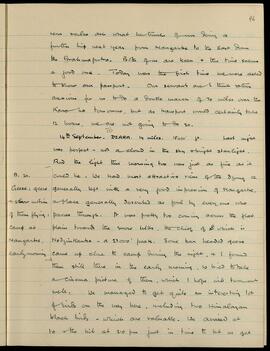
            news and also ask what he thinks of our doing a further trip next year from Nangartse to the East down the Brahmaputra. Both of us are keen and the time seems a good one. Today was the first time we were asked to show our passport. Our servants are I think rather anxious for us to do a double march of 30 miles over the Karo La tomorrow, but as transport would certainly take 12 hours, we are not going to do so.

            14th September. DZARA. 14 miles. 15400 ft. Last night was perfect - not a cloud in the sky and bright starlight. And the light this morning too was just as fine as it could be. We had most attractive views of the Dzong and Nangartse, a place generally described as foul by everyone who passes through. It was pretty too coming across the flat plain towards the snow hills, the chief of which is Nodzinkantsa - a 23000' peak. Some bar headed geese came up close to camp during the night, and I found them still there in the early morning, so tried to take a cinema picture of them, which I hope will turn out well. We managed to get quite an interesting lot of birds on the way here, including two Himalayan black birds - which are valuable. We arrived at 1.0 and the kit at 2.0 pm just in time to let us get

            [Marginal notes:]
            B. 31.
            geese generally left with a very good impression of Nangartse,
            a slow motion of them flying:
            Camp at Nangartse, early morning

            LSH/1/1/9/1/104 · Part · 1949-07-12
            Part of The Ludlow & Sherriff Collection

            SUMMARY:
            At Dur Chutsen on the Mangde Chu, the diarist met Ludlow and identified his Meconopsis as Meconopsis sherriffii, noting abundant Androsace globifera. A letter reported Betty’s injury, requiring travel to Calcutta and forcing a return to Bumthang before proceeding to Ripong; the next day was a halt during which Dorong returned with a large haul, noted as more effective than Pasang and Gunden.

            CONTENT:
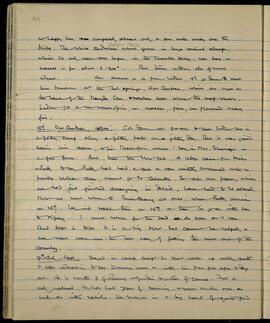
            so happy here, completely absent only a few miles away over the divide. The white Androsace globifera which grows in huge vertical clumps, which I've only seen once before, in the Chachhu Valley, was here in masses - for about 200-300'. But there's nothing else of much interest. An answer is in from Ludlow, so go down to meet him tomorrow at the hot springs, Dur Chutsen, which are right on the bank of the Mangde Chu, somewhere near where the map shows. Ludlow got a new Meconopsis, in masses, pink, one flowered very fine.

            18th - Dur Chutsen 10800'. Got down at 9:00 am to meet Ludlow in a filthy camp, along a filthy path on a filthy day. But it was grand seeing him again, and his Meconopsis, which I see is Meconopsis sherriffii in a fine form. But then the blow fell. A letter came for Hicks and Betty, to say Betty had had a fall and was mildly concussed with a possible broken arm, must go to Calcutta. So all our plans, which we had just finished arranging in detail, have had to be altered. Now we must return to Bumthang at once, where Betty arrives on the 26th. We will reach there on the 25th and then go on with her to Ripong. I must return for the seed as soon as I can. And that is that. It is a big blow, but cannot be helped, and we must work out the best way of getting the most out of the country.

            19th July Halt. Stayed in camp, except for short walks up muddy paths. It was interesting to see Dorong come in with his press full after 2 days out. He is worth 3 of Pasang and Gunden together of course. That is only natural. He has had years of training, and years on his own as well as with sahibs. He brought in a big haul of quite good

            LSH/1/1/5/1/119 · Part · 1870-03-15
            Part of The Ludlow & Sherriff Collection

            SUMMARY:
            Notes from Dungshinggang describe abundant Primula species, comparisons to a specimen from Bimbi La, and a sighting of Primula waddellii. The author records clear morning views of the Himalayas including Chomolhari and the Kangchenjunga group, with later heavy rain, and remarks on plentiful monal.

            CONTENT:
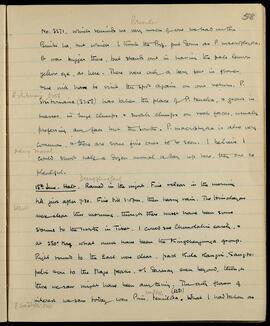
            58
            Primulas

            No. 3271, which reminds me very much of one we had on the Bimbi La, but which I think the Prof. put down as P. macrophylla. It was bigger there, but stands out in having the pale lemon yellow eye, as here. There were only a very few in flower, one will have to visit the spot again on our return.

            P. shitoriana (3258) has taken the place of P. tenella, & grows in masses, in huge clumps & small clumps on rock faces, usually preferring any face but the south. P. macrophylla is also very common, & there are some fine ones to be seen. I believe I could shoot half a dozen monal a day up here, they are so plentiful.

            Dungshinggang
            18th June. Halt. Rained in the night. Fine & clear in the morning till just after 7.30. Fine till 1.0pm, then heavy rain. The Himalayas were clear this morning, though there must have been some storms to the north in Tibet. I could see Chomolhari easily, & at 280° Mag what must have been the Kangchenjunga group. Right round to the East was clear, past Kula Kangri, Sangto-pelri down to the Mago peaks, or dare say even beyond, though those we saw might have been anything. The only thing of interest we saw today was Prim. waddellii (3281). What I had taken as

            GB 235 HJH · Collection · 1949 - 1972

            •1 box of miscellaneous papers and glass plate negatives regarding Bhutan, 1949, also 3 reels of film, now converted to DVD:

            • Diary Materials 1, 1949
            • Diary Materials 2, 1949
            • Transcript of Diaries by David Shepherd - not for reproduction
            • letters, mainly from George and Betty Sherriff, Frank Ludlow and David Humphreys
            • Christmas cards, mainly from George and Betty Sherriff and Frank Ludlow, usually illustrated with photographs or Margaret Stones illustrations
            • small box of 12 glass lantern transparencies, mostly plant portraits - tape around slides very brittle; annotations in danger of being lost, so handle with extreme care
            • cine film x 3 - converted to dvd
            • 'misc' folder; contains LSH seed lists 1949 documents and key to the cine film
            • newspaper cuttings - mostly relating to Bhutan
            • 'misc' publications - mostly relating to Bhutan, some by Frank Ludlow
            Hicks, John Herbert
            LSH/1/1/2/1/125 · Part · 1933-07-18
            Part of The Ludlow & Sherriff Collection

            SUMMARY:
            After descending about 1000 ft and collecting butterflies, the party reached Dongkar where a load fell off a bridge; Purbo later recovered the tent two miles downstream after nearly drowning. They enjoyed fine views and a garden-like camp, noted abundant Delphinium grandiflora and borage, observed Ramzana’s meagre condition after fever at Tsuna, and outlined transport changes from Bhutan via Mago toward the Cho La and Shingbe.

            CONTENT:
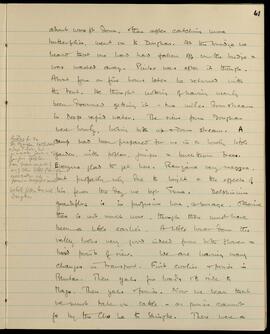
            about 1000 ft down, then after catching more butterflies, went on to Dongkar. At the bridge we heard that one load had fallen off on the bridge and was washed away. Purbo was after it though. About four or five hours later he returned with the tent. He thought nothing of having nearly been drowned getting it - two miles downstream in deep rapid water. The views from Dongkar were lovely, looking both up and down stream. A camp had been prepared for us in a lovely little "garden", with poplar, juniper and buckthorn trees. Everyone glad to get here. Ramzana very meagre, but probably only due to height and the effects of his fever the day we left Tsuna. Delphinium grandiflora is in profusion here, and borage. Otherwise there is not much now, though there must have been a little earlier. A little lower down the valley looks very good indeed from both flower and bird points of view. We are having many changes in transport. First coolies and ponies in Bhutan. Then yaks for loads and to ride to Mago. Then yaks and ponies. Now we hear that we must take on cattle - as ponies cannot go by the Cho La to Shingbe. There were a

            [Marginal notes:]
            Ludlow p. 92
            D. grandiflorum has produced a large and blue flower in a water garden in a garden from Bhutan.
            From grass carpets with blue Delphinium flowers, wild aster etc. form a delightful sward.
            We both fell in love with Dongkar.

            LSH/1/1/5/1/174 · Part · 1933-07-21
            Part of The Ludlow & Sherriff Collection

            SUMMARY:
            The diarist reviews profit estimates for Bhutan based on Bakewell’s calculations and rejects small extraction offers, then receives numerous presents from H.H. before departing Domkhar, with Naku accompanying toward the Yuto La. The party marches in hot weather to Trongsa and then Tsanka, meets the Zimpon of Trongsa, and notes local magpies called OLA BOGA.

            CONTENT:
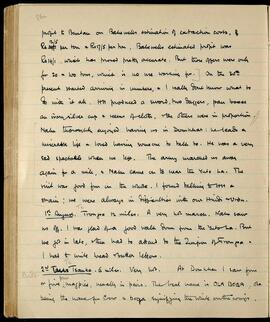
            profit to Buntan on Bakewell's estimation of extraction costs, and Rs 12/5 per ton and Rs 17/5 per ton. Bakewell's estimated profit was Rs 14/1, which has proved pretty accurate. But these offers were only for 20 or 100 tons, which is no use working for. On the 30th presents started arriving in numbers, and I really don't know what to do with it all. H.H. produced a sword, two daggers, pan boxes, an ivory silver cup and reams of cloth, the others were in proportion. Naku thoroughly enjoyed having us in Domkhar: he leads a miserable life and loved having someone to talk to. He was a very sad spectacle when we left. The army marched us away again for a mile, and Naku came on to near the Yuto La. The visit was good fun on the whole. I found talking to him a strain; we were always in difficulties with our Hindi and Urdu.

            1st August. To Trongsa 12 miles. A very hot march. Naku saw us off. I was glad of a good walk down from the Yuto La. But we got in late, then had to attend to the Zimpon of Trongsa. I had to write bread and butter letters.

            2nd To Tsanka. 6 miles. Very hot. At Domkhar I saw four or five pairs of magpies, usually in pairs. The local name is OLA BOGA, ola being the name for crow and boga signifying the white on the wings.