Bhutan

Elements area

Taxonomy

Code

Scope note(s)

    Source note(s)

      Display note(s)

        Hierarchical terms

        Bhutan

        Equivalent terms

        Bhutan

          Associated terms

          Bhutan

            419 Archival description results for Bhutan

            419 results directly related Exclude narrower terms
            LSH/1/1/3/3/180 · Part · 1983-05-05
            Part of The Ludlow & Sherriff Collection

            SUMMARY:
            Notes describe separating from Sherriff at Tsari, with the main camp at Lung in the Chayal Valley while Lumsden and the author travel via Bimbi La into the Tsangpo drainage toward Pachakshiri. Bird observations include Chinese Parakeets at Kyimdong Dzong and a Three-toed Woodpecker on the northern slopes of the Lo La, and plant collections are listed for Migyitun on June 10–11.

            CONTENT:
            Sketch. Lumsden Route

            Ludlow Ibis 47. Tsari was a paradise for flowers but the ban on shooting was an insurmountable obstacle to ornithological work, so we decided to separate. Sherriff remained behind to work the Tsari valley. The main camp in the Chayal Valley at Lung, whilst Lumsden & I set out for Pachakshiri.
            (NB. Separation on June 12th)
            The crossing of the Bimbi La brought us for the first time within the drainage of the Tsangpo. At Kyimdong Dzong (June 15) we found the Chinese Parakeet (Psittacula derbyana) in large flocks in the barley fields. From here we crossed the Lang La (15,500) to Molo, where we turned south into the Pachakshiri district. Crossing the Himalayan range by the Lo La (13,300) on the northern slopes of the Lo La (June 27) we obtained a Three-toed Woodpecker (Picoides tridactylus funebris) in Silver-fir forest and is characteristic of the forests of SW. China.
            Psittacula derbyana see Lud. Ibis 371.
            Picoides tridactylus funebris see Lud. Ibis 369 Bimbi La

            10th June Migyitun. Lonicera cyanocarpa var. porphyrantha 2101 Migyitun
            Mag. globosa 2102. Clematis montana var. wilsonii 2103,
            Streptopus simplex 2104. Iris chrysographes 2105
            Prun. aspec. var. alba 2106. Sax. brunoniana 2107
            Rh. micromeres 2108. Rho. trichocladum 2109 Bimbi La
            Mec. betonicifolia 2110. Mec. panic. 2111 11th
            P. macrophylla macrophylla 2112
            Cawdoriana 2113
            Sikkimensis form 2119
            asperula 2120
            Yargongensis 2122

            LSH/1/1/1/1/164 · Part · 1933-09-24
            Part of The Ludlow & Sherriff Collection

            SUMMARY:
            Notes describe the junction of two rivers near Luntse below Tang forming the Kuru Chu River and a long, impassable gorge cutting through the main Himalayan range. The writer remarks this prevents a direct outlet from Tibet to Bhutan without crossing a Himalayan pass. Ludlow reports only common birds observed, with nothing of particular interest.

            CONTENT:
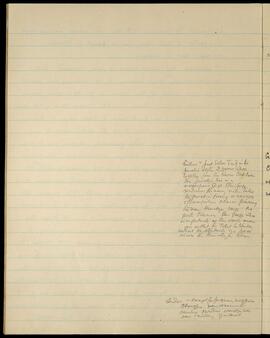
            "Luntse" just below Tang is the junction of the 2 rivers which together form the Kuru Chu River. The junction lies in a magnificent gorge. This gorge continues for many miles below the junction forming a narrow & precipitous chasm piercing the main Himalayan range. No path traverses this gorge which is unfortunate as this would mean an outlet for Tibet to Bhutan without the obstacle of a pass across the Himalayan chain.

            Ludlow - except for pigeons, magpies Choughs & an occasional bunting or willow warbler, we saw nothing of interest.

            LSH/1/1/2/1/85 · Part · 1933-07-18
            Part of The Ludlow & Sherriff Collection

            SUMMARY:
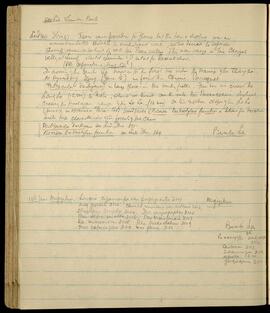
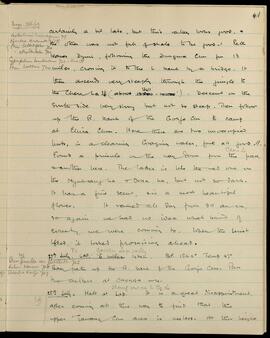
            From Dyuri the party followed the Dungma Chu, crossed to the left bank, ascended steeply to the Chera La, then descended to follow the Gorjo Chu and camped at Chira Chum, collecting several plants en route. They continued to Lap in the Gorchu Lap Valley, halted there while Sherriff went over the Bo La, and noted disappointment with the upper Tawang Chu area.

            CONTENT:
            41

            Mago - 26th July
            Notholirion bulbuliferum 717
            Spiraea arcuata 718
            Prim. bellidifolia 719
            " atrodentata 721
            Cypripedium himalaicum 722 - Himalayan
            Prim. waltonii 724

            Certainly a bit late, but this valley looks good. The other was too full of shale to be good. Path leaves Dyuri, following the Dungma Chu for 1½ miles, crossing it to the L. bank by a bridge. It then ascends very steeply through the jungle to the Chera La 3½ (about 13,411'). Descent on the south side very stony but not so steep. Then follow up the R. bank of the Gorjo Chu to camp at Chira Chum. Here there are two unoccupied huts, in a clearing. Grazing, water, fuel all good. Found a primula on the way down from the pass (Chera La), & another here. The latter is like the red one on the Nyuksang La or Orka La, but not so dark. It has a fine scent, & is a most beautiful flower. It rained all day from 9.0 am on, so again we had no idea what kind of country we were coming to. When the mist lifted, it looked promising ahead.

            27th July. To LAP. Gorchu Lap Valley. 6 miles. 14,342'. B.P. 186.6° Temp 47°
            196
            Prim. pusilla var. flabellata 725
            Lilium nanum 726
            Swertia kingii 727
            Ran path up the R. bank of the Gorjo Chu. Pass two shelters at Chumba.

            28th July. Halt at Lap. Sherriff went over the Bo La.
            NB
            It is a great disappointment, after coming all this way to find that this upper Tawang Chu area is useless. At this height...

            LSH/1/1/10/1/17 · Part · 1933-10-05 - 1933-10-01
            Part of The Ludlow & Sherriff Collection

            SUMMARY:
            The diarist receives letters from Betty and outlines plans: Hicks will arrive in Bumthang on 5 Oct, they hope to leave about the 13th and reach Tashigang on 3 Nov; the party will include Ludlow, the diarist, Betty, Virginia, Tess, and Tasho. Entries for 30 September at Pangotang and 1 October at Tolegang note wet weather, seed collecting (including Primula umbratilis), Pasang and Mundru’s work continuing until 17 October, a visit from the Sokpon who received gifts, and mail sent to HH for Kalimpong.

            CONTENT:
            To cheer me up today—I was feeling very miserable—a mail came in, with letters from Betty in Calcutta at last, and also from her in London. Nothing from HH at all for the first time when a mail has been sent. Hicks confirms that he will arrive in Bumthang on 5th Oct. So we should be able to leave on 13th about, and reach Tashigang on 3 Nov. Ludlow has got a passage, Betty says, and also she and I, Virginia, Tess, and Tasho. So we should have a good time, 6 of us from Bhutan.

            30th September. Pangotang. It rained all night again, but was fine when Pasang and Mundru went off about 6:00 am. We were off just after them, and had a day half rain half fine, but no sun. It doesn't look yet like clearing up, but I do most sincerely hope it is fine now for four days. There is a lot to be got in Tolegang and quite a lot on the other side. After that it doesn't matter so much, except for Pasang and Mundru, whose work won't finish until 17 October. Primula umbratilis here is nearly ripe, and I got some seed, but the big Androsace is still green. This is our last of many halts in Pangotang. The Sokpon came to call and I gave him a little bottle of saffron and a torch, which is doing him very well. But we've been in his district for a long time now, ever since 23rd of May. Sent off a small mail to HH for Kalimpong. I shall only be able to send off one more after this, except for Ha.

            1st October. Tolegang. Fine till 10:00 then rain and snow off and on the rest of the day. We are camped about 14,000-14,500' and it is raw and chilly. We got some seed of Primula umbratilis, the very pale form which occurs here, and a few other things. But the Phlomis (19716) I particularly wanted, is still in flower; seeds are not nearly ripe. Neither are seeds of the interesting Gentian 19721. But I took roots of

            LSH/1/1/9/1/76 · Part · 1949-06-15
            Part of The Ludlow & Sherriff Collection

            SUMMARY:
            The writer reports finding P. caveana and, with Tundup’s collections, totals 27 gatherings, then receives mail including two lots from Kalimpong and letters from Betty, who has found P. jigmediana again. They comment on Hicks’ limited results with the camera, news that Bhutan’s treaty matters seem settled, car delivery news from Chris, and concern over the Paro Penlop’s worsening condition as H.H. cannot visit. On 15th June they halt in camp, send mail to Betty, Kalimpong, and H.H., note heavy showers, and remark on large butter consumption.

            CONTENT:
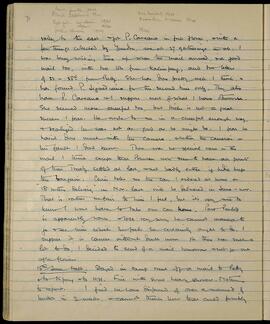
            Primula farinosa 19149
            Primula sapphirina 19147
            Meconopsis horridula 19136
            Cremanthodium decaisnei 19148
            Cypripedium himalaicum 19131
            Cypripedium elegans 19134
            Orchis chusua 19129
            19144

            valley to the east and found P. caveana in full flower, and with a few things collected by Tundup, we are 27 gatherings in all. I was busy writing these up when the mail arrived, and a good mail too, with two lots from Kalimpong, and two letters of 23rd - 28th from Betty. She has done pretty well I think, and has found P. jigmediana for the second time only. They also have P. caveana I suppose most of what I have otherwise. She seemed more cheerful too, but Hicks is not a great success I fear. He wrote to me in a cheerful enough way, and realized he was not as good as he might be. I fear he hasn't done much with the camera, whether the camera's or his fault I don't know. There was no special news in the mail I think except that Bhutan now seems to have all points of their Treaty settled at last, not badly either, if India keeps the bargain. Chris tells me the car I ordered at home on "18 months delivery" in Nov. last, will be delivered in June - now. That is rather unfair to him I feel, but it's very nice to know I won't have to take our car home. Paro Penlop is apparently worse, and H.H. very sorry he cannot manage to go and see him which he feels he certainly ought to do. I suppose it is cancer without doubt now. As there was such a lot to do, I decided to send off a mail tomorrow and not go out after flowers.

            15th June Halt. Stayed in camp and sent off a mail to Betty and to Kalimpong and to H.H. Fine with some heavy showers. Nothing to report. I find we have disposed of over a maund of butter in 3 weeks, and cannot think how that could possibly

            LSH/1/1/10/1/37 · Part · 1933-10-10
            Part of The Ludlow & Sherriff Collection

            SUMMARY:
            Expected malaria patients from Punakha did not appear, despite H.H.’s orders, leading to frustration and letters to H.H. and Tobsgye. On 20 Oct the party marched to Taluku, found the hut gone, noted a better camp at Nahila, and collected 47 bulbs of Lil. Wallichianum; on 21 Oct they reached Balimape, where the Zimpon was away in Ha.

            CONTENT:
            shrubs all the way down, but otherwise the place looks dry. We were to have had 40 malaria cases here waiting for us, from Punakha, whose blood Hicks was to make slides of to see what kind of malaria they all suffer from. H.H. ordered these men to be produced. But there was nothing here, all the Dzongpon said was "There is no fever in Punakha". If this is really so, which I very much doubt, then all our gift of 5000 Paludrine is being just thrown away now. I personally think there is a lot of fever, but that the Dzongpon is a fool who has not the energy to call in the sick people. I've written a stinker to H.H. & told Tobsgye all about it. We are both rather sick at this. It seems v. difficult to get anything done for these people. They say they want something done, but then won't do anything, when one tells them what to do.

            20th Oct. Taluku. A lovely day, with clouds in the morning, but clearing to the real cold weather dryness. This is an absurdly short march which I only arranged as there was a nice hut here, which would save trouble for the locals in making arrangements. But we got here to find the hut gone. That doesn't really matter as we have tents, but a much better camp would have been at Nahila, 4 miles on. We got 47 very fine bulbs of Lil. Wallichianum on the hillside across the valley here. Some are bigger than I have ever seen, but none has had more than 2 flowers on it, whereas in Kalimpong gardens they can have up to 5 flowers.

            21st Oct. Balimape. Again fine though mostly clouded. We got in by 2.0 but kit not till 4.0 - 5.0 pm. The Zimpon is away in Ha, so we are spared any trouble here in the way of conversation & entertainment. He is a pleasant man, but it makes things easier if he is not here.

            LSH/1/1/9/1/111 · Part · 1933-08-03
            Part of The Ludlow & Sherriff Collection

            SUMMARY:
            The writer recalls a 1933 arrival with Ludlow at Mangde Chu, aided by Tobgye with mules and beer, notes current finds including Lilium wallichianum and Codonopsis purpurea, and describes a clean bamboo house near Tongsa Dzong. On 4th August at Chendesi, in clear weather they collected many flowers, went via the Lamse La to find Primula hasecharis, and stayed in a bamboo house built two years earlier for H.H.’s visit to Ha.

            CONTENT:
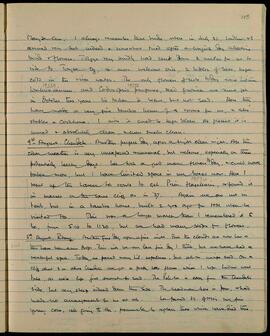
            108

            Mangde Chu. I always remember that bridge, where in July '33, Ludlow & I arrived very hot indeed & somewhat tired after a longish day collecting birds & flowers. Tobgye very kindly had sent down 2 mules for us to ride to Tongsa Dzong, & more welcome still, 2 bottles of beer, kept cold in the river water. The only flowers of note today were Lilium wallichianum (19559), and Codonopsis purpurea (19532), seed of which we must get in October this year. I've taken it before, but not seed. Here they have made a very fine bamboo house of 4 rooms for us, & also stables & cookhouse. I wish it could be kept clean. At present it is unused & absolutely clean, & even smells clean.

            4th August. Chendesi. Another perfect day, after a bright clear night. All this clear weather is very unexpected & unusual, but welcome, especially on these potentially leechy days. We took a good many flowers today, & could have taken more, but I have limited space in our boxes now. Here I went up the Lamse La route to get Primula hasecharis (19574), & found it in masses on the same cliff as in '37. Again we are not in tents, but in a bamboo house, built 2 years ago for H.H. when he visited Ha. This was a longer march than I remembered it to be, from 5

            LSH/1/1/6/1/25 · Part · 1938-03-31
            Part of The Ludlow & Sherriff Collection

            SUMMARY:
            The diary records marches from Lhapso Dzong to Lenda and then to Rabdang, with notes on weather, route conditions, and abundant vegetation including birch, pines, willows, walnuts, and bamboo, as well as sightings of Crossoptilon and snow cock. Transport was problematic, with shortages of coolies and poor paths, and Pintso had to remain behind.

            CONTENT:
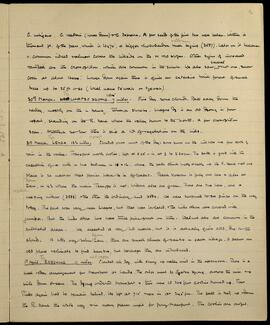
            G. nubigena, G. waltoni (lower down) and G. depressa. A few seeds of the first two were taken. Within a thousand feet of the pass, which is 16470', a bigger rhododendron vellereum bush begins (3587). Later on it becomes very common indeed and almost covers the hillside on the North and West slopes. Other signs of increased rainfall are the Crossoptilon, which are common in the shrubs. We also saw several other ones, snow cock at about 16000'. Lower down again there is quite an extensive birch forest of small trees up to 25 feet or so (local name kewah or tyewah).

            30th March. To LHAPSO DZONG. 11500' 7 miles. Fine day, some clouds. Path easy down the valley, mostly on the Left bank, through shrubs. Lhapso Dzong is an old dzong in poor repair, standing on the Right bank where the valley turns to the North. A few Crossoptilon seen. Although so low there is still a lot of vegetation on the hills.

            31st March. To LENDA. 11000' 13 1/2 miles. Clouded over most of the day; some snow on the hilltops and a few spots of rain in the valley. Transport mostly coolies; left at 6.45 - in at 2 to 2.30 pm. The path is good with the exception of a mile or two between miles 10 and 12, where the path climbs pretty steeply up the Right bank and at one place is so narrow that ponies have to be offloaded. Peach blossom is fully out here and also at Dzam, in 4 1/2 where the main Tsangpo is met. Willows also are green. There are two here, one a weeping willow (3593) and the other the ordinary kind 3594. We were surprised to see pines on the way today. The first was very near Lhapso, but that was isolated, and the hills above were covered with juniper. But the hills above here have thick pine forest on them. Walnuts also are common in the cultivated areas. We expected a very hot march, but it is actually quite cold, due to the clouds. A little way below Dzam, there are small clumps of bamboo in each village. It seems an odd place and climate to find bamboo, but perhaps they are introduced.

            1st April. To RABDANG alt 10800' 11 miles. Clouded all day, with strong up valley wind in the afternoon. There is a most rotten arrangement for transport at Lenda. The order went to Gyatsa Dzong, across the river and a mile down stream. The Dzong ordered transport and then there were 15 too few coolies turned up. Poor Pintso again had to remain behind. We left at 7.15 and were in at 2.45 pm. The path is bad, up and down the Right bank the whole way and in many places unfit for pony transport. The coolies are awful.