Bhutan

Elements area

Taxonomy

Code

Scope note(s)

    Source note(s)

      Display note(s)

        Hierarchical terms

        Bhutan

        Equivalent terms

        Bhutan

          Associated terms

          Bhutan

            419 Archival description results for Bhutan

            419 results directly related Exclude narrower terms
            LSH/1/1/1/1/105 · Part · 1933-06-25
            Part of The Ludlow & Sherriff Collection

            SUMMARY:
            Account of crossing the Kuru Chu, passing the Ngarigong Rapids, and making a very steep ascent to Lingitse with views of nearby villages and a good camp in hot weather; bridges proved challenging for ponies. L.D. collected seven bird skins, and the route on 25 July continues toward Donga Pemi, ascending a rough jungle ridge.

            CONTENT:
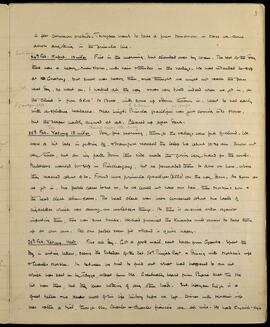
            57

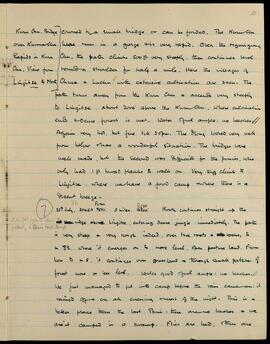
            Kuru Chu. Bridge Crossed by a small bridge or can be forded. The Kuru Chu
            over Khomachhu. Here runs in a gorge and is very rapid. Over the Ngarigong
            Rapids in Kuru Chu, the path climbs 500 ft very steeply, then continues level
            Chu. View from round a shoulder for half a mile. Here the villages of
            Lingitse to North Chusa and Luchu with extensive cultivation are seen. The
            path turns away from the Kuru Chu and ascends very steeply
            to Lingitse, about 3000' above the Kuru Chu, where cultivation
            ends and dense forest is met. Water and fuel ample: no leeches.//
            Again very hot, but fine till 3:00 pm. The Dzong looked very well
            from below and has a wonderful situation. The bridges were
            well made, but the second was difficult for the ponies, who
            only had 1 ft broad planks to walk on. Very stiff climb to
            Lingitse, where we have a good camp where there is a
            decent breeze.

            7
            L.D. got 7 bird skins including a Spine tail Swift
            To Pimi
            25th July. DONGA PEMI. 5 miles. 10800' Route continues straight up the
            ridge above Lingitse, entering dense jungle immediately. The path
            is very steep and very rough indeed, over tree roots and rocks, to
            m 3 1/2, where it emerges on
            LSH/1/1/6/1/7 · Part · 1938-06-06
            Part of The Ludlow & Sherriff Collection

            SUMMARY:
            The party marches from Kupup to Yatung over the Jelep La in heavy snow, with difficult mule transport and botanical notes on Primula gracilipes. In Yatung they deal with a customs issue over cigarettes, receive mail from Gyantse, trace missing kit sent from Ha, meet a Subedar, and dine with local contacts.

            CONTENT:
            ...a few common orchids. Tseringpen wants to take a press tomorrow, in case we come across anything in the primula line.

            24th Feb. Kupup. 13 miles. Fine in the morning, but clouded over by 10 am. The rest of the day there was a heavy snowstorm, with rain and thunder in the valleys. We had intended to stop at Gnatong, but snow was heavy then, and we thought we might not reach the pass next day, so went on. I walked all the way, and was very tired indeed when we got in, as the climb is from 6500' to 13000', with some up and down thrown in. Went to bed early with a splitting headache. Near Lingti Primula gracilipes was just coming into flower, but the scapes hardly showed at all. Cleared up after dark.

            25th Feb. Yatung 18 miles. Very fine morning, though the valleys were full of cloud. We were a bit late in getting off, and transport reached the Jelep La about 10.30 am. Snow not very much, but an icy path down this side made the going very hard for the mules. Muleteers wanted to stop in Rinchengang, but we persuaded them to come on here, where they reached about 4.30. Found more Primula gracilipes (3580) on the way down. As soon as we got in, two people came to see us, so we could not have our tea, then Norbhu's son and the head clerk also came. The head clerk was more concerned about two loads of cigarettes which were among our muleteers' things. As there is a strict order against importing them, there was some trouble. We had promised the Khampa mule owners to take these up as our own. All our people seem fit and David is quite happy.

            26th Feb. Yatung. Halt. Fine all day. Got a good mail, sent back from Gyantse. Spent the day in writing letters, seeing the Subedar of the Det. 1/15th Punjab Regt., and dining with Norbhu's wife and Charles Marbleu. In between we tried to find out what had happened to our kit which was sent on by tonga, that from Ha. Eventually heard from Phari that the Ha kit was there, but they knew nothing of any other loads. Sub. Maryam Singh is a great talker and we know most of his life history before we left. Dinner with Norbhu's wife was rather a trial, though she, Charles and Charles' fiancée are all nice. We had English-style

            LSH/1/1/9/1/24 · Part · 1949-04-21
            Part of The Ludlow & Sherriff Collection

            SUMMARY:
            The diarist reports persistent rain, a march near Kunzam with plant collecting including Albizia sherriffii seed, and a halt due to weather. News arrives that the Khoma Chu bridge below camp was destroyed, affecting Betty’s party, while rations were issued under H.H.’s orders and many sick parades occurred; later the party moves toward Pang Kha, with Betty and Hicks accompanying as far as Khoma before parting.

            CONTENT:
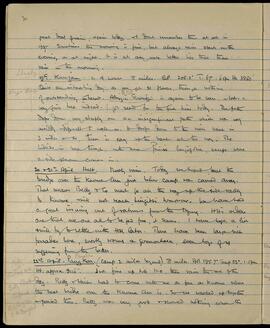
            great deal of rain, again today, I don't remember this at all in 1937. Sometimes the morning is fine, but always rain starts in the evening, or at night. It is at any rate better like that than rain in the morning.

            19th. Kunzam. c 4 hours 8 miles. B.P. 205.2° T. 67°. 6.0pm Ht 3850'
            Quite an interesting day, as we got 21 flowers, though nothing of outstanding interest. Albizia sherriffii is again to be seen, & looks a very fine tree indeed. I got seed for the first time today. The path drops down very steeply on an insignificant path which was very muddy & difficult to walk on. It drops down to the river bank in 3 miles or so, then is easy up the bank all the way. The hillside is bare though, with some Pinus longifolia, except where a side stream comes in.

            20 & 21st April. Halt. Mostly rain. Today we heard that the bridge over the Khoma Chu just below camp was carried away. That means Betty & Co must go all the way up the side valley to Khoma, & will not reach Lhuentse tomorrow. We have had a great issuing out of rations from the Dzong. H.H.'s orders are that we are all to be fed free, it seems. I have kept a list & will try to settle with H.H. later. There have been large sick parades here, mostly worms & gonorrhoea, even boys of 14 suffering from the latter.

            22nd April. Pang Kha. (Camp 2 miles beyond) 8 miles. B.P. 195.7° Temp 53°. 1.0pm Ht. approx. 9116'. Sun fine up till 11.0, then rain the rest of the day. Betty & Hicks had to come with me as far as Khoma where the next bridge over the Khoma Chu is. So we walked up together, & parted there. Betty was very good & showed nothing when the

            LSH/1/1/6/1/113 · Part · 1933-07-27
            Part of The Ludlow & Sherriff Collection

            SUMMARY:
            Field notes detail several Primula species around Kulu Pher Chu and plans with the Tsungpen to reach Lamdo over a high ridge en route to Tseladzong. A wet halt day included further plant observations on avalanche-swept slopes and concerns about mail and Shadu, followed by a cold, rain-soaked march to Lamdo (11 miles) with a guide who initially took the wrong spur.

            CONTENT:
            Kulu Pher Chu
            58
            Primula

            P. rhodochroa No. 5890, about 6 more flowers. P. capitata (subsp. crispata?) 5975 is common close to camp on the steep hillside. P. micropetala? (P. hesperidium) 5888 is also fairly common higher up. Then we found a few P. bellidifolia 5966 with flowers just over. Also what I at first took to be P. macrophylla, but which I think maybe P. sinopurpurea 5964. We saw a few seed specimens with two whorls of flowers. (P. kongboensis) 5970 I think might be P. petrocharis, but I don't know. P. muscoides, the violet form was just in flower still, 5971: and a fine form of P. jonardunii (P. dryadifolia) 5952, with all scapes 2-flowered was seen. Perhaps this is P. dryadifolia. The scapes held the flowers clear of the leaves which were bigger than usual. Saxifrages abound, over from a good many. This was a hard day's climb, or don't think we will do very much tomorrow, but prepare for the next day, when Tsungpen and I intend to go to Lamdo via the top of the ridge, instead of along the valley bed. It will be a long climb first, to over 15000 ft, then a long tedious traverse, before the steep descent. But I think it should be worth it, a good finish up before reaching Tseladzong. I hope to finish this book of Field Notes, up to 6000, which will give me up to 920 specimens this year. Taylor will likely have 1500 or so.

            28th July. Halt. Rained a good deal at night. Clouded all day, with light rain most of the day. Had a fairly slack day today, crossing the river and going up one of the side valleys opposite camp to 13000'. It was a very steep slope which is swept by avalanche every spring, and kept bare. A good deal of snow still near the bottom, and snow has kept several plants back. We saw for instance, several Prim. atrodentata still in flower. Nomocharis nana also common, in flower. All thoughts in camp are about the mail, and whether Shadu also will be at Tsela before us. I rather doubt whether either will be before us. We ourselves will be one day early. I rather dread tomorrow's trek, especially if wet, as seems likely. We climb over 2000 ft to start off with, then have a long traverse along the hillside, before a steep descent of 5000 ft to Lamdo. However camp will be waiting ready for us, which always is nice to have.

            29th July. Lamdo. 11 miles. Yesterday was a disastrous day. It poured all day and up on the hill was very cold indeed, with a strong wind. We had a Lopa to 'show us the way'. He did not start off too well, by going up the hill the wrong spur. Then we got into thick
            30th July. Halt.

            LSH/1/1/8/1/103 · Part · 1947-05-06
            Part of The Ludlow & Sherriff Collection

            SUMMARY:
            The diarist notes snowbound conditions near Kuling and observes monks making incense at a monastery. On 9 May at Hoet, promised transport animals failed to arrive; the party was entertained by the lively Jetsun Kusho, who is fond of Mohammed. On 10 May they obtained transport, reached Rong Dzong, and stayed in the Jetsun Kusho’s lingka house; she and her nun servant have traveled to Tawang and Sahden.

            CONTENT:
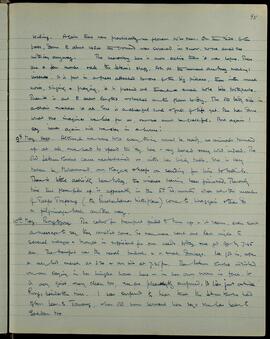
            Kuling. Again there were practically no flowers to be seen. On this side of the pass, down to about 14,500 the ground was covered in snow, so we could see nothing anyway. The monastery here is more active than it was before. There are a few monks with the Jetsun's staff. All at the moment are busy making incense. It is put in a press attached to one of the big pillars, then with much noise, singing and praying, it is pressed out through a small hole like toothpaste. Then it is cut to exact lengths and stacked on the floor to dry. The old lady sits in a chair and watches it all. She is a cheerful soul and full of life yet. She has done what she imagines we like for us, so we must be grateful. But again I say never again will we stay in a house!

            9th May. Hoet. Although we were told everything would be ready, no animals turned up at all, and we had to spend the day here—very bored and very cold indeed. The old Jetsun Kusho came and entertained us with her lively talk. She is very taken by Mohammed; our Kazakh keeps on sending for him to talk to. There is little activity here today, the incense having been finished. The only time this place fills up is apparently in the 5th Tibetan month when all the monks of Tarpo Trapsang (the Panchen Lama's birthplace) come to Lhagyari and then do a pilgrimage back another way.

            10th May. Rong Dzong. The call for transport failed to turn up and it seems, even sent a message to say they wouldn't come. So men were sent out last night to several villages and brought in sufficient for our needs today, and we got off by 7:45 am. The transport was the usual bullocks and very small donkeys. We got in, after a very hot march at 3:30 and our kit at 7:35 pm. The Jetsun Kusho insisted on our staying in her lingka house here—in her own room in fact. It is very quiet and very clean too; we are pleasantly surprised. It lies just outside Rong, beside the river. I was surprised to hear that the Jetsun Kusho had often been to Tawang, and her old nun servant here says she has been to Sahden too.

            LSH/1/1/10/1/31 · Part · 1933-10-10
            Part of The Ludlow & Sherriff Collection

            SUMMARY:
            The diarist finalizes loads, sends spare items to H.H., notes further gifts from the Ashis, and expresses deep gratitude for H.H.’s hospitality in Bhutan, agreeing with Betty to take Tasho home for five months. On 13th October they travel from Kuji to Wangdicholing to say goodbye to H.H., then on to Gyetsa in heavy rain, finding a poor reception and remarking on the late, unsettled monsoon.

            CONTENT:
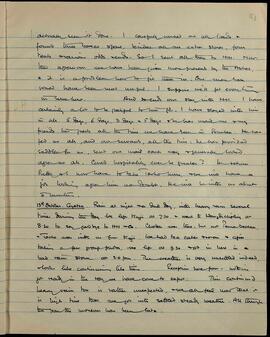
            actually seen it done. I carefully worked out all loads and found three boxes spare, besides all our extra stores, four tents and various odds and ends. So I sent all these to H.H. Now this afternoon we have been given more presents by the Ashis, and it is a problem how to fit them in. One more box would have been most useful. I suppose we'll get everything in somehow. And so ends our stay with H.H. I have certainly a lot to be grateful to him for. I have stayed with him in all 2 days, 6 days, 3 days and 5 days and he has made me and my friends his guests all the time we have been in Bhutan. He has fed us all, and our servants, all the time: he has provided saddles for us, sent our mail each way and generally looked after us all. Could hospitality ever be greater? In return Betty and I now have to take Tasho home, and we will have a job looking after him no doubt. He will be with us about 5 months.

            13th October. Gyetsa. Rain at night and a dull day, with heavy rain several times during the day. We left Kuji at 7:30 and went to Wangdicholing at 8:30 to say goodbye to HH and Co. Choden was there, but not Pema Dechen, and Tasho was with us from Kuji. We had tea cakes and so on and after taking a few group photos, we left at 9:30 and got in here in a bad rain storm at 2.0 pm. The weather is very unsettled indeed, and looks like continuing like this. Reception here poor - nothing got ready in the way we have come to expect. This continued heavy rain too is rather unexpected, and we all feel now that it is high time that we got into settled steady weather. All through the year the monsoon has been late.

            LSH/1/1/1/1/115 · Part · 1933-07-31
            Part of The Ludlow & Sherriff Collection

            SUMMARY:
            The party leaves Korra Chorten, crosses the Trashiyangsi River by a bamboo bridge, and follows the right bank past the confluence with the Wangmana Chu and through rice fields near Bumdelling before reaching Shapang. They camp by the river opposite Rissu Gompa, note fine weather, ample resources, and that the bridge was in good condition in July 1933.

            CONTENT:
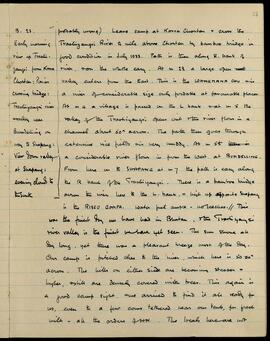
            56

            B. 23. (probably wrong) Leave camp at Korra Chorten & cross the
            Early morning Trashiyangsi River ½ mile above Chorten by bamboo bridge in
            view up Trashi- good condition in July 1933. Path is then along R. bank of
            yangsi from Korra river, on the whole easy. At m 2½ a large open
            Chorten: Ponies valley enters from the East. This is the WANGMANA CHU & is
            crossing bridge: a river of considerable size only fordable at favourable places.
            Trashiyangsi river At m 4 a village is passed on the L bank & at m 5 the
            valley near valley of the Trashiyangsi opens out & the river flows in a
            Bumdelling on channel about 60x across. The path then goes through
            way to Shapang: extensive rice fields & is very muddy. At m 5½
            View down valley a considerable river flows in from the West at BUMDELLING.
            at Shapang: From here on to SHAPANG at m 7 the path is easy along
            evening clouds to the R bank of the Trashiyangsi. There is a bamboo bridge
            the South across the river here to the L. bank, & high up opposite Shapang
            is the RISSU GOMPA. Water fuel ample - no leeches. // This
            was the finest day we have had in Bhutan, the Trashiyangsi
            river valley is the finest we have yet seen. The sun shone all
            day long, yet there was a pleasant breeze most of the day.
            Our camp is pitched close to the river, which here is 50-60x
            across. The hills on either side are becoming steeper &
            higher, & still are densely covered with trees. This again is
            a good camp site, we arrived to find it all ready for
            us, even to a few cows tethered near our tents, for fresh
            milk - all the orders of H.H. . The locals here are not

            LSH/1/1/8/1/19 · Part · 1946-11-14
            Part of The Ludlow & Sherriff Collection

            SUMMARY:
            The diary records movements from the east side of Kongbo-nga La via Mye to Shu, with delayed coolies and negotiations for transport. It notes forest and plant observations near the pass, attempts to contact Gyantse and Ford by wireless, strong winds, and halts on 1–2 Dec due to uncertain transport.

            CONTENT:
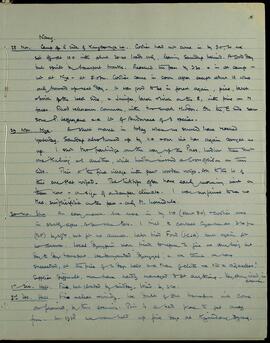
            Nang.

            28 Nov. Camp on E side of Kongbo-nga La. Coolies had not come in by 9.0, so we set off at 10.0 with about 30-40 loads only, leaving Samdup behind. A good day but spoilt by transport trouble. Reached the pass by 2.30 & in at camp - not at Nye - at 5.0pm. Coolies came in soon after except about 15 who only turned up next day. It was good to be in forest again, pine, larch & birch on the west side, & juniper, larch & birch on the E, with pine on N faces. Rhod. vellereum common, with two small Rhodos. On the E side saw some P. jaffreyana & a lot of Androsace of 3 species.

            29 Nov. Mye. A short march in today where we should have reached yesterday. Samdup also turned up by 11.0 & our kit has again caught us up. I saw two partridge on the way up the Pass. Ludlow then saw one 'Kuling' & another, while Ludlow missed a Crossoptilon on this side. This is the first village with pent wooden roofs. All to the W of this are flat roofed. The hilltops often have early morning mist on them now - a sign of a damper climate. I was surprised to see no Mec. simplicifolia on the pass - only M. horridula.

            30 Nov. Shu. An easy march. We were in by 1.0 (start 8.0) & coolies were in shortly after. A few were late. I tried to contact Gyantse at 3.30 pm (BT) by W/T, but got no answer. Later tried Ford (TASA) but again got no answer. Local Dzongpon's man tried to refuse to give us anything but day to day transport. We demanded 'Dzongyel', & we think we have succeeded, at the price of 2 days halt & a than of cloth & ten cigarettes! Supplies difficult, & we have hardly managed to get anything. Very strong wind in evening.

            1st Dec. Halt. Fine, but clouded by midday. Wind by 2.30.

            2nd Dec. Halt. Fine & clear & windy. We doubt if our transport will come as promised, by this evening. This is a bad place to get away from - in 1938 we were held up five days at Kyimdong Dzong.

            LSH/1/1/8/1/16 · Part · 1946-11-14
            Part of The Ludlow & Sherriff Collection

            SUMMARY:
            Brief captions for Kodachrome slides note scenes at Tashi Lhunz, the 13th Dalai Lama’s birthplace, Chorten Para Gompa, a view from the top of Kongbo Ngala, and the Tsangpo between Nge and Shu, with dates in late November to early December. A note also records “Types at Shu.”

            CONTENT:
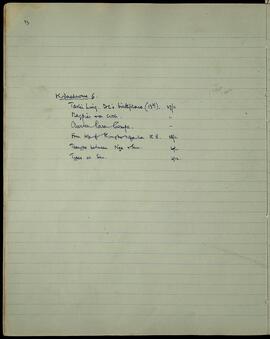
            13

            Kodachrome 6.
            Tashi Lhunz. DL's birthplace (13th). 27/11
            Magpies on rock. 27/11
            Chorten Para Gompa. 27/11
            From top of Kongbo Ngala to E. 28/11.
            Tsangpo between Nge & Shu. 30/11.
            Types at Shu. 3/12.

            LSH/1/1/10/1/40 · Part · 1933-10-10
            Part of The Ludlow & Sherriff Collection

            SUMMARY:
            Brief captions for Kodachrome slides note a view north from Belaka and lamas at Paro dated 23 October, and entries for Ha and trout dated 26 October.

            CONTENT:
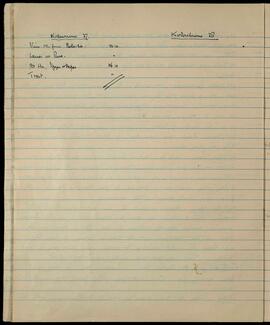
            Kodachrome 37 Kodachrome 38
            View N. from Belaka. 23.10.
            Lamas at Paro. 23.10.
            Pkt Ha, Ugyen Hapas 26.10.
            Trout. 26.10.