Bhutan

Elements area

Taxonomy

Code

Scope note(s)

    Source note(s)

      Display note(s)

        Hierarchical terms

        Bhutan

        Equivalent terms

        Bhutan

          Associated terms

          Bhutan

            419 Archival description results for Bhutan

            419 results directly related Exclude narrower terms
            LSH/1/1/2/1/191 · Part · 1933-09-22
            Part of The Ludlow & Sherriff Collection

            SUMMARY:
            Halted in rain; the Jongpen asked to go to Trashigang for dancing during a Bhutan festival called Tü, and with few flowers or ferns left they began collecting fungi. The next day, still halted at Rocha Chu in heavy rain, the party split up to hunt “binain dum” birds, with Puibo, Ludlow, and Danang taking different guns and achieving mixed results, including a shot that struck both the bird and the narrator.

            CONTENT:
            94

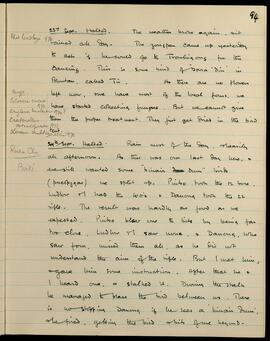
            23rd Sept. Halted. The weather broke again, and it
            Rhod. lindleyi 976 rained all day. The Jongpen came up yesterday
            to ask if he could go to Trashigang for the
            dancing. This is some kind of 'Bara Din' in
            Bhutan, called Tü. As there are no flowers
            Fungi. left now, and we have most of the local ferns, we
            Calocera viscosa 973 have started collecting fungus. But we cannot give
            Amylaria himalaica 974? them the proper treatment. They just get dried in the bird
            Craterellus cornucopioides 977 tent.
            Stereum multizonatum 978

            24th Sept. Halted. Rain most of the day, and heavily
            Rocha Chu all afternoon. As this was our last day here, and
            Birds we still wanted some "binain dum" birds
            (puepygas) we split up. Puibo took the 12 bore,
            Ludlow and I had the 410's and Danang took the 22
            rifle. The result was hardly as good as we
            expected. Puibo blew one to bits by being far
            too close, Ludlow and I saw none, and Danang, who
            saw four, missed them all, as he did not
            understand the aim of the rifle. But I met him,
            and gave him some instruction. After that he and
            I heard one, and stalked it. During the stalk
            he managed to place the bird between us. There
            is no stopping Danang if he sees a 'binain dum',
            and he fired, getting the bird and bits of me beyond.
            LSH/1/1/2/1/227 · Part · 1934-10-14
            Part of The Ludlow & Sherriff Collection

            SUMMARY:
            The diarist halts at Sanden and makes an early ascent to the Nyungsang La to take bearings and panoramas, noting clear views toward Mago, Milakatung La, and near Tsona after recent poor weather in Bhutan. Mago lamas arrive with some seeds; Danang is sent to the Bum La to collect white Meconopsis and Primulas, while previously bagged seed flowers from July are brought in. Plans and routes for retrieving seed bags and collecting around Bum La, Takpa, Tsona, and Mago are outlined.

            CONTENT:
            112

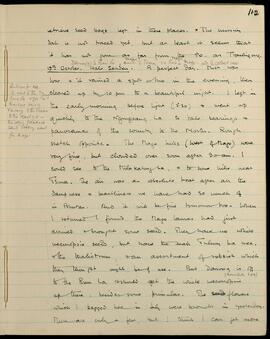
            retrieve seed bags left in these places. The missing dak is not traced yet, but at least it seems that it has not gone as far from its P.O. as Trashigang.
            Danang(?) to Bum La, Takpa and to Tsona, or there to Mago - all to collect seeds.

            19th October. Halt Sanden. A perfect day. Mist was low & it rained a spot or two in the evening, then cleared up by 10 pm to a beautiful night. I left in the early morning before light (5:30) & went up quickly to the Nyungsang La to take bearings & panoramas of the country to the North. Rough sketch opposite. The Mago hills (West of Mago) were very fine, but clouded over soon after 9:00 am. I could see to the Milakatung La, & to some hills near Tsona. The air was an absolute treat after all the dampness & beastliness we have had so much of in Bhutan. And it will be fine tomorrow too. When I returned I found the Mago lamas had just arrived & brought some seed. They have no white Meconopsis seeds, but have the small Tulung La one. Also Thalictrum, & an assortment of rubbish which they thought might be of use. But Danang is off (horridus 659) to the Bum La & should get the white Meconopsis up there, besides some Primulas. The seed flowers which I bagged here in July were brought in yesterday. There are only a few, but I think I can get more.

            Ludlow p. 148. S. went to the Nyung Sang La for a beautiful view of Tawang & the peaks to the East of it - the same peaks we saw looking West from Mago.

            LSH/1/1/2/1/163 · Part · 1933-08-30
            Part of The Ludlow & Sherriff Collection

            SUMMARY:
            Camped at Tobrang in the Bashiyang Valley, the party plans a seven-day stay, dismisses the coolies, and notes leech problems and severely disorganized mail. Pimbo goes to T'gong to investigate the missing mail, while the diarist spends the day birding near camp and reports Ahmed Sheikh’s quick recovery. Heavy Bhutan–Tibet barter traffic is observed, and plant collections are listed.

            CONTENT:
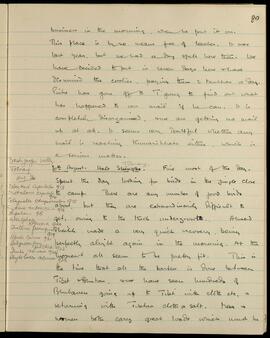
            business in the morning, when he put it on.
            This place is by no means free of leeches. It was last year, but we had a dry spell here then. We have decided to put in seven days here & have dismissed the coolies, paying them 2 tankhas a day. Pimbo has gone off to T'gong to find out what has happened to our mail if he can. It is completely disorganised, & we are getting no mail up at all. It seems very doubtful whether any mail is reaching Kumarikhata either, which is a serious matter.

            Bashiyang Valley.
            Tobrang
            Aug. 30
            Osbeckia capitata 913
            Crotalaria capitata 914
            Selaginella chrysocaulos 915
            Erythrina arborescens 916
            Impatiens 918
            Adenophora khasiana 920
            Shuteria ferruginea 919
            Apios carnea 921
            Didymocarpus pulchra 923
            Inula nervosa 924
            Phytolacca acinosa 926

            30th August. Halt Tobrang. Fine most of the day.
            Spent the day looking for birds in the jungle close to camp. There are any number of good birds about, but they are extraordinarily difficult to get, owing to the thick undergrowth. Ahmed Sheikh made a very quick recovery, being perfectly all right again in the morning. At the moment all seem to be pretty fit. This is the time that all the barter is done between Tibet & Bhutan, & we have seen hundreds of Bhutanese going up to Tibet with cloth etc, & returning with Tibetan cloth & salt. Men & women both carry great loads which must be

            LSH/1/1/1/1/177 · Part · 1933-09-05
            Part of The Ludlow & Sherriff Collection

            SUMMARY:
            On 7th September the party halted at Towa, met and lunched with the local jongpen, and confirmed plans to take the Lalung–Munda–Ling route. On 8th September they marched to Lalung, describing the good path, the Lhobrak valley, and a camp near the monastery, and discussed hopes for the Tashi Lama’s return to Tibet, a matter Williamson is expected to raise at Lhassa.

            CONTENT:
            getting pay. When a jongpen travels, he pays nothing on
            the way, but has free transport wherever he goes.

            7th September. Halt at Towa. We lazed in the morning waiting
            for the summons to eat with the jongpen. He came himself
            about 11:30, and after his visit we went up to the Dzong to
            lunch. It was the usual pleasant meal of gyatu with
            Chang - very excellent and satisfying. The jongpen is a nice
            young man of 32, and was very obliging to us. I think
            he would let us go by any route we wanted to. At any
            rate the Lalung - Munda - Ling route is decided on.

            8th September. To LALUNG 13,250' 8 miles. The path is good and
            direct the whole way to Lalung. For the first 3 1/2 miles it
            is through the Towa cultivation, then across stony waste land
            to m 5 1/2 where the Lhobrak valley narrows to a gorge. At
            m 7 the valley again broadens out and cultivation
            is met. Lalung monastery lies on the left bank, and the
            river is crossed by a bridge opposite the monastery. A very
            good camping ground is in a willow garden in front of the
            monastery. Water and fuel ample. Yesterday during
            lunch we asked the jongpen whether he thought the
            Tashi Lama would return to Tibet. This is one of the
            things Williamson will certainly have to discuss at
            Lhassa. The jongpen was full of hope, as a great
            number of Tibetans are. One of the reasons he gave

            LSH/1/1/1/1/85 · Part · 1933-07-11
            Part of The Ludlow & Sherriff Collection

            SUMMARY:
            Notes leech-bite injuries and a halt at Trongsa with a visit to the Dzong and lunch with Dorji, followed by archery and photo work. The next day they march to Gye Tsa via Yuto La, collect plants, and describe contrasting vegetation across the pass.

            CONTENT:
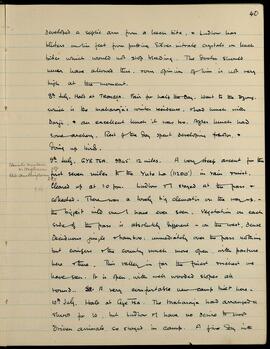
            40

            developed a septic arm from a leech bite, & Ludlow has
            blisters on his feet from putting silver nitrate crystals on leech
            bites which would not stop bleeding. The doctor should
            never have allowed this. Our opinion of him is not very
            high at the moment.

            8th July. Halt at TRONGSA. Fair for half the day. Went to the Dzong,
            which is the Maharaja's winter residence, & had lunch with
            Dorji, & an excellent lunch it was too. After lunch had
            some archery. Rest of the day spent developing photos, &
            doing up bird.

            9th July. GYE TSA. 9845' 12 miles. A very steep ascent for the
            Clematis montana
            V. tongluensis 252
            Rhod. camelliiflorum 253
            RH
            first seven miles to the Yuto La (11200') in rain & mist.
            Cleared up at 1.0 pm. Ludlow & I stayed at the pass &
            collected. There was a lovely big clematis on the way up -
            the biggest wild one I have ever seen. Vegetation on each
            side of the pass is absolutely different - on the west, dense
            deciduous jungle & bamboo: immediately over the pass nothing
            but conifers & the country much more open, with pasture
            here & there. This valley is far the finest & richest we
            have seen. It is open, with well wooded slopes all
            round. A very comfortable new camp built here

            LSH/1/1/9/1/29 · Part · 1949-05-06
            Part of The Ludlow & Sherriff Collection

            SUMMARY:
            Cold, clear halt day in camp plagued by ticks and foul water. Betty was to cross the Dongala la while the diarist and Pasang attempted collections, securing Primula listeri filipes and noting seven primula species so far. Wind scattered drying papers, later recovered by Bhutanese from the camp.

            CONTENT:
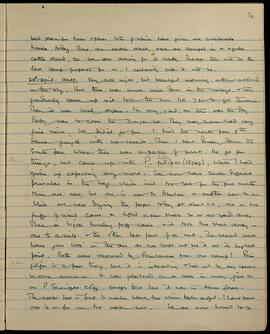
            bad place for ticks and fleas, both of which have given me considerable trouble today. There are cattle about, and we are camped in a regular cattle stand, so we are asking for it really. Perhaps this will be the last camp prepared for us. I certainly hope it will be.

            24th April. Halt. Very cold night, but beautiful morning, without a cloud in the sky. But there was much mist down in the valleys, and this gradually came up and it took the sun till 7.30 to get through. Then it was lovely again. I'm very glad, as this was the day Betty was to cross the Dongala la. They may have had very fine views. We didn't go far. I tried the north face of the dense jungle with no result. Then I sent Pasang down the south face where there was a patch of forest. He got few things, but came up with P. listeri filipes (18749), which I had given up expecting any more. We now have seven different primulas in the bag, which isn't too bad for the first month. None are new, but one is new to Bhutan, and another new to us.

            While we were drying the paper today at about 1.0, one or two puffs of wind came and lifted a few sheets 30 or 40 yards away. Then a bigger twirling puff came, and it took two sheets away — one 1/2 a mile and the other best part of a mile. The second must have gone 1000' in the air, as we could not see it at its highest point. Both were recovered by Bhutanese from our camp!

            Prim. listeri filipes is a poor thing, but it is interesting that it has not by any means become common. It was plastered on a rock in moss, just as on P. Sherriffae cliff, except that here it was in dense forest.

            The water here is foul. It makes black tea which tastes awful. I have sent over 1/2 mile for our tea water now. We are now bound to go

            LSH/1/1/5/1/135 · Part · 1936-06-27
            Part of The Ludlow & Sherriff Collection

            SUMMARY:
            The diarist halts for two days, then travels via Chendebi toward Bumthang, noting persistent rain and brief clear periods. They collect a little seed of P. Boothii and discuss an uncertain Primula (specimen 3052), comparing it with P. tenella and noting that seed is not yet ripe.

            CONTENT:
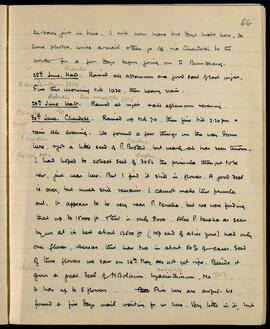
            be back just in time. I will now have two days halt here, do some photos, write a mail and then go off via Chendebi to the north for a few days before going on to Bumthang.

            28th June. Halt. Rained all afternoon and a good deal last night. Fine this morning till 10:30, then heavy rain.

            29th June Halt. Rained at night, and all afternoon and evening.

            30th June. Chendebi. Rained up till 7:00, then fine till 2:30 pm and rain all evening. We found a few things on the way down here, got a little seed of P. Boothii, but nearly all has been thrown.

            I had hoped to collect seed of 3052 the primula thought to be new, just near here. But I find it still in flower. A good deal is over, but much still remains. I cannot make this primula out. It appears to be very near P. tenella, but we were finding that up to 15,000 ft and this is only 8,000. Also P. tenella as seen by us at its best about 12,500 ft (top end of abies zone) had only one flower, whereas this has two in about 50% of cases. Seed of these flowers we saw on 14th May are not yet ripe. Beside it grows a great deal of Notholirion hy

            LSH/1/1/3/3/181 · Part · 1983-05-05
            Part of The Ludlow & Sherriff Collection

            SUMMARY:
            Stores were divided as Ludlow and Sherriff prepared to leave for Kyindong Dzong or Chutchar; Tendu was injured catching butterflies but remained cheerful. The party made a halt-day excursion to the Bimbi La with fine views but few new plants, and later the writer found a primula in bloom near camp, hoped to be P. cawdoriana. Departure was planned for the 12th amid variable weather.

            CONTENT:
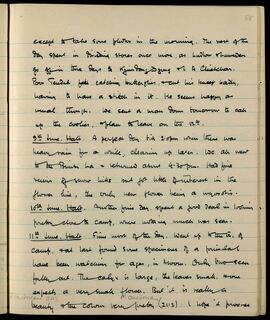
            except to take some photos in the morning. The rest of the day spent in dividing stores once more, as Ludlow & Sherriff go off in three days to Kyindong Dzong or to Chutchar. Poor Tendu fell catching butterflies & cut his knee badly, having to have a stitch in it. He seems happy as usual though. We sent a man down today to call up the coolies, & plan to leave on the 12th.

            9th June. Halt. A perfect day till 2.0 pm when there was heavy rain for a while, clearing up later. We all went to the Bimbi La & returned about 4.30 pm. Had fine views of snow hills but for little of interest in the flower line, the only new flower being a myosotis.

            10th June. Halt. Another fine day, spent a good deal in looking pretty close to camp, where nothing much was seen.

            11th June. Halt. Fine most of the day. Went up to the E. of camp, & at last found some specimens of a primula I have been watching for ages, in bloom. Only two seen fully out. The calyx is large, the leaves small, & one expects a very small flower. But it is really a beauty & the colour very pretty (2113). I hope it proves to be P. Cawdoriana.

            LSH/1/1/8/1/37 · Part · 1933-12-24
            Part of The Ludlow & Sherriff Collection

            SUMMARY:
            Notes on extreme temperatures and plant survival are followed by a halt during which the diarist and Ludlow visit the Dzongpon with gifts to secure cooperation for travel plans. They plan routes to the Sobhe La and Gyadzong, attempt to train a local to use a thermograph, test photographic equipment, and repack supplies.

            CONTENT:
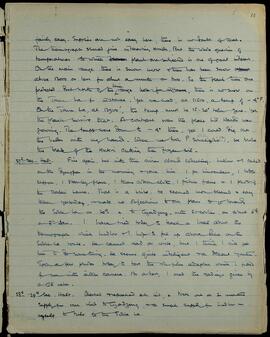
            fairly easy. Supplies are not easy here, there is no doubt of that. The thermograph showed fine interesting results. But the whole question of temperatures to which plants are subjected is one of great interest. On the main range there is snow now; there has been snow above 13,000 or less for about a month or two. So the plants there are protected. But north of the Himalayan range for instance, there is no snow on the Tamu La for instance. Yet we had, at 11,500, a temp of -4°F. On the Tamu La, at 13,900', the temp must be 15-20° below zero. Yet the plants survive that. A contrast was the place Lil. Wardii was growing. The temps were down to -4° there, yet I could dig out the bulbs with my hand. Where we took P. sonchifolia(?), we broke the blade of the kukri cutting the frozen soil.

            27th Dec. Halt. Fine again, but with thin cirrus cloud collecting. Ludlow and I called on the Dzongpon in the morning and gave him 1 pair of binoculars, 1 bottle of saffron, 1 Stanley flask, 1 than of cotton cloth, 1 picture frame and 1 photo of the Dalai Lama. That is a bribe. He seemed more pleased and easy than yesterday, and made no objections to our plans to go towards the Sobhe La on the 30th and to Gyadzong, with 50 coolies, on about the 6th or 8th of Jan. I have tried today to teach a local about the thermograph which Ludlow and I hope to put up above Laha on the Sobhe La route. He cannot read or write, but I think I will get him to do something. He seems quite intelligent and a decent youth. Took a few photos today to test the roll film adaptor which I fitted for use with either camera. As a test, I used the readings given by a GE meter.

            28th - 29th Dec. Halt. Checked and repacked all kit, and took out a 2 months' supply for our visit to Gyadzong and a small supply for Ludlow and myself to take to the Sobhe La.

            LSH/1/1/3/3/13 · Part · 1936-02-09
            Part of The Ludlow & Sherriff Collection

            SUMMARY:
            The diarist halts while Tobgye departs to meet Gould at Rangiya and then proceed to Shillong regarding Bhutan boundary matters, expressing concern over Gould’s treatment of Tobgye amid unsettled weather. Plans are made to go to Chungkar after hearing rhododendrons are out, a fishing trip is undertaken, and a wire from Mary reports the diarist’s mother has died; the Trashigong Dzongpon also departs.

            CONTENT:
            19th Feb. Halt. Tobgye stayed up till this afternoon, when he went off about 2.0 pm. He has to meet Gould at Rangiya & then go to Shillong to discuss Bhutan boundary questions. I don't much like what I hear about Gould, as he treats Tobgye rather like a 3rd grade clerk. We have queer kind of weather, thunder every day & night, some rain & some sun.

            20th Feb. I hear that rhododendrons are out in Chungkar. We have decided to go on there on 22nd. I wonder if any other flowers will be out too. Here there is nothing. We went down this morning to the river NW of here & fished with the spoon, catching several fish which resemble mahseer, & which played quite well. It thundered & rained all night, & today has been more or less fine till 4.30 pm, when very heavy hail & rain with thunder came on. We returned at 2.0 pm & heard from Mary wire to say Mother had died. She must have been glad to get away from all her pain at last. Yesterday the Trashigong Dzongpon went off too. He wanted to meet us in his district, but we