Bhutan

Elements area

Taxonomy

Code

Scope note(s)

    Source note(s)

      Display note(s)

        Hierarchical terms

        Bhutan

        Equivalent terms

        Bhutan

          Associated terms

          Bhutan

            419 Archival description results for Bhutan

            419 results directly related Exclude narrower terms
            LSH/1/1/5/1/23 · Part · 1935-11-27
            Part of The Ludlow & Sherriff Collection

            SUMMARY:
            At Nabzi (4600 ft) on April 30th, after fine weather turning to rain by noon, Pimbo fetched the local Kazi, who agreed to arrange a trip to a pass towards the Black Mountain. A brief search along the Trongsa path yielded few plants, while notes describe how the Jirgang Chu joins the Mangde Chu near Byiti Sam and outline routes via Nabzi Kortha and the Trashi La.

            CONTENT:
            Jirgang Chu Valley R. Arboreum 2800. 11

            April 30th Nabzi 4600ft. Fine all yesterday and last night, but rain by 12 noon today. The local Kazi did not come up yesterday, so Pimbo went down for him today and brought him back.

            I went out along the Trongsa path, but although the country looks wonderful - or would be 1500' higher - we found little but some ferns. A man said there were primulas along the bunds of the fields, but not yet out - red, yellow and white. But we can see no sign. When I asked the colour of some irises at the same place, he said they were red, white, yellow and blue, all from the same plant, so I can't put much weight in what he says.

            The Kazi has just been down, and he says he will arrange for us to go up to a pass, towards the Black Mountain. Beyond that he knows nothing of the country. This is good, and I hope we will get into some good country.

            The Jirgang Chu flows to the Mangde Chu, joining it about 3 miles above BYITI SAM (Bitana Sang). Shamgong Dzong is about 3 miles above BYITI SAM. The road to Byiti Sam goes via Nabzi Kortha over the Trashi La, 3 m beyond and then down a valley to the Mangde Chu. The Trongsa road goes along
            LSH/1/1/5/1/21 · Part · 1935-11-27
            Part of The Ludlow & Sherriff Collection

            SUMMARY:
            Orchids and magnolias were noted near the pass, and a snake that struck the diarist’s shoe was killed by Tsongpen. Rinso struggled with the local dialect, and the writer records route details around Nabzi, including the confluence at Nimjhong, the path to Trongsa via the Takotse La, and camp and weather notes.

            CONTENT:
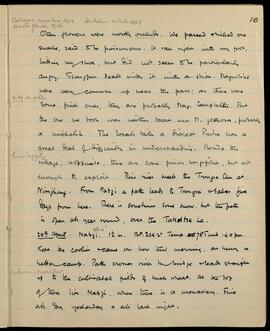
            Coelogyne corymbosa 2954 Dendrobium nobile 2957 10
            Phaius flavus 2956

            Other flowers were mostly orchids. We passed and killed one snake, said to be poisonous. It ran right into my foot, hitting my shoe, but did not seem to be particularly angry. Tsongpen dealt with it with a stick. Magnolias were very common up near the pass; as there were some pink ones, they are probably Mag. campbellii. But the one we took was neither that nor M. globosa, probably a michelia. The locals talk a dialect Rinso has a great deal of difficulty in understanding. Beside the village, opposite, there are some Pinus longifolia, but not enough to exploit. This river meets the Trongsa Chu at Nimjhong. From Nabzi a path leads to Trongsa and takes five days from here. There is sometimes some snow, but the path is open all year round, over the Takotse La.

            29th April. Nabzi. 1 1/2 m. BP. 204.2° Temp 4000' 76° Time 4.0 pm.
            Kept the coolies and came on here this morning, as being a better camp. Path crosses river by bridge and leads straight up to the cultivated fields of buckwheat. At the top of these lies Nabzi, where there is a monastery. Fine all day yesterday and all last night.

            LSH/1/1/1/1/183 · Part · 1933-09-10
            Part of The Ludlow & Sherriff Collection

            SUMMARY:
            Notes on pitching camp at Munda with views of high peaks east of the Kuru Chu beyond Towa. Describes the route via Khobrak Chu and Munda La to Tö Gompa by Pomo Tso, mentions brackish lake water, limited fuel, birds observed, and that seven lamas were resident in 1933.

            CONTENT:
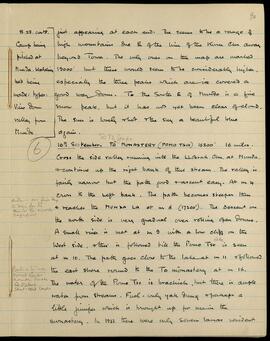
            90

            B. 28. contd.
            Camp being pitched at Munda. Watching bed being made: types: View down valley from Munda.

            just appearing at each end. There seems to be a range of high mountains due E of the line of the Kuru Chu away beyond Towa. The only ones on the map are marked 19,000' but these would seem to be considerably higher, especially the three peaks which are ice covered a good way down. To the South E of Munda is a fine snow peak, but it has not yet been clear of cloud. The sun is lovely today and the sky a beautiful blue again.

            6

            To Tö Gompa
            10th September. TO MONASTERY (POMO TSO) 16,200' 16 miles.

            Cross the side valley running into the Khobrak Chu at Munda, and continue up the right bank of this stream. The valley is fairly narrow but the path good and ascent easy. At m 4 cross to the left bank. The path becomes steeper then reaches the MUNDA LA at m 6 (17,200'). The descent on the north side is very gradual over rolling open downs.

            On a fine day the view from the Munda La must be magnificent.

            A small river is met at m 9 with a low cliff on the West side, this is followed till the Pomo Tso lake is seen at m 10. The path goes close to the lake at m 11 and followed the east shore round to the To monastery at m 16.

            Birds on the way:
            Horned Larks
            Mountain Finches
            Redstarts
            Short-toed larks

            The water of the Pomo Tso is brackish, but there is ample water from streams. Fuel - only yak dung and perhaps a little juniper which is brought up for use in the monastery. In 1933 there were only seven lamas resident.

            LSH/1/1/2/1/47 · Part · 1933-07-08
            Part of The Ludlow & Sherriff Collection

            SUMMARY:
            Notes epiphytic rhododendron bushes at the top of an ascent, including old pods with sprouting seeds collected. Describes transport difficulties near Muktur and crossing the Tawang Chu via a fine old iron-chain suspension bridge said to have been made by a Guru, with frequent changes of carriers en route.

            CONTENT:
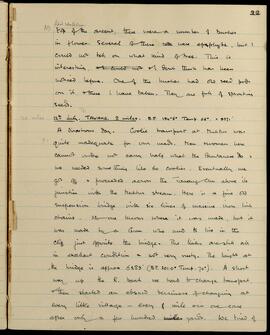
            NB Rhododendron
            Top of the ascent, there were a number of bushes
            in flower. Several of these were epiphytic, but I
            could not tell on what kind of tree. This is
            interesting, and I don't think has been
            noticed before. One of the bushes had old seed pods
            on it and these I have taken. They are full of sprouting
            seeds.

            110 miles To 12th July. TAWANG. 8 miles. B.P. 194.5° Temp. 65°. = 9371'

            A disastrous day. Coolie transport at Muktur was
            quite inadequate for our needs. Men and women here
            cannot or do not carry half what the Bhutanese do,
            we needed something like 60 coolies. Eventually we
            got off and proceeded across the Tawang Chu above its
            junction with the Muktur stream. Here is a fine old
            suspension bridge with six lines of massive iron link
            chains. No one knows where it was made, but it
            was made by a Guru who used to live in the
            cliff just opposite the bridge. The links are still all
            in excellent condition and not very rusty. The height at
            the bridge is approx 6289' (B.P. 201.0° Temp. 70°). A short
            way up the R. bank we had to change transport,
            and then started an absurd business of changing at
            every little village — every 1/2 mile in one case
            after only a few hundred yards. We tired of

            LSH/1/1/6/1/133 · Part · 1933-09-07
            Part of The Ludlow & Sherriff Collection

            SUMMARY:
            Arrangements are made for a message from Tsela Dzong to reach Pana, and Kusho rejoins to assist with the Lamdo to Sanga Choling leg. Between 18–20 Sept., the party travels from Tse to Lamdo and on to Kongshong in heavy rain, checks stores, crosses the Tsangpo with loads, and collects limited seeds; Purbo reports on routes and local groups near Molo, Dzeus, Tanjong, Lo ba, and Tsari Soma. A hard ascent via Go nyi re with a Lopa guide leads to cold, windy conditions that hinder seed collecting.

            CONTENT:
            Tsela Dzong by Dzong-Dzong runner. So I think it should be here in 5 days or so, that with any luck I will get it at Pana. I am asking the Dzongpen to send it on there at once. I am glad to have Kusho back again to help with what will be a pretty hectic trip from Lamdo to Sanga Choling.

            18th Sept. To TSE. Rain at night and nearly all today. The monsoon seems to be very busy still. In Tse all the things we left appear to be in good condition and have not suffered, as the bacon did. Nearly a whole side of it was eaten, and half a cheese too, by some kind of bug, while Ludlow and Taylor were away during June and July. We crossed the Tsangpo in six kowas, with all kit, about 24 loads the three of us.

            19th Sept. To Lamdo. Rain most of yesterday, and very heavy rain all night. Collected a few seeds of Phlomis 5798 and a very few of Plectranthus. I find I can get more or less direct from here to Go nyi re, without going up to Kongshong first. That will make things much easier, though tomorrow will be a hard day's trek. I hope we have a reasonably fine day to do it in. Purbo came in this afternoon. He reached Molo from Dzeus in three days, which is extraordinary good going, but got some fever on the way back and was held up. He stays the night with us, which I hope will give some more hints to Kusho and Dzongpen about how to manage the Molo and Tanjong people. He does not anticipate any trouble with the Molo people going to the Lo ba, but it seems the Lopas have given a lot of trouble somewhere near Tsari Soma and have carried off 5 men. However I don't think they would dare do anything to a body of 12 or 15 coolies that I would have with me, especially as they would know I had a gun.

            20th Sept. To Kongshong. Rain all night and all this morning, finer in afternoon. Coolies rather late, and did not get off till 6.15, with the same Lopa who lost me last time, as guide. To save a day I decided to go up direct from Lamdo to Go nyi re, and then drop down to Kongshong. It is an awful pull up, very steep for about 5000 ft, then along a rocky knife edge ridge, up and down and very tiring. The wind at the top was very cold and almost a gale, driving mist and fine rain. It was really too cold for seed collecting and I had no feeling in my fingers at all. We did not really do well either, but got lots of Meconopsis integrifolia, a good deal of Mec. florindae, which is not yet

            LSH/1/1/6/1/121 · Part · 1933-07-27
            Part of The Ludlow & Sherriff Collection

            SUMMARY:
            Entries describe observations around Mira La, including Lerwa, snipe, and abundant Notholirion campanulatum, with fieldwork by the diarist alongside Tsungpen and Tendu yielding notable finds such as Meconopsis horridula var. lutea and a distinctive Saxifraga. Taylor is ill then recovers, Anna falls ill, and a Pu chu man is engaged to collect seeds for delivery to a monastery below the Dzong at Tsela Dz.; later a move north of Mira La is hampered by slow and misrouted coolies, with Chomo Dzong noted next.

            CONTENT:
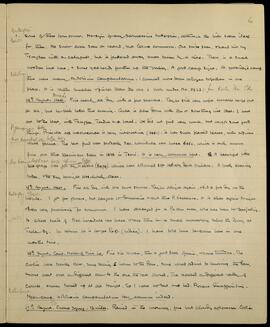
            60

            Butterflies
            Some of these tomorrow. No sign of any Parnassius butterflies, although the hills seem ideal
            Birds
            for them. No snow cock seen or heard, but Lerwa common. One snipe seen, nearly hit by
            Tsungpen with a catapult, but it fluttered away and was taken by a kite. There is a small
            wooden hut here, and some yakherds further up the valley. A good camp site. At yesterday's camp
            Notholirion
            there were many Notholirion campanulatum. I counted more than a dozen together in one
            place. It is rather smaller and pinker than the one I took under No. 5923: from Kulu Phu Chu.

            Mira La
            14th August. Halt. Fine nearly all day, with a few showers. Taylor still very unfit and unable to go out
            at all, but he feels better this evening. Anna is also down with flu or something like that. I went
            out to the West, with Tsungpen, Tendu and a coolie. We did not find very much, but we got some good
            P. Younghusbandii 6061
            things. Primula aff. macrocarpa is very interesting (6061): it has such flaccid leaves, with copious
            Mec. horridula var. lutea 6062
            white farina. The best find was probably Mec. horridula var. lutea 6062, which is only known
            from our three specimens seen in 1936 in Tsari. It is very common here. A beautiful little
            Sax. haematochroa 6070 sp. nov. type
            Saxifraga was found by Tendu (6070) which was coloured soft velvety dark crimson. A lovely evening
            today, the sky tonight absolutely clear.

            15th August. Halt. Fine all day, with one short shower. Taylor all right again, and did a full day on the
            Butterfly Birds
            hillside. I got few flowers, but caught 10 Parnassius and saw three P. tischelanus. It is clear again tonight
            and looks very promising for tomorrow. I have arranged for a Pu chu man, who has been to Darjeeling,
            Seeds
            to collect seeds of Mec. horridula var. lutea and take them to a small monastery below the Dzong at
            Tsela Dz. In return he is to get Rs 5/- (Indian). I have told him to come here in one
            month's time.

            16th August. Camp. North of Mira La. Fine till 11.00 am, then a good deal of rain, some thunder. The
            coolies were terribly slow, some taking 5 hours to the Pass. None would admit to knowing the Pass,
            and some went over a different one to the one the rest crossed. They reached a different valley of
            course, and never turned up at all tonight. So I have no tent and bed. Flowers disappointing.
            Notholirion
            Near camp, Notholirion campanulatum very common indeed.

            17th August. Chomo Dzong. 12 miles. Rained in the morning, fine but cloudy afternoon. Coolies

            LSH/1/1/3/3/195 · Part · 1996-06-18
            Part of The Ludlow & Sherriff Collection
            • SUMMARY:
              Notes a small patch of Primula tenuiloba on steep rocky cliffs, followed by observations of a Lerwa nest with five eggs and an Anthus nest with three eggs. At Mipa, records abundant primulas on hillsides, with Tenduk bringing specimens from Lhapu and a blue primula (2173) and another from Natrampa, and lists several Primula specimens (2137, 2173–2178).

            CONTENT:
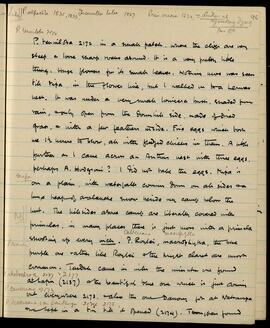
            Ludlow

            • P. alpestris 1831, 1833, Incarvillea lutea 1827 Prim. erosa 1832, = Ludlow at Kyimdong Dzong June 18th 96

            P. tenuiloba 2172
            P. tenuiloba 2172 in a small patch, where the cliffs are very steep & loose sharp rocks abound. It is a very pretty little thing. Huge flowers for its small leaves. Nothing more was seen till Mipa, in the flower line, but I walked on to a Lerwa's nest. It was under a very small Lonicera bush, shaded from rain, & only open from the downhill side, made of dried grass, & with a few feathers inside. Five eggs which took me 1 1/2 hours to blow, all with fledged chicks in them. A little further on I came across an Anthus nest with three eggs, perhaps A. hodgsoni? I did not take the eggs.

            Mipa
            Mipa is on a plain, with waterfalls coming down on all sides & a large heap of avalanche snow beside my camp below the hut. The hillsides above camp are liberally covered with primulas, in many places there is just moss with a primula shooting up every inch. P. Roylei (Calderiana), macrophylla, the blue purple one rather like Roylei & the bright claret are most common. Tenduk came in with the minute one found at Lhapu (2137) & the beautiful blue one which is just coming out everywhere 2173, & also the one Danu found at Natrampa. Two kept in a tin till it opened (2174). Tenduk found

            P. rhodochroa 2137, 2177
            P. Cawdoriana 2173
            P. dickieana var. pantlingii 2174, 2178

            LSH/1/1/8/1/34 · Part · 1946-12-23
            Part of The Ludlow & Sherriff Collection

            SUMMARY:
            Daily minimum temperatures and weather conditions are recorded at Tongkyuk Dzong from late December through early January, noting periods of cloud, clearing times, and occasional snowfall. About half an inch of snow is noted at Tongkyuk and later in camp, with clearer conditions by the 7–8 January entries.

            CONTENT:
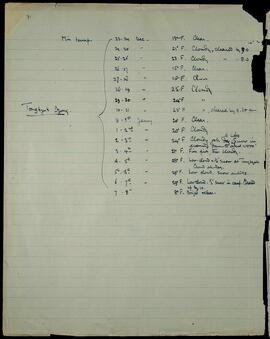
            31

            Min temp.

            Tongkyuk Dzong.

            23-24 Dec. 13° F. Clear.
            24-25 Dec. 21° F. Cloudy, cleared by 8:00.
            25-26 Dec. 23° F. Cloudy, cleared by 8:00.
            26-27 Dec. 15° F. Clear.
            27-28 Dec. 15° F. Clear.
            28-29 Dec. 23° F. Cloudy.
            29-30 Dec. 24° F. Cloudy.
            30-31 Dec. 25° F. Cloudy, cleared by 9:30 am.
            31 Dec. – 1st Jan. 20° F. Clear.
            1-2nd Jan. 20° F. Cloudy.
            2-3rd Jan. 24° F. Cloudy all day. A little snow in evening down to about 10,000'.
            3-4th Jan. 21° F. Fine first, then cloudy.
            4-5th Jan. 28° F. Low cloud & ½" snow at Tongkyuk. Cloud all day.
            5th-6th Jan. 29° F. Low cloud. Snow on hills.
            6-7th Jan. 29° F. Low cloud. ½" snow in camp. Cleared up by 10:00.
            7-8th Jan. 8° F. Bright & clear.

            LSH/1/1/4/1/84 · Part · 1933-08-15
            Part of The Ludlow & Sherriff Collection

            SUMMARY:
            Notes describe Migyitun harvesting methods and failures in vegetable cultivation despite some surviving crops. Observations record the Scaly-breasted Wren as common in Bhutan and nearby valleys, with its song noted at Taka-thum and occurrences at Lungi and Migyitun. On May 3rd the party ascended to the Tra La to seek seeds of Sclater's Monal and Kalij, with transport difficulties mentioned.

            CONTENT:
            The Migyitun people reap their crops simply by pulling off the ears of the barley. The stalk is left standing.

            L. p. 174. Migyitun is a foul spot. The vegetable seeds we planted here in May last germinated, but the locals have no idea how to grow them. They were choked with weeds. There are however, a number of young carrots & turnips & some lettuce & spinach. Most of the crops here have been cut already.

            Pnoepyga albiventer albiventer. Scaly-breasted Wren. Exceedingly common in Bhutan. In 1936 & 1938 we found it equally common in the damp forested areas of the Subansiri & Siyom. Does not occur on the main ridge but is numerous at Lungi & Migyitun where the Chayal and Tseri Rivers are cutting their way through the Him. axis. In 1938 I heard the spring song of this Wren in Taka-thum where it is very abundant. It is a pretty trill of 7 or 8 notes, quite indescribable, but quite distinct from the double-noted whistle of P. pusilla pusilla.

            L. p. 175. May 3rd. We ascended to the Tra La where we are putting in a few days in the hope of getting seeds of Sclater's Monal & Kalij. Difficult in transport.

            LSH/1/1/3/3/170 · Part · 1983-05-05
            Part of The Ludlow & Sherriff Collection

            SUMMARY:
            The diarist ascended the Na La through forest and traversed to the Pang La while traveling toward Tso Kar, searching for flowers and birds. Notes include observations of Heteroxenicus stellatus breeding among alpine rocks and a sighting of Snow Cock Pheasant (Tetraophasis szechenyii) across a wide elevational range.

            CONTENT:
            Migyitun

            Ludlow page 104. Went up the Na La and Pang La, 2 passes Migyitun 30 August
            on the road to the Tso Kar (Lake of the sacred one) which
            is a place of pilgrimage. The Na La involved an ascent Primula verrucosa var. violacea
            of some 3000 feet and led, as its name indicates, through forest. 1734, 1742.
            On reaching the summit of the Na La I made a circuit flabellifera 1737
            round to the Pang La in search of flowers and birds. macrocarpa 1743
            Got 3 specimens of Heteroxenicus stellatus stellatus Paraquilegia anemonoides
            Gould's Short-wing which has been found in East Nepal, 1744
            Sikkim and Bhutan. This species extends its range still Meconopsis simplicifolia 1735
            further eastwards. A common bird. Different from Rhododendron pumilum 1741
            other Short-wings in not being a skulker. Although Caltha palustris 1745
            it inhabits dense rhododendron and bamboo growth, it does not
            shun observation and will ascend to the tops of bushes
            to gaze at an intruder in a most confidential manner.
            The 2 were shot in - wherever there are rocks and boulders in
            the alpine zone, far away from all shrub growth. And
            the birds were breeding amidst these surroundings.
            --- shot on the next day ---
            Also saw Snow Cock Pheasant Tetraophasis szechenyii - Ludlow 383
            A common bird in Southeast Tibet. Found at all elevations between
            11-15000 feet. Lives in fir forest and also inhabits Rhododendron scrub
            in the alpine zone. - Specimen of Szechenyii 383.