Identity area
Reference code
Title
Date(s)
- 1933-08-15 (Creation)
Level of description
Extent and medium
1 page
Context area
Name of creator
Repository
Archival history
Immediate source of acquisition or transfer
Content and structure area
Scope and content
SUMMARY:
Notes describe Migyitun harvesting methods and failures in vegetable cultivation despite some surviving crops. Observations record the Scaly-breasted Wren as common in Bhutan and nearby valleys, with its song noted at Taka-thum and occurrences at Lungi and Migyitun. On May 3rd the party ascended to the Tra La to seek seeds of Sclater's Monal and Kalij, with transport difficulties mentioned.
CONTENT:
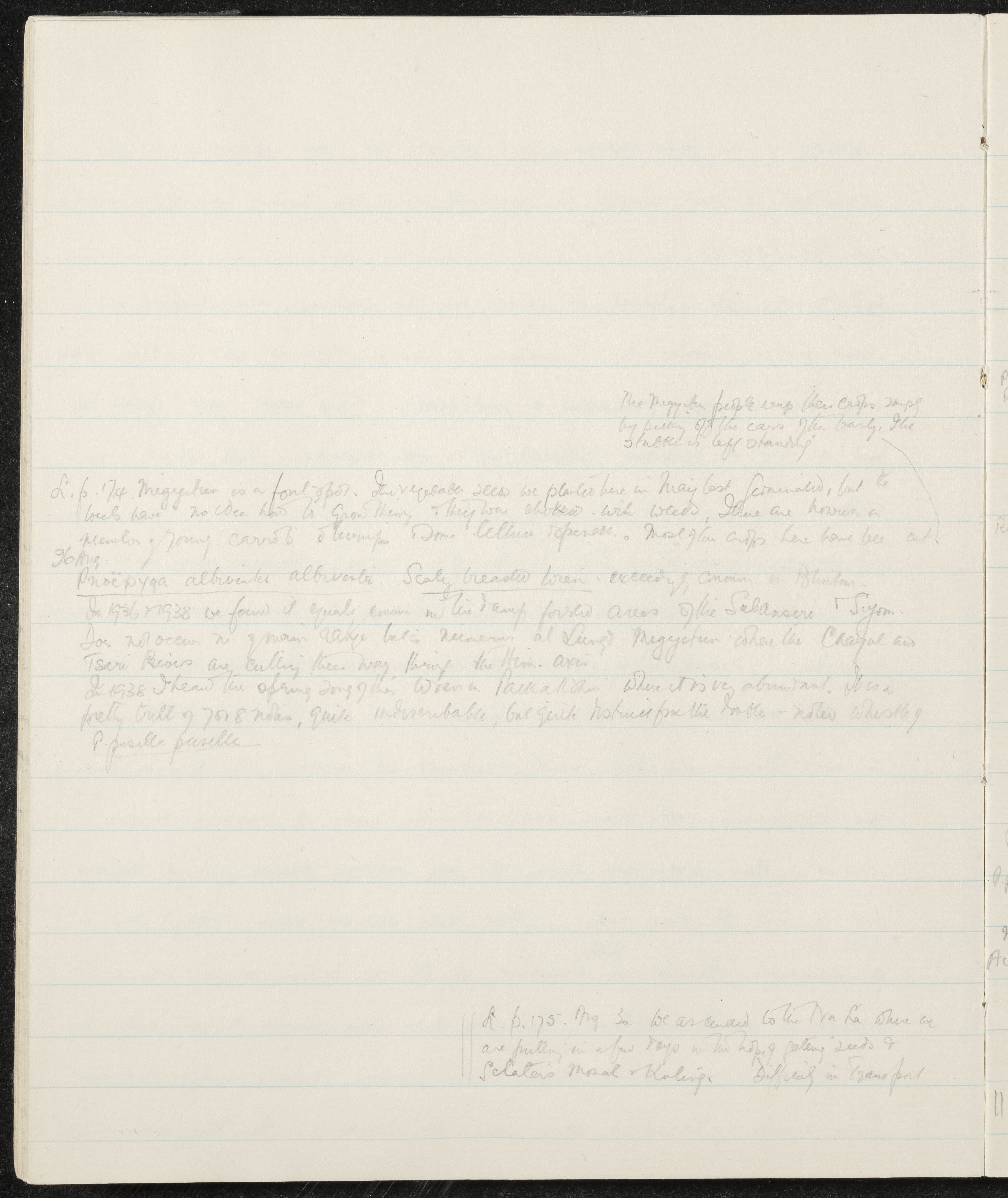
The Migyitun people reap their crops simply by pulling off the ears of the barley. The stalk is left standing.
L. p. 174. Migyitun is a foul spot. The vegetable seeds we planted here in May last germinated, but the locals have no idea how to grow them. They were choked with weeds. There are however, a number of young carrots & turnips & some lettuce & spinach. Most of the crops here have been cut already.
Pnoepyga albiventer albiventer. Scaly-breasted Wren. Exceedingly common in Bhutan. In 1936 & 1938 we found it equally common in the damp forested areas of the Subansiri & Siyom. Does not occur on the main ridge but is numerous at Lungi & Migyitun where the Chayal and Tseri Rivers are cutting their way through the Him. axis. In 1938 I heard the spring song of this Wren in Taka-thum where it is very abundant. It is a pretty trill of 7 or 8 notes, quite indescribable, but quite distinct from the double-noted whistle of P. pusilla pusilla.
L. p. 175. May 3rd. We ascended to the Tra La where we are putting in a few days in the hope of getting seeds of Sclater's Monal & Kalij. Difficult in transport.
Appraisal, destruction and scheduling
Accruals
System of arrangement
Conditions of access and use area
Conditions governing access
Conditions governing reproduction
Language of material
Script of material
Language and script notes
Physical characteristics and technical requirements
Finding aids
Allied materials area
Existence and location of originals
Existence and location of copies
Related units of description
Notes area
Alternative identifier(s)
Access points
Subject access points
Place access points
Name access points
- P. pusilla pusilla (Subject)
- Pnoepyga albiventer albiventer (Subject)