Identity area
Reference code
Title
Date(s)
- 1933-04-09 (Creation)
Level of description
Extent and medium
1 page
Context area
Name of creator
Repository
Archival history
Immediate source of acquisition or transfer
Content and structure area
Scope and content
SUMMARY:
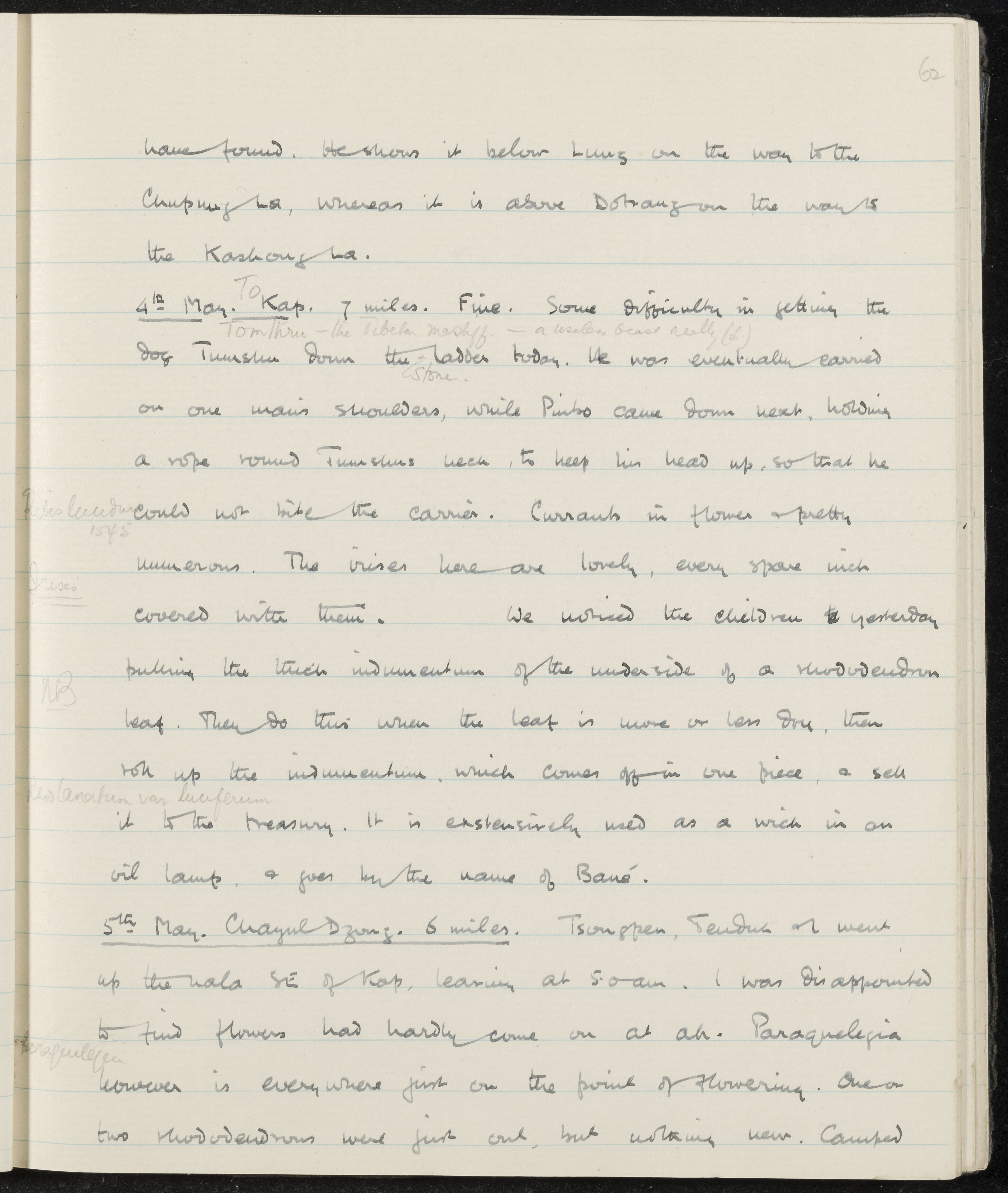
Travel to Kap and then Chayul Dzong, including difficulty lowering the Tibetan mastiff Tumshu down a stone ladder, with Pinto assisting. Notes children peeling rhododendron leaf indumentum to sell as Bané for lamp wicks and observes currants, irises, and early paraquilegia and rhododendrons; an outing up the nala SE of Kap with Tsongpen and Tendup found few flowers fully out.
CONTENT:
have found. He shows it below Lung on the way to the Chupung La, whereas it is above Dotrang on the way to the Kashong La.
4th May. To Kap. 7 miles. Fine. Some difficulty in getting the dog Tumshu—the Tibetan mastiff, a useless beast really (G.)—down the stone ladder today. He was eventually carried on one man's shoulders, while Pinto came down next, holding a rope round Tumshu's neck, to keep his head up, so that he could not bite the carrier. Currants in flower and pretty numerous. The irises here are lovely, every spare inch covered with them. We noticed the children yesterday pulling the thick indumentum off the underside of a rhododendron leaf. They do this when the leaf is more or less dry, then roll up the indumentum, which comes off in one piece, and sell it to the treasury. It is extensively used as a wick in an oil lamp, and goes by the name of Bané.
5th May. Chayul Dzong. 6 miles. Tsongpen, Tendup and I went up the nala SE of Kap, leaving at 5.0 am. I was disappointed to find flowers had hardly come on at all. Paraquilegia, however, is everywhere just on the point of flowering. One or two rhododendrons were just out, but nothing new. Camped
Appraisal, destruction and scheduling
Accruals
System of arrangement
Conditions of access and use area
Conditions governing access
Conditions governing reproduction
Language of material
Script of material
Language and script notes
Physical characteristics and technical requirements
Finding aids
Allied materials area
Existence and location of originals
Existence and location of copies
Related units of description
Notes area
Alternative identifier(s)
Access points
Subject access points
Place access points
Name access points
- Pinto (Subject)
- Tsongpen (Subject)
- Tendup (Subject)
- Paraquilegia (Subject)