Tibet

Elements area

Taxonomy

Code

Scope note(s)

    Source note(s)

      Display note(s)

        Hierarchical terms

        Tibet

          Equivalent terms

          Tibet

            Associated terms

            Tibet

              192 Archival description results for Tibet

              192 results directly related Exclude narrower terms
              LSH/1/1/2/1/185 · Part · 1933-09-19
              Part of The Ludlow & Sherriff Collection

              SUMMARY:
              The diarist describes taking telephoto and cinema panoramas from near the Me La and Dib La, viewing Kula Kangri, the Mago hills, Chakzam Chu, Gauri Chu, and the hills above Pinbogong, and mentions sketching a rough map and seeing a pnoepyga. The entry explains the meaning of Sangthopelri, first seen from the Cho La, and relates the tradition of Lobpön Rimpoche (Guru Rimpoche) traveling from India to Tibet via this route, noting glaciers seen at Mena and before reaching the Me La.

              CONTENT:
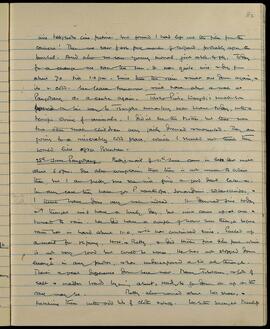
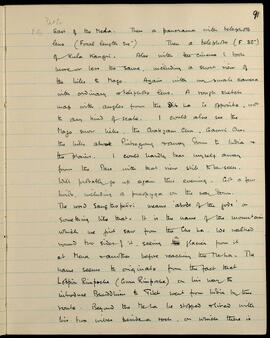
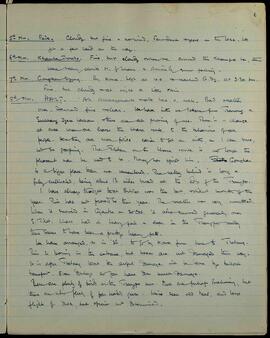
              East of the Me La. Then a panorama with telephoto lens (Focal length 24"). Then a telephoto (F 38") of Kula Kangri. Also with the cinema I took more or less the same, including a short view of the hills to Mago. Again with my small camera with ordinary telephoto lens. A rough sketch map with angles from the Dib La is opposite, not to any kind of scale. I could also see the Mago snow hills, the Chakzam Chu, Gauri Chu, the hills above Pinbogong and away down to India and the plains. I could hardly tear myself away from the Pass with that view still to be seen. Will probably go up again this evening. Got a few birds, including a pnoepyga on the way down.

              The word Sangthopelri means 'abode of the gods' or something like that. It is the name of the mountain which we first saw from the Cho La. We walked round two sides of it, seeing a glacier from it at Mena and another before reaching the Me La. The name seems to originate from the fact that Lobpön Rimpoche (Guru Rimpoche) on his way to introduce Buddhism to Tibet went from India by this route. Beyond the Me La he stopped and lived with his two wives beside a rock, on which there is
              LSH/1/1/4/1/70 · Part · 1933-08-15
              Part of The Ludlow & Sherriff Collection

              SUMMARY:
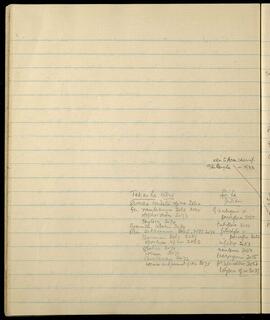
              Page lists plant collections with specimen numbers from Takar La on 15 Aug and additional Gentiana records from Sur La in the Phari-Kyirong-da area in 1933. Mentions Ludlow and Sherriff.

              CONTENT:
              aka to Ludlow & Sherriff.
              Phari-Kyirong-da in 1933

              Takar La 15 Aug
              Swertia handelii sp. nov. 2062
              Gen. namlaensis 2063, 2064
              otophoroides 2073
              taylori 2074
              Cyananthus lobatus 2084
              Prim. sikkimensis 2065, 2077, 2078
              tsariensis 2067, 2081
              odontica sp. nov. 2068
              glabra 2070
              ioessa 2071
              cawdoriana 2072
              ioessa subpinnatifida 2075

              Sur La
              Gentiana
              G. rubicunda v.
              parviflora 2050
              tubiflora 2051
              filistyla v.
              parviflora 2052
              infelix 2053
              namlaensis 2054
              tsarongensis 2055
              przewalskii 2056
              taylori sp. nov. 2057

              LSH/1/1/8/1/9 · Part · 1936-11-04
              Part of The Ludlow & Sherriff Collection

              SUMMARY:
              Entries record travel from Pede via Khamba La to Gongkar Dzong, with variable weather including snow north of Lhasa and some rain. At Gongkar they halt, note improved local attitudes off the Lhasa route, and arrange to go by kowa to Tsetang with useful letters from Tsarong and Surkhang Dzasa Lacham. They remark on recent widespread snowfall in S. Tibet around 30th Oct, the cultivated Tsangpo valley, and abundant waterfowl including Brahminy and bar-headed geese.

              CONTENT:
              6

              5th Nov. Pede. Cloudy but fine and no wind. Few ducks and geese on the lake. We got a few seeds on the way.

              6th Nov. Khamba Trombo. Fine, but cloudy when we crossed the Khamba La, there were heavy clouds N. of Lhasa and snow falling briskly.

              7th Nov. Gongkar Dzong. By kowa. Left at 10:00 and reached Gongkar Dzong at 3:30 pm. Fine, but cloudy and at night a little rain.

              8th Nov. HALT. All arrangements made here very well. Bad weather over. Damned fine and clear. We have with us letters from Tsarong and Surkhang Dzasa Lacham, these are all proving of use. There is a change at once when one leaves the Lhasa route, to the behaviour of the people. Here they are more polite, easier to get on with, and I am sure, not so grasping. The Taspon on the Lhasa route is no longer the pleasant man he used to be. Money has spoilt him. Gongkar is a bigger place than we remembered. The valley behind is long and fully cultivated, being about 1½ miles broad at the edge of the Tsangpo.

              I have always thought that October was the best, stillest month of the year. This has not proved so this year. The weather was very unsettled. When it snowed in Gyantse on 30th Oct, it also snowed generally over S. Tibet. Lhasa had a heavy fall and even in the Tsangpo valley there seems to have been a pretty heavy fall.

              We have arranged, as in '38, to go by kowa from here to Tsetang. This is boring in the extreme, but boxes are not damaged this way. It is after Tsetang that the awful damage will be done by bullock transport. Even donkeys so far have done much damage.

              There are plenty of birds on the Tsangpo now. Most are perhaps Brahminy, but there are also plenty of bar-headed geese. Have seen odd teal, and large flights of duck, but species not determined.

              LSH/1/1/9/1/87 · Part · 1933-06-28 - 1933-06-11
              Part of The Ludlow & Sherriff Collection

              SUMMARY:
              The writer notes forgetting camera film, observes leopard pug marks and young monal, and describes brief sun before returning rain and cold, with plans to leave and spend a week at Pangotang. A procession including Tasho Penlo Wangdi’s small son heads toward Tsurphu monastery near Lhasa, and on 28 June at Pangotang, Betty’s letter of 11 June arrives reporting some plant collections despite poor conditions as mist and rain persist.

              CONTENT:
              nice telephoto cine pictures, but found I had left out the film for the camera! Then we saw fresh pug marks of leopard, probably after the burrhel. And also we saw young monal, just able to fly. Today for a change we saw the sun. It was quite nice and dry from about 7.0 till 1.0 pm. Since then the rain and mist are down again, and it's very cold. We leave tomorrow, will have about a week at Pangotang as a centre again. Tasho Penlo Wangdi's small son passed on his way to Tsurphu monastery near Lhasa today, with a terrific string of animals. I didn't see the brother, but there were two other small children very gaily dressed and mounted. They are going to a miserably cold place, which I should not think they would like after Bhutan.

              28th June Pangotang. Betty's mail of 11th June came in late last night about 6.0 pm. She also complains that there is not much to collect there, but I am pretty sure she will find a good deal later on. In any case they have got P. xanthopa, jonarduni, soldanelloides, and I think have done very well indeed. It dawned fine today and I thought we'd have a lovely day, but mist came up at once and turned to rain. We did have a couple of hours sun though before rain set in hard about 11.0, and it has continued since. Packed up a mail

              LSH/1/1/6/1/99 · Part · 1933-07-05
              Part of The Ludlow & Sherriff Collection

              SUMMARY:
              The diarist reports hiring a new Khampa servant named Kesang, a difficult crossing of the broken bridge at Shona where Jill fell, and short, largely uneventful marches. In Paka they met an exiled Tibetan from Lhasa who assisted with transport arrangements, and later heavy rains delayed travel toward Samo; a coolie from Lando reportedly drowned while fording the river.

              CONTENT:
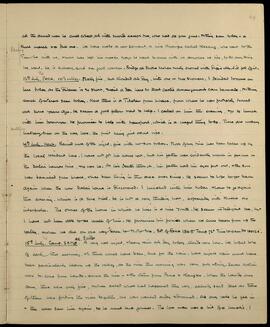
              all the armed men he could collect, all with swords except two, who had old flint guns. Nothing seen today - a short march and a dull one. We have made a new servant, a nice Khampa called Kesang, who went to the Tumba with us, and has left his master says he wants to come with us anywhere we like, to do anything we want. He is a cheery soul and a good worker. Bridge at Shona broken and only crossed with difficulty. Jill fell off it.

              13th July. PAKA. 10 1/2 miles. Mostly fine, but clouded all day, with one or two showers. I decided to come on here today as the distance is so short, and wait a day here so that coolie arrangements can be made. Nothing much of interest seen today. Here there is a Tibetan from Lhasa, from where he was probably turned out some years ago. He seems a good fellow and out to help. I called on him this evening, and go to lunch with him tomorrow. He promises to help with transport, which is a useful thing to do. There are many mulberry trees on the way here, the fruit being just about ripe.

              14th July. Halt. Rained most of the night, fine with no sun today. Most of my time has been taken up by the local resident here. I have not got his name yet, but his father was evidently much in favour in the Dalai Lama's time, and so was he. At his death though, his father had his eyes put out, and the son was banished from Lhasa, and has been living in this area ever since. He seems to hope to get back again when the new Dalai Lama is discovered. I lunched with him today, and have to go again this evening, which is a sore trial. He is not a very thrilling host, especially with Kusho as interpreter. The owner of the house in which he lives is a nice youth. He seems intelligent too, but I have not been able to see much of him. He promises his ponies when we come back from up the valley, and when we are on our way back to Molo too. BP. of Paka 194.8' Temp 72° Time 10.0 am. Ht 10012.4'.

              15th July. Camp. SAMO. To AR. 8 miles. A very wet night, and heavy rain all day today, clouds very low. We hoped to be off early this morning, or think would have been, but for the rain. Last night's rain must have been particularly heavy up the valley, as the river this morning was very full and dirty. Seven coolies were to come from Lando - across the river - and the others from Paka and Kangka. When the Lando ones came, there were only five, and when asked what had happened they very calmly said that as three of them were fording the river together, one was washed away and drowned. At any rate he fell in and they never saw him again, so he must be a goner. The lost man was a bit of a lunatic. I

              Page 41
              LSH/1/1/1/1/41 · Part · 1933-05-25
              Part of The Ludlow & Sherriff Collection

              CONTENT:
              18

              B.G. cards
              wedding
              scenes at
              White Hall
              Gangtok:
              taken by
              Richards

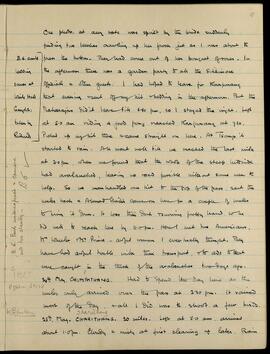
              One photo. at any rate was spoilt by the bride suddenly finding two leeches crawling up her frock just as I was about to press the button. They had come out of her bouquet of roses. In the afternoon there was a garden party to all the Sikkimese officials & other guests. I had hoped to leave for Karponang that evening & sent off my kit & bedding in the afternoon. But the Maharajas didn't leave till 6.30 pm, so I stayed the night. Left at 5.0 am riding a good pony & reached Karponang at 7.30. Picked up my kit there & came straight on here. At Tsomgo it started to rain. All went well till we reached the last mile at 3.0 pm, when we found that the whole of the steep hillside had avalanched, leaving no road possible without some men to help. So we manhandled our kit to the top of the pass, sent the mules back & Ahmad Sheikh came on here for a couple of mules to bring it down. It was then dark & raining pretty hard, so we did well to reach here by 11.0 pm. Here I met two Americans, Mrs Wheeler & Mrs Prince - awful women I eventually thought. They have had awful trouble with their transport, & to add to that were caught in the thick of the avalanches two days ago.

              B.G. Part underexposed - camera
              not too steady. - B.G.

              TIBET
              P.G. extra photos
              W. Bhutan

              24th May. CHUMBATHANG. Had to spend the day here as the mules only arrived over the pass at 2.30 pm. It rained most of the day, & all I did was to shoot a few birds.

              25th May. CHARITHANG. 10 miles. Left at 5.0 am, arrived about 1.0 pm. Cloudy & misty at first clearing up later. Rain

              Page 163
              LSH/1/1/1/1/163 · Part · 1933-09-24
              Part of The Ludlow & Sherriff Collection

              CONTENT:
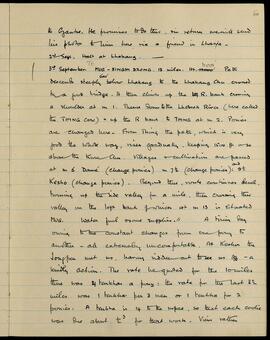
              to Gyantse. He promises to do this, in return we will send
              his photos to him here via a friend in Lhasa.

              2nd Sept. Halt at Lhakang.

              3rd September. TO MUG-SINGH DZONG. 13 miles. Ht. 11000'. Path
              descends 600' steeply below Lhakang to the Lhakang Chu crossed
              by a good bridge. It then climbs up the R. bank crossing
              a shoulder at m 1. Thence down to the Lhobrak River (here called
              the THING CHU) & up the R bank to THING at m 2. Ponies
              are changed here. From Thing the path, which is very
              good the whole way, rises gradually, keeping 1500 ft or so
              above the Kuru Chu. Villages & cultivation are passed and
              at m 6 Damé (change ponies) m 7 1/2 (change ponies) and 9 1/2
              Kesho (change ponies). Beyond this, route continues level,
              turning up the side valley for a mile, then crossing this
              valley on the left bank on which at m 13 is situated
              MUG. Water fuel & some supplies. // A tiring day
              owing to the constant changes from one pony to
              another - all extremely uncomfortable. At Kesho the
              Jongpen met us, having ridden out to see us off - a
              kindly action. The rate he quoted for the 10 miles
              there was 4 tenkhas a pony: the rate for the last 3 1/2
              miles was 1 tenkha per 3 men or 1 tenkha for 2
              ponies. A tenkha is 14 to the rupee, so that each coolie
              was due about 1/2 d for that work. Views rather

              Page 125
              LSH/1/1/1/1/125 · Part · 1933-08-06
              Part of The Ludlow & Sherriff Collection

              CONTENT:
              Sh. Aug. Prim. tenuiloba 395. Prim. pygmaeana of rev. 397. Prim. macrophylla 400. Prim. dickieana 401.
              Prim. calderiana 412. Gentiana tubiflora 398, Gent. infelix 399. Diapensia himalaica v. typica 403,
              Draba stella-aurea var. polyadena 406. Cyananthus spathulifolius 408, Sax. hispidula 410
              Notholirion bulbuliferum 411. Cremanthodium thomsonii 414.
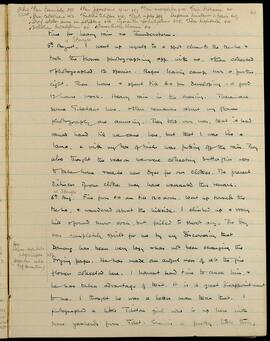
              Time for heavy rain vs thunderstorm.
              at Shingbe

              5th August. I went up myself to a spot close to the Meba & took the flower photographing app. with me, & there collected & photographed 12 species. Before leaving camp, took a further eight. Then home & spent till 6.0 pm developing - a good 12 hours work. Heavy rain in the evening. There are some Tibetans here, whose remarks about my flower photography are amusing. They told our men, that it had rained hard till we came here, but that I was like a lama, & with my box of tricks was putting off the rain. They also thought the reason we were collecting butterflies was to take home & make new dyes for our clothes. The present dirtiness of our clothes may have warranted this remark.

              at Shingbe
              6th Aug. Fine from 6.0 am till 12.0 noon. Went up towards the Meba, & wandered about the hillside. I climbed up a rocky hill & found snow cock, but failed to shoot any. The day was completely spoilt for me by my discovering that Damong has been very lazy & has not been changing the drying paper. He has made an awful mess of all the fine flowers collected here. I haven't had time to check him, & he has taken advantage of that. It is a great disappointment to me. I thought he was a better man than that. I photographed a little Tibetan girl who is up here with some yakherds from Tibet. She is a pretty little thing,

              Prim. capitata subsp. crispata 451
              Aconitum 452 (aff. leucanthum)

              LSH/1/1/9/1/103 · Part · 1949-07-12
              Part of The Ludlow & Sherriff Collection

              SUMMARY:
              The diary describes travel over the Namda La from Kyikyi Tsum, descending past a lake to yakherds' huts in mist and rain, with notable size and color differences in Meconopsis horridula across the pass. A messenger from Ludlow (at Chachhunang) prompts letters to Ludlow and to the Sonpon’s household, as the Sonpon has gone to Tibet. On 17 July, in thick mist and rain en route to Jiutang, abundant Meconopsis bella and Primula umbratilis are observed on steep cliff faces.

              CONTENT:
              The place is called Kyikyi Tsum
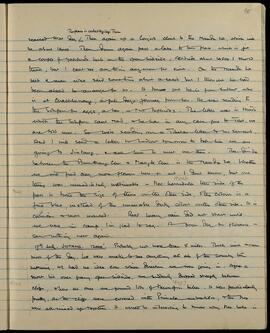
              reached that day. Then again up a longish climb to the Namda La, which will be about 16000'. Then down again past a lake to this place, which is just a couple of yakherds' huts on the open hillside. Altitude about 14500 I should think, but I can't see anything anywhere for mist. On the Namda La met a man who said something about a sahib, but I thought he had been ahead to arrange for us. It turns out he is from Ludlow, who is at Chachhunang, a full day's journey from here. He was sending to the Sonpon for eggs, a hen, and two taphukas. The letter was in Hindi which the Sonpon can't read, and he has in any case gone to Tibet, we are told now. So we're sending on a Tibetan letter to his servants. And I will send a letter to Ludlow tomorrow to tell him we are going to Jiutang, and ask him to meet me there. The divide between the Bumthang Chu and Mangde Chu is the Namda La. Whether we will find any more flowers here or not I don't know, but one thing was immediately noticeable — Meconopsis horridula this side of the pass is twice the size of those on the other side, and the colour is a fine blue, instead of the miserable dirty colour on the other side. It is curious and most marked. Real heavy rain did not start until we were in camp, I'm glad to say. A poor day for flowers — saw nothing new again.

              17th July. JIUTANG. 12000'. Probably not more than 5 miles. Thick mist and rain most of the day. We were unable to see anything at all of the country this morning, and had no idea even which direction we were going in. After a short bit over grassy open hillside, we suddenly dropped steeply between cliffs, where at once we found lots of Meconopsis bella. It was particularly pretty, as the cliffs were covered with Primula umbratilis, and the two were all mixed up together. It would be interesting to know why Meconopsis bella is

              LSH/1/1/3/3/98 · Part · 1933-04-09
              Part of The Ludlow & Sherriff Collection

              SUMMARY:
              The diarist notes that a bird considered rare in textbooks is actually abundant at all altitudes in SE Tibet and seen daily. Multiple observation dates at Jora are listed, with a citation that Ludlow described Trochalopterum henrici in Ibis 77. The route is noted as five miles to Trashi Tongme where the Loro Karpo Chu forms the Chayul river.

              CONTENT:
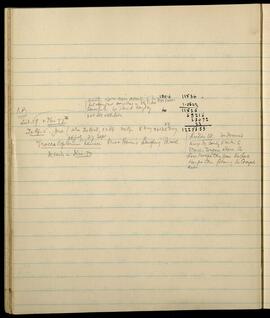
              another rare avis according to the text book 180.6 11536
              but abundant everywhere in SE Tibet. 1.0622
              Henceforth be seen everyday 60 11536
              at all altitudes. 69216
              23072
              NB 23
              Lud. 59 v Ibis 77* -------
              20 April. Jora (also 20 April, 22 Ap. 24 Ap. 8 May 24 & 25 May. 27 12253.53
              26 July, 27 Sept. Ludlow 58. he described
              Trochalopterum henrici Prince Henri's Laughing Thrush. through the country 5 miles to
              details in Ibis 77 Trashi Tongme where the
              Loro Karpo Chu joins the Loro
              Karpo Chu forming the Chayul
              river.