Área de identidad
Código de referencia
Título
Fecha(s)
- 1936-11-04 (Criação)
Nivel de descripción
Volumen y soporte
1 page
Área de contexto
Nombre del productor
Institución archivística
Historia archivística
Origen del ingreso o transferencia
Área de contenido y estructura
Alcance y contenido
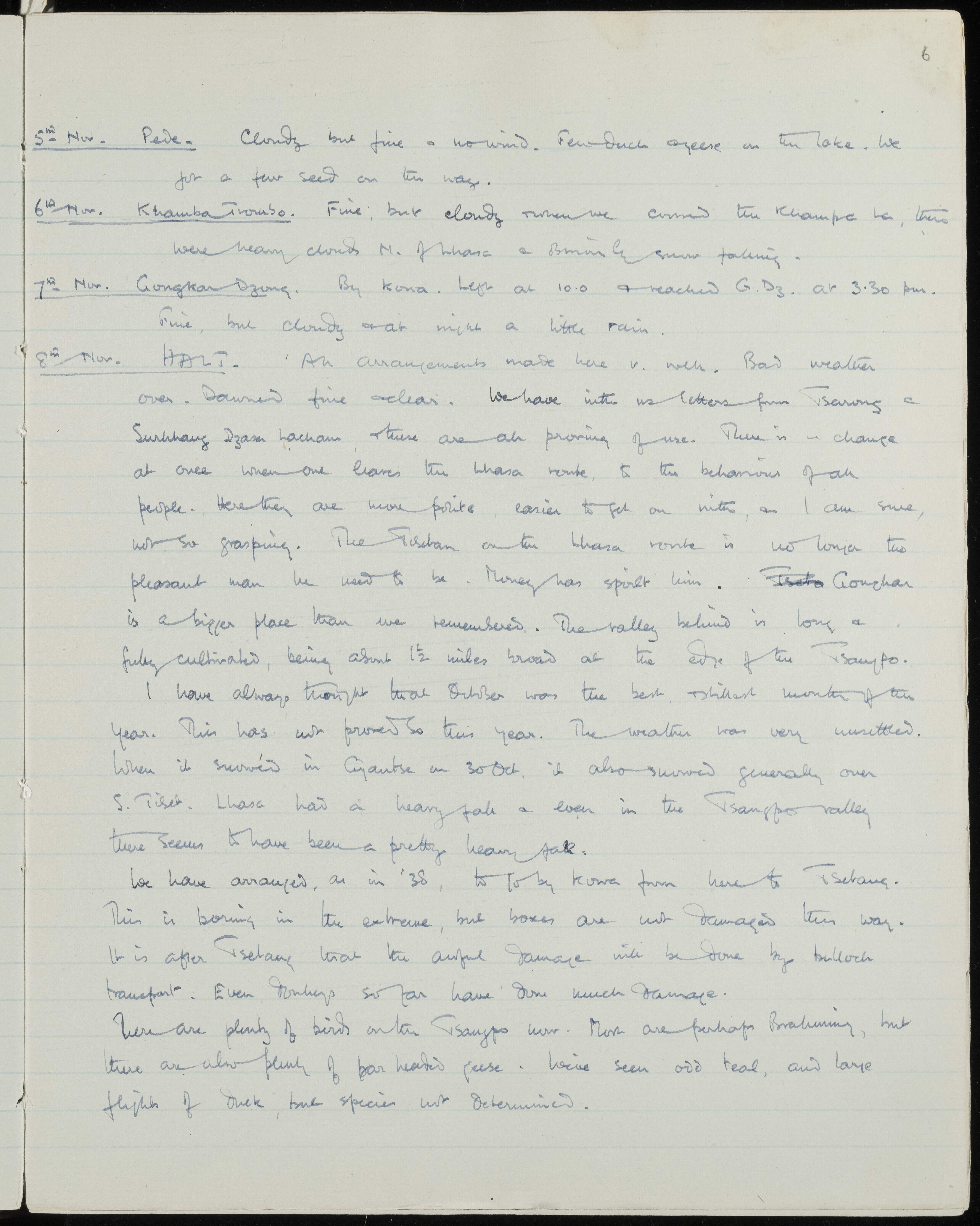
SUMMARY:
Entries record travel from Pede via Khamba La to Gongkar Dzong, with variable weather including snow north of Lhasa and some rain. At Gongkar they halt, note improved local attitudes off the Lhasa route, and arrange to go by kowa to Tsetang with useful letters from Tsarong and Surkhang Dzasa Lacham. They remark on recent widespread snowfall in S. Tibet around 30th Oct, the cultivated Tsangpo valley, and abundant waterfowl including Brahminy and bar-headed geese.
CONTENT:
6
5th Nov. Pede. Cloudy but fine and no wind. Few ducks and geese on the lake. We got a few seeds on the way.
6th Nov. Khamba Trombo. Fine, but cloudy when we crossed the Khamba La, there were heavy clouds N. of Lhasa and snow falling briskly.
7th Nov. Gongkar Dzong. By kowa. Left at 10:00 and reached Gongkar Dzong at 3:30 pm. Fine, but cloudy and at night a little rain.
8th Nov. HALT. All arrangements made here very well. Bad weather over. Damned fine and clear. We have with us letters from Tsarong and Surkhang Dzasa Lacham, these are all proving of use. There is a change at once when one leaves the Lhasa route, to the behaviour of the people. Here they are more polite, easier to get on with, and I am sure, not so grasping. The Taspon on the Lhasa route is no longer the pleasant man he used to be. Money has spoilt him. Gongkar is a bigger place than we remembered. The valley behind is long and fully cultivated, being about 1½ miles broad at the edge of the Tsangpo.
I have always thought that October was the best, stillest month of the year. This has not proved so this year. The weather was very unsettled. When it snowed in Gyantse on 30th Oct, it also snowed generally over S. Tibet. Lhasa had a heavy fall and even in the Tsangpo valley there seems to have been a pretty heavy fall.
We have arranged, as in '38, to go by kowa from here to Tsetang. This is boring in the extreme, but boxes are not damaged this way. It is after Tsetang that the awful damage will be done by bullock transport. Even donkeys so far have done much damage.
There are plenty of birds on the Tsangpo now. Most are perhaps Brahminy, but there are also plenty of bar-headed geese. Have seen odd teal, and large flights of duck, but species not determined.
Valorización, destrucción y programación
Acumulaciones
Sistema de arreglo
Área de condiciones de acceso y uso
Condiciones de acceso
Condiciones
Idioma del material
Escritura del material
Notas sobre las lenguas y escrituras
Características físicas y requisitos técnicos
Instrumentos de descripción
Área de materiales relacionados
Existencia y localización de originales
Existencia y localización de copias
Unidades de descripción relacionadas
Área de notas
Identificador/es alternativo(os)
Puntos de acceso
Puntos de acceso por materia
Puntos de acceso por autoridad
- Tsarong (Materia)
- Surkhang Dzasa Lacham (Materia)