Tibet

Elements area

Taxonomy

Code

Scope note(s)

    Source note(s)

      Display note(s)

        Hierarchical terms

        Tibet

          Equivalent terms

          Tibet

            Associated terms

            Tibet

              192 Archival description results for Tibet

              192 results directly related Exclude narrower terms
              LSH/1/1/1/1/165 · Part · 1933-09-24
              Part of The Ludlow & Sherriff Collection

              SUMMARY:
              Notes damp weather, farewell to Pimbo, Kuntip, and Danong while taking on Tenduk, with praise for the Bhutanese workers; Tenduk will help with Kusho until the party returns to Sikkim. Describes dry, treeless country, the Kuru Chu gorge near Lhakang and its several local names, steady progress by coolies including many women wearing the Lhassa head dress, and few notable flowers or birds. A margin note mentions reunion at Yatung on Oct 3.

              CONTENT:
              81

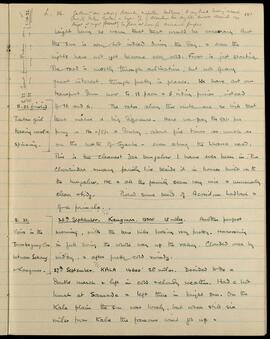
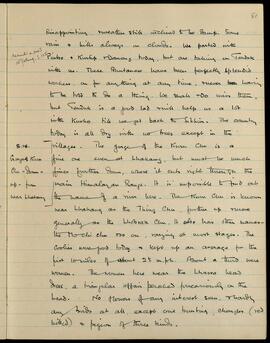
              Disappointing, weather still inclined to be damp. Some rain & hills always in clouds. We parted with Pimbo & Kuntip & Danong today, but are taking on Tenduk with us. These Bhutanese have been perfectly splendid workers, on for anything at any time, never having to be told to do a thing. We shall miss them, but Tenduk is a good lad will help us a lot with Kusho till we get back to Sikkim. The country today is all dry with no trees except in the villages. The gorge of the Kuru Chu is a fine one even at Lhakang, but must be much finer further down, where it cuts right through the main Himalayan Range. It is impossible to find out the name of a river here. The Kuru Chu is known near Lhakang as the Thing Chu, further up more generally as the Lhobrak Chu. It also has other names - the Mo chi chu & so on, varying at most stages. The coolies were good today & kept up an average for the first 10 miles of about 2 1/2 m.p.h. About a third were women. The women here wear the Lhassa head dress, a triangular affair perched precariously on the head. No flowers of any interest seen, & hardly any birds at all, except one bunting, choughs (red billed) & pigeon of three kinds.

              reunited on Oct 3 at Yatung. S. 105
              B. 26. Gorge of Kuru Chu - down
              LSH/1/1/6/1/107 · Part · 1933-07-21
              Part of The Ludlow & Sherriff Collection

              SUMMARY:
              After an unexpectedly sunny evening, the party explored the comparatively dry area of Go nyi re between here and Tsela Dzong, recording several Primula taxa and a common small Meconopsis also seen at the Tum La, plus a robust yellow Meconopsis that may be a new species. Plans are weighed against the Kucha La trip, with 10 days until due at Tse and an intention to focus on drier areas north of the Tsangpo rather than returning to the Main Range, amid coolie difficulties.

              CONTENT:
              Gonyi re.

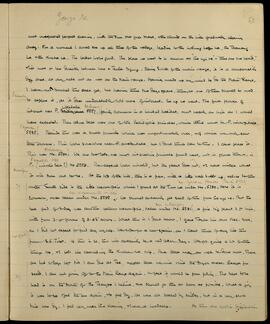
              Most unexpected perfect evening, with the sun out full blast, the clouds on the hills gradually clearing away. For a moment I could see up all three of the valleys, leading to the Holung Logu La, the Tsanang La and the Kucha La. The latter looks good. The place we went to is known as "Go nyi re" - "there are two heads," this more or less directly between here and Tsela Dzong. Being South of the main range, it is a comparatively dry area, at any rate not as wet as the main range. Having made up my mind to do the Main Range, I have not touched this area yet, but having these two days spare, thought one of them should be used to explore it, as it does undoubtedly look more of interest. So up we went. The first flower of interest was P. littledalei (baileyana?) 5887, fairly common in a limited habitat, and nearly as high as I would have expected. Then above that was one of the Bellidifolia primulas, which I think must be P. micropala, 5888. Beside this was a small primula which was unfortunately over, of which we only saw three flowers. This looks somewhere near P. atrodentata, but I don't think can be this. I can't place it. This was No. 5890. We are too late, a most interesting primula found next, not in flower though, is P. (nivalis Sect?) No 5889. The capsule looks nivalid, but the plant does not, and I have no idea what it will turn out to be. At the top of the hill, there is a pass, with a little wall built up, and close to this on the South side is the little meconopsis which I found at the Tum La under No. 5790. Here it is common, and was taken under No. 5895. We should certainly get seed of this from Gonyi re. But the best find of today was another yellow meconopsis, taken under No. 5891, a fine big plant 2 feet high, with from 3 to 10 flowers of 3-4½" across. What this is I don't know. I gave Taylor his own Mec. book, as I did not expect to find any myself. We hope for a new species, as I can't think of any like this from S.E. Tibet. If this is so, this will certainly be a red letter day. We got quite a lot of other things too, and I felt like cancelling the Kucha La trip. But that may as well be done now. There are but 10 days left till I am due at Tse, and after that we will visit the dryer areas. Except for seed, I am not going off to the Main Range again. In fact it would be poor policy. The best to be had is on the North of the Tsangpo I believe, and we should go there as soon as possible. What a joy it was to see and feel the sun again, and to feel dry. We were all soaked by midday, but in a very short time were dry. I feel very weak this evening, and have a headache. As there are coolie difficulties.

              George Sherriff
              GB 235 LSH/1 · Series · 1898 - 1967
              Part of The Ludlow & Sherriff Collection

              This collection consists of material created and gathered from the expeditions of George Sherriff in Bhutan and Tibet during 1933-1949.

              The collection consists of 5 sub-series: diaries, correspondence, expedition material, visual material, and plant collection documentation.

              [1] Diaries: This series consists of the original diaries of George Sherriff during his expeditions.

              [2] Correspondence: This series consists of a variety of correspondence from and to George Sherriff.

              [3] Expedition Material: This series consists of a variety of expedition documents ranging from itineraries and maps to administration lists and passports.

              [4] Visual Material: This series consists of a variety of material including: photographic material, films and videos. Photographic material ranges from prints and negatives taken by Sherriff and Ludlow to prints of digital images taken as exhibition documentation in 2014. The films are..... There have been dvd surrogates made of the films to ensure continued accessibility.

              [5] Plant Collection Documentation: This series consists of a variety of material which includes plant and seed lists from their expedition with a large focus on Primula, Meconopsis and Rhododendrons, as well as publications gathered by Ludlow and Sherriff which cover their shared interest in the Himalayan region and it's flora and fauna. There is also a garden register donated by the Knox Finlay family detailing the progress of plants/seeds in their gardens acquired from various expeditions including Ludlow and Sherriff's between 1951-52.

              Sherriff, George
              LSH/1/1/3/3/14 · Part · 1936-02-09
              Part of The Ludlow & Sherriff Collection

              SUMMARY:
              At dawn the party observed several skeins of Greylag Geese passing their ridge and heading north toward the Chungkar range and the Tibetan plateau; in the evening they tuned in to Indian and Scottish reels before turning in early. On the Deo Chu below the first river crossing they encountered a large Bhutanese encampment where lac from East Bhutan was being bought by Tobgye's agents and sent to Calcutta, noting beeswax and an altitude of about 2000 feet.

              CONTENT:
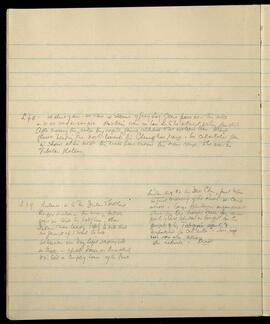
              L. p. 8 - At about 7 am. we saw 4 skeins of Greylag Geese pass over the ridge on which we were encamped. One skein was so low as to be almost within gunshot. After crossing the ridge they rapidly gained altitude & we watched them through glasses heading due north towards the Chungkar range. We calculated that in 3 hours at the most they would have crossed the main range & be over the Tibetan plateau.

              L. p. 9 Listened in to the Indian & Scottish Reel music in the evening, but we were so tired by half ten, when Delhi was ready, except to note that we gave it up & went to bed. We have our own daylight saving time on trek - up at dawn or thereabouts & in bed a couple of hours after dusk.

              Ludlow 8-9 On the Deo Chu, just below the first crossing of the River we came across a large Bhutanese encampment where the lac brought down from various parts of East Bhutan is bought from the people by Tobgye's agents & despatched to Calcutta. Some good beeswax also noted. The altitude 2000'

              LSH/1/1/6/1/9 · Part · 1933-02-27 - 1933-03-02
              Part of The Ludlow & Sherriff Collection

              SUMMARY:
              Diary notes cover travel from Gautsa to Phari, Tuna, and Dochen, dealing with delayed transport, missing supply boxes, and assembling a large mule caravan. The party notes an evening earthquake, listens to the Scotland–Ireland match result from Murrayfield, and reports strong winds, clear views of Chomolhari, and a telephone call to Gyantse.

              CONTENT:
              4

              instead of Tibetan, it was overdone. There must have been eight courses or even more. The poor fiancée had great trouble with her food, probably the first time she had had any that way. There was a small earthquake in the evening. We were just in time to hear the last five minutes of the Scotland-Ireland match at Murrayfield and get the result.

              NB 27th Feb. To Gautsa. 12 miles. Transport very late in starting and was not off till 9.30 am. Fine day. On the way up we passed some yaks, on them I saw boxes labelled Harrods. Later on I noticed my own name, and these boxes turned out to be Harrods stores, which were sent on a month ago, and should have been in Gyantse long ago. Nothing we said upset the yak men, and they fully intended to go to Phari only on the 1st March. But they now promise to get there tomorrow. Very little life on the way up. Lingmathang is a beautiful meadow, but dried up and brown now. Saw signs of a gentian above Lingmathang.

              28th Feb. To Phari. 17 miles. After a bad night of wind and some snow, today was perfect, with bright sun and very little wind. Chomolhari was clear of cloud till the evening, then cleared after an hour or two. We got our Harrods boxes on here, found Pintso waiting for us, but no Tenduk. We also found my very important Ha box had not been sent on here. These are both serious, but we hope can be put right before long. From now on we have a terrific caravan of mules.
              6 riding ponies & 35 pack mules

              1st March. To Tuna. 21 miles. Fine morning, slowly clouding over. Wind rose at 10.0 am and was very strong and cold all day, but in our backs, thank goodness. We got off in good time. 17 loads were sent through to Gyantse, while the rest came with us. The rate for everything is Rs 8/4 to Gyantse. Jibi walked all the way and is feeling very tired this evening, and a bit footsore. Chomolhari looked lovely the whole march, as we gradually came round it.

              Extract from Tuna Bungalow book. — "On a specialist's recommendation, a Poona man came on vacation. He said 'I'd far sooner have Poona than Tuna, it seems a more lively hill station.'"

              2nd March. To Dochen. 14 miles. Fine all day but very windy. Views of Chomolhari wonderful, especially in the evening. We telephoned to Gyantse this afternoon and got the P.T.O. to open.

              LSH/1/1/1/1/9 · Part · 1933-05-02
              Part of The Ludlow & Sherriff Collection

              SUMMARY:
              After staying at the Himalayan hotel in Kalimpong and meeting several contacts, the party arranged travel to Gangtok. On 26 April in Gangtok, Tobgye assisted in planning permits and a collecting route: Chumbi Valley near Lingmatang mid-May to early June, then the Ha area north of Ha and west of the Paro watershed, with plans to join Williamson and proceed toward Bumthang for a month’s collecting.

              CONTENT:
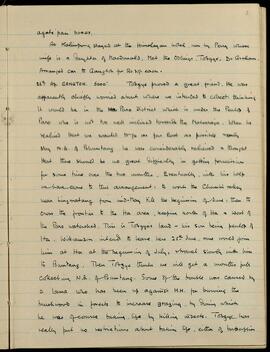
              agate 'pan' boxes,

              At Kalimpong stayed at the Himalayan hotel, run by Perry whose wife is a daughter of Macdonald. Met the Odlings, Tobgye, Dr. Graham. Arranged car to Gangtok for Rs 30/- each.

              26th Ap. GANGTOK. 6000'. Tobgye proved a great friend. He was apparently chiefly worried about where we intended to collect: thinking it would be in the Ha Paro District which is under the Penlop of Paro who is not too well inclined towards the Maharaja. When he realised that we wanted to go as far East as possible really, say N.E. of Bumthang he was considerably relieved & thought that there should be no great difficulty in getting permission for some time over the two months. Eventually, with his help we have come to this arrangement: to work the Chumbi valley near Lingmatang from mid-May till the beginning of June: then to cross the frontier to the Ha area, keeping north of Ha & West of the Paro watershed. This is Tobgye's land - his son being penlop of Ha. Williamson intends to leave here 25th June, and would join him at Ha at the beginning of July, travel slowly with him to Bumtang. Then Tobgye thinks we will get a month's full collecting N.E. of Bumtang. Some of the trouble was caused by a lama who has been up against H.H. for burning the brushwood in forests to increase grazing, by doing which he was of course taking life by

              LSH/1/1/2/1/215 · Part · 1933-10-09
              Part of The Ludlow & Sherriff Collection

              SUMMARY:
              The page records inquiries about the frontier with Tibet, noting Dis (Thib) La as the boundary and classifying Chang Pu and Manam as Bhutanese, Beting on the frontier, and Sanglung as Tibetan. It describes a hot day’s march from Trashiyangsi to Tsirgom via Chunkara monastery, descending to a cantilever bridge near the junction of the Tawang and Tyangsi Chus and then following the Trashiyangsi River.

              CONTENT:
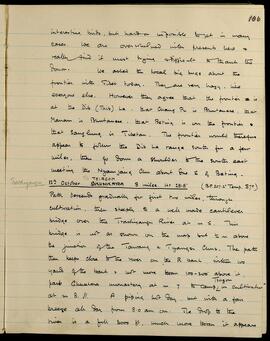
              interesting birds, but hard or impossible to get in many cases. We are overwhelmed with presents here and really find it most trying and difficult to thank the donor. We asked the local big bugs about the frontier with Tibet today. They are very hazy, like everyone else. However they agree that the frontier is at the Dis (Thib) La: that Chang Pu is Bhutanese: that Manam is Bhutanese: that Beting is on the frontier and that Sanglung is Tibetan. The frontier would therefore appear to follow the Dis La range south for a few miles, then go down a shoulder to the south east meeting the Nyamjang Chu about due E of Beting.

              Trashiyangsi 12th October TO TSIRGOM CHUNKARA 8 miles. Ht 2818' (BP. 207.2' Temp. 87°)

              Path descends gradually for first two miles, through cultivation, then steeply to a well made cantilever bridge over the Trashiyangsi River at m 5. This bridge is not as shown on the map but 1/4 m above the junction of the Tawang and Tyangsi Chus. The path then keeps close to the river on the right bank within 100 yards of the bank and not more than 100-200' above it, past Chunkara monastery at m 7 to camp Tsirgom in cultivation at m 8.11. A piping hot day, but with a fair breeze all day from 8.0 am on. The drop to the river is a full 3000 ft, much more than it appears.

              LSH/1/1/6/1/20 · Part · 1938-03-21
              Part of The Ludlow & Sherriff Collection

              SUMMARY:
              Travel account from Tsetang through Lhagyari over the Putrang La to the Tsangpo at Dzam, along to Nang Dzong, and via the Kongbo Nga La to Molo, noting wetter forests, pheasants, and a large black woodpecker, with arrival at Molo on April 14. Notes include Abba Lulla showing Bailey-related letters and observations of bar-headed geese and the valley's daily wind patterns.

              CONTENT:
              10a

              Ibis 53 . 26 March - April 14.

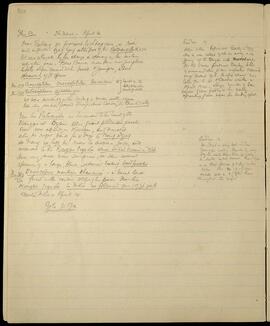
              From Tsetang we proceeded to Lhagyari, a rich and important Dzong lying at the foot of the Putrang La 16,470. We were struck by the change in scenery on the eastern side of the pass. Bare barren mountains now gave place to whole slopes covered with birch & juniper, where pheasants of 2 species

              Ibis 377 Crossoptilon crossoptilon harmani } lurked in the Rhododendron undergrowth
              Ibis 382 Tetraophasis szechenyii

              We were entering on the borders of a much wetter region than any we had passed through since leaving the Chumbi Valley.

              From the Putrang La we descended to the level of the Tsangpo at Dzam where giant pollarded peach trees were already in blossom, and marched along the right bank for 4 days to Nang Dzong. At Nang we left the river to avoid a gorge, and ascended to the Kongbo Nga La which we had crossed in 1936. Here, very much to our surprise, we saw several specimens of a large, black, satanic-looking woodpecker

              Ibis 369-372 Dryocopus martius khamensis - in burnt larch forest on the western slopes of the pass. From the Kongbo Nga La to Molo we followed our 1936 route reached Molo on April 14.

              Go to p. 17a


              Ludlow 19
              Abba Lulla befriended Bailey in 1913 when he was robbed of all his money on his journey up the Tsangpo with Morshead. The old trader produced Bailey's letter of recommendation for our inspection & seemed very proud of it. He also showed us a letter from K. W. & Cawdor written in April 1924. Large number of bar-headed geese feeding on the newly sprouting grass near the landing ghat.

              Ludlow 20.
              The dust is very bad in this Tsangpo valley. Regularly every day the wind blows down the valley from 10 am until sunset. Then there is a short period of calm until 10 pm. Then the up-stream wind sets in & (often) blows throughout the night.

              LSH/1/1/3/3/62 · Part · 1936-03-10
              Part of The Ludlow & Sherriff Collection

              SUMMARY:
              Notes record obtaining a male Fire-capped Tit (Cephalopyrus flammiceps saturatus), apparently the first for Bhutan, with prior occurrence noted in the lower Nyam Jang Chu Valley in 1936 and a Yunnan specimen from the Tengyueh district described by Rothschild as C. f. olivacea. The writer describes crossing into the Nyam Jang Chu Valley and the Tibet–Bhutan boundary near Jangphu, and remarks on the Rufous Woodpecker’s penetration up the Manas Valley.

              CONTENT:
              Lud. 634. Got the Fire-Capped Tit -
              3668 ♂ Cephalopyrus flammiceps saturatus - a bird
              that has not hitherto been met with in Bhutan.
              L. Ibis 205 - Met with in the lower Nyam Jang Chu Valley in
              1936, but not seen in this year so the species
              cannot be plentiful.
              In Yunnan Forrest obtained a ♂ in the Tengyueh
              district which Rothschild described as
              C. f. olivacea.

              2027 : 4910
              10688
              63 4910
              29460
              39280
              393
              5208921

              L. p 35. We soon crossed the spur that separates us from the Nyam Jang Chu Valley.
              The latter is massive & we could see the snows above Tawang near the Bum La where
              we crossed in 1934. The boundary between Tibet & Bhutan was crossed just below our camp
              at Jangphu? It was just a dry watercourse. It is strange that such insignificant
              geographical landmarks should be used for boundaries when others such as the Nyam Chang
              Chu itself, for example, are available at a mile or so distance.
              Rufous woodpecker Micropternus brachyurus phaeoceps (Ibis 364)
              in the Nyam Jang Chu Valley shows an interesting penetration up the main
              Manas Valley well into the interior.

              LSH/1/1/1/1/205 · Part · 1933-10-01 - 1933-09-27
              Part of The Ludlow & Sherriff Collection

              SUMMARY:
              Notes record collecting seeds of Aconitum napellus ludlowii and observations on transport reductions, high pony/donkey rates compared with Gyantse and the Lhasa road, and a notably clean dak bungalow. Additional entries describe views in the Trumbagung Chu between Sakang and Kangmar, harvesting, weather, and a double march via Samada to Kala.

              CONTENT:
              101
              1.10.33
              L. 116. Gathered some seeds of Aconitum napellus ludlowii. A very dark "Grosny" aconite. One of its tubers contains a higher % of Aconitum than any other known aconite so the thing might possibly be found of use for medicinal purposes.

              Sent from Phari
              B 32
              B 33
              height being so warm that that would be necessary. But the sun is very hot indeed during the day, & even the nights have not yet become very cold. Frost is just starting. The road is mostly through cultivation, but not of any great interest, though pretty in places. We have cut our transport down now to 13 pack & 5 riding ponies, instead of 16 and 6.

              B-32 finished
              Tibetan girl teasing wool & spinning.
              The rates along this route are so high that that makes a big difference. Here we pay Rs 1/3/- per pony or Rs -/8/- a donkey, about five times as much as on the north of Gyantse — even along the Lhasa road. This is the cleanest dak bungalow I have ever been in. The chowkidar and family live beside it in houses built on to the bungalow. He & all the family seem very nice & unusually clean & tidy. Picked some seeds of Aconitum Ludlowii & of a primula.

              B. 33.
              Views in the Trumbagung Chu between Sakang & Kangmar.
              26th September. Kangmar. 13900' 15 miles. Another perfect morning, with the bare hills looking very pretty. Harvesting in full swing the whole way up the valley. Clouded over by midday, & after pretty cold & windy.

              27th September. To KALA 14600' 28 miles. Decided to do a double march & left in cool cloudy weather. Had a hot lunch at Samada & left there in bright sun. On the Kala plain the sun was lovely, but when still six miles from Kala the famous wind got up.