Tibet

Elements area

Taxonomy

Code

Scope note(s)

    Source note(s)

      Display note(s)

        Hierarchical terms

        Tibet

          Equivalent terms

          Tibet

            Associated terms

            Tibet

              192 Archival description results for Tibet

              192 results directly related Exclude narrower terms
              LSH/1/1/8/1/66 · Part · 1947-02-20
              Part of The Ludlow & Sherriff Collection

              SUMMARY:
              The page lists Kodachrome photo subjects around Gyala Peri, Namcha Barwa, Sanglung, and the junction of the Po and Kongbo Tsangpo near Gompo Ne, including scenes and local people at Tsakchungong. It also describes the route from Dzama to Tsakchungong with distances, passes (Tana La, Adju La), a cane bridge to Dorji Jung, gradients, and elevations, noting a magnificent view of the Gyala Peri range and Namcha Barwa.

              CONTENT:
              60

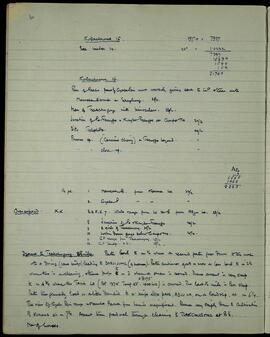
              Kodachrome 15. 197.0 = 7997
              See under 14. 42° : 1.0222
              7997
              15994
              1599
              159
              8174.5

              Kodachrome 16.
              Pan of peaks from Gyala Peri most westerly going east to G.P. then onto
              Namcha Barwa & Sanglung. 22/2.
              Men of Tsakchungong with binoculars. 22/2.
              Junction of Po Tsangpo & Kongbo Tsangpo at Gompo Ne 24/2
              Ditto Telephoto. 24/2
              Prunus sp. ("Carmine Cherry") & Tsangpo beyond. "
              " close up. "

              3280
              2
              6560
              1663
              8223

              1/4 pl. 1 Namcha B. from Karma La 22/2
              2 Gyala P. " " "
              Overexposed. XX 3, 4, 5, 6, 7. Whole range from W to E from Adju La. 23/2
              8 Junction of Po & Kongbo Tsangpo 24/2
              9 2 girls of Tsakchungong. 25/2
              10 Looking down gorge below Gompo Ne. 25/2.
              11 G.P. range from Tsakchungong. 25/2
              12 G.P. " x 2. 25/2

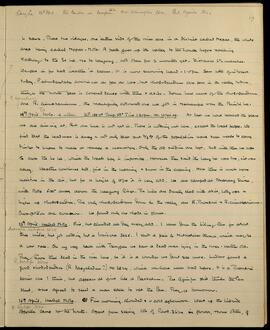
              Dzama to Tsakchungong. 8 1/2 miles. Path level to m 1/2 where a second path goes down to the river to a dring (cane bridge) leading to DORJI JUNG (4 houses). Path continues good & more or less level to m 2 1/2 where there is a clearing, thence drops to m 3 where a stream is crossed. Thence ascent is very steep = 8175' to m 4 3/4 where the TANA LA (BP 197.0° Temp 42°. 1000 hrs.) is crossed. The last 1/2 mile is less steep. Path then generally level or a little downhill to a knife edge pass, ADJU LA, on a landslip, at m 6 1/4. The view of Gyala Peri range & Namcha Barwa from here is magnificent. Runs very steeply down to cultivation of KUNONG at m 7 1/4. Ascent then gradual through clearing to TSAKCHUNGONG at 8 1/2.
              No of houses.
              LSH/1/1/8/1/16 · Part · 1946-11-14
              Part of The Ludlow & Sherriff Collection

              SUMMARY:
              Brief captions for Kodachrome slides note scenes at Tashi Lhunz, the 13th Dalai Lama’s birthplace, Chorten Para Gompa, a view from the top of Kongbo Ngala, and the Tsangpo between Nge and Shu, with dates in late November to early December. A note also records “Types at Shu.”

              CONTENT:
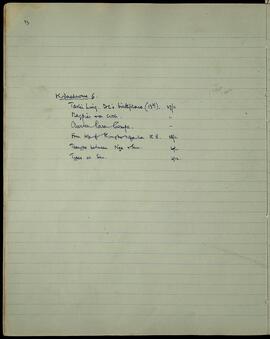
              13

              Kodachrome 6.
              Tashi Lhunz. DL's birthplace (13th). 27/11
              Magpies on rock. 27/11
              Chorten Para Gompa. 27/11
              From top of Kongbo Ngala to E. 28/11.
              Tsangpo between Nge & Shu. 30/11.
              Types at Shu. 3/12.

              LSH/1/1/8/1/19 · Part · 1946-11-14
              Part of The Ludlow & Sherriff Collection

              SUMMARY:
              The diary records movements from the east side of Kongbo-nga La via Mye to Shu, with delayed coolies and negotiations for transport. It notes forest and plant observations near the pass, attempts to contact Gyantse and Ford by wireless, strong winds, and halts on 1–2 Dec due to uncertain transport.

              CONTENT:
              Nang.

              28 Nov. Camp on E side of Kongbo-nga La. Coolies had not come in by 9.0, so we set off at 10.0 with about 30-40 loads only, leaving Samdup behind. A good day but spoilt by transport trouble. Reached the pass by 2.30 & in at camp - not at Nye - at 5.0pm. Coolies came in soon after except about 15 who only turned up next day. It was good to be in forest again, pine, larch & birch on the west side, & juniper, larch & birch on the E, with pine on N faces. Rhod. vellereum common, with two small Rhodos. On the E side saw some P. jaffreyana & a lot of Androsace of 3 species.

              29 Nov. Mye. A short march in today where we should have reached yesterday. Samdup also turned up by 11.0 & our kit has again caught us up. I saw two partridge on the way up the Pass. Ludlow then saw one 'Kuling' & another, while Ludlow missed a Crossoptilon on this side. This is the first village with pent wooden roofs. All to the W of this are flat roofed. The hilltops often have early morning mist on them now - a sign of a damper climate. I was surprised to see no Mec. simplicifolia on the pass - only M. horridula.

              30 Nov. Shu. An easy march. We were in by 1.0 (start 8.0) & coolies were in shortly after. A few were late. I tried to contact Gyantse at 3.30 pm (BT) by W/T, but got no answer. Later tried Ford (TASA) but again got no answer. Local Dzongpon's man tried to refuse to give us anything but day to day transport. We demanded 'Dzongyel', & we think we have succeeded, at the price of 2 days halt & a than of cloth & ten cigarettes! Supplies difficult, & we have hardly managed to get anything. Very strong wind in evening.

              1st Dec. Halt. Fine, but clouded by midday. Wind by 2.30.

              2nd Dec. Halt. Fine & clear & windy. We doubt if our transport will come as promised, by this evening. This is a bad place to get away from - in 1938 we were held up five days at Kyimdong Dzong.

              LSH/1/1/6/1/7 · Part · 1938-06-06
              Part of The Ludlow & Sherriff Collection

              SUMMARY:
              The party marches from Kupup to Yatung over the Jelep La in heavy snow, with difficult mule transport and botanical notes on Primula gracilipes. In Yatung they deal with a customs issue over cigarettes, receive mail from Gyantse, trace missing kit sent from Ha, meet a Subedar, and dine with local contacts.

              CONTENT:
              ...a few common orchids. Tseringpen wants to take a press tomorrow, in case we come across anything in the primula line.

              24th Feb. Kupup. 13 miles. Fine in the morning, but clouded over by 10 am. The rest of the day there was a heavy snowstorm, with rain and thunder in the valleys. We had intended to stop at Gnatong, but snow was heavy then, and we thought we might not reach the pass next day, so went on. I walked all the way, and was very tired indeed when we got in, as the climb is from 6500' to 13000', with some up and down thrown in. Went to bed early with a splitting headache. Near Lingti Primula gracilipes was just coming into flower, but the scapes hardly showed at all. Cleared up after dark.

              25th Feb. Yatung 18 miles. Very fine morning, though the valleys were full of cloud. We were a bit late in getting off, and transport reached the Jelep La about 10.30 am. Snow not very much, but an icy path down this side made the going very hard for the mules. Muleteers wanted to stop in Rinchengang, but we persuaded them to come on here, where they reached about 4.30. Found more Primula gracilipes (3580) on the way down. As soon as we got in, two people came to see us, so we could not have our tea, then Norbhu's son and the head clerk also came. The head clerk was more concerned about two loads of cigarettes which were among our muleteers' things. As there is a strict order against importing them, there was some trouble. We had promised the Khampa mule owners to take these up as our own. All our people seem fit and David is quite happy.

              26th Feb. Yatung. Halt. Fine all day. Got a good mail, sent back from Gyantse. Spent the day in writing letters, seeing the Subedar of the Det. 1/15th Punjab Regt., and dining with Norbhu's wife and Charles Marbleu. In between we tried to find out what had happened to our kit which was sent on by tonga, that from Ha. Eventually heard from Phari that the Ha kit was there, but they knew nothing of any other loads. Sub. Maryam Singh is a great talker and we know most of his life history before we left. Dinner with Norbhu's wife was rather a trial, though she, Charles and Charles' fiancée are all nice. We had English-style

              LSH/1/1/6/1/125 · Part · 1933-08-22
              Part of The Ludlow & Sherriff Collection

              SUMMARY:
              The party remains halted near Kyabden from 25–31 August due to Taylor’s continuing illness, collecting some Primula seed but otherwise limited in fieldwork. A letter from Ludlow at Shoga Dzong reports his rapid move to Tongyuk and dispatches toward Lhasa; the diarist replies via Temu La and proposes meeting at Sang or Nyima around Sept 10. Weather shifts from fine to heavy rain, and Tenduk returns after falling ill en route to Lhasa.

              CONTENT:
              Kyabden

              25th August. Halt. Went up hills due East of Kyabden river to other side. A fine and beautiful day, but very disappointing from the flower point of view. Got a good haul of seed of the little nivalid primula (P. amabilis 6192), taken first under the number 5883 at Ponyre - 21 Aug. Taylor better again, but very slow improvement.

              26th August. Halt. The weather is perfect now, and it is a great pity not to be able to make use of it. But it seems we will be a long time yet before being able to move. Taylor has no energy, and is very weak. He can walk a few hundred yards slowly and that is all. He still complains of a pain in the side now, below the ribs and above the hip bone. I think he must have strained something inside. Stayed in camp.

              27th August. Stayed in camp or close to it. Taylor rather worse again, feeling sick on 27th, but

              28th August. considerably better on 28th, and a good deal happier about himself.

              29th August. Halt. A letter at last from Ludlow who had come down fast to Shoga Dzong, where he got our second letter. On reading it, he decided to go on to Tongyuk, and started off there on the 26th. At the same time, he sent Kusho off to Lhasa and also a letter by post from Gyamda to Lhasa. Taylor much the same: there seems to be very little improvement. I wrote a letter to Ludlow today and sent it off to Tongyuk via the Temu La by a local who promises to reach there in four days. I have asked Ludlow to come and meet us at Sang or Nyima, where we hope to arrive about Sept 10th. There we must change all future plans according to Taylor's condition. I fear the year's work is really over, and that we will have to go home pretty quickly, or rather start soon and go slowly. The lovely weather we have been having has broken, and we have heavy showers again, but still with bright intervals. I do hope we have a good spell when we go down to Temu and Sang, so that I can at least get a glimpse of Gyala Peri and Namcha Barwa.

              30th August. Halt. Very heavy rain last night, and clouds low down this morning. Taylor not too good yesterday evening, but had a better night.

              31st August. Halt. Fine but cloudy. Rain last night. Taylor a different man today, full of beans. Tenduk arrived back at noon. He went via Shoga Dzong, Drugba Gompa and a pass beyond, but got fever and couldn't go on to Lhasa. So he returned to Gyamda and got a Dzongpen's man to go instead. He did...

              LSH/1/1/6/1/31 · Part · 1938-03-31
              Part of The Ludlow & Sherriff Collection

              SUMMARY:
              The party halts at Kyimdong Dzong for several days due to transport delays, washing and repairing gear, developing photographs, and interacting with local officials; the Tsongpen scouts a snowy pass and brings back a rhododendron, while the Dzongpen visits and provides provisions. Kyimdong is noted as the source of Lhasa note paper and has villages under it (Shu, Langong, Sumbatse); later they move to a camp below Taktsa after Pinto assembles animals, with Ludlow not yet following, and note coniferous forest along the route.

              CONTENT:
              up tomorrow to find one. That will mean a two days halt here. As we have not bathed or had clothes washed for a long time, that is quite a good thing. Daud, I'm afraid is not a great success always. His cooking is excellent, but he is always quarrelling with someone, Ramzana, Pinto or Tsongpen. I had to tell him off again today when we arrived.

              7th April. Halted Kyimdong Dzong. Fine morning, clouded evening. Tsongpen went to the la and reported only a foot of snow, so we can go that way. He also brought back a rhododendron (3607) = Rhod. vellereum. The Dzongpen came again to see us and stayed more than an hour. He gave us potatoes and flour, both very good. He is quite friendly and out to help. Spent the day washing ourselves and our clothes and trying to repair some of the badly smashed boxes.

              8th April. Halted KYIMDONG DZONG. Fine morning, clouded evening. Stayed in camp all day. Did a little developing etc. Kyimdong is the place where all the paper used to make notes in Lhasa comes from. The notes are made of double thickness paper of good quality (probably made from a Daphne sp.) and have a black "water mark" between the two. We have not used them yet, as they are not very popular. This is a queer place for a Dzong and this Dzongpen certainly does not like it. There were six houses, but Pinto says now there are only two. There is however a good deal of cultivation, and it has other villages under it, including Shu, Langong and Sumbatse.

              9th April. Halted KYIMDONG DZONG. "At least" 16 animals were promised without fail this morning, and the remainder by noon. By noon 8 had arrived, so we again pitched our tents and stayed the day. This doubt as to when or if we will get away from here is most annoying. If only the Dzongpen would say that we couldn't go for 10 days it would not be so bad, but he always says transport is just arriving. Fine morning, some rain clouds in the afternoon.

              10th April. 1 m. below TAKTSA. Still no sign of our yak transport, but Pinto scraped up 16 ponies and bullocks and came on with them, hoping Ludlow might be able to follow this evening. But he has not. The path is quite good, with a more or less steady ascent gradually getting into the conifer forest. On the hillsides (N face) are masses of larix, a fair amount of fir and some rhododendron and birch. At m 4 1/2 pass the ruined village of

              LSH/1/1/6/1/35 · Part · 1933-05-17
              Part of The Ludlow & Sherriff Collection

              SUMMARY:
              Diary notes from Lang La record snow, limited rhododendrons in the valley bottom, and plant collections. The route passes through the Nepar-Molo district with references to paths toward Se La and Langong, and previous finds at Natrampa and Bimbi La. On 14 April they reach Molo, noting measurements and that the headman is away while much of the population has been sent to carry timber to Lhasa.

              CONTENT:
              Lang La 13th April. Rh. lanatum var. luciferum 3620. Mec. betonicifolia 3621, Prim. bryoides 3622

              L bank. These two villages, one either side of the river are in a district called Nepar, the whole area being called Nepar-Molo. A path goes up the valley to the south before reaching Kethong to the Se La, so to Langong, not open for 2 months yet. Distance 2 1/2 marches. We are in for bad weather it seems. It is now snowing hard - 1.0 pm. Saw little of interest today. P. atrodentata continues as far as here, but rhododendrons are few in the valley bottom, though the north face is covered dense with them & abies. Down here most of the rhododendrons are R. cinnabarinum, the beautifully coloured one we got in Natrampa & on the Bimbi La.

              14th April. To Molo. 4 miles. B.P. 193.0° Temp. 56° Time 1.30 pm. Ht. 10700 ap. At last we have reached the place we are aiming at. But our luck is not yet in. There is nothing out here, except the local people. We find that the headman is away & not only that but 2/3rds of the population have been made to carry timber to Lhasa to make or remake a

              LSH/1/1/8/1/29 · Part · 1946-12-20
              Part of The Ludlow & Sherriff Collection

              SUMMARY:
              The diarist acquires a sheep and extra ponies to reach Temu La, aiming for views of snow mountains, and notes various birds including geese, a kite, Lophobasileus, a crossbill, a black woodpecker, a Sitta, and a large flock of Grandala. At Latsa Lunang above Tumbatse, poor visibility prevents mountain views; seeds of Notholirion hyacinthinum and two Berberis are collected, and weather and snow conditions are recorded before proceeding to Lunang.

              CONTENT:
              26

              very obliging, ready to help. We are getting a sheep here, & taking on 2 extra ponies to the Temu La. About 2 miles from here there were many geese, some duck on the open plain & on some odd water. I also saw one kite - only the second to be seen since India. Our main idea in coming on is to try to get views of the snow mountains from the Temu La while the good weather lasts, but I wonder if it will last. Clouds came up fast today & we would not have had good views had we been there today. Yesterday B & I were out up the valley for birds & got 2 more Lophobasileus, a crossbill, a black woodpecker & a Sitta which seems different to any we have yet got, & different to anything in the Fauna of B.I.

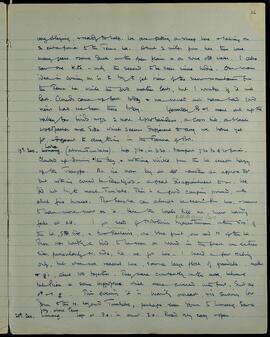
              19th Dec. Latsa Lunang (above Tumbatse). Left 7.30: in 3.30: transport 7.30 to 4.30 ponies. Clouded up during the day, & nothing visible from the La except hazy up the Tsangpo. An ice mass lay at 40° & another at approx 80°, but nothing could be identified - a great disappointment to us. We did not try to reach Tumbatse. This is a good camping ground, with about five houses. The Sancha can almost be seen from here, & seems to have more snow on it. Here the locals tell me, snow hardly falls at all. I got seed of Notholirion hyacinthinum within 500' of the La, SE side, & two Berberis, one blue fruit, one red N of the La. There was hardly a bird to be seen or heard in the forest on either side, particularly N side, till we got here - I heard a few calling only, but when we reached here, saw a large flock of Grandala, males & females, about 100 together. They were constantly on the move, between a tall Picea & some Hippophae which were covered with fruit. Shot one male or female. This evening it is heavily overcast, is snowing low down to the N beyond Tumbatse, perhaps even down to Lunang. Saw a jay, above Temo.

              20th Dec. Lunang. Left at 8.0: in about 2.0. Road very easy & open.

              LSH/1/1/8/1/63 · Part · 1947-02-20
              Part of The Ludlow & Sherriff Collection

              SUMMARY:
              Hunting continues and a Kalij is taken; tensions erupt between the Loto and Lome headmen, causing fights among coolies until Thompson calms the situation. The party travels toward Lubong and then Dzama in perfect weather, noting pine forests, landslides, seeds of Gaultheria, and views toward Gyala Peri and Namcha Barwa from near the Karma La.

              CONTENT:
              Hunting goes on here; one is constantly hearing the sound of a gun. I got one of Kalij this afternoon. There are two districts in this part of the Po Tsangpo below Trulung—Loto and Lome, divided at Dzama, each having a headman.

              21st Feb. LUBONG 5 1/2 m. The day started badly. Some coolies came early, some did not come. The headman of Loto, who was in charge, started cursing the coolies of the Lome headman and hit one. This started a regular fight with fists and sticks and a hell of a noise. We eventually got off, the headman staying behind shouting at everyone. He caught us up later, saying 3 men were after him with knives. But the trouble seemed to have settled till we got here, when it flared up again between the two headmen, who tried to throttle each other. Thompson did good work in quieting them down. The day was good, and the views fine. But we badly want a clear day tomorrow, as from the Karma La, both Gyala Peri and Namcha Barwa are visible, I'm told. It looks promising for tomorrow at present. We got seed of two Gaultherias, one with white fruit, locally called Sülü, which we have not seen before. The people here are nice, but the day has been somewhat spoilt by this awful row going on all the time. There is still very little to see of flowers of any kind, and I don't think we will get much either. Mostly the path is through pine forest, and there have been many landslides on both sides of the river. We saw a few Luculia trees, perhaps Luculia Pinceana, but in unripe fruit. From about 300' above camp, two very high snow mountains appear, one at bearing approx 170° (Namcha Barwa?) the other at approx 205° (Gyala Peri?). In the evening the headmen's quarrel was made up, and both were perfectly happy together. I prefer the Lome headman, who takes us on from tomorrow.

              22nd Feb. Dzama Left at 7.15. In at 1.30. A perfect day. Cold at night, but not a cloud all day, and the views astonishingly lovely. This is no easy route, but one well worth coming, especially if one gets weather like we are now having. It is absolutely perfect. Both of us are tired this evening, after the very steep ascent to the Karma La, which is a little

              LSH/1/1/8/1/64 · Part · 1947-02-20
              Part of The Ludlow & Sherriff Collection

              SUMMARY:
              Detailed route description from Lubong to Dzama, including streams, cultivation areas, the hut BRANGCHAM, and a steep ascent to Karma La with extensive views of the Gyala Peri Range. Bearings to nearby peaks and landmarks are recorded from Karma La, and bird observations are noted at Dzama and Lubong on 22/2.

              CONTENT:
              58

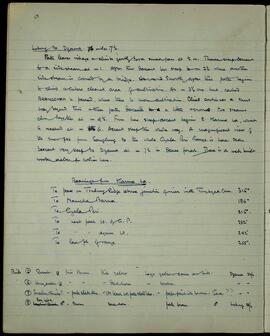
              Lubong to Dzama. 7½ miles.

              Path leaves village and climbs gently to a small pass at ½ m. Thence steep descent to a side stream at m 1. After this descent less steep to m 2½ where another side stream is crossed by a bridge. Shortly after this, path begins to climb, enters cleared area of cultivation. At m 3½ one hut, called BRANGCHAM, is passed, where there is more cultivation. Climb continues a short way beyond this, then path descends a little and crosses two streams close together at m 4½. From here steep ascent begins to Karma La, which is reached at m 6. Ascent steep the whole way. A magnificent view of the snow peaks from Sanglung to the whole Gyala Peri Range is here seen. Descent very steep to Dzama at m 7½ in dense forest. There is a well-built wooden shelter for coolies here.

              Bearings from Karma La.
              To pass on Trulung Ridge above junction of river into Tsangpo Canyon. 315°.
              To Namcha Barwa. 186°.
              To Gyala Peri. 215°.
              To next peak West of Gyala Peri. 232°.
              To next peak again West. 242°.
              To last peak of range. 255°.

              Birds

              1. Thrush. Female. Iris Brown. Bill yellow. Legs yellow same as bill. Dzama 22/2.
              2. Honeysucker. Female. Iris Brown. Bill dark horn. Legs brown. Dzama 22/2.
              3. Swallow Shrike? - pale slate blue. Upper Mandible black, Lower Mandible pale slate blue. Legs pale pinkish brown. Sex ?? Dzama 22/2.
              4. Bar-winged Laughing Thrush. Male - Brown. Bill dark horn. Legs pale brown. Male. Lubong 22/2.