Zona de identificação
Código de referência
Título
Data(s)
- 1933-08-15 (Produção)
Nível de descrição
Dimensão e suporte
1 page
Zona do contexto
Nome do produtor
Entidade detentora
História do arquivo
Fonte imediata de aquisição ou transferência
Zona do conteúdo e estrutura
Âmbito e conteúdo
SUMMARY:
Notes describe Migyitun harvesting methods and failures in vegetable cultivation despite some surviving crops. Observations record the Scaly-breasted Wren as common in Bhutan and nearby valleys, with its song noted at Taka-thum and occurrences at Lungi and Migyitun. On May 3rd the party ascended to the Tra La to seek seeds of Sclater's Monal and Kalij, with transport difficulties mentioned.
CONTENT:
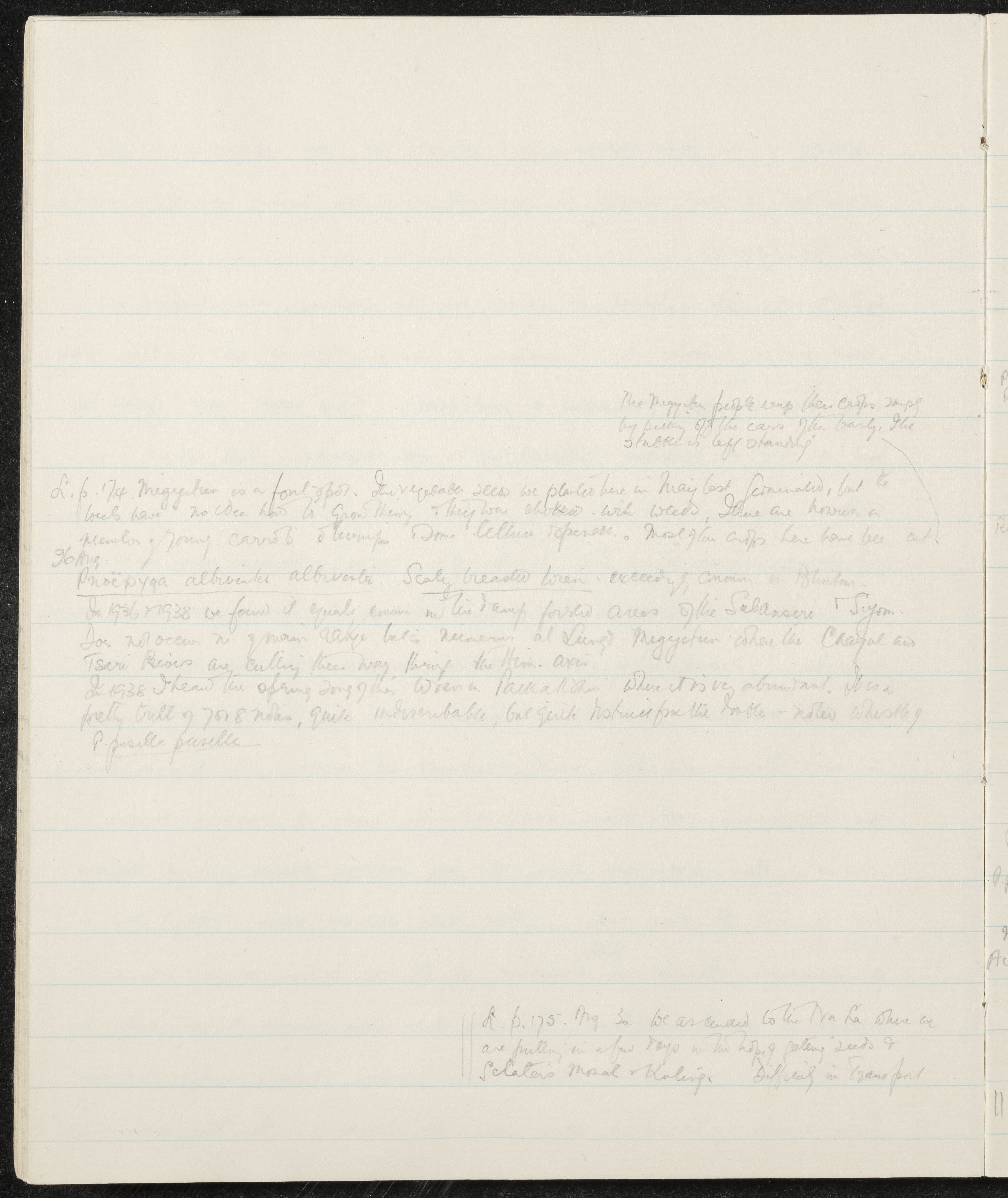
The Migyitun people reap their crops simply by pulling off the ears of the barley. The stalk is left standing.
L. p. 174. Migyitun is a foul spot. The vegetable seeds we planted here in May last germinated, but the locals have no idea how to grow them. They were choked with weeds. There are however, a number of young carrots & turnips & some lettuce & spinach. Most of the crops here have been cut already.
Pnoepyga albiventer albiventer. Scaly-breasted Wren. Exceedingly common in Bhutan. In 1936 & 1938 we found it equally common in the damp forested areas of the Subansiri & Siyom. Does not occur on the main ridge but is numerous at Lungi & Migyitun where the Chayal and Tseri Rivers are cutting their way through the Him. axis. In 1938 I heard the spring song of this Wren in Taka-thum where it is very abundant. It is a pretty trill of 7 or 8 notes, quite indescribable, but quite distinct from the double-noted whistle of P. pusilla pusilla.
L. p. 175. May 3rd. We ascended to the Tra La where we are putting in a few days in the hope of getting seeds of Sclater's Monal & Kalij. Difficult in transport.
Avaliação, seleção e eliminação
Incorporações
Sistema de arranjo
Zona de condições de acesso e utilização
Condições de acesso
Condiçoes de reprodução
Idioma do material
Sistema de escrita do material
Notas ao idioma e script
Características físicas e requisitos técnicos
Instrumentos de descrição
Zona de documentação associada
Existência e localização de originais
Existência e localização de cópias
Unidades de descrição relacionadas
Zona das notas
Identificador(es) alternativo(s)
Pontos de acesso
Pontos de acesso - Assuntos
Pontos de acesso - Locais
Pontos de acesso - Nomes
- P. pusilla pusilla (Assunto)
- Pnoepyga albiventer albiventer (Assunto)