India

Elements area

Taxonomy

Code

Scope note(s)

    Source note(s)

      Display note(s)

        Hierarchical terms

        India

          Equivalent terms

          India

            Associated terms

            India

              176 Archival description results for India

              176 results directly related Exclude narrower terms
              LSH/1/1/9/1/119 · Part · 1937-08-14
              Part of The Ludlow & Sherriff Collection

              SUMMARY:
              The diarist parts from Betty in heavy rain and reaches Ha after a fast five-hour journey, then halts there with very wet conditions from 18–20 August, attempting fishing with limited success and noting few flowers at this altitude. Letters mention Betty’s route toward Bumthang, Changu, Karponang, and Kalimpong, and the diarist suspects H.H. has held back missing mail.

              CONTENT:
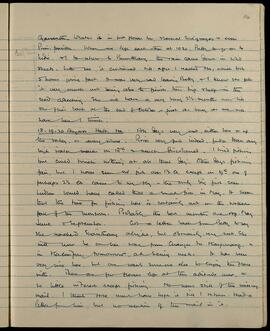
              Cyananthus lobatus is in full flower too, and several Saxifrages and even Primula pusilla. When we left each other at 10:30, Betty to go on to India, or to return to Bumthang, the rain came down in solid sheets. With me it continued till after I reached Ha, which took 5 hours going fast. It was very sad leaving Betty, and I know she felt it very much not being able to finish her trip right in the seed collecting. She will have a very busy 2 1/2 months now till she flies back at the end of October—just as busy as we will have here I think.

              18-19-20 August. Halt. Ha. All days very wet, either here or up the valley, or everywhere. River very full indeed, fuller than any high water marks on 18th and much discoloured. I tried fishing but could touch nothing at all that day. Other days fishing fair, but I have seen no fish over 1 1/2 lb, except on 19th one of perhaps 2 1/2 lb came to my fly—the only big fish seen. Ludlow would have called that a small fish in May. It seems that the time for fishing here is certainly not in the wettest part of the monsoon. Probably the best months are April, May, June and September. Got a letter back from Betty to say she reached Bumthang all right, but obviously very wet. She will now be on her way from Changu to Karponang, and in Kalimpong tomorrow, all being well. It has been very nice here, but one wants someone else to enjoy the place with. There are few flowers left at this altitude now, and so little interest except fishing. No news still of the missing mail. I think H.H. must have kept it till I return. Had a letter from him, but no mention of the mail in it.
              LSH/1/1/5/1/189 · Part · 1933-08-16 - 1933-08-25
              Part of The Ludlow & Sherriff Collection

              SUMMARY:
              Travelled to Ha on 16 August via Chela La, noting apple trees from Kashmir and non-flowering saffron, and met Chuni and Mr. Williamson there. From 17–25 August halted in Ha with wet weather, spending days with Tobgye and companions in sports and archery; a small lake had been made above the rest house. An earlier encounter involved someone examining the diarist’s false teeth and inquiring about getting some made.

              CONTENT:
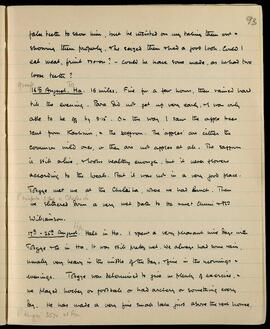
              false teeth to show him, but he insisted on my taking them out and showing them properly, then seized them and had a good look. Could I eat meat, fruit and so on? - could he have some made, as he had two loose teeth?

              16th August. Ha. 16 miles. Fine for a few hours, then rained hard till the evening. Para did not get up very early, I was only able to be off by 9.15. On the way I saw the apple trees sent from Kashmir, and the saffron. The 'apples' are either the common wild ones, or they are not apples at all. The saffron is still alive, and looks healthy enough, but it never flowers according to the locals. But it was not in a very good place. Tobgye met me at the Chela La, where we had lunch. Then we slithered down a very wet path to Ha and met Chuni and Mr. Williamson.

              17th - 25th August. Halt in Ha. I spent a very pleasant nine days with Tobgye and Co. in Ha. It was still pretty wet. We always had some rain, usually very heavy in the middle of the day, and fine in the mornings and evenings. Tobgye was determined to give us plenty of exercise, and we played hockey or football or had archery or something every day. He has made a very fine small lake just above the rest house, at Ha.

              LSH/1/1/9/1/117 · Part · 1937-08-14
              Part of The Ludlow & Sherriff Collection

              SUMMARY:
              At Haat on 14–15 August, the party finalizes plans for Betty to fly home via Gangtok, Kalimpong, and Calcutta to arrange housing, while noting property options near Inverness. They spend time fishing, with Tashi preferring bait, and receive strong local support arranged by Tobgye and help from Apa, though a missed mail causes concern. Tobgye reports that the treaty has been signed.

              CONTENT:
              with unlimited servants, who are mere dirt to him. What he needs certainly is to be taken away from all that kind of thing, and made to do something, and think for himself a bit. He knows nothing of this country at all, and seems to care less.

              14th and 15th August. Haat. Tobgye has sent orders here that everything is to be done for us, everything produced free and any wishes we have fulfilled. Apa has been very good and useful. We have got our plans now fixed at last, after a small mail came in from Kalimpong. We suddenly decided that Betty should fly home as soon as she can — on Sept 2nd if that can be arranged. She can do more that way than by remaining in India, with no home. She will get good treatment and she will be able to see about a house for us at home. Brarich is only offered at too high a price but there is another very attractive sounding place near Inverness which she can see. So now Betty leaves tomorrow, reaches Gangtok and Kalimpong on 21st and Calcutta on 26th. She'll have a few days there to do all we have all asked her to do, and off on 2nd Sept or as soon as possible after. We've been out fishing each day for a few hours. I've never seen so many trout, though I was unable to catch any big ones. None were feeding much, though they came to the fly alright. In the first 10 minutes, I had caught over 30, so it was really not much fun. There were too many. Twice I had 3 on at once. Tashi has no idea of fishing. He prefers standing in one place with bait and dangling his line trying to get big ones. His servants hold his rod and catch them too.

              We have missed at least one mail while coming here, and this has been somewhat worrying, as there have been important letters in it. I thought that it would have been returned by H.H. but it has not been. Tobgye tells us that the Treaty has been signed at last. He must be very relieved indeed, and he

              LSH/1/1/9/1/129 · Part · 1933-09-01
              Part of The Ludlow & Sherriff Collection

              SUMMARY:
              The diarist manages specimens and arranges penicillin injections for Danang in hospital, while noting a letter from Ludlow via Yundu confirming successful plant finds. Plans are made for travel to meet Ludlow at Pasu Sefu and for Pasang and Mundrup to collect primulas via Tumle La, Tongsa, Chendesi, and Ritang, with mention of a hoped-for bridge over the Tang Chu.

              CONTENT:
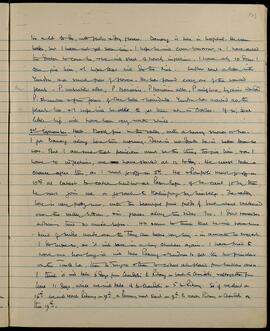
              I've a lot to do, with photos and dry flowers. Danang is here in hospital. He seems better, but I have not yet seen him. I hope he will come tomorrow, as I have asked the doctor to come too, and will start 4 hourly injections. I have only 10 doses I can give him, and hope that will do the trick. Ludlow sent a letter with Yundu, and a small press of flowers. He has found every one of the wanted plants - P. umbratilis alba, P. tsariensis, P. tsariensis alba, P. uniflora, Lychnis Wardii, P. strumosa and fine forms of Meconopsis horridula. Yundu has marked all the plants too, and I hope will be able to get them all in October. If so, that little trip will have been very worth while.

              2nd September. Haat. Mostly fine in the valley, with a heavy shower or two. I got Danang along here this morning. There is no doubt he is better than he was. But I am sure that penicillin must be the thing to give him, as I have 10 injections, we have started at 12 today. He must take a chance after this, as I must go off on 5th. He and Sompoli must go off on 10th at latest to catch Ludlow at Pasu Sefu. If he can't go by then, he must join me or go back to Kalimpong by himself. The valley here is very pretty now, with the beautiful pink fields of buckwheat scattered over the valley bottom, and in places along the sides too. I don't remember noticing this so much before. HH seems to think that he will have some kind of bridge made over the Tang Chu before very long - in a month he suggests. I do hope so, as it will save us a long chukker again. I have tried to work out how long it will take Pasang and Mundrup to get the two primulas on the Tumle La, then to Tongsa and then to collect all plants from Ludlow's area. I think it will take 6 days from Chendesi to Ritang or back to Chendesi, and altogether from here 11 days, which will take 4 to Chendesi or 5 to Ritang. So if we start on 15th we will reach Ritang on 19th, and Pasang must start on 9th to reach Ritang or Chendesi on the 19th.

              LSH/1/1/10/1/18 · Part · 1933-10-01
              Part of The Ludlow & Sherriff Collection

              SUMMARY:
              The diarist reports severe infestation of P. umbratilis seed capsules by caterpillars, difficulty finding other seeds, snow melted up to about 15,500 ft, and the drogpas leaving the high pastures. On 2nd October at Ha-chu, after clear frosty weather, they observed a large herd of burhel, finished work in the Tsampa area (Bumthang Chu watershed), planned to cross to the Dhur Chu to meet Pasang and Yundon, and reflected on concluding Himalayan trips first planned with Ludlow in 1929 at Kashgar.

              CONTENT:
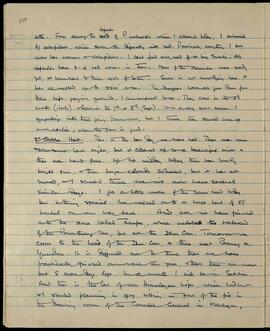
              From among the seeds of P. umbratilis which I collected today, I extracted 67 caterpillars, which shows the difficulty with seed. Practically every capsule I take now has worms or caterpillars. I can't find any seed of a big Swertia. All capsules have 3-4 red worms in them. None of the aconites were ready yet, and I have had to take roots of some. Snow is not now lying here. It has all melted up to 15500' or so. The drogpas have all gone down from these high grazing grounds, I am surprised to see. They come in the 5th month (July) and leave in the 7th or 8th (Sept). It is a very short season. I sympathize with them going down now, but I think they should come up much earlier, when the grass is good.

              2nd October. Ha-chu. This is the best day we have had. There was rain and some snow last night, but it cleared up to a beautiful morning and there was hard frost. Up till midday today there was lovely bright sun, and then huge clouds collected, but it has not snowed, and I should think we will now have several similar days. I got a little more of the same seed today, but nothing special. We walked onto a huge herd of 58 burhel on our way back. And now we have finished with the area called Tsampa, which includes the watershed of the Bumthang Chu, but not the Dhur Chu. Tomorrow we cross to the head of the Dhur Chu, and there meet Pasang and Yundon. It is difficult now to think that we have practically finished our work this year, and that there are now but 5 more days left. In a month I will be in Sikkim. And this is the last of our Himalayan trips, which Ludlow and I started planning in 1929, sitting in front of the fire in the drawing room of the Consulate General in Kashgar.

              LSH/1/1/3/3/37 · Part · 1937-02-27
              Part of The Ludlow & Sherriff Collection

              SUMMARY:
              The writer notes extensive cultivation in the Ha-chu valley of Bhutan and few interesting finds, recording Fumaria (1160, 1161) and Gentiana capitata (1127). The Dzongpen reports a fast message from Calcutta warning of an impending earthquake amid widespread rumors. A grand magnolia in bloom is noted beyond Shungphu on the Hira Road, and two kalij pheasants are shot.

              CONTENT:
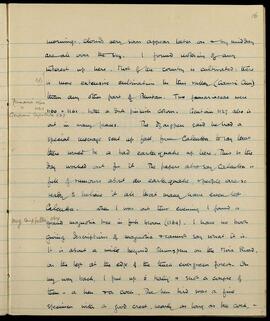
              16

              mornings, clouds very soon appear later on and by midday
              are all over the sky. I found nothing of any
              interest up here. Most of the country is cultivated: there
              is more extensive cultivation in this valley (Ha-chu)
              than any other part of Bhutan. Two Fumariaceae were
              Fumaria 1160, 1161; Gentiana capitata 1127: 1160 and 1161, both a dull pinkish colour. Gentian 1127 also is
              out in many places. The Dzongpen said he had a
              special message sent up fast, from Calcutta, to say that
              there would be a bad earthquake up here. This is the
              day worked out for it. The papers also say Calcutta is
              full of rumours about an earthquake, and people are so
              ready to believe it all that many have even left
              Calcutta. When I was out this evening I found a
              Mag. campbellii 1164: grand magnolia tree in full bloom (1164). I have no book
              giving descriptions of magnolia and cannot say what it is.
              It is about a mile beyond Shungphu on the Hira Road,
              on the left at the edge of the thick evergreen forest. On
              my way back, I put up 6 kalij and shot a couple of
              them - a hen and a cock. The hen bird was a fine
              specimen with a good crest, nearly as long as the

              LSH/1/1/2/1/127 · Part · 1933-07-18
              Part of The Ludlow & Sherriff Collection

              SUMMARY:
              The party halts at Dongkar amid showers, hosts the Tsona Dzongpon who enjoys cigarettes and Cointreau, and arranges to send him a Rhoorki chair from Calcutta. Notes mention Bhutanese traders from Trashiyangsi, glacier views near the Gorpa La with a route to Gor, and botanical finds including a notable gentian (Lomatogonium spathulatum) and other species.

              CONTENT:
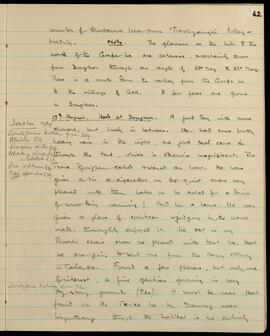
              62

              number of Bhutanese here from Trashiyangsi today - trading.

              Note. The glaciers on the hills to the north of the Gorpa La are extensive, and certainly show from Dongkar through an angle of 68° Mag to 98° Mag. There is a route down the valley from the Gorpa La to the village of Gor. A few peas are grown in Dongkar.

              17th August. Halt at Dongkar. A good day with some showers, but lovely in between. We had some pretty heavy rain in the night, and a good deal came in through the tent, which is otherwise magnificent. The Tsona Dzongpon called and stayed an hour. He was given a tin of cigarettes on the quiet and was very pleased with them. Later on he asked for a drink of something warming! And he a lama. He was given a glass of Cointreau, and judging by the noise made, thoroughly enjoyed it. He sat in my Rhoorki chair and was so pleased with that too, that we are going to send one from the Army & Navy in Calcutta. Found a few flowers, but only one of interest, a fine gentian growing in very dry stony ground. (834). It must be near that found on the Thuka La by Dansey near Lingmathang, though the habitat is so entirely...

              [Margin Notes:]
              Donkhar 17/Aug
              Lomatogonium spathulatum sp. nov. 834
              Potentilla 835.
              Adenophora smithii 836
              Pedicularis rhinanthoides var. labellata 837
              Primula sikkimensis 838
              Picris spinulosa 839

              Lomatogonium spathulatum sp. nov. 834

              LSH/1/1/9/1/32 · Part · 1949-05-06
              Part of The Ludlow & Sherriff Collection

              SUMMARY:
              A wet halt day spent scrambling on a steep rock slope near Rip la to observe rhododendrons, notably Rhododendron edgeworthii, anthopogon, and lindleyi, with signs of bear and musk deer but no sightings. Men later brought in masses of R. edgeworthii, and the diarist began a letter to Betty before receiving mail from Kalimpong.

              CONTENT:
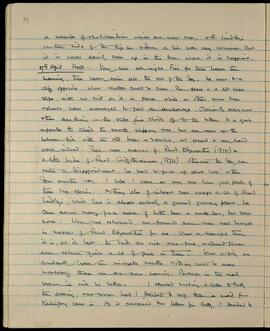
              a number of rhododendrons which are now over, and R. lindleyi
              on the side of the Rip la and down a bit was very common. But
              it is never easily seen up in the trees where it is happiest.
              27th April. Halt. Very wet all night. Fine for three hours this
              morning, then heavy rain all the rest of the day. We went to a
              cliff opposite, where Rhodos. could be seen. The place is a 45° rock
              slope, with no soil on it in places, while in others some trees
              and shrubs have managed to find an anchorage. Obviously every now
              and then anything on the slope just shoots off to the bottom. It is quite
              impossible to climb the smooth slippery rock, but we went up the
              between bits with the odd trees and bamboo, and found it very hard
              work indeed. There were masses of Rhod. edgeworthii (18777) and
              a little higher of Rhod. anthopogon (18776). Otherwise the day was
              rather a disappointment. We had to go on up above 2000' and then
              down another way. I hope I have at any rate some good photos of
              these two species. Nothing else of interest seen, except a lot of Rhod.
              lindleyi, which here is almost entirely a ground growing plant. We
              came across many fresh marks of both bear and musk deer, but saw
              none. When we returned, we found some men had brought
              in masses of Rhod. edgeworthii for me. What a beautiful thing
              it is, at its best: the buds are rich rose pink, and opened flowers
              even retain quite a lot of pink in them. What a pity we
              constantly have this miserable weather. Nothing could be more
              monsoony than we are now having. Perhaps in the real
              season it will be better. I started writing a letter to Betty
              this evening, and no sooner had I decided to stop than a mail from
              Kalimpong came in. As it contained two letters for Betty, I decided to

              LSH/1/1/10/1/14 · Part · 1949-09-27
              Part of The Ludlow & Sherriff Collection

              SUMMARY:
              The writer notes a woman's injury has healed and mentions the drokpas marking the first frost. On 27 Sept. they halt in misty weather, collecting good seed of several plants and observing Polygonum vaccinifolium, with plans to take roots. On 28 Sept. heavy continuous rain makes it difficult to dry collected seeds.

              CONTENT:
              see that it has healed well, she can use it perfectly. I must confess I am also very surprised, because the splinting I did was not good. There was some white frost on the ground this morning, which the drokpas seemed pleased about, because their calendar said this would be the first day of frost.

              27th Sept. Halt. This evening one would think we were in the middle of the worst part of the rains. It dawned sparklingly bright, yet within two hours we were in thick mist, & we haven't seen the sun since. A most disappointing day. But we got what we wanted, good seed of P. tenardinii, sapphirina & Waddellii, & one or two other things. I should think there will be a good deal of snow high up tonight. Many plants have no ripe seed yet, notably P. unistabilis, which is not nearly ready yet. There is quite a lot of Polygonum vaccinifolium up here, which I never suspected before, but it is not in profusion as it is on the Hala-Kyu la, in Sikkim, near Changu. What a beautiful thing it is though, why doesn't one see more of it at home I wonder. We have managed to get a few - very few - seed, & if we can get more will take roots for the Hala.

              28th Sept. Halt. Heavy rain all night, & rain without a stop today, much to our disgust. It is very hard to get seeds dry in this atmosphere. Anything we take is naturally soaking. I

              LSH/1/1/9/1/137 · Part · 1933-09-01
              Part of The Ludlow & Sherriff Collection

              SUMMARY:
              Plans are made for visits to Kantanang, Tolgang, and the Chachhu La route while hoping for improving weather. On 12th Sept. they halt in camp; mail arrives from H.H. along with his cook Namgye, whom the writer reluctantly keeps, and letters from T. Bagge and Betty report on Betty’s arm x-rays and her safe arrival in Calcutta, while a hoped-for house falls through.

              CONTENT:
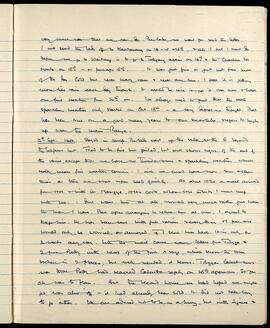
              very much now that we can do. The later we wait for seed the better. I will send the lads off to Kantanang on 14-15 or 16th, and all I feel I must do before we go to Waitang is to go to Tolgang again on 14th and the Chachhu La route on 18th - or perhaps 16th. It was just fine or just not fine most of the day. Cold but never heavy rain and never any sun. I fear it is getting more like rain each day though. It would be nice to get it over now and have our fine weather from 20th on. We always used to find that the real sparkling weather only started on Oct. 18th - a very depressing thought. That has been true on a good many years to our knowledge, refers to high up near the main Range.

              12th Sept. Halt. Stayed in camp. The lads went up the valley to the E beyond the Serpens hut. Tried to be fine but failed, but still shows signs of the end of the rains, except that we have no thunderstorms and sparkling weather, which really mean fine weather coming. I wish we could have more sun and clear skies, as these are what ripen seed quickly. At about 10.30 a mail arrived from H.H. and with it Namgye, H.H.'s cook, whom H.H. insists I must keep with me. I don't want him at all, would very much rather just have the man I have. But after arranging to return him at once, I agreed to keep him. He has been sent with full rations nevertheless and I fear H.H. would only be worried, or annoyed, if I sent him back. It is only for 3 weeks anyway. With the mail came many letters from T. Bagge and 2 from Betty with news of the first x-rays, which show the arm broken in 2 places, but well mended, it seems. T. Bagge's latest news was that Betty had reached Calcutta safely on 26th afternoon. So far all was to plan. But the second house we had hoped we might get, was also 'off' - it had already been sold. It did not take long to go either. We are advised not to be in a hurry, but with Tinnie and