England

Elements area

Taxonomy

Code

Scope note(s)

    Source note(s)

      Display note(s)

        Hierarchical terms

        England

          Equivalent terms

          England

            Associated terms

            England

              14 Archival description results for England

              LSH/1/1/3/3/167 · Part · 1983-05-05
              Part of The Ludlow & Sherriff Collection

              SUMMARY:
              The party set up the wireless and clearly heard England for the first time since Puntsogong, likely aided by monsoon conditions, with generally fine weather though cloudy on the hills. On 27 May they halted in camp due to rain, and on 28 May they went about seven miles down the valley along a difficult river path; Ludlow crossed the river, and they noted abundant Rhododendron lindleyi, a magnolia about to flower, and mixed jungle of bamboo, rhododendron, birch, larch, Tsuga dumosa and deciduous trees.

              CONTENT:
              Schisandra grandiflora 1704
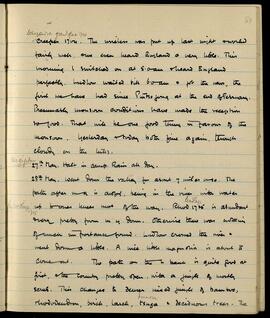
              Creeper 1704. The wireless was put up last night and worked fairly well; we even heard England a very little. This morning I switched on at 5:00 am and heard England perfectly. Ludlow waited till 6:00 am and got the news, the first we have had since Puntsogong at the end of February. Presumably monsoon conditions have made the reception so good. That will be one good thing in favour of the monsoon. Yesterday and today both fine again, though cloudy on the hills.

              Meigiptan 1714
              27th May. Halt in camp. Rain all day.

              28th May. Went down the valley for about 7 miles or so. The path after mile 4 is awful, being in the river with water up to one's knees most of the way. Rhododendron lindleyi 1715 is abundant and very pretty from mile 4 down. Otherwise there was nothing of much importance found. Ludlow crossed the river and went down a little. A nice little magnolia is about to come out. The path on the left bank is quite good at first, the country pretty open, with a jungle of mostly scrub. This changes to denser mixed jungle of bamboo, rhododendron, birch, larch, Tsuga dumosa and deciduous trees.

              LSH/1/1/6/1/17 · Part · 1938-03-21
              Part of The Ludlow & Sherriff Collection

              SUMMARY:
              Notes abundant fish in the Tsangpo and tame black‑necked cranes, with warm conditions after Yamdrok Tso. On 20 March they traveled by skin boats (Kowah) down the Tsangpo to Dorje Tra, demonstrated the wireless to the Dzongpen, dealt with missing boxes from Tamalung, and chased cormorants; on 21 March they continued by Kowah to Chira, describing Dorje Tra’s monastery on a rock and slower river flow.

              CONTENT:
              Ludlow 15
              Tsangpo river
              Fish appear numerous. The ferrymen told us that there were large fish in the river up to 10-20 lbs. Formerly they were allowed to catch them, but not nowadays.

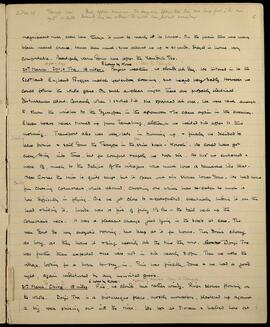
              Magnificent river, even here, though it must be nearly at its lowest. On the plain there were many black-necked cranes, tamer than usual: some allowed me up to 40 yards. Stayed in home, very comfortable. Beautifully warm down here after the Yamdrok Tso.

              20th March. Dorje Tra. 18 miles. 8 hours by Kowa - down the Tsangpo. Perfect weather, no clouds all day. We listened in to the Scotland England Rugger match yesterday evening, but heard very badly. However we could follow the whole game. On such a clear night there are probably electrical disturbances about. Certainly when I stroked Jill, she sparked all over. We were rash enough to show the wireless to the Dzongpen, in the afternoon he came again in the evening. Eleven boxes never turned up from Tamalung, although we waited till after 11:00 this morning. Transport also was very late in turning up, and finally we decided to leave ponies and sail down the Tsangpo in the skin boats - 'Kowah'. We could have got everything into three, but for comfort and safety we took six. At 11:15 we embarked and were off, much to the delight of the villagers who must love a tamasha like that.

              Near Gonkar the river is quite swift, but it opens out and is slower lower down. We had some fun chasing cormorants, which abound, choosing one which has eaten so much it has difficulty in flying. One we got close to and catapulted, eventually hitting it on the head and killing it. Inside was a fish of fully 1½ lbs - the tail well up the cormorant's neck. It was a pleasant change just lying in the boats at ease. The men don't do very energetic rowing, but keep at it for hours. They drink chang as long as they have it and sing merrily all the time they row. Dorje Tra was further than expected, we were not in till nearly 8:00 pm. Then we woke the village, looking for a house to stay in. This was finally done and we had a good night, again undisturbed by any uninvited guests.

              21st March. To Chira. 18 miles. 6 hours by Kowah again by Kowah down the Tsangpo. Fine, no clouds, but rather windy. River slower flowing on the whole. Dorje Tra is a picturesque place, mostly monastery, plastered up against a big rock sticking out into the river. We left at 8:00 am and halted here at...

              LSH/1/1/10/1/45 · Part · 1933-10-10
              Part of The Ludlow & Sherriff Collection

              SUMMARY:
              Plans were made on 11 November to arrive in London on 12 November. They were met by Stalin, who efficiently divided up everything.

              CONTENT:
              on 11th Nov, to arrive in London on 12 November. They were met
              by Stalin who divided up everything more efficiently.

              LSH/1/1/2/1/241 · Part · 1969-04-29
              Part of The Ludlow & Sherriff Collection

              SUMMARY:
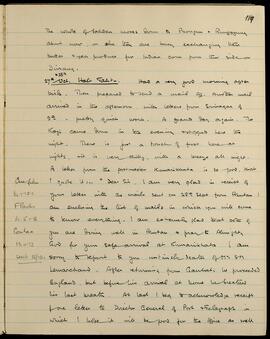
              The diarist notes movements of people from Sakden to Phongmi and Rungsung and trade with Dirang, then halts at Taktu with a good morning after birds, mails sent and received, and a visit from the Kazi. A quoted letter from the postmaster at Kumarikhata reports the death of Mr. S. M. Lemarchand and mentions earlier mails from Bhutan; nights are frosty and chilly.

              CONTENT:
              119

              The whole of Sakden moves down to Phongmi + Rungsung about now, or else they are busy exchanging their butter + yak produce for Indian corn from this side or Dirang.

              28th
              27th Oct. Halt Taktu. Had a very good morning after birds. Then prepared to send a mail off. Another mail arrived in the afternoon, with letters from Srinagar of 9th — pretty quick work. A grand day again. The Kazi came down in the evening + stopped here the night. There is just a touch of frost here at nights, + it is very chilly, with a breeze all night.

              A letter from the postmaster Kumarikhata is so good, that I quote it:— "Dear Sir, I am very glad in receipt of your letter with the mails sent on 28th Sept from Bhutan I am enclosing the list of mails in which you will come to know everything. I am extremely glad that both of you are doing well in Bhutan + pray to Almighty God for your safe arrival at Kumarikhata. I am sorry to report to you untimely death of Mr. S. M. Lemarchand. After returning from Gauhati he proceeded England, but before his arrival at home he breathed his last breath. At last I beg to acknowledge receipt of one letter to Director General of Post + Telegraph in which I hope it will be good for the office as well"

              [Marginal notes:]
              Cine film
              14 + 15 C
              F Packs
              4, 5 + 6
              Contax
              12 + 13
              sent 28/10.

              LSH/1/1/10/1/11 · Part · 1949-09-14
              Part of The Ludlow & Sherriff Collection

              SUMMARY:
              Diary notes from Pangotang describe ongoing rains, plans to visit Marlung before turning back, and requests regarding taking Yundru and Ngudup to Kalimpong, with preference for Yundru. The writer develops Hicks’ photos, comments on Thompson’s image of P. eburnea, sends Dorji with airmail to Hicks and HH, and packs a ‘tsang’ of rooted plants for shipment to London, hoping to add more from Marlung and Ritang.

              CONTENT:
              147

              Air mail plants
              more specimens and also some roots. I have now so many roots to send home by air, that I wonder how many loads there will be, also how much it will all cost!

              24th Sept. Pangotang. Fine morning, and a bit of rain after midday. There really is precious little sign of the end of the rains, although I keep on hoping there is. We are, in a way, on our way back home now. But still there is one place, Marlung, to visit, before we can say we have turned round and started back. But everyone obviously feels that things are winding up. I had a request today from Pasang, from Ngudup and Yundru that I should take both to Kalimpong. I don't mind taking Yundru, who is a good and cheery lad and a good worker, but I hope I won't have to take Ngudup one day beyond Bumthang. I do not like him, and except to arrange transport, he is useless. I am writing to HH tomorrow to ask for Changchuk, and to give him our final dates. Today I developed Hicks' photos. If only he had taken my advice at first, all his photos would have been like these which are good. But he would not, and considered he knew better. Thompson's photo of P. eburnea is quite good, much better than Hicks' first efforts. It is a real disappointment to me that in 6 months he has only taken 48 photos altogether, in spite of having lots of film packs available. There were so many photos he could have taken.

              25th September. Sent off Dorji and with airmail to Hicks, HH and Kalimpong and paid him Rs 24/-. We then packed up a 'tsang' with rooted plants, each rooted plant in its own little basket inside the big one. The whole thing now is ready to go to London, except that I hope there will be a few more plants added from Marlung, and then more again at Ritang.
              roots

              LSH/1/1/10/1/17 · Part · 1933-10-05 - 1933-10-01
              Part of The Ludlow & Sherriff Collection

              SUMMARY:
              The diarist receives letters from Betty and outlines plans: Hicks will arrive in Bumthang on 5 Oct, they hope to leave about the 13th and reach Tashigang on 3 Nov; the party will include Ludlow, the diarist, Betty, Virginia, Tess, and Tasho. Entries for 30 September at Pangotang and 1 October at Tolegang note wet weather, seed collecting (including Primula umbratilis), Pasang and Mundru’s work continuing until 17 October, a visit from the Sokpon who received gifts, and mail sent to HH for Kalimpong.

              CONTENT:
              To cheer me up today—I was feeling very miserable—a mail came in, with letters from Betty in Calcutta at last, and also from her in London. Nothing from HH at all for the first time when a mail has been sent. Hicks confirms that he will arrive in Bumthang on 5th Oct. So we should be able to leave on 13th about, and reach Tashigang on 3 Nov. Ludlow has got a passage, Betty says, and also she and I, Virginia, Tess, and Tasho. So we should have a good time, 6 of us from Bhutan.

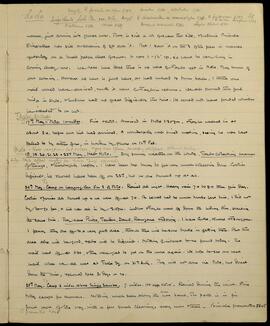
              30th September. Pangotang. It rained all night again, but was fine when Pasang and Mundru went off about 6:00 am. We were off just after them, and had a day half rain half fine, but no sun. It doesn't look yet like clearing up, but I do most sincerely hope it is fine now for four days. There is a lot to be got in Tolegang and quite a lot on the other side. After that it doesn't matter so much, except for Pasang and Mundru, whose work won't finish until 17 October. Primula umbratilis here is nearly ripe, and I got some seed, but the big Androsace is still green. This is our last of many halts in Pangotang. The Sokpon came to call and I gave him a little bottle of saffron and a torch, which is doing him very well. But we've been in his district for a long time now, ever since 23rd of May. Sent off a small mail to HH for Kalimpong. I shall only be able to send off one more after this, except for Ha.

              1st October. Tolegang. Fine till 10:00 then rain and snow off and on the rest of the day. We are camped about 14,000-14,500' and it is raw and chilly. We got some seed of Primula umbratilis, the very pale form which occurs here, and a few other things. But the Phlomis (19716) I particularly wanted, is still in flower; seeds are not nearly ripe. Neither are seeds of the interesting Gentian 19721. But I took roots of

              LSH/1/1/6/1/57 · Part · 1936-06-26
              Part of The Ludlow & Sherriff Collection

              SUMMARY:
              Diary records travel from Lo La and Singo Samba to Molo, where Taylor arrives, followed by several halt days to reorganise. The party then moves to camps on the Langong Chu and above Singo Samba while Ludlow and Taylor explore down the Lilung Chu; mail and future rendezvous plans are noted. Botanical collecting is mentioned throughout, though limited by logistics and weather.

              CONTENT:
              Lo La
              May 16. R. forrestii var. repens 3783, Primula 3784, Calostrotum 3785.
              Singo Samba, Loda Chu near Molo. May 16. R. chaetomallum var. chamaephytum 3786. R. ponderosum 3792. 78.
              P. calderiana 3788, locosa 3789. Paraquilegia anemonoides 3790. Lloydia tibetica 3791. R. laudum var. lucidum 3793.

              masses, just coming into flower now. There is still a lot of snow on this side; Ludlow's Primula elizabethae has still a covering of 3ft over it. But I saw it on the south of the pass in masses yesterday on a small patch clear of snow. It was 1-1 1/2" up, so it won't be very long in coming away now. We hear here that there is no news of Taylor yet in Molo. They know of our coming. However, no news is good news, as had he had to turn back, I think our mail would have arrived with news of Taylor's return. We all crossed this fine bridge in style; Ludlow had no great difficulty this time. He could not have turned whether he wanted to or not.

              Taylor arrives
              17th May. To Molo. 10 miles. Fine road. Arrived in Molo 1:30 pm. Taylor walked in at about 3:00, before our kit had arrived. A wonderfully well-timed meeting, seeing he was last talked to by either of us in London by phone on 12th Feb.

              Molo - Halt, reorganise kit and loads, buying bags of flour, developing photographs, planning future.
              18, 19, 20, 21, 22 and 23rd May. Halt Molo. Dry sunny weather on the whole. Taylor is collecting masses of things, thoroughly happy. I have been too busy to get very much collecting done. Coolies were difficult. We should have been off on the 23rd, but no one turned up at all.

              24th May. To Camp on Langong Chu, 5 miles south of Molo. Rained all night. Heavy rain 7:00 to 9:00 then a fine day. Coolies and ponies all turned up and we were off at 7:00. As we had had so much trouble last time, I did not try to go far, and kit was all in by 2:00 pm. Ludlow and Taylor went off down the Lilung Chu, starting at the same time. They have Pinso, Tenduk, Dawd, Ramzana and Tsering. I have Cutha, Kusho and Tsourpon. I fancy they are off to a very good area, though there will be some trouble in getting there. But this area also will be good, and also will be difficult. Nothing of interest to me was found today. The mail went off at 6:30, and then we were glad to get on the move again. We hope to see our next mail when we all meet at Tsala Dz. on 31st July. They will not come via Molo, but direct down the river, and should take 21 days or so.

              25th May. To Camp 3 miles above Singo Samba. 7 miles. Height approx. 11,500'. Rained during the night. Fine today except for showers. Nothing much seen along the river bank. The path is in fine forest most of the way, with a few small clearings every now and then. Primula prenantha 3848.

              LSH/1/1/6/1/148 · Part · 1938-10-16
              Part of The Ludlow & Sherriff Collection

              SUMMARY:
              Lists live plants to be sent by KLM freight to London and the R.B.G. Edinburgh, noting a large quantity of roots, bulbs, and tubers collected. Describes severe weather at Chumbumbu La and successful but difficult seed collecting trips from Langong to the Chiniung La, with plans to march to Migyitun.

              CONTENT:
              75 Live Plants Collected
              Chumbumbu La Oct 17 P. chionantha 6609 P. elizabethae 6610
              mec. violacea 6611.

              ...the live plants wanted, which are now: 1 small plant Pedicularis, 1 small Primula Aliciae, 1 Elizabethae (Lola) 2 Tsariensis (Lola) 1 Rowlei (Lola) & laeta (Lola) 1 ? Clutterbuckii (Lola) 1 Boothii (Lola) 1 yellow Pet. Sect. (Lola) 1 big plant Tsariensis (Lola) 1 yellow Pet sect (Tsari Sama) 1 yellow Pet sect (Chumbumbu La) 1 Elizabethae (Chumbumbu La). All these are at the moment timed to arrive in London on the 12th Dec, & in the R.B.G. Edinburgh on early morning of 13th! Ludlow & Taylor also have a good bundle of roots too, & altogether we have far more roots, bulbs & tubers than ever brought back before. So I hope we get them successfully home this time. I intend to send all by KLM freight, & shudder at the thought of how much they will cost.

              17th October. Langong. Rain all night & day. Very cold indeed on the Chumbumbu La, in fact everywhere. Today was a repetition of yesterday, really beastly weather, a strong wind driving rain & sleet. We got a few seed of P. Elizabethae 6610, roots of it & of the Pet. Primula & also seeds of the Primula aff. Clutterbuckii, which I did not expect. Also a few of Omphalogramma brachysiphon 3952. The others I have taken as these are probably nearly all O. minus, with perhaps a small mixture of O. brachysiphon. So cold & beastly up the last camp, that as we were back by 12.30, we packed up at once & came on here, arriving at 4.0pm. No sign of rain stopping, in fact the locals say this is a very wet month, rain below & snow on the hills. We thus save a day, & tomorrow I must go up to the Chiniung La to finish off the Langong collecting.

              18th October. Halt. Heavy rain all night & all today. Tsongpen & I went up to the Chiniung La, making an early start. Snow was everywhere above about 13500 & nearly a foot deep on the Pass. However we did better than I expected, & got some of all the seeds we were for except the little dwarf Lonicera, which had dropped its seed & was hardly to be seen. P. macrocarpa had very few seed, nearly every capsule was blind. And so now I have finished all seed collecting from flowers seen this year. The rest of our march is either over new ground, or over the old 1936 ground. But there can be little but Rhododendrons with any seed left. All seems fixed for our march to Migyitun on the 20th, rather to my surprise. At present I cannot make out the route, but

              LSH/1/1/9/1/85 · Part · 1949-06-30
              Part of The Ludlow & Sherriff Collection

              SUMMARY:
              The writer reports that meat set aside by Lhahpa was stolen overnight, likely by a dog, while Lhahpa suspects passing Tibetans. A letter from Rani Chuni relays that H.H. says the Maharajkumar may go to England with them for several months, prompting logistical concerns; on 27 June they halt, deem the area poor after working all surrounding valleys, plan to leave tomorrow, and note certain plants absent here but present at the Mela.

              CONTENT:
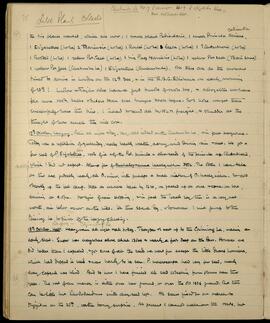
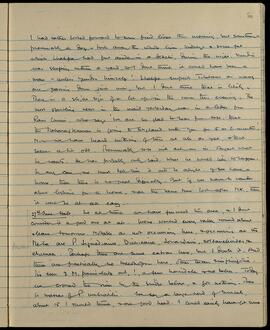
              I had rather looked forward to some fried liver this morning, but something - presumably a dog - took away the whole liver, kidneys & some fat which Lhahpa had put aside in a dekchi, during the night. Yundru was sleeping within a yard, so I don't think it could have been a man - unless Yundru himself! Lhahpa suspects Tibetans as many are passing down just now, but I don't think that is likely.

              There is a slight sign of a let up in the rain this evening. The most startling news in the mail yesterday was in a letter from Rani Chuni, who says 'we are so glad to hear from H.H. that the Maharajkumar is going to England with you for 5 or 6 months'. Now we have heard nothing of this at all as yet, which seems a bit odd. Presumably H.H. will ask us in August what he wants. He has probably only said what he would like to happen. In any case we must tell him it will be alright. If we have a house, then there is no real difficulty. But if we have to wander about looking for a house, & at the same time look after M.K., then it won't be at all easy.

              27th June Halt. We all think we have finished this area, & I don't consider it a good one at all. We've worked every valley round about & leave tomorrow. Notable as not occurring here, & occurring at the Mela are P. sikkimensis, dich

              LSH/1/1/5/1/13 · Part · 1935-11-27
              Part of The Ludlow & Sherriff Collection

              SUMMARY:
              After a short march, the diarist set up an aerial and tested the wireless, receiving London clearly and noting it is much improved, intending to give it to H.H. The day was hot with leeches, ticks, and biting flies; the route went down through Surelakha cultivation to cross the Rong Nala, then up the Ratrikhola past Pakhegaon to a ridge.

              CONTENT:
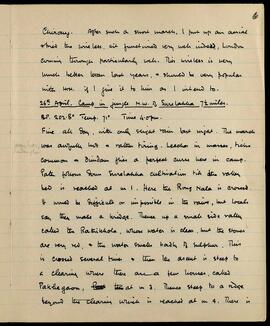
              Chirony. After such a short march, I put up an aerial and tried the wireless; it functioned very well indeed, London coming through particularly well. This wireless is very much better than last year's, and should be very popular with H.H. if I give it to him as I intend to.

              26th April. Camp in jungle N.W. of Surelakha 7 1/2 miles.
              B.P. 202.8° Temp. 71° Time 4.0pm.

              Fine all day, with only slight rain last night. The march was awfully hot and rather tiring. Leeches in masses, ticks common and dimdam flies a perfect curse here in camp. Path follows down Surelakha cultivation till the valley bed is reached at m 1. Here the Rong Nala is crossed. It would be difficult or impossible in the rains, but locals say they make a bridge. Thence up a small side valley called the Ratrikhola, whose water is clear, but the stones are very red, and the water smells badly of sulphur. This is crossed several times and then the ascent is steep to a clearing where there are a few houses, called Pakhegaon, this at m 3. Thence steep to a ridge beyond the clearing which is reached at m 4. There is