Bhutan

Elements area

Taxonomy

Code

Scope note(s)

    Source note(s)

      Display note(s)

        Hierarchical terms

        Bhutan

        Equivalent terms

        Bhutan

          Associated terms

          Bhutan

            419 Archival description results for Bhutan

            419 results directly related Exclude narrower terms
            LSH/1/1/4/1/169 · Part · 1933-10-19
            Part of The Ludlow & Sherriff Collection

            SUMMARY:
            Diary entry from Thang describing a clear day’s march avoiding the Tun La by going down-valley and up to the Rala La, noting snow conditions, frozen lake, and wildlife. Seeds of gentian (no. 2006) and other seeds were collected, and birds were shot and skinned; blackbirds were seen. Plans to arrive on the 8th with transport on the 9th are mentioned, and the Tsonpen is unwell.

            CONTENT:
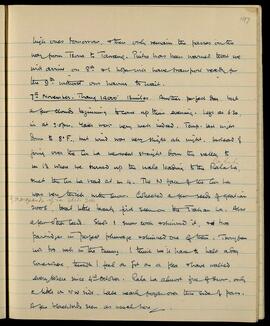
            high ones tomorrow, and then only remain the passes on the way from Tsona to Tawang. Pintso has been warned that we will arrive on 8th and hope will have transport ready for the 9th without our having to wait.

            7th November. Thang 14,000' 13 miles. Another perfect day, but a few clouds beginning to come up this evening. Left at 6:30, in at 2:00 pm. Yaks went very well indeed. Temp. last night down to 8°F, but wind was very slight all night. Instead of going over the Tun La we went straight down the valley to m 1 1/2 where we turned up the nala leading to the Rala La, and met the Tun La road at m 4. The N face of the Tun La was very thick with snow. Collected a few seeds of gentian 2006, that little beauty first seen on the Trakan La. Also a few other seeds. Shot 1 snow cock and skinned it, and two partridges in perfect plumage and skinned one of them. Tsonpen not too well in the tummy. I think we'll have to halt a day somewhere, though I feel as fit as a flea and have walked everywhere since 4th October. Rala La almost free of snow, only a little on NW side. Lake nearly frozen over this side of pass. A few blackbirds seen as usual here.
            LSH/1/1/6/1/131 · Part · 1933-09-07
            Part of The Ludlow & Sherriff Collection

            SUMMARY:
            The party splits, with S. going up the Lando Chu towards Molo and Tsari while Ludlow and Taylor head to Lusha; the diarist travels via Tsela Dzong with Gulla and the Tsongpen, aiming to meet Kusho. Taylor is improving but will avoid the passes, with Tendrup assigned most passes and Ludlow to do Lusha La; notes mention continuing rain, river levels on the Tsangpo and Nyang Chu, and timelines to Dewangiri. Mail news: Kusho has returned from Lhasa, and Norbhu redirected the mail via Gyantse.

            CONTENT:
            Sept 16 Party splits - S. up the Lando Chu then on to Molo, the Do La, Langong Valley & Tsari
            L. & T. to Lusha - then up the Pan La across to Tsari. Tamnyen La - Po-Doshong La

            14th Sept. } Halt Temo. Rained a good deal, hardly any sun to dry our seeds. All plans made for
            15th " } future. Ludlow & Taylor go off to Lusha tomorrow, while I start off too, via Tsela Dzong - Taylor very much better & able to do quite a lot. Gulla & Tsongpen only accompany me, but we hope to pick up Kusho in Tsela Dzong.

            16th September. Ligding. 8 miles. Fine, but still very cloudy, with rain apparently constant on the Main Range. We have now parted again, Ludlow & Taylor going over to Lusha to start collecting in that area, while I go West. Taylor will not do the Passes, but Tendrup will work them all but the Lusha La, which Ludlow will do. They will thus be very quick, & should leave Tse before the end of the month. Taylor wants to return as quickly as possible, seeing he cannot work the passes, & he should & must be in Dewangiri by the 16th November. I work out my moves to get me down there by the 1st Dec. if I travel fast, & so I hardly think that Ludlow will wait for me so long. It looks as if we should not meet again this trip till we are in Kashmir, or won't see Taylor certainly. He is much better, & were his tongue only reasonably clean, I would say he was safely out of the wood. He is a difficult person to feed, being very particular about what he eats, & that is not easy to cope with on a trip like this. Although the rain continues, - we have had no sun at all these last three days - the monsoon must be over except for odd rain on the Main Range, which we always notice goes on till the 18th Oct or so. The Tsangpo went down two or three feet during the week we were at Temo, and it is a good 12 ft or more lower than it was when at its highest. The Nyang Chu does not show such a big drop nearly.

            17th Sept. Tsela Dzong. Rain at night & showery today. It took us a good long time to get ponies etc to be transported over here. There are 5 branches of the river to cross. The Nyang Chu has only dropped a foot since we were here on 10th August. Kusho is here, having returned from Lhasa in 8 days. The mail had not reached Lhasa when he caught it up on, I think, the 31st Aug. Norbhu stayed the mail runner & sent him back here, while he sent on our mail to Gyantse by the Tibetan post. He expected it back in 8 days & was then to send it to

            LSH/1/1/9/1/7 · Part · 1949-09-13
            Part of The Ludlow & Sherriff Collection

            SUMMARY:
            The party crosses a high swinging bridge, climbs steeply through burnt pine forests to the Tata La, and reaches Shamgong Dz/Dzong amid clouds and afternoon thunderstorms. The next stage begins with a descent to the Wangdi Chu near the Mangde Chu, followed by a steep ascent to the Bruksong La en route to Tesar.

            CONTENT:
            have managed the bridge, which was high over the water, long, and swung from side to side. After that, we had a mile, level along the L bank, then straight up the hillside at the steepest point anyone could find - Coolies tackled it in wonderful style, keeping up with us on H.H.'s fine mules, which took the hill in a series of short sharp rushes. This continues for about 5 miles, where oak mixes with the Pinus longifolia forest, which is slowly replaced. And so to mile 7, a pass is reached on the ridge, called the TATA LA. Just over this lies Shamgong Dz, a fine square building on a spur, with a village behind it, and a little cultivation. The most noticeable thing today is that all the young pine trees are burnt. One passes nothing but old fully grown trees, except near the top where it seems little grass burning has been carried out. What potential waste has taken place in these forests, and this cannot be put right now. Even if re-afforestation is started, there will be a long gap of bareness. It has been clouded all day, and just as we got in at 12:00 the rain started, and we've had thunder and heavy rain this afternoon. I hope that will clear away the haze over everything, which takes the beauty away. A few Rhodo arboreum seen, but no others. Flowers mostly uninteresting.

            1st April. Tesar 17 miles. A long day, starting with a heavy thundershower, which cleared up before we left camp. It was sad to have to lose all our altitude within the first two hours. The path goes straight down to the Wangdi Chu, at almost the level of the Mangde Chu. But once over that it goes even steeper up the other side to the Bruksong La, which is not so high as Shamgong Dzong, but not far off it. It is about 4 miles down and nearly the same to

            LSH/1/1/9/1/127 · Part · 1933-08-26
            Part of The Ludlow & Sherriff Collection

            SUMMARY:
            Mail arrived with letters up to 6 August and a note from Betty at Changu; Danang departed with Pompoli and Tundru. At Tashiling the path to Chendesi was badly damaged, a pony fell through a weakened bridge and could not be rescued, and after storms the huts were preferred except for filthy Tsalimape; on hearing H.H. had gone back to Bumthang they planned to go straight through. Reaching Tongsa, the heaviest rains continued and people in Trongsa Dz. reported considerable recent damage.

            CONTENT:
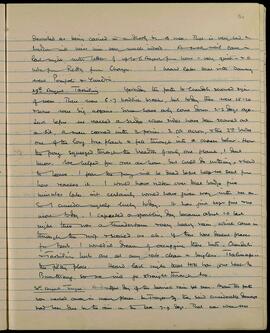
            Described as being carried in a dhooley by 4 men. That is very sad, & Ludlow will miss him very much indeed. A small mail came in last night, with letters of up to 6 August from home - very quick - & a note from Betty from Changu. I heard later that with Danang went Pompoli & Tundru.

            29th August. Tashiling. Yesterday the path to Chendesi showed signs of wear. There were 6-7 baddish breaks, but today there were 15-20 & some were big affairs. Some have only come down 2-3 days ago. Just before we reached a bridge whose sides have been scoured out a bit, a man crossed with 3 ponies. 2 got across, & the 3rd broke one of the long tree planks & fell through into a chasm below. How the pony squeezed through the breadth of only one plank, I don't know. We helped for over an hour, but could do nothing, & had to leave. I fear the pony will be dead before help we sent for here reaches it. I would have ridden over that bridge five minutes later, & it certainly would have given way with me on. So I consider myself lucky today. It has just kept fine once more today. I expected a sparkling day because about 1.0 last night there was a thunderstorm & very heavy rain, which came in through the roof & soaked us all. If there were decent places for tents, I wouldn't dream of occupying these huts. Chendesi & Tashiling huts are, at any rate, clean & bugless. Tsalimape is the filthy place. Heard last night that H.H. has gone back to Bumthang, so we will go straight through too.

            30th August. Tongsa. A dreadful day of the heaviest rain yet seen. Again the path was washed away in many places. In Trongsa Dz. they said considerable damage had been done by the rain in the last 7-9 days. That was when H.H.

            LSH/1/1/8/1/123 · Part · 1933-06-01 - 1933-06-02
            Part of The Ludlow & Sherriff Collection

            SUMMARY:
            At Tashigong, despite few coolies and a missing tent load, mules with syces arrived and the Nyerchen, informed by Tobgye, provided assistance and lodging, though one room was infested with bugs. Arrangements were made to proceed to Puntso-gong, where heavy rain fell through the night and following day.

            CONTENT:
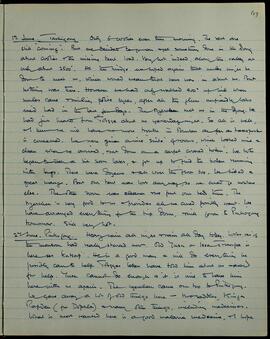
            1st June. Tashigong Only 6 coolies even this morning. The rest are still "coming". But we decided to go on after some talk in the dzong about coolies & the missing tent load. Very hot indeed, along the valley at only about 2500'. At the bridge we hoped again that mules might be down to meet us, which would mean that news was in about us. But nothing was there. However we had only walked 400 yards up hill when mules came trailing polite syces, after all the glum unfriendly looks we'd had in the last few days. The Nyerchen met us in the dzong. He had just heard from Tobgye about us yesterday night. So all is well, & I know we will have no more trouble in Bhutan as far as transport is concerned. We were given a nice "suite" of rooms, which looked nice & clean when we arrived, sat down on a carpet covered "boden". We both began to itch a bit soon later, & got up to find the boden running with bugs. There were dozens & all over the floor too. We killed a great many. But our tent was lost anyway so we could go nowhere else. The other room was cleaner & we put our beds there. The Nyerchen is very good to us & provides all we could possibly want. We have arranged everything for the trip down, will go on to Puntso-gong tomorrow. Still very hot.

            2nd June. Puntso-gong. Heavy rain all night & rain all day

            LSH/1/1/1/1/191 · Part · 1933-09-13
            Part of The Ludlow & Sherriff Collection

            SUMMARY:
            Notes a black‑necked crane near Talung and describes Talung’s monastery, village, and August fair, with showers and thunder in the evening. Describes the 13th September route toward Nangartse Dzong via Chö Dzong by Yamdrok Tso, noting high river levels preventing the lakeshore route and that the party is on the route the Williamsons took to Lhasa.

            CONTENT:
            94

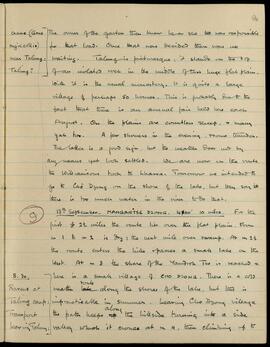
            crane (Grus nigricollis) near Talung: Talung?
            The owner of the garden then knew he or she too was responsible for that load. Once that was decided there was no waiting. Talung is picturesque; it stands on the top of an isolated rock in the middle of this huge flat plain. With it is the usual monastery. It is quite a large village of perhaps 50 houses. This is probably due to the fact that there is an annual fair held here each August. On the plains are countless sheep, & many yak too. A few showers in the evening, some thunder. The latter is a good sign, but the weather does not by any means yet look settled. We are now on the route the Williamsons took to Lhasa. Tomorrow we intended to go to Chö Dzong on the shore of the lake, but they say there is too much water in the river to do that.

            (9)
            13th September. NANGARTSE DZONG. 14,500' 10 miles. For the first 2 1/2 miles the route lies over the flat plain. From m 1 to m 2 is dry; the next mile over swamp. At m 2 1/2 the route enters the hills & passes a small lake on the west. At m 3 the shore of the Yamdrok Tso is reached & here is a small village of CHO DZONG. There is a cold weather route along the shores of the lake, but this is impracticable in summer. Leaving Cho Dzong village the path keeps along the hillside turning into a side valley which it crosses at m 4, then climbing up to

            B. 30.
            Ravens at Talung camp:
            Transport leaving Talung:

            LSH/1/1/2/1/241 · Part · 1969-04-29
            Part of The Ludlow & Sherriff Collection

            SUMMARY:
            The diarist notes movements of people from Sakden to Phongmi and Rungsung and trade with Dirang, then halts at Taktu with a good morning after birds, mails sent and received, and a visit from the Kazi. A quoted letter from the postmaster at Kumarikhata reports the death of Mr. S. M. Lemarchand and mentions earlier mails from Bhutan; nights are frosty and chilly.

            CONTENT:
            119

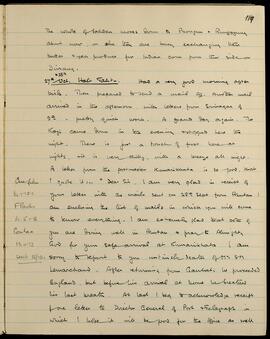
            The whole of Sakden moves down to Phongmi + Rungsung about now, or else they are busy exchanging their butter + yak produce for Indian corn from this side or Dirang.

            28th
            27th Oct. Halt Taktu. Had a very good morning after birds. Then prepared to send a mail off. Another mail arrived in the afternoon, with letters from Srinagar of 9th — pretty quick work. A grand day again. The Kazi came down in the evening + stopped here the night. There is just a touch of frost here at nights, + it is very chilly, with a breeze all night.

            A letter from the postmaster Kumarikhata is so good, that I quote it:— "Dear Sir, I am very glad in receipt of your letter with the mails sent on 28th Sept from Bhutan I am enclosing the list of mails in which you will come to know everything. I am extremely glad that both of you are doing well in Bhutan + pray to Almighty God for your safe arrival at Kumarikhata. I am sorry to report to you untimely death of Mr. S. M. Lemarchand. After returning from Gauhati he proceeded England, but before his arrival at home he breathed his last breath. At last I beg to acknowledge receipt of one letter to Director General of Post + Telegraph in which I hope it will be good for the office as well"

            [Marginal notes:]
            Cine film
            14 + 15 C
            F Packs
            4, 5 + 6
            Contax
            12 + 13
            sent 28/10.

            LSH/1/1/3/3/57 · Part · 1936-03-10
            Part of The Ludlow & Sherriff Collection

            SUMMARY:
            An easy downhill march from Takhtoo to a standard camp with rhododendrons and Magnolia campbellii in bloom; Primula denticulata is common, and a young Tibetan mastiff was bought in Sanden. From Phungni on the 16th March, heavy smoke over Bhutan from widespread grass burning is noted, with half-burnt rhododendrons and contrasting vegetation on the valley’s north and south faces; Ludlow remarks on rapid changes over a few days.

            CONTENT:
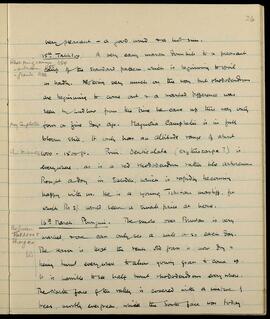
            very pleasant - a good wind and hot sun.

            15th Takhtoo. A very easy march downhill to a pleasant
            (Rhod. kingianum 1184, arboreum 1185, grande 1186) camp of the standard pattern, which is beginning to spoil
            us badly. Nothing very much on the way, but rhododendrons
            are beginning to come out and a marked difference was
            seen by Ludlow from the time he came up this way only
            (Mag Campbellii) four or five days ago. Magnolia Campbellii is in full
            bloom still. It only has an altitude range of about
            (Prim denticulata) 1000 - 1500 ft. Prim. denticulata (erythrocarpa?) is
            everywhere, as is a red rhododendron rather like arboreum.
            Bought a dog in Sanden, which is rapidly becoming
            happy with us. He is a young Tibetan mastiff, for
            which Rs 2/- would seem a small price at home.

            16th March. Phungni. The smoke over Bhutan is very
            (Between Takhtoo and Phungni) marked, one can only see a mile or so each day.
            (NB) The reason is that the rank old grass is now dry and
            being burnt everywhere to allow young grass to come up.
            It is horrible to see half burnt rhododendrons everywhere.
            The North face of the valley is covered with a mixture of
            trees, mostly evergreen, while the South face was today

            LSH/1/1/5/1/11 · Part · 1935-11-27
            Part of The Ludlow & Sherriff Collection

            SUMMARY:
            The writer describes a steep forested path to the clearing at Surelakha, notes the absence of rhododendrons, and seeks directions to the Black Mt. Locals suggest Shamgong Dzong and mention the name Dungshigon; Puibo explains that 'gon' means a range. The headman proposes reaching Nabsigaon or Nabsikorbhu in two days and then the Black Mt. in another two, though transport may be difficult, with only shepherds operating in the area.

            CONTENT:
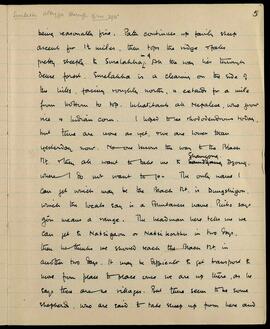
            Surelakha Albizzia Sherriff 27 Nov 1935

            being reasonably fine. Path continues up fairly steep ascent for 1 1/2 miles, then tops the ridge and falls pretty steeply to Surelakha. All the way lies through dense forest. Surelakha is a clearing on the side of the hills, facing roughly north, and extends for a mile from bottom to top. Inhabitants all Nepalese, who grow rice and Indian corn. I hoped to see rhododendrons today, but there are none as yet, we are lower than yesterday now. No one knows the way to the Black Mt. They all want to take me to Shamgong Dzong, where I do not want to go. The only name I can get which may be the Black Mt. is Dungshigon, which the locals say is a Bhutanese name. Puibo says gon means a range. The headman here tells me we can get to Nabsigaon or Nabsikorbhu in two days, then he thinks we should reach the Black Mt. in another two days. It may be difficult to get transport to move from place to place once we are up there, as he says there are no villages. But there seem to be some shepherds, who are said to take sheep up from here and

            LSH/1/1/9/1/132 · Part · 1933-09-01
            Part of The Ludlow & Sherriff Collection

            SUMMARY:
            Heavy traffic on the route is attributed to HH’s fair in Bumthang beginning on the 7th, alongside plans for reforms such as cash payment for work. At Sumitang, the party had fine weather but a delayed start (likely due to Ngudup); the writer prefers Changchuk managing transport, and with most seed still unripe, Pasang will return in a month to collect target species from beyond Sharitang and around Bumthang/Kyikyi La, after noting a jelly-coated aquatic plant and cooler conditions than Bumthang.

            CONTENT:
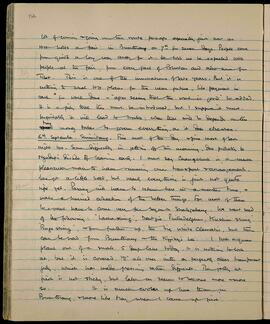
            Lot of coming and going on this route, perhaps especially just now as HH holds a fair in Bumthang on the 7th for seven days. People come from quite a long way away for it. He told me he expected 1,000 people at the fair, from every part of Bhutan and also some from Tibet. This is one of the innovations of late years. But it is nothing to what HH plans for the near future, like payment in cash for work done - "after seeing that the work is good" he added. It is a pity that this must be introduced, but I suppose it must. Inevitably it will lead to trouble; when that will be depends on the time money takes to govern everything, as it does elsewhere.

            6th September. Sumitang. Fine most of the day, and fine most of last night too. Some difficulty in getting off this morning, due probably to Ngudup's dislike of leaving early. I must say Changchuk is a much pleasanter man to have running one's transport arrangements. We got a little seed, but nearly everything is just not quite ripe yet. Pasang will have to return here in a month's time, and make a hurried collection of the better things. For most of these we would have to come very far beyond Sharitang. We want seed of the following: "Lachasung", Deutzia, Philadelphus, "Kushim sung", "Rugosung", and from further up, the big white Clematis, but this can be had from Bumthang or the Kyikyi La. I took a queer plant out of a small 5' deep lake today. It is nothing to look at, but it is covered, 1/8" all over with a perfectly clear transparent jelly, which has made pressing rather difficult. The jelly at first is not sticky, but later on seems to become more and more so. It is much cooler up here than in Bumthang, and more like May when I came up first.