Bhutan

Elements area

Taxonomy

Code

Scope note(s)

    Source note(s)

      Display note(s)

        Hierarchical terms

        Bhutan

        Equivalent terms

        Bhutan

          Associated terms

          Bhutan

            419 Archival description results for Bhutan

            419 results directly related Exclude narrower terms
            LSH/1/1/8/1/185 · Part · 1946-12-22
            Part of The Ludlow & Sherriff Collection

            SUMMARY:
            Notes describe diurnal and seasonal wind patterns in the Tsangpo valley, with gentle upstream winds in early mornings and stronger downstream winds later, and increased water levels causing multiple shallow channels and sandbank issues. Observations cover downstream winds at Tsela Dzong, upstream winds in April, river breadth at Tsela in December, the influence of the Gyamda Chu valley, and seasonal changes at Yigrong Tso with winter flow extending below Chara; comparison is made with March and an entry around Feb 1st is referenced.

            CONTENT:
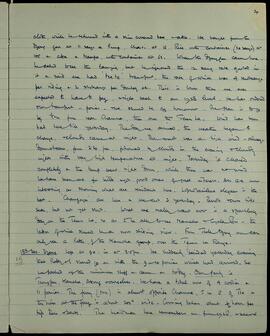
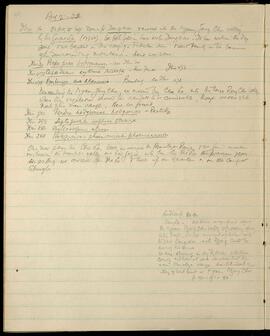
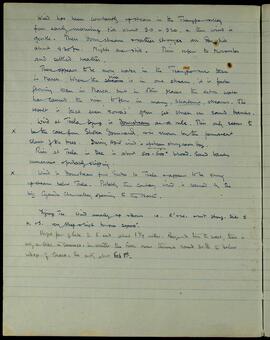
            Wind has been constantly upstream in the Tsangpo valley from early morning till about 9.0 or 9.30, and this wind is gentle. Then downstream and rather stronger all day till about 4.30 pm. Nights are still. This refers to November and settled weather.

            There appears to be more water in the Tsangpo now than in March. Where the river stream is in one stream, it is faster flowing than in March, but in other places the extra water has caused the river to flow in many, shallow, streams. The result is that even 'kowas' often get stuck on sand banks.

            Wind at Tsela Dzong is downstream as a rule. This only seems to be the case from Shoka downward, as is shown by the permanent slant of the trees. During April wind is upstream strong each day.

            River at Tsela in Dec is about 500 - 600 yds broad. Sand banks numerous and probably shifting.

            Wind is downstream from Shoka to Tsela and appears to be strong upstream below Tsela. Probably the contrary wind is caused by the big Gyamda Chu valley opening to the North.

            Yigrong Tso. Wind usually up and down i.e. E. and W. not strong. Hills to N. and S. very steep and high to over 20,000'.

            Useful part of lake is E. end, about 1 3/4 miles. Beyond this to west, there is only a lake in summer. In winter the river runs through sand beds to below village of Chara. See entry about Feb 1st.
            LSH/1/1/7/1/7 · Part · 1940-05-24
            Part of The Ludlow & Sherriff Collection

            SUMMARY:
            The diarist notes bodies with bows left beside them and observes alpine flora on nearby snow slopes and streambeds. Accompanied by Langong coolies, they visit the Tsari Sama (Sarpa) pilgrimage area, finding it rich in Primula, Rhododendron, and a new white-flowered Daphne near the pass to Lopa territory. Trashiyang is mentioned as the starting and finishing point of the pilgrimage.

            CONTENT:
            Beside each body, the owner's bow had been stuck in the ground. All arrows had been taken away, but all their other possessions seemed to have been left intact, even to their meagre rations of food. Near here, at the top of the snow slopes, were vertical cliffs. Tucked away in dust-dry pockets, completely sheltered from rain, were fine clumps of P. littledalei.

            A little lower down, at 14,000', the first Meconopsis simplicifolia were coming into flower. Beside this, P. chamaethauma was in flower, and on a steep bank just above this, a little creeping Lonicera, only an inch or two off the ground, showed its yellow flowers. Some of the open swampy flats held masses of a fine Allium (No. ). On stony beds beside streams grow P. macrophylla v. macrocarpa.

            There remained, near Langong, one area to visit, that was Tsari Sama. This is a place of pilgrimage, called Tsari Sama or Sarpa—the new Tsari—to distinguish it from the better-known, more important Tsari Chikchar. The Langong coolies were not anxious to go round the pilgrimage, for which I could not blame them. However, they took me, and it was a most interesting trip. As at the Lo La, there is in Tsari Sama a fairly extensive, reasonably open flat bit of country, just north of the immediate Himalayas, gradually rising to a steep rocky ridge. The whole of this area was very rich in flora. This, to a certain extent, can, I think, be put down to the fact that no yaks are kept here in the summer. None of the dwarf rhodos were now in flower, and R. campylogynum (5560), R. trichocladum (5555), R. glaucum (5565). Also 5568.

            A Primula not seen elsewhere, P. Kingii covered acres of open ground with its deep wine-coloured blooms, P. laeta, a glorified form of P. Roylei. Primula, P. gracilipes.

            Perhaps the most interesting Rhododendron was 5571 (yellow, red spots). Growing among rocks just below the ridge before reaching the pass to Lopa territory, we came across a fine large, white-flowered new Daphne. No seeds.

            At Trashiyang, the starting and finishing point of the pilgrimage,

            LSH/1/1/6/1/146 · Part · 1936-10-02
            Part of The Ludlow & Sherriff Collection

            SUMMARY:
            Entries for 13 and 14 October describe wet, misty conditions around Trashidzung and Langong, limited success collecting rhododendron seed, and a pressing of P. chamaethauma, with coolies assisting and seeds dried for packing. News from Ludlow reports delays and rerouting due to the Lilung bridge collapse, with casualties and mail issues, and mentions movements via Lhacha, Tsela Dzong, and toward Kyindong/Sangachöling.

            CONTENT:
            74a
            Oct. 13 Tsari Sama
            seeds of P. chamaethauma 6603, P. morsheadiana 6604,
            P. sikkimensis 6606, P. vernicosa 6607,
            Swertia kantelu 6605.

            far as from Trashidzung here: & that the third stage is much the same. He gives two names as on the preceding page. He also says that the path never enters Loque, but it must go very close to it.

            Tsari Sama
            13th October. Trashidzung. Another beastly day. Thick mist & driving rain south of the Pass, & little on this side. But as we got near Trashidzung the sun came out. From here it appears exactly the same as in camp at the Kashong La in Oct. 1936. Driving rain or snow coming over the main range, petering out in a few miles. I suppose this will last another 3 or 4 days then stop, probably with some thunder snow. I did not expect much today, but hoped for seed of a good rhododendron got from here in June. But there was not a single good capsule. We saw about a dozen tiny wee things with no seed in them. Took a pressing of P. chamaethauma on the pass & root as well. Tsari Sama would undoubtedly have been a good place in June, had I been able to do the whole circle. The coolies have done well this trip, & are always ready to come out collecting seed or whatever I want. Got all my seeds dry enough to pack up before leaving this morning, for which I am very glad. We still have a good many Lo-La - Pachakshiri rhodo seeds which need more drying.
            See Ludlow's diary - Kew Journal XII 14.

            14th October. Langong. Heavy rain all night & all today, with mist right down in the valley. Left at 8.30 am, in at 1.0 pm, kit in a little after 3.0 pm. One coolie left for Molo yesterday evening without giving any reason, but the others agreed to carry on his load. I had hoped to hear from Ludlow here, & did so. Tendup came up on the 5th to Molo & was leaving for Kyindong on the 7th, so should have been there on the 9th. But a man here says he would only be reaching Kyindong today. Ludlow is positive the Lilung bridge was broken down to prevent their coming up to Molo. One cannot believe a word the Molo people say, but I was told quite definitely that one man & 3 mules were drowned when it broke, & that one pony got out again. The rest of the caravan going down then, returned to Molo. Ludlow & Co had to go round by Lhacha leaving on the 5th. There was no sign of the mail between, but Ludlow had left Kesang behind at Tsela Dzong, with instructions to go on to Kyindong, if necessary to Sangachöling. So at any rate I can not hear any more till then.

            LSH/1/1/8/1/27 · Part · 1946-12-11
            Part of The Ludlow & Sherriff Collection

            SUMMARY:
            The diarist negotiates transport with the Dzongpon, notes low rates, and plans to cross by ferry near Chamna and go over the Temu La, with observations on weather and local birds. On 18 Dec at Dzeng, Betty and the diarist travel with a small party, crossing the river by ferry opposite Chamna, where the headman recalls their 1938 visit.

            CONTENT:
            cloth, while he returned with a skin covered box - atta. We bought from the Dzongpon at 11 sangs a lump, chari at 15. Rice with container (30 sangs) at 105 - atta & tsampa, with container at 63. When the Dzongpon came here, he asked to see the lamyig, but he ignored the 12 sang rate quoted in it & said we had 'tse te' transport, the rate of which was 4 shokangs per riding & 2 shokangs per donkey etc. This is lower than we ever expected to have to pay, right back to our 1938 level. He has ordered our transport - ponies - they should be off tomorrow. The plan is to go by tru from near Chamna, then over the Temu La. Wind has been bad here till yesterday. The day we arrived, the weather began to change, & clouds came at night. The result was a high wind - always downstream, from 2.30 pm, followed by clouds in the evening & cloudy nights with very high temperature at night. Yesterday it cleared completely & the temp went right down, while there was no wind. We have been out for birds & got good ones of great interest. All are now interesting as showing what are residents here. Lophobasileus elegans is the best. 'Chang-tsai' are here & we shot 3 yesterday. Parrots & crossbills seen, but not yet shot. What we really want now is a sparkling day on the Temu La, so as to be able to see Namcha & Gyala Peri - the latter of which should be a more striking view. From Tsela Dzong one can only see a little of the Namcha group, over the Temu La Range.

            18th Dec. Dzeng. Left at 9.0: in at 3.0 pm. We suddenly decided yesterday evening that Betty & I should go on with the goro ponies which had arrived. So we packed up the minimum stuff & came on today. Our party is Tsongpon, Kancha, Akong & ourselves. We have a total now of 4 coolies & 11 ponies. The ferry (tru) is almost opposite Chamna, 5 m. E. of Tse & the river at the ferry is about 200 yds wide. Crossing takes about 1/2 hour per trip there & back. The headman here remembers us from 1938, & seems

            LSH/1/1/6/1/21 · Part · 1938-03-21
            Part of The Ludlow & Sherriff Collection

            SUMMARY:
            While halted at Tsetang, the party sent Pimbo back to Gonkar to recover 11 boxes of kit, which he found near Chora. They met the Ladakhi trader Ata Ulla, who spoke about Bailey, showed bird eggs from near Lhagyari, and helped procure a sheep. On 26 March they marched to Rong (Rongchaka) Dzong with poor bullock transport, and the writer suffered a minor fall from a pony.

            CONTENT:
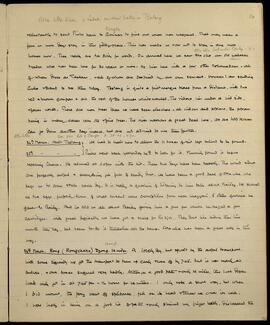
            Atta Ulla Khan, a Ladakhi merchant trading in Tsetang

            Kongka reluctantly to send Pimbo back to Gonkar to find out what has happened. That may mean a four or more days stay in this filthy place. This has made us vow not to stay in any more houses now. They really are too dirty for words. On arrival here we saw Ata Ulla, an old Ladakhi trader who has been here for 30 years or more. He lives here with a few other Mohammedans—all of whom dress as Tibetans, and all of whom are despised by our own servants. However I am sending Culla and Daud to see them today. Tsetang is quite a picturesque place from a distance, with two red and brown gompas and all the rest of the houses whitewashed. The village lies under a hillside, faces north. There are more trees than we have seen elsewhere—all willows and poplars, the poplars being in many cases very old and fine trees. The river narrows a great deal here. We are told kowas can go down another day's march, but are not advised to use them further.

            24th March. Halt Tsetang. We had to halt here to allow the 11 boxes of kit left behind to be found.

            25th March. Halt Tsetang. Pimbo went back yesterday 24th to look for it, and luckily found it before reaching Chora. He returned at 6:00 pm with the kit. These two days have been beastly. The wind and dust are perfectly awful and everything gets full of sandy dust. We have seen a good deal of Ata Ulla who begs us to come and talk each day. It is really a question of listening to him talk about Bailey. He showed us two eggs, properly blown, of what he said were crossoptilon from near Lhagyari, 5 others of which he gave to Bailey. And he told us all about Bailey giving him a gun for which he had a few cartridges. With great difficulty we have got a sheep for Rs 2/12. They don't like killing them this month they say, but seem to do it themselves all the same. Ata Ulla has been a great help in this way.

            26th March. Rong (Rongchaka) Dzong. 14 miles. A lovely day, but spoilt by the awful transport. With some difficulty we got the transport to turn up early and were off by 7:45. But it was nearly all bullocks, and our boxes suffered very badly. Although a good path and only 14 miles, the last dozen loads only got in at 7:45 pm—12 hours for 14 miles. I only rode a short way, but when I did mount, the pony went off splitarse, fell on its head and threw me over its neck. I was lucky in being on a good bit of path and only skinned my finger badly, and dislocated the...

            LSH/1/1/8/1/13 · Part · 1946-11-14
            Part of The Ludlow & Sherriff Collection

            SUMMARY:
            Diary entries record travel from Tsetang through Rong Dzong, Lhagyari, Lasor and Lhapso to Lenda, with delays due to slow transport and negotiations over animal hire rates. Notes include hospitality from local officials and the Jetsung Kusho’s sister, and botanical observations of Gentiana waltonii and Androsace with seed collected.

            CONTENT:
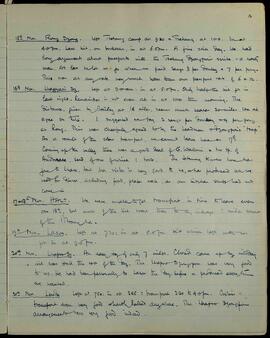
            15th Nov. Rong Dzong. Left Tsetang camp at 9.20 & Tsetang at 10.0. In at 4.0 pm. Last kit, on bullocks, in at 6.0 pm. A fine still day. We had long arguments about passports with the Tsetang Dzongpon's scribe - a nasty man. At last he let us go when we paid sangs 3 per donkey & 7 per pony. This was at any rate very much better than our passport rate of 6 & 12.

            16th Nov. Lhagyari Dz. Left at 9.0 am: in at 5.0 pm. Only half the kit got in last night. Remainder is not even all in at 10.0 this morning. The distance, given by Bailey at 16 miles, seems much nearer 20 miles. We all agree on this. I suggested we pay 2 sangs per donkey & 4 per pony at Rong. This was cheerfully agreed to by the headmen & Dzongpon's "trap". As a result of the slow transport, we cannot leave here on 17th. Coming up the valley there was a good deal of G. Waltoni & two sp. of Androsace, seed of one of which I took. The Jetsung Kusho here has gone to Lhasa, but her sister is very good to us, & has produced all we need for dinner, including food, plates etc., as our kitchen stuff had not come in.

            17th & 18th Nov. HALT. We were unable to get transport in time to leave even on 18th, but most of the kit went then to a village 3 miles short of the Potrang La.

            19th Nov. Lasor. Left at 7.30: in at 5.0 pm. Kit which left with us got in at 9.0 pm.

            20th Nov. Lhapso Dz. An easy day of only 7 miles. Cloud came up by midday & it was dull the rest of the day. The Lhapso Dzongpon was very good to us. He had been personally to Lasor the day before & produced everything we wanted.

            21st Nov. Lenda. Left at 7.50: in at 2.45: transport 3.30 to 4.0 pm. Coolies & transport were very good though hardly halted anywhere. The Lhapso Dzongpon arrangements were very good indeed.

            LSH/1/1/3/3/89 · Part · 1933-04-09
            Part of The Ludlow & Sherriff Collection

            SUMMARY:
            At Tsona the party halts through 13–15 April amid cold, wind, frost, and snowfall, noting numerous waterfowl on the lake and recording barometer, temperature, and altitude. Yaks are promised though there is disagreement on the route. A man arrives from Trashigang with rice from the Dzongpon and is tasked with sending mail.

            CONTENT:
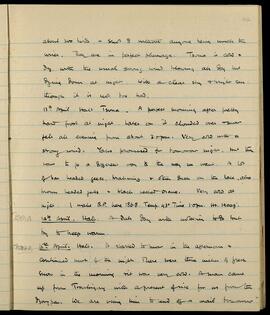
            about 300 birds, and shot 8 without anyone being much the wiser. They are in perfect plumage. Tsona is cold and dry, with the usual strong wind blowing all day but dying down at night. With a clear sky and bright sun though it is not too bad.

            13th April. Halt Tsona. A perfect morning after pretty hard frost at night. Later on it clouded over and snow fell all evening from about 3.0pm. Very cold with a strong wind. Yaks promised for tomorrow night, but they want to go a different way to the way we want. A lot of bar-headed geese, brahminy and other duck on the lake, also brown-headed gulls and black-necked crane. Very cold at night. I make B.P. here 186.8. Temp. 43° Time 1.0pm. Ht. 14,000'.

            Tsona. 14th April. Halt. A dull day with nothing to do but try to keep warm.

            Tsona. 15th April. Halt. It started to snow in the afternoon and continued most of the night. There were three inches of fresh snow in the morning and it was very cold. A man came up from Trashigang with a present of rice for us from the Dzongpon. We are using him to send off a mail tomorrow.

            LSH/1/1/2/1/122 · Part · 1933-07-18
            Part of The Ludlow & Sherriff Collection

            SUMMARY:
            The party left Tsona for Dongkar via the Gorpo La, re-entering the Nyam Jang Chu valley in dry, sunny conditions and noting several bird records. They descended the Nyam Jang Chu, crossed the Cho La into the wetter Taree Rong Chu Valley, then on 22 Aug crossed the Me La to resume camp at Shengbe, with views over the Nyam Dzong Chu Valley from the Tibetan plateau. Notes reference related descriptions in Ludlow’s pages 89–92.

            CONTENT:
            Aug 15-22

            Hrs 16. On Aug 15 left Tsona for Dongkar, re-entered into the Nyam Jang Chu valley by the Gorpo La, (17,750). We both fell in love with Dongkar. It lies within the dry zone & we basked in the rays of a Tibetan sun & saw beauty in the bareness of the surrounding mountains. Here we saw
            Hrs 30 Pica pica bottanensis - see Hrs 30
            Hrs 473 Carpodacus erythrinus roseatus - Rose Finch Hrs 473
            Hrs 478 Emberiza cia khamensis - Bunting see Hrs 478

            Descending the Nyam Jang Chu, we crossed the Cho La into the Taree Rong Chu Valley, where the vegetation showed the rainfall to be considerable, though we were still north of the main range. Here we found
            Hrs 501. Perdix hodgsoniae hodgsoniae - Partridge
            Hrs 293 Leptopoecile sophiae obscura
            Hrs 386 Phylloscopus affinis
            Hrs 268 Hodgsonius phoenicuroides phoenicuroides

            Our new pass, the Cho La, took us across the Himalayan Range, & we overlooked the beautiful valley we had gazed into from the Me La the previous year. On 22 Aug we crossed the Me La & took up our quarters in our old camp at Shengbe.

            Ludlow p. 89-90
            Sangla - we had a magnificent view of
            the Nyam Dzong Chu Valley stretching away
            to the North, whilst immediately below us to
            the west Dongkar with Dzong could be
            easily discerned.
            We were standing on the Tibetan plateau
            country & it was at once realized that the
            main Himalayan range was to the south of us.
            Story of lost bird in Nyam Dzong Chu
            p. 90-91-92

            LSH/1/1/4/1/171 · Part · 1933-11-08 - 1933-11-09
            Part of The Ludlow & Sherriff Collection

            SUMMARY:
            At Tsona on 8 November, after a very cold night, the diarist arrived early; Pintso prepared for departure toward the Kechen La, while Ludlow, delayed at Tawang and Sakden, had reached Trashigang on 28 October with seeds and flowers. The diarist dealt with a Dzongpen, noted missing post, and had mail from Chayul forwarded; on 9 November the party left Tsona joyfully for a camp north of Kechen La amid evening clouds over the Nyam Jang Chu, though yaks were delayed.

            CONTENT:
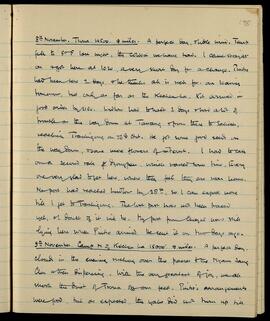
            8th November. Tsona. 14500. 9 miles. A perfect day, and little wind. Temp fell to 5°F last night, the coldest we have had. I came straight on and got here at 10:30, a very short day for a change. Pintso had been here 2 days, and he thinks all is well for our leaving tomorrow, but only as far as the Kechen La. Kit arrived in good order by 11:30. Ludlow had to halt 2 days and had a lot of trouble on the way down at Tawang and from there to Sakden, reaching Trashigang on 28th Oct. He got some good seeds on the way down, and some more flowers of interest. I had to call on a second rate of Dzongpen, which wasted some time. Everyone very glad to get here, where they feel they are near home. No post had reached Ludlow by 28th, so I can expect none till I get to Trashigang. The lost post has not been traced yet, and I doubt if it will be. My post from Chayul was still lying here when Pintso arrived. He sent it on two days ago.

            9th November. Camp N of Kechen La 15000' 9 miles. A perfect day. Clouds in the evening rushing over the passes of the Nyam Jang Chu and then dispersing. With the very greatest of joy, we all shook the dust of Tsona off our feet. Pintso's arrangements were good, but as expected, the yaks did not turn up till

            LSH/1/1/3/3/91 · Part · 1933-04-09
            Part of The Ludlow & Sherriff Collection

            SUMMARY:
            A perfect day after earlier delays from missing yaks and money wrangles in Tsona; the party moved north over a pass to Tre with easy gradients. Lumsden attempted but missed a gazelle. Tre is noted as having 73 houses, and a visit toward Thang to look for blackbirds resulted in a difficult chase without success.

            CONTENT:
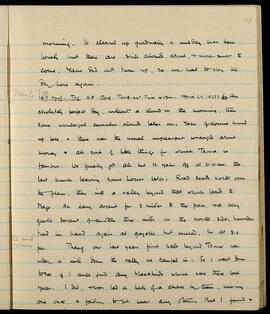
            morning. It cleared up gradually and midday has been lovely, but there are still clouds about, and more snow to come. Yaks did not turn up, so we had to stay the day here again.

            Tsona to Tre
            16th April. Tre B.P. 186.4 Temp. 44° Time 4.0pm. Approx ht. 14272 ft. An absolutely perfect day, without a cloud in the morning, then some wonderful cumulus clouds later on. Yaks of course turned up late, and there was the usual unpleasant wrangle about money and all sorts of little things for which Tsona is famous. We finally got all but 12 yaks off at 11.0 am, the last bunch leaving some hours later. Road leads north over the plain, then into a valley beyond that which leads to Mago. An easy ascent for 3 miles to the pass, and a very gentle descent of another three miles on the north side. Lumsden tried his hand again at gazelle, but missed. In at 3.0 pm.

            Tre counts 73 houses
            Thang, our last year first halt beyond Tsona was under a mile down the valley we camped in. So I went down to see if I could find any blackbirds which were there last year. I did, and was led a hell of a chase by them, missing one once, and failing to get near any others. But I found a