Bhutan

Elements area

Taxonomy

Code

Scope note(s)

    Source note(s)

      Display note(s)

        Hierarchical terms

        Bhutan

        Equivalent terms

        Bhutan

          Associated terms

          Bhutan

            419 Archival description results for Bhutan

            419 results directly related Exclude narrower terms
            LSH/1/1/5/1/172 · Part · 1933-07-21
            Part of The Ludlow & Sherriff Collection

            SUMMARY:
            The writer describes court etiquette around H.H., with Nahu the Donyer managing access and notes language difficulties between Hindi and North Country Urdu. They observe the army’s routines, play football with them, note Dunkley’s request to see the 2.75-inch gun whose ammunition is in Trongsa, and remark on H.H.’s newly built Dzong with a corrugated iron roof.

            CONTENT:
            85a

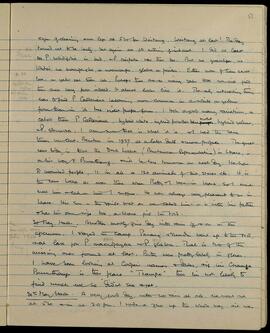
            ...or even Nahu and the Maharani. None are allowed before him unless called for. Nahu is the Donyer and brings people to see H.H., but he himself must not come unless called. I noticed how he had always to stand behind H.H.; this must have been rather awkward for him once when I was explaining a camera to H.H. and kept turning the camera in a different direction. As H.H. turned, so Nahu had to run behind him. I have had a little difficulty with language, H.H. talking Hindi and I answering in North Country Urdu. [It is perhaps because of that that I cannot get anything very definite about the forests.] The Army now has its own lines, cook houses, and everything; they parade regularly most of the morning. They are a smart lot and seem pretty keen too. I played football against them once and had an amusing but not scientific game. Dunkley asked to see the 2.75-inch gun. It is all here, but ammunition is missing; it is all in Trongsa. The Army has its own signallers who practice daily and a band of drums, bagpipes, fifes, and trumpets. H.H. has made a fine new Dzong here, all to his own design. To my mind, it is spoilt by the corrugated iron roof. It is built in a good position, nice and open, commanding a good view.
            LSH/1/1/1/1/29 · Part · 1933-05-13
            Part of The Ludlow & Sherriff Collection

            SUMMARY:
            Notes on film rolls B.3–B.5 record scenes from the ascent to the Natu La, including a telephoto of Chomolhari and views from Chumpitang. The entry describes setting out after persuading Williamson, traversing deep snow to the pass with views over the plains of India, then returning to collect birds and one flower (Primula Stewartii) in a fir forest.

            CONTENT:
            B3 / B4
            B 3 & 4 good -
            B.3. finished: Ludlow in bungalow.
            B.4. full roll taken of scenes on the ascent to the Natu La. At the top. telephoto of Chomolhari
            B.5. First 50 ft of views from Chumpitang.

            difficulty in persuading Williamson. Eventually we got off at 7.40 on the only perfect day we have yet had. The snow was then hard enough to walk on, & remained so for the first two miles or more. Until 2 miles from the top there was no difficulty at all, & we were surprised to find how easy the pass had become in the last two days. The last 2 miles ascent are fairly steep & were hard work for the mules. As long as they kept in the narrow hardened path they got along well, but when once they put a foot off it, they sank into deep soft snow. There were still some five feet or so of snow at the top. We reached the top in a little over four hours, & had a lovely view: to the South was a low sea of clouds over the plains of India, & to the N.E. was Chomolhari, clear but not very distinct. Chomolhari means "Goddess of the mountain pass". After half an hour we started down again & the first 100 yds caused nearly every mule to fall in very soft thick snow: but no damage done. Ludlow & I reached here about 3.0 pm. very tired indeed. But after a rest & some whisky we went out after birds for 1 1/2 hours, & got a few good specimens. Collected only one flower - Primula Stewartii I think, very like Denticulata. This is a most beautiful place in the middle of a fir forest with, across the valley, a fine line of snow hills leading up to the Natu La. The evening light through the trees on the

            LSH/1/1/1/1/157 · Part · 1933-08-30 - 1933-08-31
            Part of The Ludlow & Sherriff Collection

            SUMMARY:
            Diary notes the ascent of Bod La (properly Pö La), a rocky pass with an old Tibetan block house, followed by a descent past a lake to the Hamo Chu and the Hamo camping ground. Weather clears after snow over the pass; plant collections are listed. The next day is a halt at Hamo.

            CONTENT:
            Ludlow Aug 30-28 - Bod La is a misnomer. It should be the Pö La // Tibetan Pass 77

            30th Aug. plateau
            Bod La steeper but easy to a plain from m 3 - m 4. The
            Cyananthus lobatus 494 last ascent up to the Bod La (16300) at m 4 1/2 is very
            Gentiana paludosa 493 steep over rocky hillside. On the top is an old
            Arenaria musciformis 495
            " ciliolata 497 Tibetan block house, built across the narrow pass.
            Phlomis sikkimensis 496
            Delphinium grandiflorum 499 The pass is very rocky & for the first mile down the
            path is over large rocks and difficult. Then a grassy
            plain is reached & beyond this a lake 3/4 mile long.
            Tibetan warbler Path keeps to E. side, & descent at north end is easy
            off grassy hillside. Rhododendrons are met at m
            7, where the path crosses the stream from the lake
            to the L. bank. It cuts over the shoulder of a hill &
            drops steeply down to the Hamo Chu which runs East to West.
            At the foot of the steep descent is HAMO at m 8.
            Hamo is a small grassy plain at the very head of the
            conifer forest. Water & fuel are ample & the camping
            ground is good. // A comparatively easy day,
            B 26. especially as it hardly rained at all. There was
            View toward some snow over the pass, but soon after we
            the Bod (Pö) crossed it stopped & the sun came out, - the
            La from the first real sun we have seen since leaving the
            N. end of the Me La. It must have cleared a bit in Bhutan,
            lake, north of but is undoubtedly drier here than on the South
            the pass of the Range. A lovely camping ground.
            Hamo.
            31st August. Halt at Hamo. Rained last night, nearly all

            LSH/1/1/9/1/61 · Part · 1949-06-01
            Part of The Ludlow & Sherriff Collection

            SUMMARY:
            After an early start the party reached Weitang, noting Primula bellidifolia in bud, P. crispata, and particularly P. calderiana in white, yellow, and hybrid forms, while other expected species were absent, possibly due to heavy yak grazing. News arrived that the Druk Locha (Bumthang Representative) from Lhasa is en route to Bumthang and expected shortly; the diarist recalls meeting him previously in Lhasa with Betty.

            CONTENT:
            Signs of clearing and we left at 5:30 for Weitang. Weitang at last! The day turned out to be lovely, but again we saw nothing of interest. I did at last see P. bellidifolia in bud, and P. crispata was there too. But no gracilipes, no whitei, no macrophylla, or macrocarpa, glabra or puella. Either none of them exist here, or yaks eat them all. Perhaps there are so many yaks that we will find this area very poor indeed. It almost looks like it. The only interesting thing was to find P. Calderiana becoming more common in a white or yellow form than in its true violet purple form. I took a good many variations, and called them P. Calderiana, hybrid white, hybrid powder blue violet, hybrid yellow, and P. strumosa. I am sure that is what it is, and had the same times in central Bhutan in 1937 at a later date and more profuse. The great news today is that the Druk Locha (Bumthang Representative) in Lhasa, is on his way to Bumthang, will be here tomorrow or next day. He has 8 mounted people, 11 in all and 120 animals of kit, stores etc. It is the same Locha as was there when Betty and I were in Lhasa, so I must meet him and talk to him I suppose. He was always very pleasant to us in Lhasa. His son—the spoilt brat as we called

            LSH/1/1/8/1/33 · Part · 1946-12-23
            Part of The Ludlow & Sherriff Collection

            SUMMARY:
            The party trekked through spruce, oak, pine, and larch forest, passed below Chunyima, obtained butter and fresh milk from herdsmen with yaks, and noted several plants including Primula atrodentata and Lilium wardii. They reached Tongkyuk Dzong after 68 days, glimpsing the Po Yigrong Range and collecting limited seed of an unidentified Rhododendron, a Gaultheria, and an evergreen Berberis.

            CONTENT:
            hard indeed - so much so that the kukri we used to cut out plants was broken slightly, & sparks were actually made when striking the ground! This might possibly be P. bhutanica or Whitei. Like P. atrodentata the buds were covered with dense farina. We did not see Chunyima at all, but passed below it scarcely a few miles (2?) to an open space, on the other side of the river from which is a herdsman's hut where there are two men with 50 yaks. Up behind that is a very fine snow peak (Sangdam Pu?) where the valley looks very good for flowers. We got some very dirty butter from them at 9 sangs the piece, about 1 1/2 lbs. Also most excellent fresh milk as a gift. The milk was brought in a ladle made of Rhododendron wood, holding about 1/2 gallon. Our 4 coolies caught us up today joined us here, so did 7 extra pony loads which had come on "sadsi". The path all day is through fine spruce, holly oak & latterly a little pine larch. Rhododendron in places plentiful. For the first mile or two the valley is open: thence it is a gorge, but everywhere very pretty indeed. My one only pair of shoes have given out, & am reduced to gym shoes from now on. We saw a little Mec. betonicifolia at Lunang, but no more anywhere else. I also saw one Prim. chungensis. Prim. atrodentata is everywhere & is all ready for moisture & a little warmth, to put it into flower.

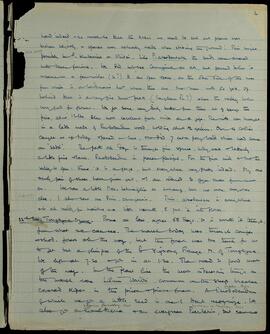
            22nd Dec. Tongkyuk Dzong. Home at last, after 68 days. It is worth it though, from what we can see. The march today was through conifer & rhod. forest all the way, but the forest was too thick for us to get but a glimpse of the Po Yigrong Range N. of Tongkyuk. We left at 7.30 & got in at 1.30. The road is good most of the way. In the plant line the most interesting things on the march were Lilium Wardii, common on the steep bracken covered slopes in the picea & pinus forest. A Rhododendron of which we got a little seed is one I don't recognize. We also got a Gaultheria & an evergreen Berberis, but saw no...

            LSH/1/1/2/1/49 · Part · 1933-07-08
            Part of The Ludlow & Sherriff Collection

            SUMMARY:
            The party arrived at Tawang in heavy rain after their horses gave out, with baggage arriving late or not at all. An acting body in place of a Dzongpen failed to assist, while a lama from another Bhutan-affiliated monastery offered help that was declined. The entry notes Tawang’s large gompa community and cultivation, a glimpse of the Tawang Chu, and a halt on 13 July with further discussions with Tibetans who were willing but unable to help.

            CONTENT:
            23

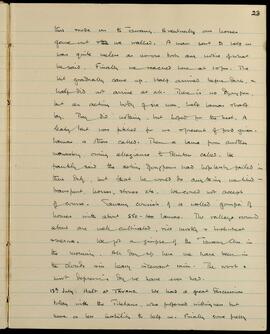
            Then rode on to Tawang. Eventually our horses gave out and we walked. A man sent to help us was quite useless as no one took any notice of what he said. Finally we reached here at 1.0 p.m. The kit gradually came up. Half arrived before dark, and half did not arrive at all. There is no Dzongpen, but an acting body of six men, half lamas and half lay. They did nothing, but hoped for the best. A leaky tent was pitched for us and presents of food given. Lamas and others called. Then a lama from another monastery, owing allegiance to Bhutan called. He frankly said the acting Dzongpens had hopelessly failed in their duty, but that he would do anything we liked - transport, horses, stores etc. We could not accept of course. Tawang consists of a walled gompa of houses with about 550-600 lamas. The valleys round about are well cultivated, rice mostly and buckwheat over. We got a glimpse of the Tawang Chu in the morning. All day up here we have been in the clouds in heavy incessant rain. The worst and most depressing day we have ever had.

            13th July. Halt at TAWANG. We had a great discussion today with the Tibetans, who professed willingness but more or less inability to help us. Finally some pretty

            LSH/1/1/1/1/87 · Part · 1933-07-14 - 1933-07-11
            Part of The Ludlow & Sherriff Collection

            SUMMARY:
            Notes on film sent from Bumthang and exposure issues; shooting was limited due to Tobgye’s concern about H.H.’s views on filming in E. Bhutan. Describes arrival at Bumthang with a pompous musical welcome by H.H.’s trained band, mentions groups on the Kykji Pass, and the march to Bumthang (9 miles, alt. 9900').

            CONTENT:
            41

            14.7.33
            Sent from Bumthang on Report 2 to 17 satisfactory, slightly underexposed.
            18A colour filter on wrong column complimentary.

            Quite a lot of sun. We had hoped to spend the whole day shooting, but Tobgye is anxious as to what H.H. will say about our shooting in E. Bhutan, and does not want us to spoil our chances by shooting too much now.

            16 B. finished. 11th July. To BUMTHANG. 9850. 9 miles. (Alt. 9900').
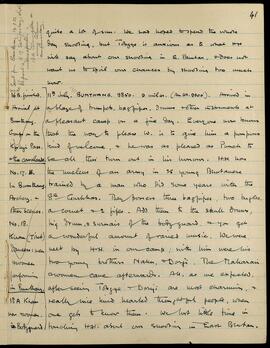
            Arrival at Bumthang. Arrived in a blaze of trumpets, bagpipes, drums and other instruments at Bumthang. A pleasant camp on a fine day. Everyone now knows
            Groups on the Kykji Pass. that the way to please W. is to give him a pompous kind of welcome, and he was as pleased as Punch to
            the cavalcade. see all this turn out in his honour. H.H. has
            No. 17. B. the nucleus of an army in 25 young Bhutanese
            In Bumthang. trained by a man who did some years with the
            Archery and 8th Gurkhas. They possess three bagpipes, two bugles,
            other scenes. a cornet and 2 fifes. Add them to the kettle drums,
            No. 18. big drum, and surnais of the bodyguard, and you get

            LSH/1/1/2/1/23 · Part · 1924-06-23
            Part of The Ludlow & Sherriff Collection

            SUMMARY:
            The party stays in the Dzongpen’s guest quarters, sends presents to Bumthang, and arranges future mail to India via Neoli instead of Dewangiri to avoid the wet march to Darrang Mela; the Dzongpen is very hospitable and even takes up shooting sparrows. On 29 June they make a short, mostly downhill march to Trashigong with the Jongpen, passing cultivated hills near Pinhogong (Rongtung) and noting the Dangme Chu (Trashiyangsi Chu) below.

            CONTENT:
            boxes and stores. The Dzongpen has two quite pleasant quarters for guests, and had made a place for our servants. We sent off all presents for Bumthang and arranged for the first mail to go to India today. It will go by Dewangiri, but we are arranging that in future it should go by Neoli, so as to miss the wet march from Dewangiri to Darrang Mela. The Dzongpen is not likely to worry us for shooting birds, as he saw my two rifles yesterday and immediately took both out and started potting sparrows himself. He is being as kind as Bhutan officials always have been, and provides everything. In fact he provides far too much, and we are not allowed to pay for anything if he can help it.

            29th June TO TRASHIGONG 5 miles. (205.2° = 3574'. Temp. 81°.

            Sent off all loads about 10 am and followed with the Jongpen at 11.30. A very short march, steep down for the first mile over a small side valley. Then the road is well graded, slightly downhill, through open hillside. The hills are cultivated here and there, but there are signs that formerly there used to be a great deal of cultivation near here. Pinhogong is the RONGTUNG of the map, or near it. Below Trashigong flows the Dangme Chu (Trashiyangsi Chu) a fine big swift

            LSH/1/1/1/1/61 · Part · 1933-06-08
            Part of The Ludlow & Sherriff Collection

            SUMMARY:
            A rainy day at HA included archery practice with Tobgye, during which an eagle owl was seen but not taken. The party used a local fish-catching method with a V-shaped stone barricade and bamboo cone, followed by wrestling, races, other games, and a Tibetan dinner with Tobgye and his lama at the Dzong.

            CONTENT:
            28
            Reportage Excellent

            being within a couple of yards of the mark. It rained all the time we were out, and became so heavy we had to stop. Tobgye tea'd with us here and stayed the evening.

            13th June. HA. Rain most of the morning. Went down the valley at 9.30, back at 12.0. No birds, but I saw and tried to shoot an eagle owl - the only owl we have seen in Bhutan so far.
            B. 9. finished.

            Archery at HA. (Poor light, raining slightly).
            After lunch Tobgye arrived and took us off for more archery practice, which we went on with for more than an hour. There were only a dozen or so out shooting, but we are promised a day when women folk will turn out. Apparently the women, who don't shoot, enjoy the tamasha a lot. And woe betide the man who holds his bow upside down: he will be turned upside down too, and dipped in the river.

            B. 10. Local method of catching fish by driving them up or down stream, and into a cone placed at the point of a V barricade of stones and men.
            Later the schoolboys all turned up, and we did some fishing. A stretch of about 60 yds of a side stream was chosen: then a close line of men walked up stream beating the water and hissing. At the other end of the stretch 8-10 men made a V shaped barrier of stones, and at the point, put a submerged bamboo cone. When the beaters got close to this, they ran in, and the fish were forced into the cone. We collected 20-30 like this in one bout. After this, we watched wrestling matches, and I took on one man myself: relay races followed, and all sorts of other games. Tobgye finished up after we left with some "cricket" practice. We finished the day with dinner - Tibetan - with Tobgye and his lama at the Dzong.

            LSH/1/1/1/1/189 · Part · 1935-09-11
            Part of The Ludlow & Sherriff Collection

            SUMMARY:
            Travel across a broad valley over a pass to the plain leads to the Dzong of Talung, with a river crossing, dirty water, and little fuel amid persistent rain and low cloud. Yamdrok Tso is a disappointment in the weather, though many ducks, greylag geese, and black-necked cranes are noted, and animal loads are assigned by a local elder drawing garters.

            CONTENT:
            93

            a broad open valley to a pass at m 3 over a shoulder, about 750'
            above the plain. Thence a gradual descent on the west side
            past a village on a spur, to the plain again at m 4.
            A small river is crossed here by a bridge, and the path then
            B. 29. lies over an open damp plain, the Dzong of Talung being
            Types of seen in the distance built on an isolated rock. It is
            Tibetans loading reached at m 8. Water apt to be very dirty after rain. A
            up at LING: little wood fuel available. // Most of the night it rained off and on,
            yaks: children and was still raining in the morning. The clouds were right
            down on the hills. We waited till 9:45 and then the sun
            suddenly came out, but it was clouded over all day, with
            only patches of sunshine. The Yamdrok Tso was therefore
            B. 29. finished. a disappointment, though even in the bad weather, it
            The west end of looked fine. The edges had many duck round
            the Yamdrok Tso: them, and close to the lake were hundreds of greylag
            A general view geese. On the flat plain we saw some black-necked
            of the Yamdrok crane (Grus nigricollis), two of which I took a cinema
            Tso, from near of. The start this morning was quite amusing. When
            the west end. all the loads were laid out, it was a question as
            to who should take which load, that was decided by
            a venerable old man taking a garter each from the
            B. 30. men and women who were to load up the animals. These
            A pair of he held behind his back, and went round all the
            black-necked pairs of loads, putting one garter on each pair.