Bhutan

Elements area

Taxonomy

Code

Scope note(s)

    Source note(s)

      Display note(s)

        Hierarchical terms

        Bhutan

        Equivalent terms

        Bhutan

          Associated terms

          Bhutan

            419 Archival description results for Bhutan

            419 results directly related Exclude narrower terms
            LSH/1/1/10/1/25 · Part · 1933-10-07 - 1933-10-10
            Part of The Ludlow & Sherriff Collection

            SUMMARY:
            Arrived in Bumthang, met by Tasho at Kurji; Hicks arrived later due to Trinley’s septic foot. Plans set to leave on 13 October, with Gundra and Basang going on 9 October to Sephu, Omta Tso, Thampala, and Ritang; received news from home written 8 September and discussed Tasho’s behavior toward Raja Dorji. From 8–10 October at Haat, with heavy rain and a meal with HH on the 8th.

            CONTENT:
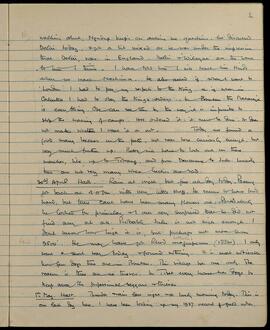
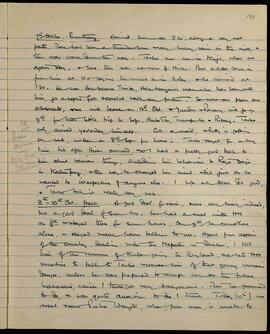
            7th October. Bumthang. Arrived here at 8:30, along a very wet path. There had been a thunderstorm and very heavy rain in the night, - but was worse down this way: Tasho met us in Kurji, where we again stay, and here there was no news of Hicks. But a letter came in from him at 10:00 saying he would be in today, and he arrived at 1:30. He was late because Trinley, Ashi Wangmo's man who has been with him, got a septic foot and couldn't walk any further. So now our plans are all made, we will leave on 13th October, and Gundra and Basang will go on 9th for their little trip to Sephu, Omta Tso, Thampala and Ritang. Tasho only arrived yesterday himself. Got a mail, and Betty is getting on well, written on 8th September from home. Tasho stayed for a long time till after Hicks arrived and I had a pretty good talk to him about various things, including his behaviour to Raja Dorji in Kalimpong, and the way he changed his mind and did just as he wanted to irrespective of anyone else. I hope all that did good, and Tasho took it really very well.

            8th - 10th October. Haat. A good deal of rain, some very heavy indeed, but a good deal of sun too. We had a meal with HH on 8th and stayed there for some
            LSH/1/1/3/3/90 · Part · 1933-04-09
            Part of The Ludlow & Sherriff Collection

            SUMMARY:
            Notes describe Brahminy ducks inspecting nesting sites in cliff holes and deserted houses near the Dzong, with local reports that parents push chicks from nests while one waits below to break the fall. This account matches a story told to Ludlow at Gyantse ten years earlier. The page also includes various measurements and times.

            CONTENT:
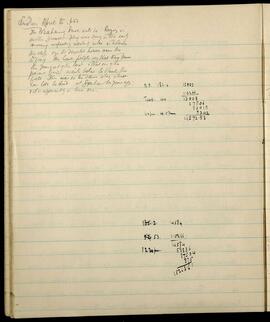
            Ludlow, April 15, p. 52
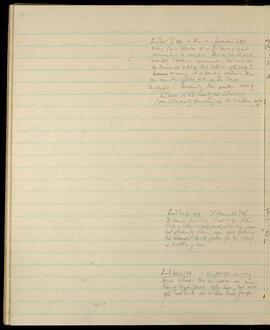
            The Brahminy duck will be laying in another 3 weeks. They were busy in the early morning inspecting nesting sites in holes in the cliffs or in the deserted houses near the Dzong. The local people say that they push the young out of the nest and that one of the parent birds waits below to break the fall. This is the same story which was told to Ludlow at Gyantse 10 years ago, and it is apparently a true one.

            B.P. 186.4 13903
            1.0266
            Temp. 44 13903
            27806
            83418
            4.0 pm 8342
            14272.82

            185.2 14584

            1. 1.0466
              14584
              12.30 pm. 58336
              87504
              875
              15263.61
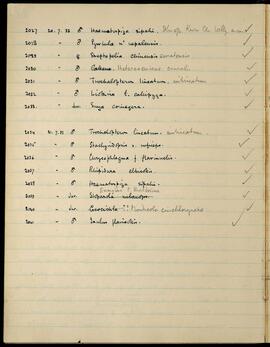
            LSH/1/1/1/1/96 · Part · 1933-07-20 - 1933-07-21
            Part of The Ludlow & Sherriff Collection

            SUMMARY:
            Entries dated 20/07/1933 and 21/07/1933 list multiple bird taxa with sex or juvenile status noted at Kuru Chu Valley (elevation 4700), with a note of “in coat.” Species mentioned include Haematospiza sipahi, Trochalopteron lineatum imbricatum, Stachyridopsis r. ruficeps, and others.

            CONTENT:
            2027 20. 7. 33 ♂ Haematospiza sipahi. Elev 4700 Kuru Chu Valley. in coat.
            2028 - ♂ Pyrrhula n. nepalensis.
            2029 - ♀ Streptopelia chinensis suratensis.
            2030 - ♂ Callene. Heteroxenicus cruralis.
            2031 - ♂ Trochalopteron lineatum. imbricatum.
            2032 - ♂ Liothrix l. calipyga.

              • Juv. Suya crinigera.

            2034 21. 7. 33 ♂ Trochalopteron lineatum. imbricatum.
            2035 - ♂ Stachyridopsis r. ruficeps.
            2036 - ♂ Chrysophlegma f. flavinucha.
            2037 - ♂ Rhipidura albicollis.
            2038 - ♂ Haematospiza sipahi.
            2039 - Juv. Eumyias t. thalassina Stoparola melanops.
            2040 - Juv. Geocichla ?? Monticola cinclorhyncha
            2041 - ♂ Ixulus flavicollis.

            LSH/1/1/1/1/98 · Part · 1935-07-22
            Part of The Ludlow & Sherriff Collection

            SUMMARY:
            Ledger entries (2042–2046) record bird specimens including Magalaima virens magnifica, Oriolus traillii traillii (Maroon oriole), Coracina c. tenuirostris, and Pericrocotus b. affinis, with notes on sex/age and Iris/NB references. Locations include Kuru Chu Valley, Burma, and the route from Lhuntse Dzong to Tamachu.

            CONTENT:
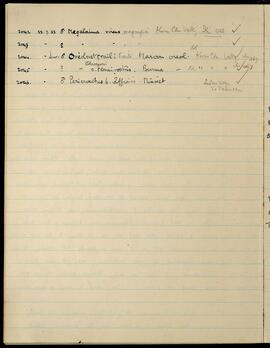
            2042 22.7.35 ♂ Magalaima virens magnifica Kuru Chu Valley Iris 486 ✓
            2043 " ♀ " " " " NB ✓
            2044 " Juv. ♂ Oriolus traillii traillii Maroon oriole NB Kuru Chu Valley Iris 467 ✓
            2045 " ? Coracina c. tenuirostris Burma " NB " " " Iris 467 ✓
            2046 " ♂ Pericrocotus b. affinis Minivet Lhuntse Dzong to Tamachu ✓

            LSH/1/1/4/1/12 · Part · 1936-07-02
            Part of The Ludlow & Sherriff Collection

            SUMMARY:
            Notes record a blackbird and Conostoma at about 14,000–14,500 ft, and mention Ludlow at Nyung La and Pachakshiri, with no further Ludlow field notes until 14 July. A Ludlow diary excerpt describes shooting an Ixops identified as I. daflaensis, previously obtained by Godwin Austen in 1875; Deutzia hookeriana (1908) and Sibia nipalensis daflaensis are noted.

            CONTENT:
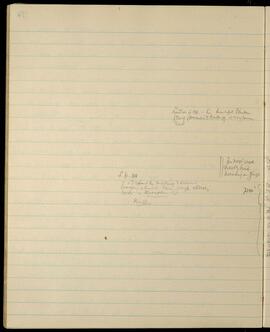
            Blackbird seen, common, at the extreme of
            rhododendrons, about 14500'.
            Conostoma at about 14000'.

            Ludlow at Nyung La
            Pachakshiri
            Deutzia hookeriana 1908
            no further Ludlow field notes
            until 14th July
            Ludlow diary 145. 'I shot an Ixops
            which is a different bird to the Bhutan
            Ixops & appears to be I. daflaensis'
            which was obtained by Godwin Austen
            as far back as 1875 - see d. Ibis 54.

            • Sibia nipalensis daflaensis.
            LSH/1/1/2/1/162 · Part · 1933-08-29
            Part of The Ludlow & Sherriff Collection

            SUMMARY:
            The writer notes that the Bhutan Glory butterfly is very common. Plans are made for mostly bird hunting next week, and S and the diarist spent the morning and evening at about 7,500 feet creeping through dense jungle collecting birds such as Hoopoe.

            CONTENT:
            Ludlow p. 108. - the beautiful Bhutan
            Glory (Armandia) Butterfly is very common
            here

            For next week
            mostly bird
            hunting in jungle

            L. p. 108
            S & I spent the morning & evening 7500'
            creeping about in dense jungle collecting
            birds - Hoopoe etc.

            Birds

            LSH/1/1/9/1/12 · Part · 1949-07-30
            Part of The Ludlow & Sherriff Collection

            SUMMARY:
            Notes discussions with H.H. on a new treaty affecting Bhutan, mention of Tasho Jigme’s freedom to travel, and soldiers sent up the Bumthang road to collect flowers including Prim. bracteosa, a Magnolia, and a Daphne. On 8th April they watched Bhutanese dancers and later hosted H.H. for a long session reminiscing about Calcutta and P.O.'s Gould, Williamson, Bailey, and Bell; letters from Kalimpong reported Ludlow’s departure and Norman’s sale of Glenulli.

            CONTENT:
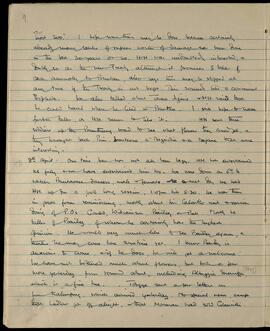
            almost 300." I hope something may be done, because certainly already many lakhs of rupees worth of damage has been done in the last 30 years or so. H.H. was undoubtedly interested, & doubly so as the new Treaty, although it promises 5 lakhs of cash annually to Bhutan, also says this may be stopped at any time if the Treaty is not kept. This sounds like a convenient loophole. We also talked about Tasho Jigme, & H.H. said that he could travel where he liked in Bhutan. I still hope to have further talks, as H.H. seems to like it. H.H. sent three soldiers up the Bumthang road to see what flowers they could get, & they brought back Prim. bracteosa, a Magnolia & a Daphne that were interesting.

            8th April. Our time here has not all been lazy. H.H. has entertained us fully & we have entertained him too. We were down on 6th to watch Bhutanese dancers, male & female, & the next day we had H.H. up for a good long session, 1.0pm till 5.30. He was then in great form reminiscing, mostly about his Calcutta visit & various doings of P.O.'s Gould, Williamson, Bailey or Bell. Mostly he talks of Bailey, of whom he certainly has the highest opinion. He would very much like to see Bailey again, & thinks he may come here sometime yet. I know Bailey is anxious to come, & if he does, he will get a welcome. We have not bothered much about flowers, but took a few more yesterday from round about, including Albizzia Sherriffii (18657), which is a fine tree. Tobgye sent a few letters on from Kalimpong, which arrived yesterday. No special news, except that Ludlow got off alright, & that Norman had sold Glenulli.

            LSH/1/1/9/1/35 · Part · 1949-05-06
            Part of The Ludlow & Sherriff Collection

            SUMMARY:
            The diarist walks alone while Ngundup asks about Delhi, London, and the King; the writer reflects on the Maharaja’s authority in Bhutan and warns of leeches on routes toward Tobrang and between Denchume and Jula. During halts on 30 April and 1 May near Sulu, Pasang returns with few specimens (no primulas) and a possible Rhododendron magnificum, and the diarist notes the scarcity of dogs and consults 1937 field notes.

            CONTENT:
            Walking alone, Ngundup keeps on asking me questions. We discussed Delhi today, and got a bit mixed as he was under the impression that Delhi was in England. Delhi and 'Wilayat' are the same to him I think. I have told him I will teach him Hindi when we reach Nashima. He also asked if when I went to 'London' I had to pay my respects to the King, and if when in Calcutta I had to obey the King's orders. In Bhutan the Maharaja is everything. One can see this by the way it is impossible to stop the making of camps. H.H. ordered it: it must be done. It does not matter whether I want it or not. Today we found a good many leeches on the path, not near here curiously enough, but very much further up. Betty will have to look out on these marches, like up to Tobrang, and from Denchume to Jula. Luckily there are not very many where leeches are bad.

            30th April Halt. Rain at night, but fine all day today. Pasang got back at 4.0 pm, with very little stuff. He seems to have tried hard, but there can't have been many flowers out. Particularly he looked for primulas, and I am very surprised that he did not find any at all. Probably Sulu is not high enough. I don't know how high it is, but perhaps not more than 9500'. He may have got Rhod. magnificum (18801). I only went a short way today, and found nothing. It is most noticeable how few dogs there are in Bhutan. This village has one only. The reason is there are no thieves. In Tibet every house has dogs to keep away the professional beggars and thieves.

            1st May. Halt. Thunder and rain last night, a lovely morning today. This is our last day here. I have been looking up my 1937 record of field notes,

            LSH/1/1/2/1/176 · Part · 1933-09-08
            Part of The Ludlow & Sherriff Collection

            SUMMARY:
            Notes describe a pervasive small biting fly in Bhutan, abundant around camp, and a lack of birds on the eastern side of a pass compared to the western side. It reports continuous heavy rain through night and day, and very dense, steep jungle with short visibility where the best birds are found.

            CONTENT:
            Ludlow 118 - There is a peculiar little biting fly in Bhutan which is the cause of great annoyance to everyone. It is as small as a sandfly, it bites one vehemently, not noticed so much at midday, but late in afternoon and early morning it is particularly active. There are numbers of these flies in the camp.
            No birds - evidently this eastern side of the pass is not nearly so interesting (ornithologically speaking) as the western side.

            Ludlow 119 'A damnable day'
            It rained the whole of last night and the whole of today - not just ordinary rain but streaming rain, rain that falls from the clouds as it falls from the rose of a watering can.

            Ludlow 120 - the jungles are very dense and steep. One can seldom see more than a dozen yards, often less, but most of the best birds are in these thick jungles.