Bhutan

Elements area

Taxonomy

Code

Scope note(s)

    Source note(s)

      Display note(s)

        Hierarchical terms

        Bhutan

        Equivalent terms

        Bhutan

          Associated terms

          Bhutan

            419 Archival description results for Bhutan

            419 results directly related Exclude narrower terms
            LSH/1/1/8/1/109 · Part · 1947-05-06
            Part of The Ludlow & Sherriff Collection

            SUMMARY:
            Describes a route from Cuny up a forked valley with irises, roses, and berberis, passing villages toward the Samu La, noting carved dorings and that the area is the 5th D.L.'s birthplace. On 16th May at Triju Dzong, details the ascent over a ridge with views of Triju Tso (apparently drying), descent past Drokpa tents to Teachee, and lodging in the butter tax collector’s house, noting local officials and yak herders.

            CONTENT:
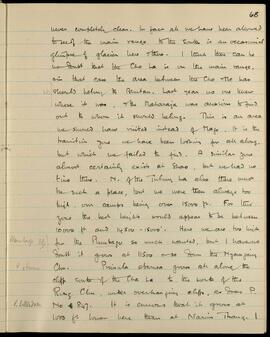
            a picturesque place, more so when the whole fort, plastered onto a hillside beside the Dzong, is seen. Here also are monasteries, all because the place is the 5th D.L.'s birthplace. On the plain are two "dorings", about 15 ft high and carved. They appear very old. There is no writing on them. We crossed the main valley at Cuny and to the right bank, and went up a valley which is a fork of the main one. This valley is a nicer one, with a small stream in it, some [Iris laeter 12448] shrubs - roses and berberis - among irises, with lingkas at most of the small villages or gompas. About mile 7 1/2 this valley is left for one which comes in from the left or SE. is followed up to this village, the last on the way up to the Samu La. There is cultivation up to here, and a group of 5-6 homes together. Turdus merula maxima is common here; there are a good many snowcocks high up. T. henrici is common as far as this.

            16th May Triju Dzong. A cold dismal morning, clearing up by 10.0, with occasional hail showers round about, and some heavy storms too. Left at 6.15 in at 1.30 pm. Kit in at 4.30 pm. The road is good nearly throughout, but from what I hear, this is an area where storms are common and there is a heavy snow and rainfall. Path ascends the same valley easily till the valley peters out at mile 5. There is a pass leading down here to the Yaktsang Chu, but our path keeps right-handed (west) and continues to climb to about mile 7 when a ridge is crossed. From here the Triju Tso is visible but not Triju Dzong. Now the lake consists of deepish water of about 1/2 mile at the N. end, 1/2 mile wide and then marshy shallow looking water further south. There is I believe much more water in summer; but the lake appears to be drying up. The descent is easy, with one or two ups and downs. A few Drokpa tents are passed but no pukka buildings till the stony ones here in Teachee. There must be 50 houses here, and I suppose they contain people who mostly look after yaks. We stayed in a house kept for the butter tax collector - quite good and convenient. There are 4 headmen. The Dzongpon.
            LSH/1/1/2/1/129 · Part · 1933-07-18
            Part of The Ludlow & Sherriff Collection

            SUMMARY:
            Notes abundant Delphinium grandiflorum and a large Aconite, with Plumbago absent here but expected lower down. Describes travel from the Dzong across the Nyamjang Chu, along the right bank to the Tsuk Chu and up to the customs village of Tsuk, then ascending toward the Cha La. Mentions reports on the road to Shingbe and contrasts the friendliness of Dongkar people with the rudeness in Tsuna.

            CONTENT:
            63

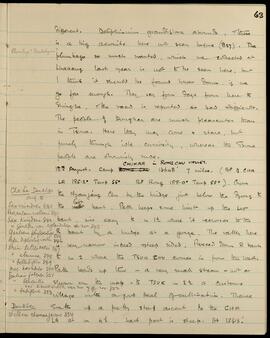
            Different. Delphinium grandiflorum abounds, there is a big Aconite here not seen before (827). The Plumbago so much wanted, which we collected at Lhakang last year is not to be seen here, but I think it should be found lower down, if we go far enough. They say four days from here to Shingbe, the road is reported as bad & difficult. The people of Dongkar are much pleasanter than in Tsuna. Here they may come & stare, but purely through idle curiosity, whereas the Tsuna people are boorishly rude.

            CHUKAR in RONG CHU VALLEY.
            18th August. Camp 13648' 7 miles. (BP of CHA LA 185.2° Temp 55° BP Rong 188.0° Temp 55°). Cross the Nyamjang Chu by the bridge just below the Dzong to the left bank. Path keeps some height up the left bank, is easy to m 1 1/2 where it recrosses to the R bank by a bridge at a gorge. The valley here is very narrow indeed steep sided. Proceed down R bank to m 2 where the TSUK CHU comes in from the west. Path leads up this — a very small stream — not as shown on the map — to TSUK m 2 1/2 a customs village with a good deal of cultivation. Thence south up a pretty steep ascent to the CHA LA at

            LSH/1/1/6/1/66 · Part · 1937-06-05
            Part of The Ludlow & Sherriff Collection

            SUMMARY:
            Field notes describe the ascent to Chubumbu La with bearings, terrain, and vegetation changes, and map labels for nearby locations. The page records locations and observations for several alpine plants, including Rhododendron, Omphalogramma, and Primula specimens, with altitudinal ranges and morphological notes.

            CONTENT:
            33a

            [Map Labels]
            Potsangla
            Chianang
            Pass
            Peak
            Lagyong
            Sheltangla
            Chubumbu La
            46°
            65°
            145°
            162°

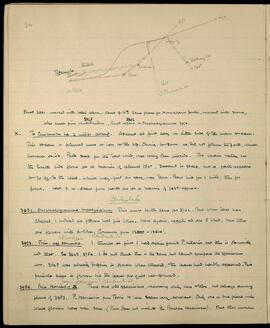
            Rhododendron 3941 marked with label above camp of 6th. Same place for Nomocharis souliei, marked with stone, also small pink Rhododendron 3925, Rhododendron repens 3942 and Omphalogramma 3970.

            X - To Chubumbu La 2 miles ascent. Ascent at first easy on either side of the main stream. This stream is followed more or less to the top. Owing to snow, we did not follow the path, which however exists. Path steep for the last mile, over rocky open hillside. The main valley on the South side flows at a bearing of almost 180°. Descent is steep, but a path appears to go off to the West, which may find an easy way down. Bare hill for 1 mile, then fir forest. Last 2 miles ascent from North are at a bearing of 142° approx.
            Chubumbu La

            1. Omphalogramma brachysiphon. This must be the same as 3762. But when that was collected, I noticed all flowers had five lobes. Here again, nearly all are 5 lobed, but there are flowers with 6 lobes. Common from 13,000 - 13,500'.
              Chubumbu La

            2. Primula aff. strumosa. (chionogenes? Chubumbu La) I thought at first I had again found P. hilaris, but this is obviously not that. See 3648, 3754. I do not think this is the same, but cannot compare the specimens now. 3648 was already dropping its flowers when collected, the leaves had hardly appeared. This primula keeps its flowers till the leaves are quite well formed.
              (tsariensis x chionogenes? Chubumbu La)

            3. Primula tsariensis X. These are odd specimens, occurring only here and there, but always among plants of 3983. P. tsariensis from Tsari to here seems very constant. Only one or two plants with white flowers have been seen. (This does not include the Bhutan specimens). But this number

            LSH/1/1/4/1/80 · Part · 1933-08-15
            Part of The Ludlow & Sherriff Collection

            SUMMARY:
            Notes record abundant Cyananthus lobatus below Chosam and, on Aug. 22, a gorgeous journey to Chickchar. The page mentions women leaving Chickchar for Yarob to avoid tempting monks, a monastery rebuilt at the expense of the Maharaja of Bhutan, and lists plant taxa with specimen numbers from Chickchar.

            CONTENT:
            L 173 Cyananthus lobatus perfectly beautiful
            below Chosam in great abundance.

            • next day - Aug. 22, a gorgeous
              sight all the way to Chickchar.

            L 173-4 In a few weeks' time all the women of Chickchar
            have to clear out of the village and go to Yarob lest they should
            prove a temptation to the monks. The monastery was
            burned down a few years ago, and I believe it was rebuilt at
            the expense of the Maharaja of Bhutan.

            Chickchar
            P. tsariensis sp. nov. 2478 2483
            " odontica sp. nov.
            cocoon suspended from 2490
            Gen. Otophora 2480
            fistula 2487
            Phyllocalyx 2488
            Aconitum rotundifolium 2481
            tsariense sp. nov. 2491
            Lomatogonium chumbicum 2482
            " spath. 2489
            Notholirion bulbuliferum 2479

            LSH/1/1/2/1/197 · Part · 1933-09-27
            Part of The Ludlow & Sherriff Collection

            SUMMARY:
            Notes on receiving mail from Calcutta, ongoing photography with a small camera and limited use of the big camera at Dib La. Locals bring gifts; the Dzongpen of Lhuentse sends a man and has new bridges built over the Khoma and Kuru Chhu in expectation of a visit. On 30th Sept., the party returns to the main valley near Chorten Korra amid fair weather, though the monsoon persists and potted plants are not doing well.

            CONTENT:
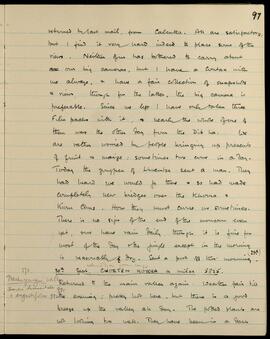
            returned by last mail, from Calcutta. All are satisfactory, but I find it very hard indeed to place some of the views. Neither of us has bothered to carry about our big cameras, but I have a Contax with me always, and have a fair collection of snapshots and views, though for the latter, the big camera is preferable. Since we left I have only taken three film packs with it, and nearly the whole of one of them was the other day from the Dib La. We are rather worried by people bringing up presents of fruit and maize: sometimes two come in a day. Today the Dzongpen of Lhuentse sent a man. They had heard we would go there and so had made completely new bridges over the Khoma and Kuru Chhu. How they must curse us sometimes. There is no sign of the end of the monsoon even yet, we have rain daily, though it is fine for most of the day and the jungle except in the morning is reasonably dry. Sent a post off this morning.

            30th Sept. CHORTEN KORRA 4 miles 5825'.
            Returned to the main valley again. Weather fair till the evening: pretty hot here, but there is a good breeze up the valley all day. The potted plants are not looking too well. They have been in a dark

            LSH/1/1/2/1/199 · Part · 1933-10-01 - 1933-10-02
            Part of The Ludlow & Sherriff Collection

            SUMMARY:
            The party halted at Chorten Kora in Trashiyangsi, noting abundant cosmos flowers and a falling river; Damong departed with two men for the Me La, and Ramzana caught a Kalij pheasant. On 2 October they ascended to Sana (c. 8397 ft), with most coolies arriving shortly after, amid changing weather.

            CONTENT:
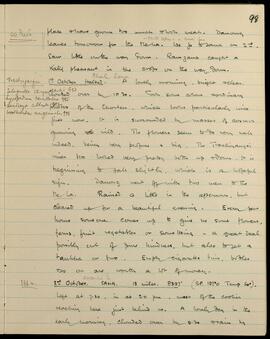
            98

            (see Me La)
            Place above grown too much dhobi wash. Damong leaves tomorrow for the Me La - shall return in a week's time. We go to Sana on 2nd. Saw little on the way down. Ramzana caught a Kalij pheasant in the crops on the way down.

            (Trashiyangsi)
            (Selaginella chrysocaulos 993)
            (Lycopodium cancellatum 995)
            (Lindsaya cultrata 997)
            (Woodwardia unigemmata 998)

            1st October. Halted. Chorten Kora. A lovely morning, bright and clear. Clouded over by 10.30. Took some photos, ordinary photos of the Chorten, which was particularly nice just now. It is surrounded by masses of cosmos growing wild. The flowers seem to do very well indeed, being very profuse and big. The Trashiyangsi river too looked very pretty both up and down. It is beginning to fall slightly, which is a hopeful sign. Damong went off with two men to the Me La. Rained a little in the afternoon, but cleared up for a beautiful evening. Every few hours someone comes up to give us some flowers, ferns, fruit, vegetables or something - a great deal possibly out of pure kindness, but also to get a tankha or two. Empty cigarette tins, bottles and so on are worth a lot of money.

            (386 n.)
            2nd October. SANA. ascended to 13 miles. 8397' (BP. 197.0 Temp 60°). Left at 7.30, in at 2.0 pm, most of the coolies reaching here just behind us. A lovely day in the early morning, clouded over by 9.30 and rain by...

            LSH/1/1/8/1/107 · Part · 1947-05-06
            Part of The Ludlow & Sherriff Collection

            SUMMARY:
            Arrangements for transport were secured via clerks in the absence of a Dzongpon or Drunyer, and Pedong Dorje plans to accompany the party to Trigu. On 14 May they marched 13 miles to Chong gye Dzong in intense heat, noted extreme dryness in the valley, passed a large wall of chortens, and recorded that the old Dzong is the birthplace of the Great Fifth Dalai Lama; plans were made to reach Trigu in two days.

            CONTENT:
            on, eventually a kind of dayig was given me, and transport was promised. All was done by 3 clerks, as there is no Dzongpon and even the Drunyer has gone, so no seal could be put on the paper, but all seems well. Pedong Dorje insists on coming with us to Trigu.

            14th May. Chong gye Dzong 13 miles. A good day, but very hot indeed and difficult for Jill. Transport was late, but we got off at 7:30 and were in by 2:15 pm. The valley is very dry indeed. There is no water in the river at all, none in any irrigation channels and only a little in wells. The whole valley is broad and full of cultivation. I have never seen so much in Tibet before - even near Gyantse. About mile 7 we passed a small village with a huge wall of chortens all joined together, each about 6 ft square and perhaps 10-12 ft tall. There were supposed to be 108 chortens. I counted more than that. Here the old Dzong is perched on a ridge and consists of several buildings joined together by bridges. This is the birthplace of the Great Fifth Dalai Lama. All seems set for tomorrow's march, which could be done in one to Trigu. But I intend to go in two days. As usual, there is no Dzongpon. Every Dzongpon has been called to Lhasa, and only tsapos or clerks are left. But I don'

            LSH/1/1/6/1/123 · Part · 1933-08-18 - 1933-08-22
            Part of The Ludlow & Sherriff Collection

            SUMMARY:
            Entries for 18–22 August describe halts at Chomo Dzong and Kyabden, poor weather, and a short march crossing the Nyang Chu in four coracles. Taylor became seriously ill at Kyabden (suspected appendicitis or gastric ulcer), prompting messages to Lhasa for help and to call Ludlow; he later improved.

            CONTENT:
            again very slow indeed. Left at 6.30 am, last coolies in at 6.00 pm. Again very little seen. Primula latisecta common a few miles up the valley from here. Seed not yet ripe. A large monastery here, & considerable cultivation. Crops just about to be harvested, some barley already cut & in.

            18th August. Halt. Chomo Dzong. Wet a good deal of the day.

            19th August. Kyabden. 5 miles. Fine with showers. We crossed the Nyang Chu opposite Chomo Dzong in four kowas, the stream is in two channels very swift. Path up N bank good & easy, though swampy in places. No villages passed till camp reached.

            20th August. Halt. Kyabden. Taylor has been very ill here, with some unknown complaint. So much so that I sent off to Lhasa for help if possible, also to call Ludlow. It appeared to be appendicitis, with awful pains, nausea, vomiting & a high rate of pulse.

            21st August. Halt. Kyabden.

            22nd August. Halt. Kyabden. This went on till yesterday evening, when after vomiting, he said he was all right, & that the pains had gone. Shortly before this the pain seemed to have localized to the left of the navel. What it has been I don't know, though I should think a gastric ulcer is possible. He is ever so much better today, & I have sent off to

            LSH/1/1/2/1/139 · Part · 1933-07-18
            Part of The Ludlow & Sherriff Collection
            • SUMMARY:
              The writer discusses limited views of the main range, suggesting Cho La is on the main range and that the area between it and the pass may belong to Bhutan; they note it is the transition zone they sought and should have visited instead of Mago, with similar zones at Shao and north of Tulung La. They record altitude preferences, expecting Plumbago lower along the Nyamjang Chu, and note Primula eburnea along the Cho La cliffs north of the Rung Chu at a lower elevation than at Narim Thang.

            CONTENT:
            68

            never completely clear. In fact all we have been allowed
            to see of the main range to the south is an occasional
            glimpse of glacier here and there. I think there can be
            no doubt that the Cho La is on the main range,
            in that case the area between the Cho and the La
            should belong to Bhutan. Last year no one knew
            where it was, and the Maharaja was anxious to find
            out to whom it should belong. This is an area
            we should have visited instead of Mago. It is the
            transition zone we have been looking for all along,
            but which we failed to find. A similar zone
            almost certainly exists at Shao, but we had no
            time there. N. of the Tulung La also there must
            be such a place, but we were then always too
            high, our camps being over 15000 ft. For this
            zone the best heights would appear to be between
            10000 ft and 14500 - 15000'. Here we are too high
            Plumbago NB

            • for the Plumbago so much wanted, but I have no
              doubt it grows at 11500 or so down the Nyamjang
              P. eburnea
            • Chu. Primula eburnea grows all along the
              cliff side of the Cho La to the north of the
              Rung Chu, under overhanging cliffs, as does P.
              P. lilledale
            • No 847. It is curious that it grows at
              1000 ft lower here than at Narim Thang. I
            LSH/1/1/7/1/23 · Part · 1940-04-22
            Part of The Ludlow & Sherriff Collection

            SUMMARY:
            The diary describes the poorly maintained Molo–Lhalung path, the heavy loads carried by local coolies, and observations of Primula species along the route, including P. Normaniana and P. latisecta with notes on their phenology. From a camp on the Chindi Chu the party climbed over the Nyug La through dense forest with Rhododendron and bamboo, noted P. tsariensis var. porrecta and P. Boothii, and obtained a view of the Lhalung valley, with P. Boothii extending its known distribution from the type locality in Bhutan.

            CONTENT:
            usually hanging over the river.

            The people of Molo and Lhalung who use this path do not bother to keep it in any kind of repair. Only when they are unable to get over an obstacle do they do anything. Fallen trees remain where they fell. Rather than cut through them, they place notched logs over them and in some stretches one is compelled to walk more on notched logs than on path. We found it difficult enough, slippery and wet as the logs always are, and we were filled with admiration at the way the Molo coolies managed with their very heavy loads. In some cases one man chose to carry two loads, thus allowing an extra man to remain at home. These loads, with their own rations for both journeys, may have been as much as 160 lbs, but they did not seem to worry. Along the edges of the path or stream, as it often was, grew two new Primulas - P. Normaniana and P. latisecta. Both were in full bloom, and both records show an interesting extension westward. When we returned in May P. latisecta was over, and the plants had produced leaves in the axils of the pedicels. The stems then seem to fall over and act as stolons, the new leaves rooting beside the parent plant.

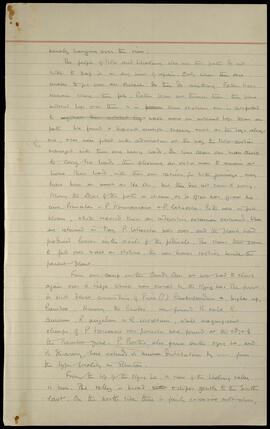
            From our camp on the Chindi Chu we now had to climb again over a ridge which was crossed by the Nyug La. The forest is still dense, consisting of Picea (?) Rhododendron and, higher up, Bamboo. Among the Rhodos, we found R. rude, R. aureum, R. arizelum and R. uvarifolium, while magnificent clumps of P. tsariensis var porrecta were found at the edge of the Bamboo zone. P. Boothii also grows on the Nyug La, and its discovery here extends its known distribution by —— from the type locality in Bhutan.

            From the top of the Nyug La, a view of the Lhalung valley is seen. The valley is broad and slopes gently to the South East. On the north side there is fairly extensive cultivation,