Bhutan

Elements area

Taxonomy

Code

Scope note(s)

    Source note(s)

      Display note(s)

        Hierarchical terms

        Bhutan

        Equivalent terms

        Bhutan

          Associated terms

          Bhutan

            419 Archival description results for Bhutan

            419 results directly related Exclude narrower terms
            LSH/1/1/1/1/169 · Part · 1933-09-05
            Part of The Ludlow & Sherriff Collection

            SUMMARY:
            Describes the route from a pass down to a bridge and onward via Lala to Towa Dzong, with camping near the river. Notes long delays when changing transport at villages, including a 13-hour day and a 1¾-hour wait at Lala, with locals, coolies (mostly women), and various pack animals involved.

            CONTENT:
            The drop from the pass to the bridge is over 2000'. Over the bridge the path climbs up the R bank by very steep zig zags for 1600' to m 8½. A village is passed at m 9½, thence the path is nearly level round the hillside to the west, reaching the village of Lala at m 12. Here transport is changed. From Lala the path descends gently to the Towa villages cultivation at m 15, and thence proceeds through cultivation to Towa Dzong and a very good camping ground ½ mile beyond the Dzong, close to the river at m 17. Water and fuel ample - 11.

            Changing transport is proving a perfect curse. Yesterday we took 13 hours to reach here: started at 6:00 am and arrived 7:00 pm. Luckily it was a good day. The changing is really rather amusing: it would be very funny were it not for the awful delay. Everyone in the village turns out. They look at and examine all our things; then there is endless talk, which seems to lead nowhere at all. People shout to others miles away for horses. Somehow or other there eventually turn up, with some coolies, donkeys, cattle, yaks, and horses off we eventually go again. Yesterday at Lala it took 1¾ hours for this to be done: otherwise we should have been here in daylight. The coolies are mostly women, and they get on with the work pretty well. Everyone seems happy and they all joke and laugh
            LSH/1/1/2/1/57 · Part · 1933-07-08
            Part of The Ludlow & Sherriff Collection

            SUMMARY:
            The party travels north past Chio Tso and Kachen Tso, descends to an old lake bed, ascends to Dending La, and then down to Tsona, noting a hot spring near the Dzong, barley cut green for winter fodder, and good grazing. Kurhip becomes ill with a cold fever and is left with Danong while the others push on in cold rain to reach Tsona at 5 pm; the Dzongpen provides the best available room despite poor conditions.

            CONTENT:
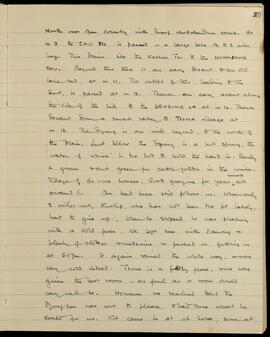
            North over open country with dwarf rhododendron scrub. At m 9 the CHIO TSO is passed - a large lake 1 1/2 to 2 miles long. This drains, like the Kachen Tso to the NYAMBANG CHU. Beyond this there is an easy descent to an old lake bed at m 11. The outlet of this, leading to the East, is passed at m 12. Thence an easy ascent along the side of the hill to the DENDING LA at m 14. Thence descent down a small valley to TSONA village at m 16. The Dzong is one mile beyond, to the north of the plain. Just below the Dzong is a hot spring, the water of which is too hot to hold the hand in. Barley is grown cut green for cattle fodder in the winter. Village of 60-100 houses. Good grazing for yaks and sheep all around it.

            Our bad luck still follows us. When only 2 miles out, Kurhip, who has not been too fit lately, had to give up. When he stopped he was shaking with a cold fever. We left him with Danong - plenty of clothes and medicine and pushed on, getting in at 5.0 pm. It again rained the whole way, and was very cold indeed. Tsona is a filthy place, and we were given the best room - as foul as a room could very well be. However we realised that the Dzongpen was one to please, and had done what he could for us. Kit came in at odd hours, some at

            LSH/1/1/3/3/33 · Part · 1937-02-27
            Part of The Ludlow & Sherriff Collection

            SUMMARY:
            Describes a short, very hot march up the Gamri Chu from Rungzyung, noting plentiful Pinus longifolia and flowering Bauhinia variegata below Trashigong, along with Desmodium tiliaefolium, Woodfordia fruticosa, violets, and a spiraea. Mentions a notably well-built village of about ten houses, and records Lumsden’s view that the sores seen on locals last year were due to the Damdim fly (Simulium damnosum).

            CONTENT:
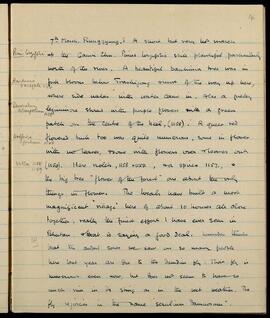
            7th March. Rungzyung. A short but very hot march
            [Pinus longifolia] up the Gamri Chu. Pinus longifolia still plentiful particularly
            north of the river. A beautiful Bauhinia tree was in
            [Bauhinia variegata 1154] full bloom below Trashigong some of the way up here,
            where side nalas with water come in. Also a pretty
            [Desmodium tiliaefolium 1155] leguminous shrub with purple flowers with a green
            patch in the centre of the keel, (1155). A queer red
            [Woodfordia fruticosa 1150] flowered bush too was quite numerous, some in flower
            with no leaves, some with flowers over & leaves out.
            [Viola 1158, 1159] (1150). Here violets, 1158 & 1159, a spiraea 1157, &
            the big tree "flower of the forest" are about the only
            things in flower. The locals have built a most
            magnificent 'village' here of about 10 houses all close
            together, really the finest effort I have ever seen in
            Bhutan, & that is saying a good deal. Lumsden thinks
            that the awful sores we saw on so many people
            here last year are due to the Damdim fly. That fly is
            numerous even now, but does not seem to have so
            much vim in its sting as in the wet weather. The
            fly rejoices in the name 'Simulium damnosum'.

            LSH/1/1/2/1/35 · Part · 1915-05-29
            Part of The Ludlow & Sherriff Collection

            SUMMARY:
            The party reaches Sakden near the Gamri Chu, noting ample water, fuel, grazing, and a nearby gompa with a Tawang lama. On 5th July they halt at Sakden, finding few flowers in bloom, observing local clothing and village life, and practicing rifle shooting with the Jongpen and his men.

            CONTENT:
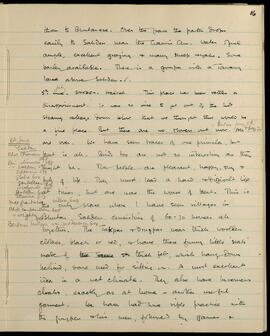
            than to Bhutanese. Over the pass the path drops easily to Sakden near the Gamri Chu. Water & fuel ample, excellent grazing & many sheep & yaks. Some barley available. There is a gompa with a Tawang lama above Sakden. //

            5th July. SAKDEN. Halted. This place has been rather a disappointment. It was so nice to get out of the hot steaming valleys down below that we thought this would be a fine place. But there are no flowers out now. All are over. We have seen traces of one primula, but that is all. Birds too are not so interesting as they might be. The people are pleasant, happy, shy & full of life. They must lead a hard & difficult life at times, but are none the worse of that. This is the only place where I have seen villages in Bhutan, Sakden consisting of 60-70 houses all together. The Takpas & Drugpas wear thick woollen clothes, black or red, & have these funny little 'seats' made of thick felt, which hang down behind, & are used for sitting on. A most excellent idea in a wet climate. They also have Inverness cloaks, exactly as at home - another useful garment. We have had some rifle practice with the Jongpen & his men, followed by games &

            [Margin notes]
            6th June
            Sakden.
            Rhod. Thomsoni 595
            Prim. strumosa 597
            " Waltoni 598
            " Sikkimensis 599
            " Glabra 602
            " Gambelliana 608
            " Involucrata 610
            " Gambelliana 611
            " Strumosa 612
            Mec. grandis 609
            Rhod. campanulatum 605
            " wightii 606
            Berberis lichiangensis var. sakdenensis 604

            • But see June 6th! p. 20
            LSH/1/1/2/1/30 · Part · 1924-06-23
            Part of The Ludlow & Sherriff Collection

            SUMMARY:
            Notes describe Sakden as excellent for birds and plants; the party returned in autumn to collect seeds and study the avifauna, obtaining a new Fulvetta. Species observations include Fulvetta ludlowi common in bamboo and rhododendron forest on the extreme eastern frontier of Bhutan, and finding Tragopan satyra instead of T. b. molesworthi in dense rhododendron within silver fir forest.

            CONTENT:
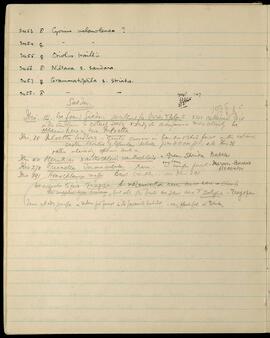
            2453 ♂ Cyornis melanoleuca ?
            2454 ♀ - " -
            2455 ♀ Oriolus traillii
            2456 ♂ Niltava s. sundara.
            2457 ♀ Grammatoptila s. striata.
            2458 ♂ - " -

            Sakden
            Ibis. 15. We found Sakden excellent for birds & plants & we returned to it in the autumn to collect seeds & study its avifauna more closely. We obtained here a new Fulvetta.

            Ibis. 38. Fulvetta ludlowi - quite common in bamboo & rhododendron forest on the extreme eastern frontier of Bhutan between 7500 & 11000 ft. see Ibis 38
            rather intensely open sub-alpine

            Ibis 44 Pteruthius xanthochloris xanthochloris - Green Shrike Babbler
            Ibis 278 Prunella immaculata rare. very tame in conifer forest. - Maroon Backed Accentor
            Ibis 291 Homochlamys major Bush Warbler - see Ibis 291

            We expected to find Tragopan b. molesworthi here, as we were so close to the supposed type locality, but all the birds we saw were T. satyra - Tragopan
            dense rhodo jungle in silver fir forest is its favourite habitat - very plentiful in Bhutan

            LSH/1/1/2/1/223 · Part · 1934-10-14
            Part of The Ludlow & Sherriff Collection

            SUMMARY:
            The diarist describes comfortable bamboo hut accommodations and stages from Samri Chu to Taktu and then to Sakden over the Munda La, noting fine weather and elevations. At the first village over the pass, they observe papermaking driven by a waterwheel and efficient turning of wooden drinking bowls; Danang suggests the wood is a kind of Prunus.

            CONTENT:
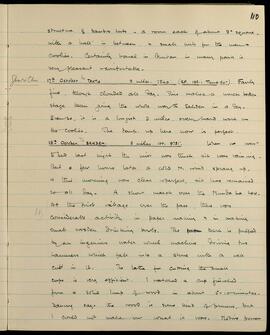
            110

            structure of bamboo huts - a room each of about 8' square, with a 'hall' in between, and small huts for the men coolies. Certainly travel in Bhutan in many parts is very pleasant and comfortable.

            Samri Chu
            17th October. to TAKTU 9 miles. 7840' (B.P. 18.1 Temp 60°). Fairly fine, though clouded all day. This makes a much better stage than doing the whole way to Sakden in a day. Even so, it is a longish 9 miles, and very hard work on the coolies. The temp. up here now is perfect.

            18th October. To SAKDEN. 5 miles. Ht. 9731'. When we went to bed last night the mist was thick and it was raining. But a few hours later a cold N. wind sprang up, and this morning was clear and perfect, and it has remained so all day. A short march over the Munda La here.

            FB
            At the first village over the pass, there was considerable activity in paper making and in making small wooden drinking bowls. The paper bark is pulped by an ingenious water wheel machine, driving two hammers which fall into a stone with a well cut in it. The lathe for cutting the small cups is very efficient. I watched a cup finished from a solid lump of wood in about 5-10 minutes. Danang says the wood is some kind of prunus, but I could not make out what it was. Motive power

            LSH/1/1/2/1/207 · Part · 1933-10-08 - 1933-10-09
            Part of The Ludlow & Sherriff Collection

            SUMMARY:
            The party halts at Sana amid heavy rain that floods the tent; a Tibetan patient improves as more pus and cores are expelled. Their taphon begs for trousers and is promised pyjamas, and the next day they march to Trashiyangsi Dzong before rain sets in, with Danong and Kurtip returning.

            CONTENT:
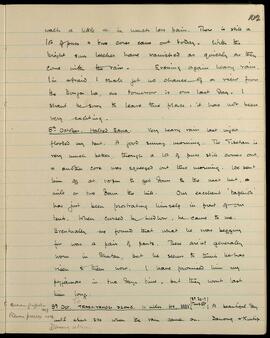
            walk a little and in much less pain. There is still a lot of pus and two cores came out today. With the bright sun leeches have vanished as quickly as they come with the rain. Evening again heavy rain. I'm afraid I shall get no chance of a view from the Donger La, as tomorrow is our last day. I shan't be sorry to leave this place; it has not been very exciting.

            8th October. Halted Sana. Very heavy rain last night flooded my tent. A good sunny morning. The Tibetan is very much better, though a lot of pus still comes out, and another core was squeezed out this morning. We sent him off at 1.0pm to get down to the next hut, a mile or two down the hill. Our excellent 'taphon' has just been prostrating himself in front of our tent. When cursed by Ludlow, he came to me. Eventually we found that what he was begging for was a pair of pants. These aren't generally worn in Bhutan, but he seems to think he has risen to them now. I have promised him my pyjamas in two days time, but they won't last him long.

            Quercus griffithii 1053
            Pleione praecox 1056
            9th Oct. TO TRASHIYANGSI DZONG. 11 miles Ht. 5883' (BP. 20.17) Temp 68° A beautiful day until about 2.30 when the rain came on. Danong and Kurtip returned.

            LSH/1/1/2/1/205 · Part · 1933-10-05
            Part of The Ludlow & Sherriff Collection

            SUMMARY:
            The diarist reports a serious epidemic to the south in Shinga Dzong, thought by Puibo to be influenza though possibly typhoid. While halted at Sana, Ludlow treated a Tibetan man's abscess and ongoing dressings improved his condition amid rainy weather and delays awaiting mail.

            CONTENT:
            101

            to be a serious outbreak of some epidemic to
            the south in Shinga Dzong. Two hundred or
            more are said to have died already. Puibo
            says it is influenza, though typhoid is more
            likely.

            6th October. Halted Sana. Fair morning, rain the rest
            of the day. Yesterday Ludlow cut the Tibetan's
            abscess with a razor blade. Pus just poured out
            and the man was obviously greatly relieved. We
            dress it four times a day, and still any amount
            of stuff pours out. The hand is a little less
            swollen, but still big and very painful. I wonder
            if he will be able to walk down with us in
            two days' time. We cannot leave him here, or
            the whole thing will just start off again. I
            wish the next mail would arrive. With all this
            rain, one feels the need of reading matter. It is
            little or no use going out in misty dull weather,
            as birds are not on the move then. We should
            know definitely next mail whether all our mails
            have been delivered or not.

            7th Oct. Halted Sana. The first good day since we
            have been here. Cloudy, but sun bright in the
            valleys. The Tibetan is much better, able to

            Phylloscopus affinis wallichiana 10000

            LSH/1/1/6/1/157 · Part · 1938-10-22
            Part of The Ludlow & Sherriff Collection

            SUMMARY:
            The diary notes arrival at Sanga Chöling after severe cold, the first fine day in some time, active seed collecting and drying of specimens, and a letter from Ludlow with specimen numbers. It records news of Tarka’s party (with Tendrup and Tsering), plans to proceed via Tsona toward Trashigang, kindness from Ashi Gyelmo, and missing photo enlargements likely held by the Kharpon Dzongpon. The party then marches to Charme with transport arranged, while men sent with rice by the HH of Bhutan fail to locate them.

            CONTENT:
            be glad to reach Sanga Chöling tomorrow. I purposely took no riding ponies today, as it was far too cold to ride, and would be dangerous, but Simba got on a spare pony till I spotted him, by which time he was almost too cold to walk. Everyone laughed at him, which certainly did him good.

            29th October. Sanga Chöling. Fine at last. Our first day without rain or snow since leaving the Loka, we are all very glad to have it. It is reasonably warm down here too, though a strong wind blows all day. Got seed of Gentiana waltonii; Primula jaffreyana var. hyacinthina, & 2 Dracocephalums. Found a letter from Ludlow & R. vellereum 6645, Dracocephalum hemsleyanum 6646, Frac. 6647.
            Tarka here: they left on 21st & seemed in good form, & have got a fine lot of seeds, more probably than I have since we last saw each other. But of course Tarka has both Tendrup & Tsering with him, & although rainy in Tsari, they had no snow. Tarka sent off Tendrup for seed & seedlings of Meconopsis sherriffii, to the Drichung La, so I will not have to go up there either. We will stop here two days & then go on without a halt to Tsona if possible, reaching there I hope on the 11th Nov. If Pemba is there, I hope I may then be able to send off Tarka's mail so as to catch him still in India. Ashi Gyelmo has been very kind, & provided a hot lunch of gyathuk on our arrival, & has sent potatoes & other things down already. She is a kind soul. The peach, Ludlow said, looked awful, covered in kutch. But she must have been taken unawares, as she has now a clean face & is as much a peach as ever. The enlargements I took of her have never turned up. The Kharpon Dzongpon must have them still.

            30th & 31st October. Halt Sanga Chöling. Fine: clouded at night. Bright sun & strong wind during the day. Spent these days in camp, repacked roots of primulas, got out the dry specimens & got seeds all dried. The air is very dry indeed, & everything was soon dry.

            1st Nov. To Charme. We got a letter sent on about transport, so had no difficulties with changes today, & got to Charme by noon. Dry & sunny with a very strong cold wind up the valley. Clouds over the main range, & a lot of snow on the hills south of Kaprang, but we don't see any up towards the La. I hope now to go through to Trashigang without a stop, eleven days to Tsona, & another 6 or 7 from there on to Trashigang. HH of Bhutan sent four men with rice to meet us, but did not know where we were, these poor people spent a long time wandering

            LSH/1/1/9/1/108 · Part · 1949-07-12
            Part of The Ludlow & Sherriff Collection

            SUMMARY:
            Notes list seed needs and collections with specimen numbers and plant observations (e.g., Meconopsis, Primula, Notholirion) from areas including Tongsa Chu valley, Bumthang, Kyikyi La, Yuto La, and Tongsa-Tashiling. Mentions locations such as a cliff below Mandating and a Yakherd hut, with additional observations near camp.

            CONTENT:
            Seed wanted from Tongsa Chu valley. From Bumthang
            19437 Meconopsis bella cliff below Mandating. Clematis big.
            19439 White Androsace. just below there. Honeysuckle " x
            19441 ? pink striped flower " Briggsia yellow on trees. x
            Notholirion hyacinthinum. at Yakherd hut. Podocarpum. x
            19447 Primula geraniifolia
            19464 " hopeana - some with red tube.
            Fine big Polygonum just beside them.
            19467 Big thistle.
            Meconopsis horridula.
            " sinuata.
            19469 Primula pusilla
            ? glabra.
            Anemone rupicola.
            Meconopsis horridula.
            " sinuata
            " bella
            Thistle big white.
            Iris blue.
            19490 Lily x x x
            19494 Polygonum fine big flowers. behind rhodo scrub in clearing.
            19484 Geranium big flowered same clearing.
            19498 Notholirion macrophyllum.
            Yellow orchid on rock 100x before camp R side.

            Seed from Kyikyi La. Rhododendron ciliatum. Notholirion macrophyllum, Thalictrum chelidonii. 19544.
            Yuto La. Big clematis Gaultheria, Streptopus, Smilacina oleracea,
            Tongsa-Tashiling. Codonopsis purpurea. Lily. alt. Briggsia White rose

              1. 19561.