Bhutan

Elements area

Taxonomy

Code

Scope note(s)

    Source note(s)

      Display note(s)

        Hierarchical terms

        Bhutan

        Equivalent terms

        Bhutan

          Associated terms

          Bhutan

            419 Archival description results for Bhutan

            419 results directly related Exclude narrower terms
            LSH/1/1/8/1/182 · Part · 1947-02-08 - 1947-04-27
            Part of The Ludlow & Sherriff Collection

            SUMMARY:
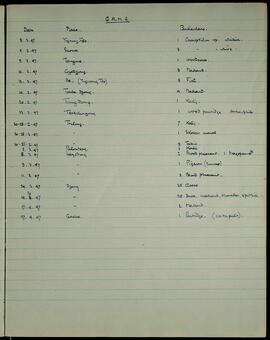
            Tabulated records of game observed or taken with counts by date and place, including species such as Crossoptilon sp., woodcock, mallard, fish, Kalij, wood partridge (Arborophila), Sclater's monal, takin, blood pheasant, tragopan, pigeon (snow), geese, and various duck. Coverage spans multiple locations from Yigong Tso to Gacha between 8 February and 27 April 1947.

            CONTENT:
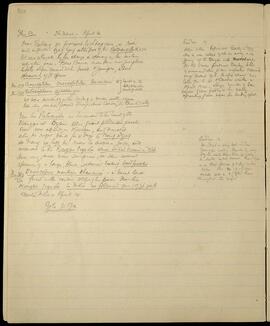
            GAME.

            Date Place. Particulars.

                1. Yigong Tso. 1 Crossoptilon sp. whitish.
              1. 47 Showa 3 Crossoptilon sp. - white.
                1. Tangme. 1 Woodcock.
              1. 47 Gyadzong. 3 Mallard.
              1. 47 Be. (Yigong Tso) 5 Fish.
              1. 47 Tombe Dzong. 4 Mallard.
              1. 47 Tangdong. 1 Kalij.
              1. 47 Tsakchungong 1 wood partridge Arborophila
                20-28. 2. 47 Trulung. 7 Kalij.
                20-28. 2. 47 " 1 Sclater's monal
                20-28. 2. 47 - 9 Takin.
              1. 47 Palonteng. 1 Kalij
              1. 47 Layoting 2 Blood pheasant. 1 tragopan ♂
              1. 47 " 1 Pigeon (snow)
              1. 47 " 2 Blood pheasant.
              1. 47 Dzeng 25 Geese
                to
              1. 47 - 25 Duck. mallard, shoveller, spotbill.
              1. 47 - 2 Mallard.
              1. 47 Gacha. 1 Partridge. (catapult).
            LSH/1/1/6/1/20 · Part · 1938-03-21
            Part of The Ludlow & Sherriff Collection

            SUMMARY:
            Travel account from Tsetang through Lhagyari over the Putrang La to the Tsangpo at Dzam, along to Nang Dzong, and via the Kongbo Nga La to Molo, noting wetter forests, pheasants, and a large black woodpecker, with arrival at Molo on April 14. Notes include Abba Lulla showing Bailey-related letters and observations of bar-headed geese and the valley's daily wind patterns.

            CONTENT:
            10a

            Ibis 53 . 26 March - April 14.

            From Tsetang we proceeded to Lhagyari, a rich and important Dzong lying at the foot of the Putrang La 16,470. We were struck by the change in scenery on the eastern side of the pass. Bare barren mountains now gave place to whole slopes covered with birch & juniper, where pheasants of 2 species

            Ibis 377 Crossoptilon crossoptilon harmani } lurked in the Rhododendron undergrowth
            Ibis 382 Tetraophasis szechenyii

            We were entering on the borders of a much wetter region than any we had passed through since leaving the Chumbi Valley.

            From the Putrang La we descended to the level of the Tsangpo at Dzam where giant pollarded peach trees were already in blossom, and marched along the right bank for 4 days to Nang Dzong. At Nang we left the river to avoid a gorge, and ascended to the Kongbo Nga La which we had crossed in 1936. Here, very much to our surprise, we saw several specimens of a large, black, satanic-looking woodpecker

            Ibis 369-372 Dryocopus martius khamensis - in burnt larch forest on the western slopes of the pass. From the Kongbo Nga La to Molo we followed our 1936 route reached Molo on April 14.

            Go to p. 17a


            Ludlow 19
            Abba Lulla befriended Bailey in 1913 when he was robbed of all his money on his journey up the Tsangpo with Morshead. The old trader produced Bailey's letter of recommendation for our inspection & seemed very proud of it. He also showed us a letter from K. W. & Cawdor written in April 1924. Large number of bar-headed geese feeding on the newly sprouting grass near the landing ghat.

            Ludlow 20.
            The dust is very bad in this Tsangpo valley. Regularly every day the wind blows down the valley from 10 am until sunset. Then there is a short period of calm until 10 pm. Then the up-stream wind sets in & (often) blows throughout the night.

            LSH/1/1/7/1/19 · Part · 1940-05-17 - 1940-04-22
            Part of The Ludlow & Sherriff Collection

            SUMMARY:
            While awaiting Taylor’s arrival at Molo on 17 May 1940, the party planned a four-week excursion south of the Himalayas and left Molo on 22 April for the Pachakshiri district. The page notes the rich flora of Sikkim and Bhutan toward the Tsangpo gorge and recalls a 1936 split expedition in the Tsari District, where Ludlow briefly explored near Lo La and Nyug La, revealing notable alpine flora.

            CONTENT:
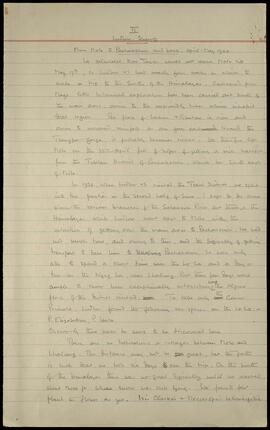
            II
            Ludlow - Sherriff
            From Molo to Pachakshiri and back. April - May 1940.

            We calculated that Taylor would not reach Molo till May 17th, so Ludlow and I had nearly four weeks in which to make a trip to the south of the Himalayas. Eastward from Mago little botanical exploration has been carried out south of the main axis, owing to the unfriendly tribes which inhabit that region. The flora of Sikkim and Bhutan is rich, and owing to increased rainfall as one goes eastward towards the Tsangpo gorge, it probably becomes richer. We therefore left Molo on the 22nd April full of hopes of getting a rich harvest from the Tibetan District of Pachakshiri, which lies southeast of Molo.

            In 1936, when Ludlow and I visited the Tsari District, we split into two parties in the second half of June. I kept to the area where the various branches of the Subansiri River cut through the Himalayas, while Ludlow went east to Molo, with the intention of getting over the main axis to Pachakshiri. He had not much time, and owing to this, and the difficulty of getting transport to take him to Pachakshiri he was only able to spend a short time near the Lo La and a day or two on the Nyug La, near Lhalung. But these few days were ample to show how exceptionally interesting was the Alpine flora of the district visited. To take only the Genus Primula: Ludlow found the following new

            LSH/1/1/6/1/120 · Part · 1933-07-27
            Part of The Ludlow & Sherriff Collection

            SUMMARY:
            Notes two Primula specimens and common birds observed, including Phylloscopus tibetanus and a juvenile ruby-throat. Describes the route from camp over the Mira La to Chomo Dzong with multiple river crossings and mentions a large monastery, and the Shambuling Chu entering the Nyang Chu valley.

            CONTENT:
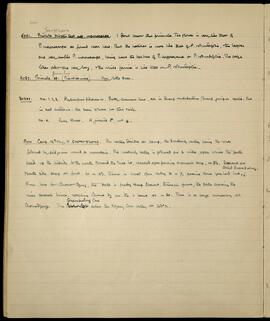
            600
            Younghusband

            1. Primula Nivalis sect aff. macrocarpa. I don't know this primula. The flower is very like that of P. macrocarpa as found near here. But the habitat is more like that of P. rotundifolia, the leaves are very unlike P. macrocarpa, being more the texture of P. Jaffreyana or P. rotundifolia. The calyx lobes also are very long, the white farina is like that on P. rotundifolia.
            2. Primula sp. (Minutissimae) pumilio Very little seen.

            BIRDS. No. 1, 2, 3, Phylloscopus tibetanus. Pretty common here, all in dwarf rhododendron, dwarf juniper & salix. But in bad condition. All seem to have lost their tails.
            No. 4. Ruby throat. A juvenile ♂, not ♀.

            From Camp 12th May, to CHOMO-DZONG. The valley divides at camp, the southerly valley being the route followed by pilgrims round a mountain. The westerly valley is followed for 2 miles, after which the path leads up the hillside to the north toward the Mira La, reached after passing a small lake, in 3½. Descent on North side steep at first, to m 4½, then in broad open valley to m 7, passing some yak herd huts, L. From here to Chomo Dzong, the path is pretty steep descent, through forest, the path crossing the river several times, reaching Chomo Dz on the L bank at m 20. There is a large monastery at Chomodzong. The Shambuling Chu enters the Nyang Chu valley at 250° M.

            LSH/1/1/3/3/62 · Part · 1936-03-10
            Part of The Ludlow & Sherriff Collection

            SUMMARY:
            Notes record obtaining a male Fire-capped Tit (Cephalopyrus flammiceps saturatus), apparently the first for Bhutan, with prior occurrence noted in the lower Nyam Jang Chu Valley in 1936 and a Yunnan specimen from the Tengyueh district described by Rothschild as C. f. olivacea. The writer describes crossing into the Nyam Jang Chu Valley and the Tibet–Bhutan boundary near Jangphu, and remarks on the Rufous Woodpecker’s penetration up the Manas Valley.

            CONTENT:
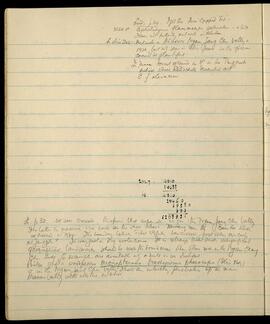
            Lud. 634. Got the Fire-Capped Tit -
            3668 ♂ Cephalopyrus flammiceps saturatus - a bird
            that has not hitherto been met with in Bhutan.
            L. Ibis 205 - Met with in the lower Nyam Jang Chu Valley in
            1936, but not seen in this year so the species
            cannot be plentiful.
            In Yunnan Forrest obtained a ♂ in the Tengyueh
            district which Rothschild described as
            C. f. olivacea.

            2027 : 4910
            10688
            63 4910
            29460
            39280
            393
            5208921

            L. p 35. We soon crossed the spur that separates us from the Nyam Jang Chu Valley.
            The latter is massive & we could see the snows above Tawang near the Bum La where
            we crossed in 1934. The boundary between Tibet & Bhutan was crossed just below our camp
            at Jangphu? It was just a dry watercourse. It is strange that such insignificant
            geographical landmarks should be used for boundaries when others such as the Nyam Chang
            Chu itself, for example, are available at a mile or so distance.
            Rufous woodpecker Micropternus brachyurus phaeoceps (Ibis 364)
            in the Nyam Jang Chu Valley shows an interesting penetration up the main
            Manas Valley well into the interior.

            LSH/1/1/10/1/137 · Part · 1949-10-24
            Part of The Ludlow & Sherriff Collection

            SUMMARY:
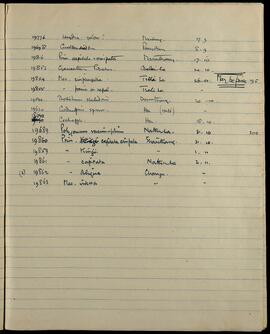
            Notebook page listing plant specimens with collection numbers, taxa, and localities such as Marlung, Pangshang, Chela La, Tseli La, Natu La, Ha (Hato), Shanthang, and Changu, along with day–month collection dates. Brief notes occur for some entries (e.g., possible flower color).

            CONTENT:
            19776 Lloydia yellow? Marlung. 27.9
            19698 Cremanthodium Pangshang 8.9
            19856 Prim. capitata v. crispata Maruthang. 17.10
            19853 Cyananthus rosatus. Chela la 24.10
            19854 Mec. simplicifolia Tseli la 26.10. May be pink 195
            19855 " panic or nepal. Tseli la "
            19544 Thalictrum chelidonii Damthang. 30.10.
            19620 Codonopsis sp. nov. Ha (Hato) "
            18040 Crabapple. Ha. 25.10.
            19689 Polygonum vacciniifolium Natu la. 31.10 200
            19860 Prim. capitata crispata Shanthang. 31.10.
            19859 " Kingii. " 1.11
            19861 " capitata Natu la 2.11.
            (2) 19862 " obliqua Changu. "
            19863 Mec. nivosa " "

            LSH/1/1/3/3/216 · Part · 1996-06-18
            Part of The Ludlow & Sherriff Collection

            SUMMARY:
            Notes mention obtaining a rose finch (Procarduelis rubescens) at Lopa Sho La Chu, rare in Bhutan in 1933–1934 but plentiful in SE Tibet in 1936. Observations include Lerwa with young at 15,500' east of Takar La, magpies common at Zimsaktoi, and white-breasted dippers. Several plant taxa are listed.

            CONTENT:
            Lud. Ibis 354 Ludlow at Singo Samba
            Obtained a Rose Finch - Procarduelis rubescens Lopa Sho La Chu
            rare in Bhutan in 1933 & 1934. Tho' plentiful Pedic. megalochila v. ligulata 1874 var. nov.
            enough in the conifer forests of SE Tibet both N. & S. of Megacodon stylophora 1875
            the main range in 1936. Anemone 1876
            Mecon. simplicifolia 1877

            Lerwa with young 15500' E of Takar La.
            Magpies pretty common at Zimsaktoi.
            White breasted Dippers.

            LSH/1/1/9/1/145 · Part · 1933-09-01
            Part of The Ludlow & Sherriff Collection

            SUMMARY:
            Notes record altitudinal occurrences and absence of hybrids, with blue flowers flowering later than white, and observations on farina and scent. Mentions that the Bumthang Chu-Trongsa Chu Divide may separate blue and white forms, and that pedicellation is not diagnostic for P. dryadifolia, with comparisons to cliffs in SE Tibet.

            CONTENT:
            137

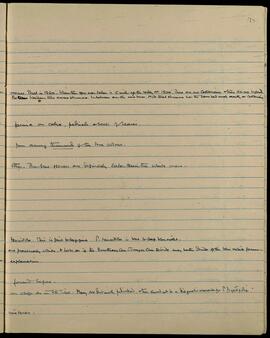
            occurs. That is 13500'. Where the specimen was taken is 5 miles up the valley at 15000'. There are no Calderiana there are no hybrids.
            Waihau there are no strumosa. In between are the mixtures. Note that strumosa has the same bad smell exactly as Calderiana.

            farina on calyx, pedicels & back of leaves.

            from among thousands of the true colour.

            Other. The blue flowers are definitely later than the white ones.

            tenuiloba. This is pink to deep pink. P. tenuiloba is blue to deep blue-violet.
            are practically white. It looks as if the Bumthang Chu-Trongsa Chu Divide may be the divide of the blue & white forms.
            explanation.

            found before.
            on cliffs as in SE Tibet. Many are distinctly pedicelled, this should not be a diagnostic character for P. dryadifolia.

            mixtures.

            LSH/1/1/1/1/63 · Part · 1933-06-08
            Part of The Ludlow & Sherriff Collection
            • SUMMARY:
              Evening dancing by local men, including a lama, with observations on the music. On 14 June Ludlow went down the Ha while the writer climbed the Paro road and shot a tragopan; preparations were made for W’s arrival. Notes for 15–19 June in Ha mention entertainments such as archery, football, and a musk deer/serow drive, with botanical collections recorded.

            CONTENT:
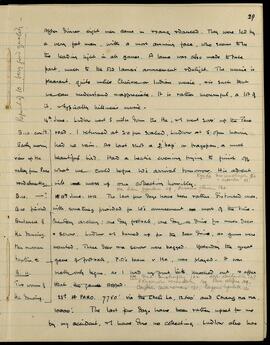
            29

            Report of 10. very good quality.

            After dinner eight men came in and danced. They were led by a very fat man, with a most amusing face, who seems to be the leading light in all games. A lama was also made to take part, much to the old lama's amusement and delight. The music is pleasant, quite unlike Chinese or Indian music, and is such that we can understand and appreciate. It is rather mournful, a lot of it, typically hillmen's music.

            14th June. Ludlow went 5 miles down the Ha, and I went 2000' up the Paro road. I returned at 2.0 pm soaked, Ludlow at 5.0 pm having had no rain. At last shot a 'pi bap' or tragopan, a most beautiful bird. Had a hectic evening trying to finish off what we could before W's arrival tomorrow. His advent will mess up our collecting horribly.
            [Kyu La. Meconopsis 92 "superba" 93.]

            B.10 contd.

            • 15-19th June. HA. [Ha. Lilium giganteum 119, Arisaema flavum 120.] The last few days have been rather disturbed ones, with something provided for W's amusement most of the time. One day archery; one day football, one day a drive for musk deer and serow. Ludlow and I turned up for the deer drive, as guns were wanted. Three
            LSH/1/1/9/1/93 · Part · 1933-07-03
            Part of The Ludlow & Sherriff Collection

            SUMMARY:
            The diarist describes plant collecting on cliffs and sand slopes, with Pasang separately gathering notable specimens, and notes wildlife sightings, weather, and plans to camp higher and visit Marlung. Letters were sent to Betty and Asha Wangmoo. On 4 July, amid active trade movement, Pasang and Yundun collected more plants near the Sekpen's huts, and plans are considered for a September trip to the Tibdey La after returning from Bumthang.

            CONTENT:
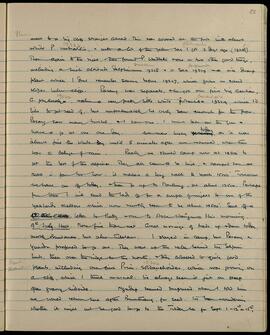
            1 June
            Went to a big cliff straight ahead. This was covered at the foot with almost white P. umbratilis (19332), and with a lot of the yellow Sax I saw 2 days ago, glabricaulis (19306). Then again to the right, then found P. waddellii and one or two other good things, including a high altitude Delphinium muscosum (19328) and a Sax bergianoides (19329) and a nice dwarf plant which I don't remember seeing before (19327), which grows in sand slopes below cliffs. Pasang was separate, and he got one fine big Gentian, G. phyllocalyx (19322), and also a very pretty little white Potentilla coriandrifolia (19324), which I'd like to get seed of, but unfortunately he only saw enough for the press.

            Pasang saw many bharal, I saw one. I must take out the gun and have a go at one one day. We were lucky today, as it was almost fine the whole day until 5 minutes after we returned, when there was a deluge of rain. Really we should camp now at 14,500' to get the best of the alpines. They all seem to be high, and camping here at 12,000' is far too low: it makes a long walk to reach 15,000'. Tomorrow we have an off day, then go up to Marlung, at about 13,500'. Perhaps from there I will send the lads off for a couple of nights to one of the yakherds' shelters, which now mostly seem to be about 14,500'. Sent off a letter to Betty and one to Asha Wangmoo this morning.

            4th July. Halt. More fine than wet. Great moving of trade up and down today, mostly Bhutanese, but also Tibetans. I stayed in camp, but Pasang and Yundun preferred to go out. They went up the valley behind the Sekpen's huts, then over the ridge to the north, and they collected 10 quite good plants, including one fine Prim. soldanelloides (19346), which was growing on a cliff, which I think unusual. I've always seen it just on steep open grassy hillside. Ngudup seemed surprised when I told him we would return here after Bumthang, for seed. I've been wondering whether it might not be good to go to the Tibdey La for Sept 1-12th or 15th.