Bhutan

Elements area

Taxonomy

Code

Scope note(s)

    Source note(s)

      Display note(s)

        Hierarchical terms

        Bhutan

        Equivalent terms

        Bhutan

          Associated terms

          Bhutan

            419 Archival description results for Bhutan

            419 results directly related Exclude narrower terms
            LSH/1/1/1/1/129 · Part · 1933-08-11
            Part of The Ludlow & Sherriff Collection

            SUMMARY:
            The writer records taking a group photo as the party prepares to split, listing members and discussing conflicting reports about the Tobrang–Pang La route, with Golay warning it is impassable for mules and plans to send Petuk back with them. On the 10th they collected 19 birds and prepared potted flowers for travel, and on the 11th August they marched 11 miles to LAO (11,200'), aided by Tibetans when coolies were short, with misty weather and an owl collected.

            CONTENT:
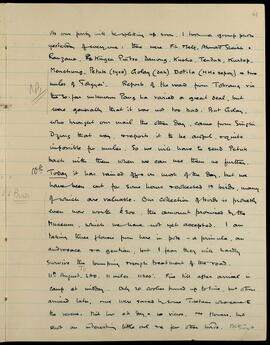
            As our party will be splitting up soon, I took a group photo yesterday of everyone: there were F.L., self, Ahmad Sheikh, Rauzana, Ba Kingsa Puntso, Danong, Kusho, Tenduk, Kurtep, Menchung, Petuk (syce), Golay (dak), Dotila (HH's sepoy) and two mules of Torgues'. Reports of the road from Tobrang via the so-far unknown Pang La varied a great deal, but were generally that it was not too bad. But Golay, who brought our mail the other day, came from Singhi Dzong that way, and reports it to be awful, and quite impossible for mules. So we will have to send Petuk back with them when we can use them no further.

            10th: Today it has rained off and on most of the day, but we have been out for some hours and collected 19 birds, many of which are valuable. Our collection of birds is probably even now worth £200, the amount promised by the Museum, which we have not yet accepted. I am taking three flowers from here in pots - a primula, an androsace and a gentian, but I fear they will hardly survive the bumping rough treatment of the road.

            11th August. To LAO. 11 miles. 11200'. Fine till after arrival in camp at midday. Only 20 coolies turned up to time, but others arrived later, and we were saved by some Tibetans who came to the rescue. Mist low all day, and no views. No flowers, but shot an interesting little owl and a few other birds. Although
            LSH/1/1/10/1/23 · Part · 1933-10-01
            Part of The Ludlow & Sherriff Collection

            SUMMARY:
            Entries describe leaving frost-bound Gortsum after a storm, incentivizing the team to dig a large haul of lily bulbs (430 total) with little Meconopsis bella seed found, and reaching camp early. The next day at Dhur was a short march with collection of Notholirion macrophyllum bulbs and Thalictrum chelidonii seed, seed-drying and packing, games with companions, and Yundon sent to Shasjetang to collect more seed before rejoining at Kuji (Bumthang).

            CONTENT:
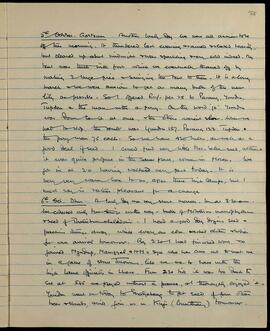
            5th October. Gortsum. Another lovely day. We were all anxious to be off this morning. It thundered last evening and rained and sleeted heavily, but cleared up about midnight and was sparkling and very cold indeed. My tent was thick with frost which we eventually thawed off by making 3 large fires and bringing the tent to them. It is a long march and we were anxious to get as many bulbs of the new lily as possible. So I offered Rs 1/- per 25 to Pasang, Yundru, Tupden and the man with a pony. On the word 'go' Yundru was down to it at once, the others were slower. When we had to stop, the result was Yundru 157, Pasang 123, Tupden and the pony man 75 each. So we have 430 bulbs, as well as a good deal of seed. I could find very little Mec. bella seed, although it was quite profuse in the same place, when in flower. We got in at 2.0 having walked very fast today. It is very very warm here to us, after those high camps, but I must say is rather pleasant for a change.

            6th Oct. Dhur. A lovely day and a very short march. In at 8.30 am. We collected only two things on the way - bulbs of Notholirion macrophyllum and seed of Thalictrum chelidonii. I had a good day drying seed and packing things away, while everyone else washed clothes and bodies for our arrival tomorrow. By 2.30 I had finished work, so joined Ngudup, Namgyal, and HH's syce who had come out to meet me in a game of stone throwing, like we used to have with the high lama officials in Lhasa. From 2.30 till it was too dark to see at 5.45 we played without a pause, and thoroughly enjoyed it. Yundon went on today to Shasjetang to get seed of four other trees and shrubs, and will join us in Kuji (Bumthang) tomorrow.

            LSH/1/1/1/1/165 · Part · 1933-09-24
            Part of The Ludlow & Sherriff Collection

            SUMMARY:
            Notes damp weather, farewell to Pimbo, Kuntip, and Danong while taking on Tenduk, with praise for the Bhutanese workers; Tenduk will help with Kusho until the party returns to Sikkim. Describes dry, treeless country, the Kuru Chu gorge near Lhakang and its several local names, steady progress by coolies including many women wearing the Lhassa head dress, and few notable flowers or birds. A margin note mentions reunion at Yatung on Oct 3.

            CONTENT:
            81

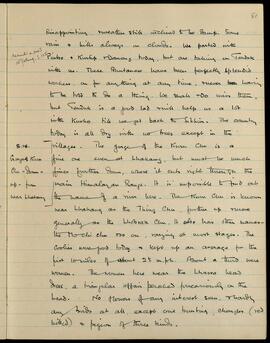
            Disappointing, weather still inclined to be damp. Some rain & hills always in clouds. We parted with Pimbo & Kuntip & Danong today, but are taking on Tenduk with us. These Bhutanese have been perfectly splendid workers, on for anything at any time, never having to be told to do a thing. We shall miss them, but Tenduk is a good lad will help us a lot with Kusho till we get back to Sikkim. The country today is all dry with no trees except in the villages. The gorge of the Kuru Chu is a fine one even at Lhakang, but must be much finer further down, where it cuts right through the main Himalayan Range. It is impossible to find out the name of a river here. The Kuru Chu is known near Lhakang as the Thing Chu, further up more generally as the Lhobrak Chu. It also has other names - the Mo chi chu & so on, varying at most stages. The coolies were good today & kept up an average for the first 10 miles of about 2 1/2 m.p.h. About a third were women. The women here wear the Lhassa head dress, a triangular affair perched precariously on the head. No flowers of any interest seen, & hardly any birds at all, except one bunting, choughs (red billed) & pigeon of three kinds.

            reunited on Oct 3 at Yatung. S. 105
            B. 26. Gorge of Kuru Chu - down

            LSH/1/1/8/1/113 · Part · 1933-05-18 - 1933-05-19
            Part of The Ludlow & Sherriff Collection

            SUMMARY:
            The diarist travels from Go-Cyae in perfect weather, noting tame gazelle, kyang, high passes, and sightings of parnassius butterflies, with observations on elevation, vegetation, and local attire. On 19 May they make a long march to Dongkar Dzong with mules and donkeys, encounter unhelpful local officials (Chanzo and Gyimpon) but find tipping effective, and plan to continue toward Trimo via Lior, noting Primula in flower and changing peoples along the route.

            CONTENT:
            18th May. Go-Cyae. A perfect day without a cloud in the sky as we started off at 7.0. We were in at 1.30, again at 2.0pm. The day remained perfect, with fine cumulus clouds, but no storms anywhere. Again we saw many gazelle, all of which were tame, and some kyang. The hills are still very dry, but begin here to show signs of heavier rainfall. On the Chidney La we saw 4 parnassius butterflies, but I failed to catch any. All these passes are high, though easy. I judge all are 16500' or perhaps more. The Yangtse is perhaps 15500' or a bit more, and I should think the Triju Tso must be over 15000'. This place is perhaps 14000', as there are a few dwarf juniper appearing here. The women here all wear big amber necklaces. There are only three houses and a Gompa.

            19th May. Dongkar Dzong. 17 miles. A longish march, but we had first class mules and 4 donkeys which kept up with us all the way here. We left at 6.40 and got in at 2.0pm, going well. The route is not very interesting, only shows signs of more vegetation in the last 3 or 4 miles. The Chanzo here is a silly little man who is not one to help. The Gyimpon also was not one to help. I tipped the latter, who became at once much more easy to deal with. This is not a Dzong so the Chanzo claimed he could do nothing with me, but eventually agreed to send me on to Trimo. I fear we may have some difficulty there too, without any authority from Tsona. But I will again try what a tip will do. Prim. sikkimensis and P. tibetica in flower here and generally more signs of life. It is further from here to Trimo than I imagined, we are told 3 days will be necessary. First to Lior only by yak: thence coolies. The road is said to be bad after Lior and very difficult. But there is one thing: the people will be pleasanter after leaving here, I feel sure. They are Tibetan to Trimo then Monba, then Tahpa.

            LSH/1/1/6/1/107 · Part · 1933-07-21
            Part of The Ludlow & Sherriff Collection

            SUMMARY:
            After an unexpectedly sunny evening, the party explored the comparatively dry area of Go nyi re between here and Tsela Dzong, recording several Primula taxa and a common small Meconopsis also seen at the Tum La, plus a robust yellow Meconopsis that may be a new species. Plans are weighed against the Kucha La trip, with 10 days until due at Tse and an intention to focus on drier areas north of the Tsangpo rather than returning to the Main Range, amid coolie difficulties.

            CONTENT:
            Gonyi re.

            Most unexpected perfect evening, with the sun out full blast, the clouds on the hills gradually clearing away. For a moment I could see up all three of the valleys, leading to the Holung Logu La, the Tsanang La and the Kucha La. The latter looks good. The place we went to is known as "Go nyi re" - "there are two heads," this more or less directly between here and Tsela Dzong. Being South of the main range, it is a comparatively dry area, at any rate not as wet as the main range. Having made up my mind to do the Main Range, I have not touched this area yet, but having these two days spare, thought one of them should be used to explore it, as it does undoubtedly look more of interest. So up we went. The first flower of interest was P. littledalei (baileyana?) 5887, fairly common in a limited habitat, and nearly as high as I would have expected. Then above that was one of the Bellidifolia primulas, which I think must be P. micropala, 5888. Beside this was a small primula which was unfortunately over, of which we only saw three flowers. This looks somewhere near P. atrodentata, but I don't think can be this. I can't place it. This was No. 5890. We are too late, a most interesting primula found next, not in flower though, is P. (nivalis Sect?) No 5889. The capsule looks nivalid, but the plant does not, and I have no idea what it will turn out to be. At the top of the hill, there is a pass, with a little wall built up, and close to this on the South side is the little meconopsis which I found at the Tum La under No. 5790. Here it is common, and was taken under No. 5895. We should certainly get seed of this from Gonyi re. But the best find of today was another yellow meconopsis, taken under No. 5891, a fine big plant 2 feet high, with from 3 to 10 flowers of 3-4½" across. What this is I don't know. I gave Taylor his own Mec. book, as I did not expect to find any myself. We hope for a new species, as I can't think of any like this from S.E. Tibet. If this is so, this will certainly be a red letter day. We got quite a lot of other things too, and I felt like cancelling the Kucha La trip. But that may as well be done now. There are but 10 days left till I am due at Tse, and after that we will visit the dryer areas. Except for seed, I am not going off to the Main Range again. In fact it would be poor policy. The best to be had is on the North of the Tsangpo I believe, and we should go there as soon as possible. What a joy it was to see and feel the sun again, and to feel dry. We were all soaked by midday, but in a very short time were dry. I feel very weak this evening, and have a headache. As there are coolie difficulties.

            LSH/1/1/5/1/75 · Part · 1937-05-22
            Part of The Ludlow & Sherriff Collection

            SUMMARY:
            The diarist records a halt at Gnüdülakh and an early start to reach Nabzi La over steep snow. From the pass they describe extensive views of the main Himalayan range, including Chomolhari, Kula Kangri, and peaks near Me La and Black Mountain (Dungshinggang), noting clouds prevented continuing to the next pass or seeing the lakes.

            CONTENT:
            36
            Gnüdülakh.
            21st May Halt. Fine at night and a good clear morning. We were
            much later than I had meant, and did not get off till 5.45. Going
            hard we reached the Nabzi La at 8. There was a good deal of
            View from Nabzi La
            snow to cross, and a very steep snow slope up the last 300-400
            ft, which was hard. From the pass we had a magnificent
            view. Had we been an hour earlier, it really would have
            been as fine a view as any I have ever seen. All round to
            the north were snow mountains - the main Himalayan range.
            Owing to clouds, the furthest west we could see was Chomolhari;
            other big peaks showed due north, and then came Kula Kangri and
            another mass away to the east of them, which might have
            been Sangtopelri, near the Me La. But there again clouds
            were just coming up and there was no time to study them.
            To the south were the peaks of the Black Mountain,
            (Dungshinggang). Only one of the Pünsum (three brothers)
            could be seen, the others being behind it, but there were
            several subsidiary peaks visible close to. We did not go on
            to the next pass, only a mile or so, as clouds were broken
            over the tops, so did not see the lakes, but I enjoyed
            every minute of the day's outing. At the top,

            LSH/1/1/2/1/107 · Part · 1933-07-18
            Part of The Ludlow & Sherriff Collection

            SUMMARY:
            After bathing at the hot springs, the party received gifts from the Maharaja via eight men from Bumthang, including rice, butter, cloth, a dagger, silver lime boxes, and potatoes, with plans to return the cloth to Trashigang. Flower collecting has been modest, and they expect to write multiple letters of thanks. Pimbo probed why locals discouraged their movements, learning it may be due to fears of them digging for valuables and disturbing earth spirits.

            CONTENT:
            a bath at the hot springs. There are several places banked up to make it possible to sit in water 2 ft deep, just as hot, or hotter, than one likes. I felt much better after a good bath. When we came back we found that a party of 8 men had arrived with presents from the Maharaja & Co in Bumthang. They brought 2 maunds of rice, 2 maunds of butter(!), about 3 maunds of cloth of various kinds, a dagger, silver lime boxes and a maund of potatoes. We kept all but will return the cloth to Trashigang by the same people. We have not done much in the way of flower collecting between us. I think we have perhaps 6 or 8 good things collected in these six days. However we have found out a good deal about the country and something of the people. The worst about the presents is that they mean that tomorrow we must write to Bumthang no less than seven letters of thanks each! Pimbo has been trying to get to the bottom of why these people have been doing their utmost to put us off wandering about the countryside. The only likely true answer he can get, is that they were afraid we would try to dig up 'pearls' or gold or other valuable stones, and so, of course disturb the earth spirits. Beyond that I think

            George Sherriff
            GB 235 LSH/1 · Series · 1898 - 1967
            Part of The Ludlow & Sherriff Collection

            This collection consists of material created and gathered from the expeditions of George Sherriff in Bhutan and Tibet during 1933-1949.

            The collection consists of 5 sub-series: diaries, correspondence, expedition material, visual material, and plant collection documentation.

            [1] Diaries: This series consists of the original diaries of George Sherriff during his expeditions.

            [2] Correspondence: This series consists of a variety of correspondence from and to George Sherriff.

            [3] Expedition Material: This series consists of a variety of expedition documents ranging from itineraries and maps to administration lists and passports.

            [4] Visual Material: This series consists of a variety of material including: photographic material, films and videos. Photographic material ranges from prints and negatives taken by Sherriff and Ludlow to prints of digital images taken as exhibition documentation in 2014. The films are..... There have been dvd surrogates made of the films to ensure continued accessibility.

            [5] Plant Collection Documentation: This series consists of a variety of material which includes plant and seed lists from their expedition with a large focus on Primula, Meconopsis and Rhododendrons, as well as publications gathered by Ludlow and Sherriff which cover their shared interest in the Himalayan region and it's flora and fauna. There is also a garden register donated by the Knox Finlay family detailing the progress of plants/seeds in their gardens acquired from various expeditions including Ludlow and Sherriff's between 1951-52.

            Sherriff, George
            LSH/1/1/6/1/9 · Part · 1933-02-27 - 1933-03-02
            Part of The Ludlow & Sherriff Collection

            SUMMARY:
            Diary notes cover travel from Gautsa to Phari, Tuna, and Dochen, dealing with delayed transport, missing supply boxes, and assembling a large mule caravan. The party notes an evening earthquake, listens to the Scotland–Ireland match result from Murrayfield, and reports strong winds, clear views of Chomolhari, and a telephone call to Gyantse.

            CONTENT:
            4

            instead of Tibetan, it was overdone. There must have been eight courses or even more. The poor fiancée had great trouble with her food, probably the first time she had had any that way. There was a small earthquake in the evening. We were just in time to hear the last five minutes of the Scotland-Ireland match at Murrayfield and get the result.

            NB 27th Feb. To Gautsa. 12 miles. Transport very late in starting and was not off till 9.30 am. Fine day. On the way up we passed some yaks, on them I saw boxes labelled Harrods. Later on I noticed my own name, and these boxes turned out to be Harrods stores, which were sent on a month ago, and should have been in Gyantse long ago. Nothing we said upset the yak men, and they fully intended to go to Phari only on the 1st March. But they now promise to get there tomorrow. Very little life on the way up. Lingmathang is a beautiful meadow, but dried up and brown now. Saw signs of a gentian above Lingmathang.

            28th Feb. To Phari. 17 miles. After a bad night of wind and some snow, today was perfect, with bright sun and very little wind. Chomolhari was clear of cloud till the evening, then cleared after an hour or two. We got our Harrods boxes on here, found Pintso waiting for us, but no Tenduk. We also found my very important Ha box had not been sent on here. These are both serious, but we hope can be put right before long. From now on we have a terrific caravan of mules.
            6 riding ponies & 35 pack mules

            1st March. To Tuna. 21 miles. Fine morning, slowly clouding over. Wind rose at 10.0 am and was very strong and cold all day, but in our backs, thank goodness. We got off in good time. 17 loads were sent through to Gyantse, while the rest came with us. The rate for everything is Rs 8/4 to Gyantse. Jibi walked all the way and is feeling very tired this evening, and a bit footsore. Chomolhari looked lovely the whole march, as we gradually came round it.

            Extract from Tuna Bungalow book. — "On a specialist's recommendation, a Poona man came on vacation. He said 'I'd far sooner have Poona than Tuna, it seems a more lively hill station.'"

            2nd March. To Dochen. 14 miles. Fine all day but very windy. Views of Chomolhari wonderful, especially in the evening. We telephoned to Gyantse this afternoon and got the P.T.O. to open.

            LSH/1/1/1/1/9 · Part · 1933-05-02
            Part of The Ludlow & Sherriff Collection

            SUMMARY:
            After staying at the Himalayan hotel in Kalimpong and meeting several contacts, the party arranged travel to Gangtok. On 26 April in Gangtok, Tobgye assisted in planning permits and a collecting route: Chumbi Valley near Lingmatang mid-May to early June, then the Ha area north of Ha and west of the Paro watershed, with plans to join Williamson and proceed toward Bumthang for a month’s collecting.

            CONTENT:
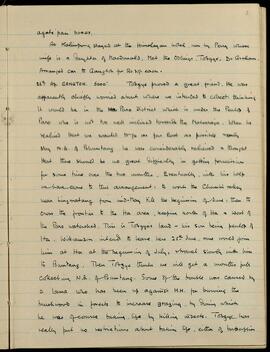
            agate 'pan' boxes,

            At Kalimpong stayed at the Himalayan hotel, run by Perry whose wife is a daughter of Macdonald. Met the Odlings, Tobgye, Dr. Graham. Arranged car to Gangtok for Rs 30/- each.

            26th Ap. GANGTOK. 6000'. Tobgye proved a great friend. He was apparently chiefly worried about where we intended to collect: thinking it would be in the Ha Paro District which is under the Penlop of Paro who is not too well inclined towards the Maharaja. When he realised that we wanted to go as far East as possible really, say N.E. of Bumthang he was considerably relieved & thought that there should be no great difficulty in getting permission for some time over the two months. Eventually, with his help we have come to this arrangement: to work the Chumbi valley near Lingmatang from mid-May till the beginning of June: then to cross the frontier to the Ha area, keeping north of Ha & West of the Paro watershed. This is Tobgye's land - his son being penlop of Ha. Williamson intends to leave here 25th June, and would join him at Ha at the beginning of July, travel slowly with him to Bumtang. Then Tobgye thinks we will get a month's full collecting N.E. of Bumtang. Some of the trouble was caused by a lama who has been up against H.H. for burning the brushwood in forests to increase grazing, by doing which he was of course taking life by