Bhutan

Elements area

Taxonomy

Code

Scope note(s)

    Source note(s)

      Display note(s)

        Hierarchical terms

        Bhutan

        Equivalent terms

        Bhutan

          Associated terms

          Bhutan

            419 Archival description results for Bhutan

            419 results directly related Exclude narrower terms
            LSH/1/1/3/3/61 · Part · 1936-03-10
            Part of The Ludlow & Sherriff Collection

            SUMMARY:
            Travel past last year's camp at Tsingorn, then from Kini the route climbs steeply above the Tawang Chu with largely bare hillsides, passing some cultivation and villages. A very short march follows to Changpu via a side nala, with notes on tropical vegetation and observations of inquisitive locals including Tibetans.

            CONTENT:
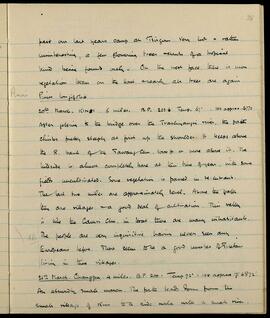
            past our last year's camp at Tsingorn. Very hot and rather uninteresting, a few flowering trees and shrubs of a tropical kind being found only. On the west face, there is more vegetation than on the east, and nearly all trees are again Pinus longifolia.

            20th March. KINI. 6 miles. B.P. 203.6 Temp. 67°. Ht approx. 4770'.
            After getting to the bridge over the Trashingangsi river, the path climbs pretty steeply at first up the shoulder. It keeps above the R. bank of the Tawang Chu, 1000 ft or more above it. The hillside is almost completely bare at this time of year, with some fields uncultivated. Some vegetation is passed in re-entrants. The last two miles are approximately level. Above the path there are villages and a good deal of cultivation. This valley is like the Gamri Chu, in that there are many inhabitants. The people are very inquisitive, having never seen any Europeans before. There seem to be a good number of Tibetans living in these villages.

            21st March. Changpu. 4 miles. B.P. 200.1 Temp 72°. Ht approx 6872'.
            An absurdly small march. The path leads down from the small village of Kini to a side nala with a small river.

            LSH/1/1/1/1/181 · Part · 1933-09-05
            Part of The Ludlow & Sherriff Collection

            SUMMARY:
            The writers received provisions and friendly letters sent by H.H., note Dorji’s recovery and Tobgye’s imminent departure for Kalimpong, and an invitation to return to collect seeds. They describe a short, easy march up the Kuru Chu via Lalung to Munda, with bridges, ample water but scarce fuel, observed crops, and fine valley views.

            CONTENT:
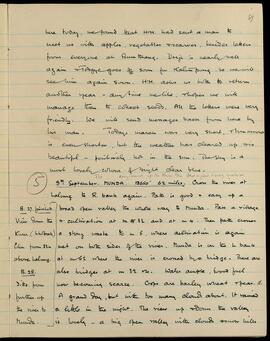
            here today, we found that H.H. had sent a man to meet us with apples, vegetables & scarves, besides letters from everyone at Bumthang. Dorji is nearly well again & Tobgye goes off soon for Kalimpong, so we won't see him again soon. H.H. asks us both to return another year - anytime we like, & hopes we will manage then to collect seeds. All the letters were very friendly. We will send messages back from here by his man. Today's march was very short, & tomorrow is even shorter, but the weather has cleared up & is beautiful - positively hot in the sun. The sky is a most lovely colour of bright clear blue.

            9th September. MUNDA. 13650' 6 1/2 miles. To easy march up the Kuru Chu past a good deal of cultivation. Cross the river at Lalung to R. bank again. Path is good & easy up a broad open valley the whole way to Munda. Pass a village & cultivation at m 3 1/2 and at m 4. Then path crosses a stony waste to m 5, where cultivation is again met on both sides of the river. Munda is on the L bank at m 6 1/2 where the river is crossed by a bridge. There are also bridges at m 3 1/2 & 4. Water ample, wood fuel now becoming scarce. Crops are barley wheat & peas.

            A grand day, but with too many clouds about. It rained a little in the night. The view up & down the valley is lovely - a big open valley with clouds & snow hills.

            B. 27. finished. View down the Kuru (Khobrak) Chu from 3 1/2 m above Lalung.
            B. 28. Ditto from further up the river to Munda.

            LSH/1/1/9/1/53 · Part · 1949-05-28
            Part of The Ludlow & Sherriff Collection

            SUMMARY:
            The diarist notes magpies and quail, sends mail to H.H., Kalimpong, and Betty, and dispatches a box of dried flowers to Byakar Dz. On 20th May they march about five miles to Takhung via the Tang chu and Takhung chu, note altitude observations, collect Primula geraniifolia, and describe a well-made camp near Bumthang. The entry opens the next day's move toward Shabejetang.

            CONTENT:
            There are still a number of magpies about here, so they certainly breed. Also since we were here in April, there are many quail in the standing crops. One can hear them all day. I send off a mail from here to H.H., Kalimpong and Betty via H.H.. Also tomorrow morning Lundrup will take in a box of dried flowers to go to Byakar Dz. into our other boxes.

            20th May Takhung About 5 miles. Heavy rain last night, fine this morning till 11.0. This was a nice march, up the Tang chu for a mile or so then cross to the R bank and up a side valley, called the Takhung chu. The path is half over open grassland and half through easy forest. The whole country here is very open and pleasant looking. Crops look very good this year. Here they are barley and wheat almost entirely. We have come up quite a lot, so I was surprised to see the alt. is only just over 10000'. I have always called Tang the same height as Bumthang which it obviously is not. It cannot be above 9000 at the outside. Today we found one more primula to add to the total, now 13. This is P. geraniifolia 18913, common in the forest beside streams. This seems rather low for it. I have always found it mostly above 12000'. This is a grand camp, but could do with being 1000 ft. higher. The forest is mostly tsuga and picea. Near Bumthang as we are, the locals make very good camps for us. I allowed Ngudup to persuade me to say we still wanted them. Here, in a lovely open place, the servants have a fine hut, while I have a very fine latrine - as if one could want such a thing here. However, if I don't use it, I see that a cow at any rate, has gone in and used it much more fully than I ever could have.

            21st May Shabejetang Very wet last night, rain until we were

            LSH/1/1/6/1/29 · Part · 1938-03-31
            Part of The Ludlow & Sherriff Collection

            SUMMARY:
            The diary records a hard ascent over the Kongbo Nga La to Nye with notes on rhododendrons, larch, birch, juniper, and sightings including crossoptilon, large black woodpeckers, a Camberwell Beauty, and a blood pheasant, alongside seed collecting and march times. The following day describes an easier, mostly level route to Kyimdong Dzong via Shu and the Kyimdong Chu, noting Berberis near Kyimdong and a meeting with the local dzongpen, while sending two men to check whether the Lang La is open.

            CONTENT:
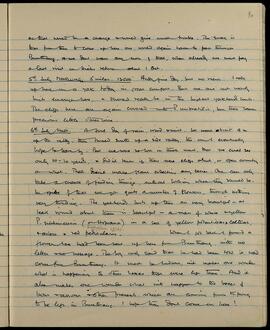
            5th April. NYE. 11 miles. Fine morning, clouded afternoon: some snow on the hill tops. A hard day but quite interesting. Path leads up the Lapu Chu left bank for 2 miles, then up the right bank to mile 3 1/2. So far the ascent is easy but path not very good. Thence the ascent is very direct and steep to the Kongbo Nga La, 14470', mile 6. Descent is equally steep. On either side of the pass, about 1 1/2 miles from it is a house. A small nala is reached, and followed for a short way, then the path climbs up the spur on the right bank and drops down to Nye, where there is a good deal of cultivation, and several houses. On the west side of the pass are many rhododendrons, some larches and large areas of birch beside scrub of all kinds. In this I flushed a dozen crossoptilon and saw 5 or 6 very large black woodpeckers of a kind not in the F.B.I. They are about the size of a chough, absolutely black, with the exception of the male having a bright chestnut band across his forehead. I could not shoot any. Besides getting some seeds, I got two butterflies, which for a few moments were fairly common. One was a Camberwell Beauty. On the east side I flushed two "kuling", and later on shot a blood pheasant, most beautifully coloured, and in excellent plumage. Two primulas were in bloom, pink. Pine trees are common and away to the south we could see firs as well. On the east there are many more junipers than on the west. A trying march: left at 6:40, in at 3:30 and some of the kit not in till 6:00 pm or later.

            6th April. KYIMDONG DZONG. 14 miles. c 11000'. Fine morning, clouded afternoon, some rain and snow on the hills. An uninteresting march. The path is easy on the whole level. First through cultivation for a mile, then at mile 2 pass a small village. From here on there are no villages till Shu is reached at mile 12. There is a lot of sand and gravel which continues till the Tsangpo is left at mile 9 1/2 where the path climbs steeply up a cliff on the right bank. From here it descends gradually to Shu village, where a side valley is crossed. The Kyimdong Chu is followed first on the left bank then on the right, up to Kyimdong Dzong, situated where the valley from the Lang La meets that from the Pa and Bimbi Las. Nothing of any interest seen today, except Berberis which is just out close to Kyimdong. The dzongpen, a lama, is a young man and seems nice. He does not know whether the Lang La is open or not, but we are sending two men

            LSH/1/1/1/1/117 · Part · 1933-08-01
            Part of The Ludlow & Sherriff Collection

            SUMMARY:
            The diary describes marches along the Trashiyangshi river to Tobrang and then to Lao, noting distances, elevations, path conditions, and river crossings. It remarks on local people’s appearance and distinctive felt hats, hot clear weather, abundant water, absence of leeches, and cows waiting at camp.

            CONTENT:
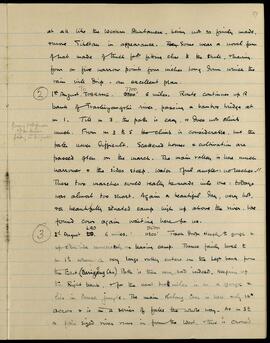
            at all like the Western Bhutanese, being not so finely made, more Tibetan in appearance. Some wear a novel form of hat made of thick felt fitting close to the skull, having four or five narrow points four inches long down which the rain will drip - an excellent plan.

            (2) 1st August. TO TOBRANG. 7700' 5 miles. Route continues up R bank of Trashiyangshi river, passing a bamboo bridge at m 1. Till m 3, the path is easy, & does not climb much. From m 3 to 5 the climb is considerable, but the path never difficult. Scattered houses & cultivation are passed often on the march. The main valley is here much narrower & the sides steep. Water of course ample: no leeches!! These two marches could really be made into one: today's was almost too short. Again a beautiful day, very hot, & a beautifully situated camp high up above the river. We found cows again waiting here for us.

            (3) 2nd August LAO. 6 miles. 9500' Track drops steeply to gorge & up other side immediately on leaving camp. Thence fairly level to m 1 1/2 where a very large valley enters on the left bank from the East. (Barigang Chu.) Path is then very bad indeed, keeping up the Right bank, & for the next two miles is in a gorge & lies in dense jungle. The main Kulong Chu is here only 10' across & is in a series of falls the whole way. At m 3 1/2 a fair sized river runs in from the West, & this is crossed

            LSH/1/1/9/1/95 · Part · 1933-07-03
            Part of The Ludlow & Sherriff Collection

            SUMMARY:
            The diarist rides a yak to Marlung and conducts plant collecting despite mist, rain, and poor visibility, noting abundant primulas and other flowers near yakherds' huts. A flower box arrives from Bumthang, thought to be Ludlow's, raising concerns about other boxes and presents coming from Kpong, while a future visit tied to Hicks' return is mentioned.

            CONTENT:
            as that would be a change and would give much trouble. The snag is that from there to come up here one would again have to pass through Bumthang, and we don't want any more of that, when already we must pay a last visit on Hicks' return about 1 Oct.

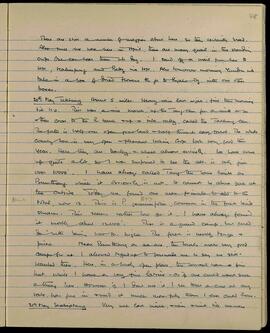
            5th July MARLUNG. 6 miles. 13500' Pretty fine day, but no views. I rode up here on a yak today in real comfort. But we are not nearly high enough here, and should really be in the highest yakherds' huts. The cliffs here are again covered with P. umbratilis, but there seems precious little otherwise.

            6th July Halt. A foul day of rain, wind and mist. We went about 4 miles up the valley, then turned south up a side valley, the one I eventually hope to leave by. But we were so lost in thick mist, that we could see only 10-20 yards, and didn't know if there were cliffs above, or open country or what. That doesn't make plant collecting any easier. One can only take a chance of finding things, without looking where they should be. In spite of that we got quite a number of flowers, though nothing very thrilling. The yakherds' huts up there are very beautiful—at least round about them is beautiful—a mass of white and yellow P. sikkimensis (orthopiana) in a sea of yellow potentillas and calthas, and asters and red pedicularis. When I got back I found a flower box had been sent up here from Bumthang, with no letter and message. The boy only said that he had been told it had come from Bumthang. It must be Ludlow's, and makes one wonder what is happening to other boxes that were left there. And it also makes one wonder what will happen to the boxes of bows and arrows and other presents which are coming from Kpong to be left in Bumthang. I hope they don't come on here!

            LSH/1/1/2/1/149 · Part · 1933-07-18
            Part of The Ludlow & Sherriff Collection

            SUMMARY:
            A rainy, disappointing day with no views as yak men delayed and refused to go as far as Shingbe. The writer praises the valley between the Cho and the La for its floral richness, regrets not spending more time between there and Dongkar, and reports that by the 20th July none of their mail had reached Kumari Khata, including a post sent from Trashigang by the Dzongpen, possibly misrouted via Nerli. On 23rd August at Shingbe they halted to check and pack flowers and write letters for dispatch.

            CONTENT:
            Me La - Aug 22
            Codonopsis sp. nov. 876
            Cardamine macrophylla 877
            Me La Aug 24

            A most disappointing day. It rained steadily the whole day, we never had a view of the hills & glaciers at all. The yak men did not want to go as far as Shingbe & made a late start. The valley between the Cho & the La is one of the best we've seen anywhere. I believe had we spent all our time between here & Dongkar we would have got nearly every flower we have collected in all our wanderings. A few of the Sakden ones might not have been found, but there would have been others of the earlier flowers to make up for that. But it can't be helped now. Last night I made the rather unpleasant discovery that by the 20th July none of our mail sent off by us had ever reached Kumari Khata at all. As that includes a post from Trashigang when it was personally sent by the Dzongpen, it is rather unpleasant. What can have happened I do not know. He must have sent it to Nerli, but from there it has not been sent either.

            23rd August. Halt Shingbe. Spent the day checking & packing up flowers & writing letters for a mail to be sent off tomorrow on the

            LSH/1/1/8/1/111 · Part · 1952-05-17
            Part of The Ludlow & Sherriff Collection

            SUMMARY:
            The party negotiates passage with an elderly Dzongpen (father of the acting official), who promises limited pony transport and sealed letters to Kome and Koto, while the diarist sends letters to Surkhang Dzasa and to Darjeeling. On 17 May at Yangtso they depart with yak transport, seen off by Pedong Dorji, and note clear views of Yala Shampo, lake birds, and herds of kyang and gazelle.

            CONTENT:
            At first, they said no British or Bhutanese could pass this way without a sealed passport of the T.G. The Dzongpens were very sticky too. The other Dzongpen said the locals were all Drokpas and only owned five, with no transport. But we settled down and asked the Dzongpen—really the father of the real man—to come see us. He came, an old man of 62, with no teeth. He was full of life and fun and is one of the few Tibetans who have done things. He's been all over East Tibet, to India with the 13th Dalai Lama, to China, to Ladakh, to Monyul, and everywhere else. He talked so fast that we could not get a word in anywhere. He talked so loud that he could be heard 100 yards away. But he was a good soul, and was most friendly and helpful. He would provide transport for us, with only 2 ponies, as there are no more there, and he would give us sealed letters to Kome and Koto, where the Takhar Tengba Dzongpen would find us a change of transport. Although we have "Dzongyel", we have to change there. He was a most lively and entertaining old man, who kept us thoroughly amused for more than half an hour. After he went, there was a marked change in the Dzongpen's behaviour. The old boy leaves for Lhasa on the 17th, and I gave him a letter for Surkhang Dzasa saying I had come here, and several for Darjeeling too.

            17th May. Yangtso. 11 miles. A beautiful day, with a few heavy showers round about. Pedong Dorji saw us off at 7:30, all arrangements being good. He will go back today to Chong-gye Dzong. He has been a help and a good friend. We had yak transport which came on well. To the east, the fine peak of Yala Shampo (20,230') was very clear this evening. The lake here is beautiful, and has a good many birds on it: gulls, terns, brahminy geese, pochard, and redshanks. On the main Triju plain were many kyang and several gazelle. Further up this way we saw more gazelle, one herd having 15 in it. They were not frightened.

            In car with young husband 17/5/52

            LSH/1/1/3/3/49 · Part · 1934-03-10
            Part of The Ludlow & Sherriff Collection

            SUMMARY:
            Notes on routes between Laori and Mera via the Sirim La and nearby rivers. At Mera, the diarist relocates camp from Gus to the Dzong and, with Tenduk and a tumpa, climbs a 15,000 ft hill through conifer and rhododendron forest, observing Prim. 1133 at high elevation and hazy views reaching Kula Kangri and Namcha Barwa.

            CONTENT:
            gradually flows south then close to the Laori chu - 3 miles
            distant, emerging near Neoly: that there is a bad road by
            the Mera chu to the plains: that from Laori to Mera takes
            two days by the Sirim La.

            12th March. MERA. I left camp at Gus this morning and coolies
            moved my camp back to Mera where I am now in the
            Dzong, the village having nearly all blown away. Tenduk
            and I with a tumpa went up a hill to the north, which must
            be 15,000 ft, as it overlooks the Nyahsung La. It was a pleasant
            not too steep climb, and we got to the top - about 4,000 ft climb
            in 2 1/4 hours. Mostly the path was through conifer and rhododendron
            forest, and I was surprised to see Prim. 1133 coming out at 13,000
            ft or even more. It must be very common here. Yesterday
            was so wonderfully clear, I was hoping to see everything today.
            But for some reason all the smoke had covered the country
            again, and although I saw the snow hills, they were very
            indistinct. I could see Kula Kangri in the N. West and as
            far as Namcha Barwa in the N. East. Had the atmosphere
            been sparkling like yesterday, the view would have been
            perfectly wonderful. I took a round of bearings and the

            LSH/1/1/3/3/170 · Part · 1983-05-05
            Part of The Ludlow & Sherriff Collection

            SUMMARY:
            The diarist ascended the Na La through forest and traversed to the Pang La while traveling toward Tso Kar, searching for flowers and birds. Notes include observations of Heteroxenicus stellatus breeding among alpine rocks and a sighting of Snow Cock Pheasant (Tetraophasis szechenyii) across a wide elevational range.

            CONTENT:
            Migyitun

            Ludlow page 104. Went up the Na La and Pang La, 2 passes Migyitun 30 August
            on the road to the Tso Kar (Lake of the sacred one) which
            is a place of pilgrimage. The Na La involved an ascent Primula verrucosa var. violacea
            of some 3000 feet and led, as its name indicates, through forest. 1734, 1742.
            On reaching the summit of the Na La I made a circuit flabellifera 1737
            round to the Pang La in search of flowers and birds. macrocarpa 1743
            Got 3 specimens of Heteroxenicus stellatus stellatus Paraquilegia anemonoides
            Gould's Short-wing which has been found in East Nepal, 1744
            Sikkim and Bhutan. This species extends its range still Meconopsis simplicifolia 1735
            further eastwards. A common bird. Different from Rhododendron pumilum 1741
            other Short-wings in not being a skulker. Although Caltha palustris 1745
            it inhabits dense rhododendron and bamboo growth, it does not
            shun observation and will ascend to the tops of bushes
            to gaze at an intruder in a most confidential manner.
            The 2 were shot in - wherever there are rocks and boulders in
            the alpine zone, far away from all shrub growth. And
            the birds were breeding amidst these surroundings.
            --- shot on the next day ---
            Also saw Snow Cock Pheasant Tetraophasis szechenyii - Ludlow 383
            A common bird in Southeast Tibet. Found at all elevations between
            11-15000 feet. Lives in fir forest and also inhabits Rhododendron scrub
            in the alpine zone. - Specimen of Szechenyii 383.