Bhutan

Elements area

Taxonomy

Code

Scope note(s)

    Source note(s)

      Display note(s)

        Hierarchical terms

        Bhutan

        Equivalent terms

        Bhutan

          Associated terms

          Bhutan

            419 Archival description results for Bhutan

            419 results directly related Exclude narrower terms
            LSH/1/1/1/1/11 · Part · 1933-11-06
            Part of The Ludlow & Sherriff Collection

            SUMMARY:
            Ludlow and S.D. struggled to collect birds due to swarms of leeches. The party arrived on the 25th, met Price and Waters, heard of Williamson’s engagement and plans to bring his wife to Bhutan, and lunched with Tobgye (Raja S.T. Dorje) in Kalimpong, whose wife is sister to the Maharaja of Sikkim.

            CONTENT:
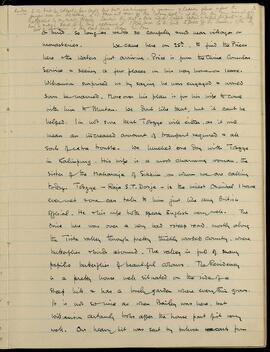
            Ludlow and S.D. tried to collect a few birds but badly handicapped by swarms of leeches which infest the jungle near here. He seeing L.D. dare not move off the stony path - if they did they were immediately attacked by myriads of leeches. Someone says that a bird which dropped about a yard behind the path way, they had to make a dash for the bird, retrieve it and flee back to the path to pick off the leeches. After they lost the specimen if they don't find them on trees.

            or bird, so long as we do so carefully and near villages or monasteries.

            We came here on 25th, to find the Prices here also Waters just arriving. Price is from the China Consular Service and seeing a few places on his way home on leave. Williamson surprised us by saying he was engaged and would soon be married. Moreover his plan is for his wife to come with him to Bhutan. We don't like that, but it can't be helped. I'm not sure that Tobgye will either, as it will mean an increased amount of transport required and all sorts of extra trouble. We lunched one day with Tobgye in Kalimpong. His wife is a most charming woman, the sister of the Maharaja of Sikkim, on whom we are calling today. Tobgye - Raja S.T. Dorje - is the nicest Oriental I have ever met and one can talk to him just like any British official. He and his wife both speak English very well. The drive here was over a very bad
            LSH/1/1/9/1/48 · Part · 1933-05-07
            Part of The Ludlow & Sherriff Collection

            SUMMARY:
            Notes describe intense heat in lowland Bhutan and a fine bridge over the Kuru Chu, followed by return to camp at Lhuntse Dzong. Yundru requests medicine for syphilis, mentioning prior injections by Kapo. The Tinnymu Bridge is described in detail, with no notable flowers observed.

            CONTENT:
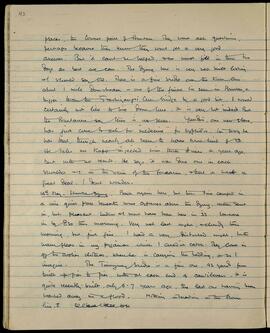
            43

            places, the lowest part of Bhutan. They won't ask questions, perhaps because they know they won't get a very good answer. But it can't be helped, one must fill in these two days as best we can. The Dzong here is very well worth looking at, I should say old. There is a fine bridge over the Kuru Chu about 1 mile downstream - one of the finest I've seen in Bhutan, a bit bigger than the Trashigangsi Chu bridge by a good bit. I would certainly not like to live down here. It is very hot indeed. But the Bhutanese say there is no fever. Yundru, our new slave, has just come to ask for medicine for syphilis. I'm sorry he has that, though nearly all seem to have some kind of V.D. He tells me Kapo injected him three times a year ago, but with no result. He says it was done one in each shoulder or in the vein of the forearm, and that it hurts a great deal. I don't wonder.

            14th May. Lhuntse Dzong. Back again here, but this time camped in a nice quiet place beneath some cypresses above the Dzong, rather shut in, but pleasant. Ludlow and I must have been here in 1933. We were in by 8:30 this morning. Very wet last night, and cloudy this morning, but just fine. I had a very disturbed night, with water fleas in my pyjamas which I couldn't catch. They come in off the coolies' clothes, when he is carrying the bedding, or so I imagine. The Tinnymu Bridge is a fine one, 42 yards from built up pier to pier, with at each end 4 cantilevers. It is quite recently built, only 6-7 years ago, the last one having been washed away in a flood. Nothing interesting in the flower line.

            LSH/1/1/1/1/187 · Part · 1935-09-11
            Part of The Ludlow & Sherriff Collection

            SUMMARY:
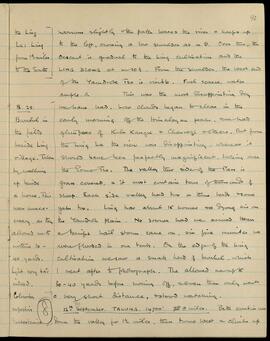
            The diary describes the route along the Ling to Ling Dzong via the Ling La, with scarce fuel but ample water, and a disappointing view despite glimpses of Kulu Kangri and Chenrezi. Ling village has about 15 houses and a dzong; a severe hailstorm flooded the tents shortly after arrival. Burrhel and yaks were observed near the Ling cultivation.

            CONTENT:
            92

            the Ling ] narrows slightly. The path leaves the river and keeps up
            La: Ling ] to the left, crossing a low shoulder at mile 9. Over this, the
            from 1 1/2 miles ] descent is gradual to the Ling cultivation and the
            to the South ] LING DZONG at mile 10 1/2. From the shoulder, the west end
            of the Yamdrok Tso is visible. Fuel scarce, water
            ample. // This was the most disappointing day

            B. 29. we have had. Low clouds began to clear in the
            Burrhel in early morning off the Himalayan peaks, we had
            the fields glimpses of Kulu Kangri and Chenrezi and others. But from
            beside Ling the Ling La the view was disappointing, whereas it
            village. Taken should have been perfectly magnificent, looking over
            by walking the Pomo Tso. The valley this side of the Pass is
            up beside grass covered, and it must contain tens of thousands of
            a horse. This sheep. Each side valley had two or three herds and some
            was unnecessary, yaks too. Ling has about 15 houses and a Dzong as on
            as they the Yamdrok plain. No sooner had we arrived than
            allowed me to a terrific hail storm came on, and in five minutes we
            within 30 - were flooded in our tents. On the edge of the Ling
            40 yards. cultivation we saw a small herd of burrhel, which
            Light very bad I went after

            LSH/1/1/2/1/106 · Part · 1933-07-18
            Part of The Ludlow & Sherriff Collection

            SUMMARY:
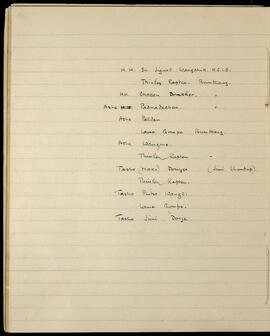
            A page listing names of individuals, many with honorifics or titles, alongside place references. Mentions include H. H. Sir Jigmed Wangchuk, Thinley Rapten, several Ashe and Tasho figures, and places such as Bumthang, Domkher, Lama Gompa, and Haku.

            CONTENT:
            H. H. Sir Jigmed Wangchuk. K.C.I.E.
            Thinley Rapten. Bumthang.
            H.H. Choden Domkher. "
            Ashe Padmadechen. "
            Ashe Palden
            Lama Gompa Bumthang.
            Ashe Wangmo.
            Thinley Rapten -
            Tasho (Haku) Donyer (Jimi Lhundup).
            Thinley Rapten.
            Tasho Puntso Wangdi.
            Lama Gompa.
            Tasho Jimi Dorje.

            LSH/1/1/6/1/55 · Part · 1936-05-13 - 1936-05-16
            Part of The Ludlow & Sherriff Collection

            SUMMARY:
            Entries from camps east of Lo La describe rough roads, changing weather, and botanical collecting focused on rhododendrons and primulas. Ludlow shot two male monal while coolies snared a female, and the diarist explored with Tsongpen and Tsering before moving to Singo Samba.

            CONTENT:
            Lo La
            27

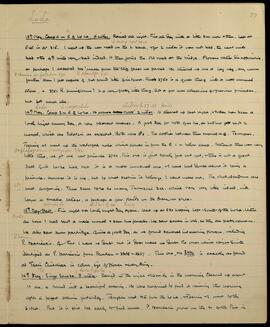
            13th May. Camp 4 m E of Lo La. 6 miles. Rained all night. Fine all day with a little sun now and then. Left at 5.45, in at 3.15. I went up the new road on the L bank (L bank = right bank), and for 2 miles it was not bad, the next mile bad and the 4th mile very bad indeed. It then joins the old road at the bridge. Flowers rather disappointing, or perhaps I expected too much from the cliff faces we passed. We climbed up one a long way, very much further than I felt capable of, but found little of interest. Rhododendron 3750 is a queer thing with a most unusual colour, and 3751 R. primuliflorum? is a very pretty little thing. Got a few more collections of previous primulas, but not much else.

            14th May. Camp 2 m E of Lo La. At approx 12000' 2 miles. It cleared up last night, and today has been a lovely bright sunny day, a very pleasant change. A good day for both of us too, as Ludlow shot 2 monal, which are Sclateri as expected. Both were males. The coolies between them snared a female. Tsongpen, Tsering and I went up the waterfall nullah which comes in from the E 1 m below camp. Although there was very little there, we got one new primula 3762. This one is just barely fully out yet, and there is not a great deal of it to be had, but it is a most unusual one, and I have had doubts about it being a primula. However it is one, but to what section it belongs, I can't make out. The rhododendrons are most confusing. There seem to be so many Thomsonii Ser. which vary very little indeed, with larger or smaller calyces, or perhaps a few glands on the ovary or style.

            15th May Halt. Fine night and a lovely bright day again. Went up at 5.30 keeping high - South - of the Lo La. Within an hour I had shot a male monal and seen two females. We saw seven in all, so they are pretty common. We also saw snow partridge. Quite a good day, as we found several interesting flowers, including P. tsariensis. Of this I have no doubt but it does make me doubt the ones which Wright Smith identified as P. bariensis from Bhutan - 3366 - 3367. This one, No 3779, is exactly as found at Tsari Chikchar in colour, size of flower and everything.

            16th May. Singo Samba. 8 miles. Rained in the night and early in the morning. Cleared up about 10 am, and turned into a beautiful evening. We were surprised to find it raining this morning after a perfect evening yesterday. Tsongpen went NE from the Lo La, and Tsering and I went to the S West. But it is still too early to find much. P. tsariensis grows on the N of the Pass in...

            LSH/1/1/4/1/44 · Part · 1936-04-28
            Part of The Ludlow & Sherriff Collection

            SUMMARY:
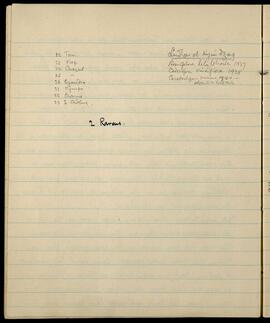
            Brief notes list several localities with associated plant records (including Adenophora liliifolia, Codonopsis viridiflora, and Ceratostigma minus) dated 1937, 1938, and 1940. Mentions Ludlow at Kyim Dzong, notes that Gyandro abounds on the hillside, and records an observation of two ravens.

            CONTENT:
            22 Trun. Ludlow at Kyim Dzong
            23 Kap. Adenophora liliifolia 1937
            24 Chaqul Codonopsis viridiflora 1938
            25 - Ceratostigma minus 1940 -
            26 Gyandro abounds on hillside.
            27 Kyuphu
            28 Charme
            29 S. Chöling

            2 Ravens.

            LSH/1/1/4/1/40 · Part · 1936-04-28
            Part of The Ludlow & Sherriff Collection

            SUMMARY:
            Notes by Ludlow at Pa La near Kyim Dzong listing plant taxa, including Pedicularis megalochila f. rhodantha, Primula chamaethauma, Gentiana phyllocalyx, and Cyananthus nervosa, with associated numbers.

            CONTENT:
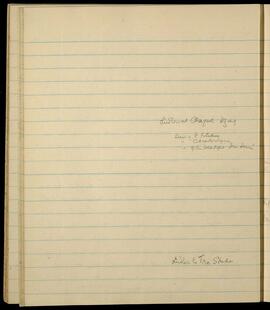
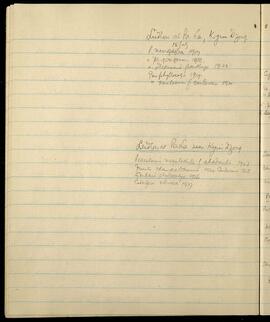
            Ludlow at Pa La, Kyim Dzong.
            18/VII
            P. macrophylla 1917
            " yangongensis 1918 =
            " flexuosa xanthina 1922
            Gen phyllocalyx 1919
            " nantaensis f. caulescens 1920

            Ludlow at Pa La near Kyim Dzong
            Pedicularis megalochila f. rhodantha 1923
            Primula chamaethauma 1924 Cawdoriana 1928
            Gentiana phyllocalyx 1926
            Cyananthus nervosa 1927

            LSH/1/1/3/3/196 · Part · 1996-06-18
            Part of The Ludlow & Sherriff Collection

            SUMMARY:
            Note indicating Ludlow at Taktsa and Kyimdong Dzong in 1937, listing plant taxa with associated numbers: Iris goniocarpa, Cypripedium guttatum, Anemone demissa, and Potentilla parvifolia.

            CONTENT:
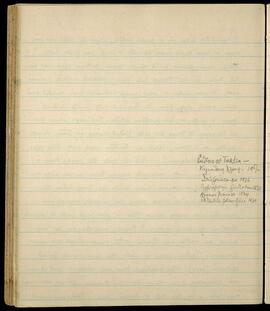
            Ludlow at Taktsa —
            Kyimdong Dzong. 1937
            Iris goniocarpa 1836
            Cypripedium guttatum 1835
            Anemone demissa 1834
            Potentilla parvifolia 1839