Bhutan

Elements area

Taxonomy

Code

Scope note(s)

    Source note(s)

      Display note(s)

        Hierarchical terms

        Bhutan

        Equivalent terms

        Bhutan

          Associated terms

          Bhutan

            419 Archival description results for Bhutan

            419 results directly related Exclude narrower terms
            Page 163
            LSH/1/1/1/1/163 · Part · 1933-09-24
            Part of The Ludlow & Sherriff Collection

            CONTENT:
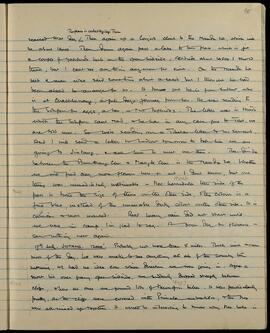
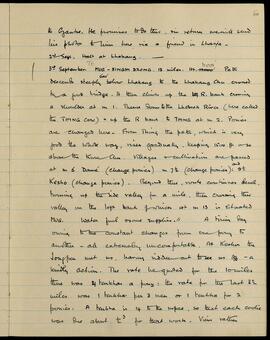
            to Gyantse. He promises to do this, in return we will send
            his photos to him here via a friend in Lhasa.

            2nd Sept. Halt at Lhakang.

            3rd September. TO MUG-SINGH DZONG. 13 miles. Ht. 11000'. Path
            descends 600' steeply below Lhakang to the Lhakang Chu crossed
            by a good bridge. It then climbs up the R. bank crossing
            a shoulder at m 1. Thence down to the Lhobrak River (here called
            the THING CHU) & up the R bank to THING at m 2. Ponies
            are changed here. From Thing the path, which is very
            good the whole way, rises gradually, keeping 1500 ft or so
            above the Kuru Chu. Villages & cultivation are passed and
            at m 6 Damé (change ponies) m 7 1/2 (change ponies) and 9 1/2
            Kesho (change ponies). Beyond this, route continues level,
            turning up the side valley for a mile, then crossing this
            valley on the left bank on which at m 13 is situated
            MUG. Water fuel & some supplies. // A tiring day
            owing to the constant changes from one pony to
            another - all extremely uncomfortable. At Kesho the
            Jongpen met us, having ridden out to see us off - a
            kindly action. The rate he quoted for the 10 miles
            there was 4 tenkhas a pony: the rate for the last 3 1/2
            miles was 1 tenkha per 3 men or 1 tenkha for 2
            ponies. A tenkha is 14 to the rupee, so that each coolie
            was due about 1/2 d for that work. Views rather
            LSH/1/1/5/1/93 · Part · 1933-05-30
            Part of The Ludlow & Sherriff Collection

            SUMMARY:
            The party revisits the La, noting flowering Lilium giganteum, rhododendrons (possibly R. maddenii or R. calophyllum), and a primula akin to P. Boothii. A sepoy brings letters and gifts from Ashi Wangmoo and Tasho Haku, with reflections on Wangmoo’s situation as a nun; the Mara Chu is observed plunging in dramatic falls.

            CONTENT:
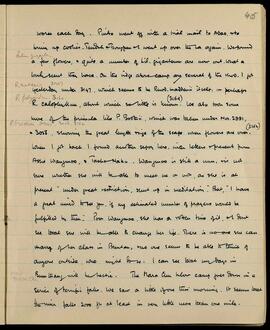
            worse each day. Pintso went off with a trial mail to Adao, to bring up coolies. Tenduk & Tsoupen & I went up over the La again. We found a few flowers, & quite a number of Lil. giganteum are now out. What a lovely scent they have. On the ridge above camp are several of the Rhod. I got yesterday under 3147, which seems to be Rhod. maddenii itself, or perhaps R. calophyllum, about which so little is known. We also took some more of the primula like P. Boothii, which was taken under Nos. 2991, & 3056, showing the great length & size of the scape when flowers are over.

            When I got back I found another sepoy here, with letters & presents from Ashi Wangmoo, & Tasho Haku. Wangmoo is still a nun, & is not sure whether she will be able to meet me or not, as she is at present "under great restriction, shut up in meditation". But, "I have a great mind to see you, if my estimated number of prayers would be fulfilled by then." Poor Wangmoo, she has a rotten time of it, & I don't see that she will be able to change her life. There is no one she can marry of her class in Bhutan, & no one seems to be able to think of anyone outside, who might do so. I can see that my days in Bumthang will be hectic. The Mara Chu below camp goes down in a series of terrific falls. We saw a little of one this morning. It seems that the river falls 2000 ft at least in very little more than one mile.

            LSH/1/1/9/1/103 · Part · 1949-07-12
            Part of The Ludlow & Sherriff Collection

            SUMMARY:
            The diary describes travel over the Namda La from Kyikyi Tsum, descending past a lake to yakherds' huts in mist and rain, with notable size and color differences in Meconopsis horridula across the pass. A messenger from Ludlow (at Chachhunang) prompts letters to Ludlow and to the Sonpon’s household, as the Sonpon has gone to Tibet. On 17 July, in thick mist and rain en route to Jiutang, abundant Meconopsis bella and Primula umbratilis are observed on steep cliff faces.

            CONTENT:
            The place is called Kyikyi Tsum
            reached that day. Then again up a longish climb to the Namda La, which will be about 16000'. Then down again past a lake to this place, which is just a couple of yakherds' huts on the open hillside. Altitude about 14500 I should think, but I can't see anything anywhere for mist. On the Namda La met a man who said something about a sahib, but I thought he had been ahead to arrange for us. It turns out he is from Ludlow, who is at Chachhunang, a full day's journey from here. He was sending to the Sonpon for eggs, a hen, and two taphukas. The letter was in Hindi which the Sonpon can't read, and he has in any case gone to Tibet, we are told now. So we're sending on a Tibetan letter to his servants. And I will send a letter to Ludlow tomorrow to tell him we are going to Jiutang, and ask him to meet me there. The divide between the Bumthang Chu and Mangde Chu is the Namda La. Whether we will find any more flowers here or not I don't know, but one thing was immediately noticeable — Meconopsis horridula this side of the pass is twice the size of those on the other side, and the colour is a fine blue, instead of the miserable dirty colour on the other side. It is curious and most marked. Real heavy rain did not start until we were in camp, I'm glad to say. A poor day for flowers — saw nothing new again.

            17th July. JIUTANG. 12000'. Probably not more than 5 miles. Thick mist and rain most of the day. We were unable to see anything at all of the country this morning, and had no idea even which direction we were going in. After a short bit over grassy open hillside, we suddenly dropped steeply between cliffs, where at once we found lots of Meconopsis bella. It was particularly pretty, as the cliffs were covered with Primula umbratilis, and the two were all mixed up together. It would be interesting to know why Meconopsis bella is

            LSH/1/1/6/1/86 · Part · 1938-07-01
            Part of The Ludlow & Sherriff Collection

            SUMMARY:
            Records bird observations, including a cuckoo on 01/07/1938 near Simbitanka and a large black woodpecker nest at Peteng, and notes disposal of a spoiled blackbird specimen. Provides route instructions along the right bank of the Tsangpo via Simbitanka, Yüsum, Perudu, Peteng, and Miling, with remarks on bridges and transport changes.

            CONTENT:
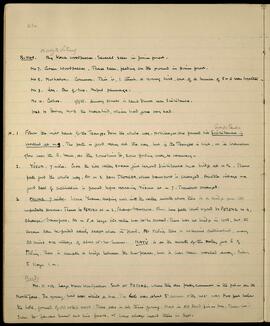
            43a

            On way to Lilung
            BIRDS. Big black woodpecker. Several seen in pinus forest.
            No 7. Green Woodpecker. Three seen, feeding on the ground in pinus forest.
            No 8. Nuthatch. Common. This is, I think, a young bird, one of a bunch of 5 or 6 seen together.
            No 9. Jay. One or two. Awful plumage.
            No 10. Cuckoo. 1/7/38. Among shrubs in sand dunes near Simbitanka.
            Had to destroy No 6 the blackbird, which had gone very bad.

            X. 1 Follow the right bank of the Tsangpo down the whole way. No villages are passed till Simbitanka is reached at m 9. The path is good nearly all the way, but if the Tsangpo is high, or its branches flow near the R. bank, as they sometimes do, some fording may be necessary.

            1. YÜSUM. 7 miles. Cross the side valley stream just beyond Simbitanka by a bridge at m 1/2. Thence path good the whole way. At m 2 pass TRONGSA, where transport is changed. Another village with a good deal of cultivation is passed before reaching Yüsum at m 7. Transport changed.

            2. MILING. 7 miles. Leave Yüsum, keeping well into the valley mouth where there is a bridge over the unfordable stream. Thence to PERUDU at m 2. Change transport. From here path level & good to PETENG m 4, change transport. At m 5, a large side valley has to be crossed. There was no bridge in 1938, but the stream can be forded easily except when in flood. At Miling there is extensive cultivation, many old ruins or village of about 15-20 houses. NAYÜ is at the mouth of the valley just E of Miling. There is usually a bridge between the two places, but it has been washed away. Miling to Nayü 1 m.

            Birds
            No. 11 & 12. Large black Woodpecker. Shot at PETENG, where they are pretty common in the pinus on the North face. The young bird was inside a tree. The hole was about 3" across & the nest was two feet below the hole, formed of old rotted wood. There were in all three young. Nest in old dead pinus tree. These birds seem to favour burnt out pinus forests, I have always heard them in such.

            LSH/1/1/4/1/16 · Part · 1936-07-02
            Part of The Ludlow & Sherriff Collection

            SUMMARY:
            Account of a steep ascent from Nyug La camp to the Nyug La pass, crossing three nullahs, with dense bamboo in the final 500 ft and conifers on the 11,200 ft summit; the pass is compared to those crossed in Bhutan in 1933. Observations include Cyanoptila on the south side of Chanyul Chu above Trim and many erythaca at Nabrampa.

            CONTENT:
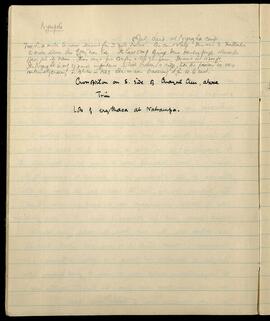
            Nyug La

            8th July. Decided at Nyug La camp
            Took us 2 miles to reach streams for 3 miles distance. Ascent steep. There were 3 nullahs to cross where the going was bad. The last 500 ft. through dense bamboo jungle whence the pass gets its name. There were a few conifers on top of the pass. Summit is 11,200 ft. The Nyug La is one of several important lateral crests of a ridge, like the passes we were continually crossing in Bhutan in 1933 when we were traversing it from West to East.

            Cyanoptila on South side of Chanyul Chu, above
            Trim

            Lots of erythaca at Nabrampa.

            LSH/1/1/4/1/54 · Part · 1933-07-23
            Part of The Ludlow & Sherriff Collection

            SUMMARY:
            Cites Ludlow’s description of the march to Chosam Sur La in Tsari while on the way to Chosam, with plant specimen notes numbered 1952–1954. Records movement to Chorten Namu on July 29.

            CONTENT:
            L. p 162-3 28th July Ludlow on
            desc. of march to Chosam Sur La, Tsari - on way to
            Chosam
            Sax. bergenioides 1952
            Cremanthodium purpureifolium
            Pedic. megalochila f. rhodantha 1953
            1954

            L. to Chorten Namu. July 29.

            LSH/1/1/4/1/48 · Part · 1933-07-23
            Part of The Ludlow & Sherriff Collection

            SUMMARY:
            Notes from the pass near Nang Dzong, Kongbo record poor flowers but abundant butterflies, including Parnassius, Fritillaries, and Camberwell Beauties. The pass is wooded to the summit with larch and birch over shrubs and Rhodos, and from L. to Pero there was no conifer forest, only shrubs and bushes. Specimens listed include Didissandra kingiana, Delph. gyalanum, and Pedic. trichoglossa.

            CONTENT:
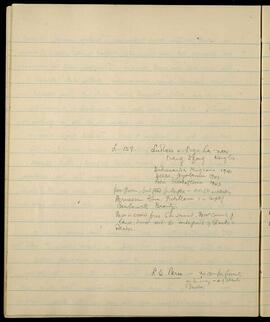
            L. 159. Ludlow & Nga La - near
            Nang Dzong, Kongbo.

            Didissandra kingiana 1941
            Delph. gyalanum 1942
            Pedic. trichoglossa 1943

            poor flowers, but good butterflies - over 50 including
            Parnassius Blues, Fritillaries & a couple of
            Camberwell Beauties.

            Pass is wooded face to the summit. Forest consists of
            larch, birch with an undergrowth of shrubs &
            Rhodos.

            L. to Pero - no conifer forest;
            on the way - only shrubs
            bushes.

            LSH/1/1/6/1/96 · Part · 1933-07-05
            Part of The Ludlow & Sherriff Collection

            SUMMARY:
            Notes an observation of Primula vernicosa lacking scapes despite being common. Describes routes from Nayu along the Tsangpo to Suoka (via Pangya and Tungdo) and onward to Paka (via Rakwa, Pema Trongmo, the P. Trongmo Chu, and Kangka), including bridge conditions and nearby passes (Lolung Leku La, Tsanang La, Kucha La).

            CONTENT:
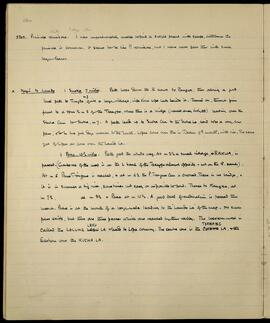
            245a

            White Nayu Chu

            1. Primula vernicosa. I was unfortunately unable to find a single plant with scape, although the primula is common. It seems to be like P. vernicosa, but I have never seen this with such large leaves.

            x Nayu to Lando i Suoka 7 miles. Path keeps down the R bank to Pangya, then along a good level path to Tungdo (m 3), quite a large village, with some Lopa huts beside it. Thence on, through pine forest to a spur ½ m S of the Tsangpo, where there is a bridge (washed away July 38) leading over the Suoka Chu to Suoka, m 7. A path leads up to Suoka Chu to the Suoka La, said to be a very low pass, to be two full days march to the South. Lopas come over this in Tibetan 9th month, with rice. The same sort of Lopas as come over the Lando La.

            ii Paka 10½ miles. Path good the whole way. At m 2½ a small village, RAKWA, is passed. (Gumbo-wo of the map is on the L bank of the Tsangpo almost opposite - not on the R. bank). At m 5 Pema Trongmo is reached, & at m 6½ the P. Trongmo Chu is crossed. There is no bridge, & it is in summer a big river, sometimes not easy or impossible to ford. Thence to Kangka, at m 7½, at m 9½ Paka at m 10½. A good deal of cultivation is passed this march. Paka is at the mouth of a large nala leading to the 'Lando La' of the map. No such pass exists, but there are three passes which are reached by this valley. The westernmost is called the LOLUNG LEKU LA & leads to Lopa country. The centre one is the TSANANG LA, & the Eastern one the KUCHA LA.

            LSH/1/1/4/1/21 · Part · 1936-07-02
            Part of The Ludlow & Sherriff Collection

            SUMMARY:
            Collected several flowers including scented Maddenii-series rhododendrons (specimens 2332, 2334, 2338); noted dense jungle like near Lao in Bhutan, scarce leeches, numerous ticks, and no Pnoepyga, and considered marching down the Chayul Chu. On 11 July, traveled 7 miles to Natrampa in heavy rain and shot two birds near arrival, the same species previously sought near Lung.

            CONTENT:
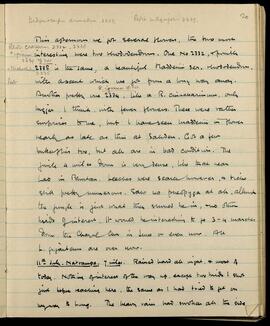
            Didymocarpus aromatica 2333, Pedic. integrifolia 2339. 120

            This afternoon we got several flowers, the two most interesting were two rhododendrons. One No. 2332 (Rhod. crassum 2332, 2338), 2338 is the same, a beautiful Maddenii ser. rhododendron with a scent which we got from a long way away. Another pretty one 2334 ("igneum" 2334 sp. nov.), like a R. cinnabarinum, only bigger I think, with fewer flowers. These were rather surprises to me, but I have seen Maddenii in flower nearly as late as this at Sanden. Got a few butterflies too, but all are in bad condition. The jungle 4 miles down is very dense, like that near Lao in Bhutan. Leeches were scarce however, and ticks still pretty numerous. Saw no Pnoepyga at all, although the jungle is just what they should be in, nor other birds of interest. It would be interesting to go 3–4 marches down the Chayul Chu in June or even now. All L. giganteum are over now.

            11th July. Natrampa. 7 miles. Rained hard all night, and most of today. Nothing of interest on the way up, except two birds I shot just before reaching here, the same as I had tried to get on my way to Lung. The heavy rain had swollen all the side

            LSH/1/1/1/1/147 · Part · 1933-08-22
            Part of The Ludlow & Sherriff Collection

            SUMMARY:
            Persistent mist and rain hamper work between Narin Thang and Kang La, with notes on friendly sheep rations, leech troubles, and lamas’ warnings from Singhi Dzong. The writer reports finding more eburnea and a new primula, plans seed collection arrangements for October, and records low temperatures.

            CONTENT:
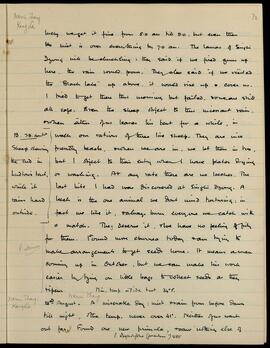
            Narin Thang
            Kang La

            Lucky, we get it fine from 5.0 am till 9.0, but even then the mist is over everything by 7.0 am. The lamas of Singhi Dzong will be chuckling: they said if we fired guns up here, the rain would pour. They also said if we visited the "Black lake" up above, it would rise up and cover us. I tried to get there this morning but failed. Some are still all safe. Even the sheep object to this incessant rain, and when either of us leaves his tent for a while, in walk our rations of three live sheep. They are nice friendly beasts, and when we are in, we let them in too, but I object to their entry when I have plates drying or washing. At any rate there are no leeches. The last bite I had was discovered at Singhi Dzong. A leech is the one animal we don't mind torturing: in fact we like it, and always burn everyone we catch with a match. They deserve it, and we have no feeling of pity for them. Found more eburnea today and am trying to make arrangements to get seeds home. It means a man coming up in October, but we can make his work easier by tying on little bags to collect seeds as they ripen. Min. temp inside tent 34°F.

            Narin Thang
            Kang La
            22nd August. A miserable day: mist and rain from before dawn till night, and the temp. never over 41°. Neither of us went out far. Found one new primula, and saw nothing else of P. dryadifolia (jonarduni?) 455.