Bhutan

Elements area

Taxonomy

Code

Scope note(s)

    Source note(s)

      Display note(s)

        Hierarchical terms

        Bhutan

        Equivalent terms

        Bhutan

          Associated terms

          Bhutan

            419 Archival description results for Bhutan

            419 results directly related Exclude narrower terms
            LSH/1/1/3/3/100 · Part · 1933-04-09
            Part of The Ludlow & Sherriff Collection

            SUMMARY:
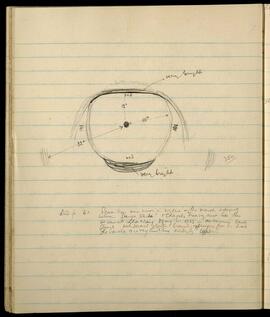
            Notes describe prominent peach trees observed on the march between Sanga Shika? and Chayul, with comparison to similar trees seen at Lhakhang Dzong in 1933. The trees are characterized by enormous broad trunks with several slender branches, often widely lopped.

            CONTENT:
            very bright
            red
            12°
            15°
            32°
            red
            very bright
            250

            Lud. p. 61. Peach trees were much in evidence on the march, especially between Sanga Shika? & Chayul. They are very much like those we saw at Lhakhang Dzong in 1933 — an enormous broad trunk with several slender branches springing from the head. The branches are sometimes very widely lopped.

            LSH/1/1/1/1/67 · Part · 1933-06-24
            Part of The Ludlow & Sherriff Collection

            SUMMARY:
            The diary describes arrival in Paro, visiting the monastery of Gorina with views toward Chomolhari, being escorted by soldiers, and being received and housed near the Dzong by the Paro Penlop. The writer notes practising and watching archery and mentions ongoing recovery from a serious lip injury; the entry was sent from Paro on 24 June 1933 with a report dated 5 July 1933.

            CONTENT:
            31

            extraordinary sight, one quite unique I should think. A little further on we came to the monastery of Gorina, which we stopped to look at. It has a lovely view point from the top story, looking up the broad Paro valley towards Chomolhari. The day was lovely and the views excellent. As we came down, the forest changed gradually, fir giving way to Pine trees, while here in the valley, crops are ripe and rice is being planted. Two miles from Paro we were met by a bodyguard of steel helmeted soldiers, who looked like soldiers of the Norman times. From here on they accompanied us together with the surnai men and dancers. At the magnificently built and designed rest house opposite the huge Dzong we were met by the Penlop, an enormously fat man of 32, and are very comfortably housed.

            B. 11. 12. 13. Sent from Paro - 24. 6. 33.
            Report: - Good quality. 5/7/33

            My lip, which was cut in half, is healing pretty well, but my mouth is still very painful, and another tooth is giving some trouble. It will be a long while I'm afraid, before I can eat anything solid at all.

            24th June. Yesterday we spent most of the morning watching and practising archery. They are rather better at it here than in Ha, and became very excited, singing and dancing most of the time. In the evening the Paro Penlop had his dancers down, and they performed in the court

            B. 13. complete
            Archery at

            LSH/1/1/1/1/71 · Part · 1933-07-07
            Part of The Ludlow & Sherriff Collection

            SUMMARY:
            The writer recounts time in Paro, including lunches with the Penlop at the dzong, watching lama dances, and enjoying archery practice with Tobgye and Ludlow, while expressing frustration with Williamson’s behavior. On 28 June they leave Paro for Pemithanka via the Bela La, where the Penlop offers tea and rice before farewells.

            CONTENT:
            monastery, a fine old building with walls about 6ft thick, loopholed for archery. This was once attacked by the Tibetans, who were driven off by the Bhutanese. Returned to Paro at 12.0 and lunched with the penlop, who then gave another show of his dancers. Williamson must always have something done for him, and I think everyone is now getting very tired indeed of him and his requests for more. He has no work to do, that is the chief trouble. His manners to the penlop are perfectly beastly. I would not remain with him a day if I could help it. Tobgye is getting thoroughly sick of him too. In the evening Tobgye took Ludlow and I out for some archery practice, which we all enjoyed very much.

            27th June. PARO. Yesterday it rained most of the day. At 11.30 went to the dzong to lunch with Penlop. It is a huge place, and when one gets inside looks most impressive. After lunch watched the lama dances done inside a huge hall. Cleared up by 3.0 pm when we left. Ludlow and I walked up the river and took photos of the dzong from various angles. More practice of archery in the evening. My mouth is now much better, but another tooth is coming out by itself, and now sticks down 1/8 inch, preventing me chewing.

            28th June. PEMITHANKA. 10 miles. 8500'. Left Paro at 8.30 and after a short visit to the Penlop in the dzong, rode up to the Bela La, 11650', where the Penlop gave us tea and rice, where we said goodbye. When we were

            B. 16. Views in Paro up the river, mostly of Paro Dzong and in dzong and of helmeted soldiers.

            LSH/1/1/9/1/121 · Part · 1937-08-14
            Part of The Ludlow & Sherriff Collection

            SUMMARY:
            On 21 August the diarist left Paro in heavy rain, reached Gorena, met repeatedly with Tasho, the Tongsa Zimpon, other Zimpons, and a Lama Delegate, dealt with a bath mix-up, and recovered delayed mail, sending Betty’s letters by express to Kalimpong before her trip to Calcutta. They noted no specimens of Paeonia suffruticosa from Gorena down, suspecting loss to fires or cultivation at Gorena Monastery. On 22 August at Pyimitangka, Tasho joined an early breakfast that proved poor due to a new cook, with weather still wet and misty.

            CONTENT:
            21 August. Paro. A dreadful day of rain again. We left in heavy rain at 6.0; it continued heavy till 12.0 when we reached Gorena. At 1.0 we got in, to be met by Tasho. Last night after I had been in bed for over 2 hours, the Tongsa Zimpon was announced. We had a cheerful talk for an hour before he left. I thought that politeness itself on both our parts, and said goodbye to him. But just as I was ready, at 5.15 next morning, to start off, the 2 Zimpons and Lama Delegate rolled up, and again we talked for an hour. In Paro, I stayed in the same place, and this time was again offered a bath. I said, knowing the house before, that I would not have one, and sat down to tea. Half an hour later the Ha Zimpon said, "I'll leave you now to have your bath." Water had been in all the time. Nothing else exciting happened until it was dark, when the mails which had been lost came in. Tasho said he was sending an 'express man' to Kalimpong who would be there in 4 days. So I hurriedly packed up Betty's letters and sent them off. She will get them before going to Calcutta. It was all an awful rush in Paro. I had ample time there, but I was not left alone for more than 10 minutes till Tasho left at 7.45 pm. Otherwise I could have gone through Betty's letters to see if anything needed an answer or not. Got nothing special on the way, and could see no sign of Paeonia suffruticosa which B.S. asked for from Gorena down. Either it has gone due to fires, or it was grown at Gorena Monastery—cultivated—or something like that.

            22nd August. Pyimitangka. Again wet and misty, but not so bad. Tasho came to breakfast at 5.15, and her new cook did not excel. He produced an omelette each in a plate each and a spoon each. Nothing else at all. Gradually salt and other things materialised. No milk or sugar. Rather a failure. We left just...

            LSH/1/1/1/1/69 · Part · 1933-06-26 - 1933-07-07
            Part of The Ludlow & Sherriff Collection

            SUMMARY:
            Photographs and notes on masked dancing at Paro, with an excursion up the Paro valley to the Tak Tsang (Tiger's Nest) monasteries in poor weather, and botanical observations. The party camped below Drugye monastery amid severe mosquitoes and flies, and notes include film dispatch and report dates.

            CONTENT:
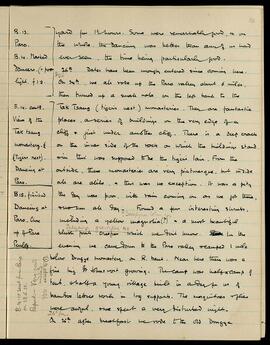
            32

            B.13. Paro.
            B.14. Masked Dancers. (v poor light. f 1.8.)
            yard for 1½ hours. Some were remarkably good, & on the whole the dancing was better than any of us had ever seen, the time being particularly good.

            26th. Dates have been wrongly entered since coming here.
            On 24th, we all rode up the Paro valley about 6 miles, then turned up a small nala on the left bank to the

            B.14. contd. View of the Tak Tsang monastery & (Tiger's nest). Dancing at Paro.
            Tak Tsang (tiger's nest) monasteries. They are fantastic places, a series of buildings on the very edge of a cliff & just under another cliff. There is a deep crack on the inner side of the rock on which the buildings stand, in this was supposed to be the tiger's lair. From the outside, these monasteries are very picturesque, but inside all are alike, & this was no exception. It was a pity the day was poor, with rain coming on as we got there, & no sun all day. Found a few interesting shrubs, including a yellow magnolia(?) (?Diospyros lotus L.) - a most beautiful blush pink creeper (Schizandra grandiflora H.f.) which we didn't know. In the evening we came down to the Paro valley & camped 1 mile

            B.15. finished Dancing at Paro. Close up of Paro Penlop.
            below Drugye monastery on R. bank. Near here there was a fine big St. John's wort growing. The camp was half a camp of tents, & half a young village built in a day for us of bamboo lattice work in log supports. The mosquitoes & flies were awful, & we spent a very disturbed night.
            26th June
            On 25th after breakfast we rode to the old Drugye

            B. 4-15 sent from Paro on 28.6.33.
            Report: - Very good indeed. 7/7/33. except 4.

            LSH/1/1/10/1/11 · Part · 1949-09-14
            Part of The Ludlow & Sherriff Collection

            SUMMARY:
            Diary notes from Pangotang describe ongoing rains, plans to visit Marlung before turning back, and requests regarding taking Yundru and Ngudup to Kalimpong, with preference for Yundru. The writer develops Hicks’ photos, comments on Thompson’s image of P. eburnea, sends Dorji with airmail to Hicks and HH, and packs a ‘tsang’ of rooted plants for shipment to London, hoping to add more from Marlung and Ritang.

            CONTENT:
            147

            Air mail plants
            more specimens and also some roots. I have now so many roots to send home by air, that I wonder how many loads there will be, also how much it will all cost!

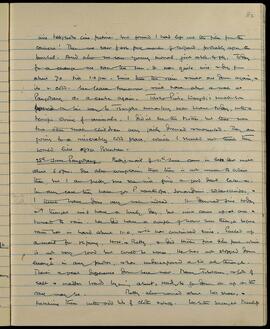
            24th Sept. Pangotang. Fine morning, and a bit of rain after midday. There really is precious little sign of the end of the rains, although I keep on hoping there is. We are, in a way, on our way back home now. But still there is one place, Marlung, to visit, before we can say we have turned round and started back. But everyone obviously feels that things are winding up. I had a request today from Pasang, from Ngudup and Yundru that I should take both to Kalimpong. I don't mind taking Yundru, who is a good and cheery lad and a good worker, but I hope I won't have to take Ngudup one day beyond Bumthang. I do not like him, and except to arrange transport, he is useless. I am writing to HH tomorrow to ask for Changchuk, and to give him our final dates. Today I developed Hicks' photos. If only he had taken my advice at first, all his photos would have been like these which are good. But he would not, and considered he knew better. Thompson's photo of P. eburnea is quite good, much better than Hicks' first efforts. It is a real disappointment to me that in 6 months he has only taken 48 photos altogether, in spite of having lots of film packs available. There were so many photos he could have taken.

            25th September. Sent off Dorji and with airmail to Hicks, HH and Kalimpong and paid him Rs 24/-. We then packed up a 'tsang' with rooted plants, each rooted plant in its own little basket inside the big one. The whole thing now is ready to go to London, except that I hope there will be a few more plants added from Marlung, and then more again at Ritang.
            roots

            LSH/1/1/9/1/87 · Part · 1933-06-28 - 1933-06-11
            Part of The Ludlow & Sherriff Collection

            SUMMARY:
            The writer notes forgetting camera film, observes leopard pug marks and young monal, and describes brief sun before returning rain and cold, with plans to leave and spend a week at Pangotang. A procession including Tasho Penlo Wangdi’s small son heads toward Tsurphu monastery near Lhasa, and on 28 June at Pangotang, Betty’s letter of 11 June arrives reporting some plant collections despite poor conditions as mist and rain persist.

            CONTENT:
            nice telephoto cine pictures, but found I had left out the film for the camera! Then we saw fresh pug marks of leopard, probably after the burrhel. And also we saw young monal, just able to fly. Today for a change we saw the sun. It was quite nice and dry from about 7.0 till 1.0 pm. Since then the rain and mist are down again, and it's very cold. We leave tomorrow, will have about a week at Pangotang as a centre again. Tasho Penlo Wangdi's small son passed on his way to Tsurphu monastery near Lhasa today, with a terrific string of animals. I didn't see the brother, but there were two other small children very gaily dressed and mounted. They are going to a miserably cold place, which I should not think they would like after Bhutan.

            28th June Pangotang. Betty's mail of 11th June came in late last night about 6.0 pm. She also complains that there is not much to collect there, but I am pretty sure she will find a good deal later on. In any case they have got P. xanthopa, jonarduni, soldanelloides, and I think have done very well indeed. It dawned fine today and I thought we'd have a lovely day, but mist came up at once and turned to rain. We did have a couple of hours sun though before rain set in hard about 11.0, and it has continued since. Packed up a mail

            LSH/1/1/3/3/71 · Part · 1936-03-10
            Part of The Ludlow & Sherriff Collection

            SUMMARY:
            Notes describe a valley with magnolia and pine, a Jasminum dispermum at a bamboo bridge, and Primula gracilipes at a waterfall by the Chorten, thought to be where Kingdon Ward previously collected it. On 28th March at Pangchen, a few orchids and Mahonia sidneyi sp. nov. were found; ticks were troublesome, and the party decided the locality was poor but stayed due to illness.

            CONTENT:
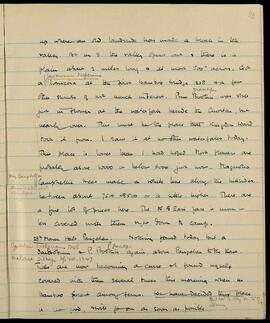
            up where an old landslide has made a block in the
            valley. At mile 9, the valley opens out and there is a
            plain about 2 miles long and at most 500 acres. Got
            a Jasminum dispermum at the first bamboo bridge 1238, and a few
            other shrubs of not much interest. Primula gracilipes was still
            just in flower at the waterfall beside the Chorten, but
            nearly over. This must be the place that Kingdon Ward
            took it from. I saw it at no other waterfalls today.
            This place is lower than I had hoped. Most flowers are
            probably above 10,000 or below 6,000 just now. Magnolia
            campbellii trees make a white line along the hillsides,
            they are abundant and beautiful, between about 7,500 - 8,500 or a little higher. There are
            a fine lot of pines here. The East face is more or
            less covered with them right down to camp.

            28th March. Halt Pangchen. Nothing found today but a
            Cymbidium hookerianum 1245, Mahonia sidneyi sp. nov. 1247,
            Dendrobium and Primula gracilipes again, above Pangchen to the East.
            Ticks are now becoming a curse; I found myself
            covered with them several times this morning when in
            bamboo forest among ferns. We have decided this place
            is no good, will go on as soon as possible, but had to stay on account of illness.

            LSH/1/1/1/1/135 · Part · 1933-08-15
            Part of The Ludlow & Sherriff Collection

            SUMMARY:
            After an exceptionally heavy night of rain, the party crossed Pang La and collected 15 bird skins, including four adult and one young Heteroxenicus stellatus and a female blood pheasant, while finding few flowers due to lack of permanent snow. They were misinformed about the distance to camp and then made a steep descent through jungle to a long-neglected bridge that was recently strengthened, of the usual cantilever type found in Bhutan, Turkestan, and Kashmir.

            CONTENT:
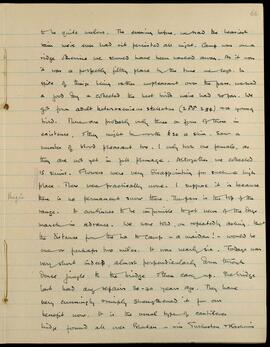
            to be quite useless. The evening before, we had the heaviest rain we've ever had and it persisted all night. Camp was on a ridge otherwise we should have been washed away. As it was it was a perfectly filthy place by the time we left. In spite of things being rather unpleasant over the pass, we had a good day and collected the best birds we've had so far. We got four adult Heteroxenicus stellatus (2 males, 2 females) and a young bird. There are probably only three or four of these in existence, and they might be worth £20 a skin. Saw a number of blood pheasant too. I only took one female, as they are not yet in full plumage. Altogether we collected 15 skins. Flowers were very disappointing for such a high place. There were practically none. I suppose it is because

            Pang La

            there is no permanent snow there. The pass is the top of the range. It continues to be impossible to get news of the day's march in advance. We were told, on repeatedly asking, that the distance from the la to camp — a maidan! — would be one or perhaps two miles. It was nearly six. Today's was very short indeed, almost perpendicularly down through dense jungle to the bridge and then easy up. The bridge last had any repairs 30–40 years ago. They have very cunningly and simply strengthened it for our benefit now. It is the usual type of cantilever bridge found all over Bhutan — in Turkestan and Kashmir.

            LSH/1/1/4/1/42 · Part · 1936-04-28
            Part of The Ludlow & Sherriff Collection

            SUMMARY:
            Notes on rubythroats at camp and the yak man's account of 'Kuling' birds and their habitat, with mention that blood pheasants are present though not seen. Entries for July 20 and 21 record Ludlow in Paka Valley near Kyim Dzong with plant taxa and brief faunal observations, and a note referencing a description of the journey to Kyimdong Dzong.

            CONTENT:
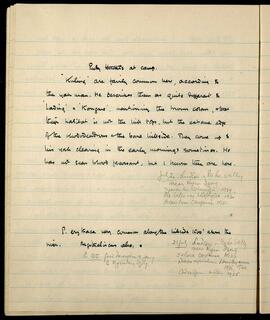
            Rubythroats at camp.

            'Kuling' are fairly common here, according to the yak man. He describes them as quite different to 'Lading' & 'Kongmo', mentioning the brown colour, & that their habitat is not the hill tops, but the extreme edge of the rhododendrons & the bare hillside. They come up to his yak clearing in the early mornings sometimes. He has not seen blood pheasant, but I know they are here.

            July 20 - Ludlow in Paka Valley
            near Kyim Dzong.
            Cyananthus sherriffii 1939.
            Rhod. bella var. holophylla 1930.
            Aconitum tangense 1931

            P. erythraca very common along the hillside 1500' above the river. Aegithaliscus also.

            L. 155. food description of journey to Kyimdong Dzong.

            21 July - Ludlow in Paka Valley
            near Kyim Dzong.
            Salvia castanea 1932
            Dracocephalum hemsleyanum 1936, 1934.
            Codonopsis mollis 1935