Bhutan

Elements area

Taxonomy

Code

Scope note(s)

    Source note(s)

      Display note(s)

        Hierarchical terms

        Bhutan

        Equivalent terms

        Bhutan

          Associated terms

          Bhutan

            419 Archival description results for Bhutan

            419 results directly related Exclude narrower terms
            LSH/1/1/6/1/116 · Part · 1933-07-27
            Part of The Ludlow & Sherriff Collection

            SUMMARY:
            The page describes the route from Tsola Dzong along the Nyang Chu to the Pu Chu, then up the Pu Chu valley past DRUG CHORTEN Gompa and Mirando Gompa, with multiple bridge crossings and a suggested camp site. It notes a pilgrimage circuit toward Mira La, and records B.P. and temperature at Mirando Gompa on 12th August, with a further note at Mira La on 14 Aug. Plant specimens noted include Primula bellidifolia and Dic. leptorrhiz.

            CONTENT:
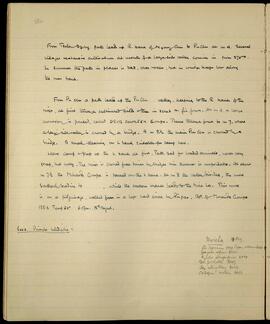
            From Tsola Dzong path leads up R. bank of Nyang Chu to Pu chu at m 4. Several villages & extensive cultivation at mouth of a large side valley coming in from 270°. In summer the path in places is bad, over rocks, but in winter keeps low along the river bank.

            From Pu chu a path leads up the Pu Chu valley, keeping to the R bank of the river, at first through cultivated fields then in scrub & fir forest. At m 4 a large monastery is passed, called DRUG CHORTEN Gompa. Thence through forest to m 7, where a large side valley is crossed by a bridge. At m 8½ the main Pu Chu is crossed by a bridge. A small clearing on L bank, suitable for camp here.

            Leave camp & keep up the L bank at first. Path bad for loaded animals, never very steep, but rocky. The river is crossed four times by bridges & in summer is unfordable. At about m 7½ the Mirando Gompa is passed on the L bank. At m 8 the valley divides, the more southerly leading to [blank], while the western branch leads to the Mira La. This route is on a pilgrimage, walked round in a left hand circle by Pilgrims. B.P. of Mirando Gompa 188.2 Temp 50° 6.0pm. 12th August.

            1. Primula bellidifolia

            Mira La 14 Aug.
            Dic. leptorrhiz

            LSH/1/1/2/1/33 · Part · 1915-05-29
            Part of The Ludlow & Sherriff Collection

            SUMMARY:
            Mentions a flowering specimen at Punakha on 29 May 1915 and doubts about obtaining seed. Provides a detailed route description from Phungui across side valleys and bridges along the Gauri Chu to the Munde La, noting waterfalls, villages, and Takpa inhabitants.

            CONTENT:
            certainly Cooper's 3937, found at Punakha at 5000'
            in flower on 29th May '15. It is a fine flower, but
            I doubt if we could get the seeds. I saw it growing
            on rocky ground about ½ mile above the bridge over
            the main Gauri Chu, on the R. bank - 30 yards off
            the road to the right, and again close to the road a little
            further on. // Leaving Phungui the road drops and
            crosses a side valley which leads up to the Sikkim
            La. Then up, and again down to a side valley, the
            Murbe Chu at m 3. Both are crossed by bridges, and the
            latter is a fair sized river. Again the ascent is steep,
            over a ridge and down to the L bank of the Gauri Chu at m 5.
            This is followed to m 6½ where the Gauri Chu is
            crossed by a bridge to the R bank. Path gradually
            climbs and crosses a side valley at 7½. Thence ascent
            very steep, over a ridge and past a fine waterfall at m 8.
            Then past a village at m 9, it turns slightly left and
            an exceedingly steep ascent begins, after crossing a side
            valley at m 10. The path is stepped for a great part
            of the steep climb to the Munde La (about 9600') at m
            12½. Most of this is through jungle. At the Munde La,
            the country opens out and slopes of wonderful grazing are
            around. There are several villages near here and the
            inhabitants are Takpas, more nearly allied to Tibetans.

            LSH/1/1/6/1/154 · Part · 1938-10-22
            Part of The Ludlow & Sherriff Collection

            SUMMARY:
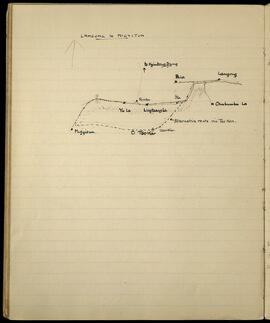
            The page lists an itinerary from Langong to Migyitun via Pala, Öla, Chubumber La, Rimbu, Lingtsang La, and Yu La, with an alternative route via Tso Kar. It also notes a route to Kyimdong Dzong.

            CONTENT:
            LANGONG to MIGYITUN

            to Kyimdong Dzong

            Langong
            Pala
            Öla
            Chubumber La
            Rimbu
            Lingtsang La
            Yu La
            Migyitun
            Tso Kar
            Alternative route via Tso Kar.

            LSH/1/1/6/1/16 · Part · 1938-03-21
            Part of The Ludlow & Sherriff Collection

            SUMMARY:
            The diary describes traveling from Kampa Padze down to the right bank of the Tsangpo, along cultivated land, then ascending 500 ft to the TAB LA pass. After a similar descent and a flat plain, the route returns to the river at mile 10 and reaches the Dzong on a rock at mile 11.

            CONTENT:
            From Kampa Padze the path descends to the R. bank of the Tsangpo, keeps along it for a mile or two, gradually leaving it & continuing over cultivated land. At m 5 it begins to ascend to the TAB LA, a climb of 500 ft over a bad path. Descent similar for one mile, then over flat plain to the river bank again at m 10 & to the Dzong on a rock at m 11.

            LSH/1/1/5/1/42 · Part · 1937-05-06
            Part of The Ludlow & Sherriff Collection

            SUMMARY:
            The page notes a turn up the right bank of the Rindi Chu valley, where the village of Phumzor lies. It also records that Shamgong Dzong is visible below the junction of the Sergang Chu and Mangde Chu on the left bank about half a mile downstream.

            CONTENT:
            L a turns up the R bank of a big side valley coming in from the West. This valley is called the Rindi Chu, the village of Phumzor is in the valley.

            LL Shamgong Dzong can be seen below the junction of the Sergang Chu & Mangde Chu, about 1/2 m down on the Left bank.

            LSH/1/1/5/1/89 · Part · 1937-05-28
            Part of The Ludlow & Sherriff Collection

            SUMMARY:
            The diary describes following the Mara Chu, crossing small side streams and ridges, and reaching a camp at mile 8. It notes the village of Adao, whose inhabitants move to Phobjikha during the rains and occasionally return to tend crops, with some fever present. Observations include abundant R. Maddenii/R. Edgeworthii and a fine forest of Pinus longifolia opposite Adao.

            CONTENT:
            absolutely solidly the rest of the evening - real Bhutan rain at its very
            best. The path follows what is here known as the Mara Chu, the
            whole way down. It is good most of the way, sometimes sunken.
            At m 3 a big side valley from the R is crossed, then the path
            ascends easily to m 4 1/2 the highest point reached. Up till here there
            is some cultivation. Then an easy, though steep in places, descent
            to near the main river again to 6 level to 6 1/2 where another
            sidestream is crossed. Both are small. The main valley is here
            narrow and steep sided, the path ascends to a ridge, crossed at
            m 7. Thence descent begins easily at first to m 8 camp.
            The Mara Chu here must fall very rapidly indeed, and both sides
            of the valley are very steep and precipitous. About 1 m further
            on a valley enters from the Right on the L bank of the
            Mara Chu, above m 11 is ADAO a biggish village with
            lots of cultivation. The inhabitants of Adao all leave their
            village at this time and go to Phobjikha, just returning every now
            and then to look after their crops. There is some fever in Adao during
            the rains. / Here R. Maddenii or R. Edgeworthii are very common
            indeed. Opposite Adao I see forest of Pinus longifolia, and it looks
            a very fine forest indeed, bigger than any I have yet seen,

            LSH/1/1/2/1/135 · Part · 1933-07-18
            Part of The Ludlow & Sherriff Collection

            SUMMARY:
            The writer explains the origin of the Cha La pass name and describes camping in the steep Rong Chu valley, planning to stay to collect flowers and arranging a local to watch bags until a man from Trashiyangsi can retrieve them in October. The mail finally arrived after 20 days via Mago, Dirang Dzong, Poshnig, and the Tse Las; the carriers were fed, paid 20/- each, and sent off.

            CONTENT:
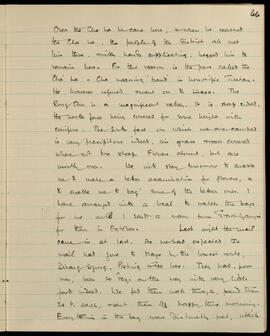
            Over the Cho La he came here, and when he reached the Cha La, the people of the District all met him there, with hands supplicating, begged him to remain here. For this reason is the pass called the 'Cha La'—Cha meaning 'hand' in honorific Tibetan. He however refused, and went on to Lhasa.

            The Rong Chu is a magnificent valley. It is steep-sided, the north face being covered for some height with conifers. The south face, on which we are camped, is very precipitous indeed, and grass and rock covered where not too steep. Flowers abound, but are mostly over. We will stay tomorrow to enable us to make a better examination for flowers, and to enable me to 'bag' some of the better ones. I have arranged with a local to watch the bags for me until I send a man from Trashiyangsi for them in October.

            Last night the mail came in at last. As we had expected, the mail had gone to Mago by the lowest route, Dirang Dzong, Poshnig and Tse Las. They had, poor men, been 20 days on the way with very little food indeed. We fed them well though, paid them 20/- each, and sent them off happy this morning.

            Everything in the bag was distinctly wet, which

            GB 235 RBG/2/REC · Collection · 1913 - 2010
            Part of Royal Botanic Garden Edinburgh Institutional Archives

            Eight boxes of material relating to Roland Edgar Cooper who was Curator (Head Gardener) at the Royal Botanic Garden between 1934 and 1950. Material consists of correspondence, field notes, photographs and maps from his plant collecting expeditions in Sikkim, Bhutan and Punjab between 1913 and 1916, and family / genealogical information.

            Cooper, Roland Edgar
            LSH/1/1/2/1/195 · Part · 1933-09-27
            Part of The Ludlow & Sherriff Collection

            SUMMARY:
            Halted at Lagnabi near Rocha Chu. Notes mail problems with parcels stuck at Kumarikhata and returned from Rangiya; sent Box No. 3 of flowers and some seeds by air mail. Plans to move to Sana, with Danang going to the Me La for seed; avoiding Bumthang at HH’s request and going to Sakden instead.

            CONTENT:
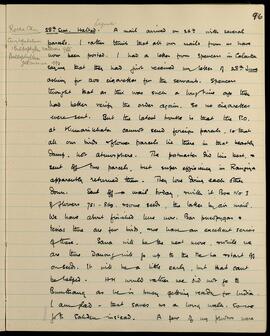
            96

            Rocha Chu 28th Sept. Halted. Lagnabi.
            Cirrhopetalum = Bulbophyllum wallichii 988
            Bulbophyllum yokzunense 998

            A mail arrived on 26th with several parcels. I rather think that all our mails from us have now been posted. I had a letter from Spencers in Calcutta saying that they had just received my letter of 28th June asking for 1200 cigarettes for the servants. Spencers thought that as this was such a long time ago they had better verify the order again. So no cigarettes were sent. But the latest trouble is that the P.O. at Kumarikhata cannot send foreign parcels, so that all our bird & flower parcels lie there in that beastly damp, hot atmosphere. The postmaster did his best, & sent off two parcels, but super efficiency in Rangiya apparently returned them. They love doing each other down.

            Sent off a mail today, with it Box No 3 of flowers 751 - 869, & some seeds, the latter by air mail. We have about finished here now. Bar Pnoepygas & Tesias there are few birds, we have an excellent series of these. Sana will be the next move, & while we are there Danang will go up to the Me La & start off on seed. It will be a little early, but that can't be helped. HH would rather we did not go to Bumthang as he is busy getting ready for India. I am glad - that saves us a long walk. So we go to Sakden instead. A few of my photos were

            LSH/1/1/9/1/27 · Part · 1949-05-06
            Part of The Ludlow & Sherriff Collection

            SUMMARY:
            The diarist spent the morning near the Rip La, viewed the Khoma Chu, and planned to reach Dengchu in three days for a week. They recorded Primula Normaniana as a new Bhutan record and observed Rhod. Lindleyi and Poryocarpum himalaicum in flower, photographed them, and from above the Ripla saw mountains near Sinchi Dzong and toward Tomtom; locals reported no road to Bumthang from Tomtom.

            CONTENT:
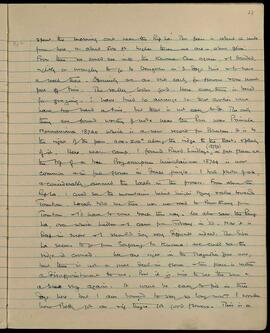
            Spent the morning out near the Rip La. The pass is about a mile
            from here, and about 500 feet higher than we are - about 9600'.
            From there we could see into the Khoma Chu again, and decided,
            rightly or wrongly, to go to Dengchu in three days' time and to have
            a week there. Obviously we are still early for flowers and one must
            put off time. The valley looks good. Here everything is bared
            for grazing. I have tried to arrange so that coolies won't
            have too hard a time, but that is not easy to do. The only
            thing we found worthy of note near the pass was Primula
            Normaniana 18740 which is a new record for Bhutan. It is to
            the right of the pass, 400-500x along the ridge to the East, and plenty
            of it. Here, near camp, I found Rhod. Lindleyi (18739) in full flower at
            the top of a tree. Poryocarpum himalaicum 18744 is now
            common and in full flower in dense jungle. I took photos of all,
            and considerably amused the locals in the process. From above the
            Ripla, I could see the mountains behind Sinchi Dzong and also towards
            Tomtom. Locals told me there was no road to Bumthang from
            Tomtom, and I'd have to come back this way. We also saw the Pang