Bhutan

Elements area

Taxonomy

Code

Scope note(s)

    Source note(s)

      Display note(s)

        Hierarchical terms

        Bhutan

        Equivalent terms

        Bhutan

          Associated terms

          Bhutan

            419 Archival description results for Bhutan

            419 results directly related Exclude narrower terms
            LSH/1/1/9/1/98 · Part · 1933-07-10 - 1933-07-11
            Part of The Ludlow & Sherriff Collection

            SUMMARY:
            Notes snow leopard tracks and sparse flowers, including masses of P. concinna and an Allardia found by Pasang, after a strenuous day. On 10 July the party stayed in camp, sent mail to several correspondents, discussed travel plans with H.H., and chose to take the pass opposite Drolmo Sishi La on the 16th; on 11 July bad weather arrived in the afternoon, Yundun could not go out, and the diarist and Pasang went up a nearby valley.

            CONTENT:
            93
            Saxifraga contraria op no. 19390

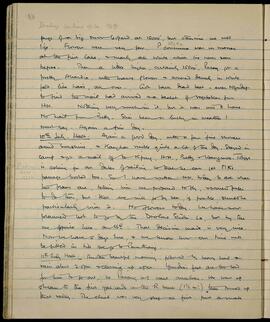
            pugs of a big snow leopard at 15000', but otherwise no wild life. Flowers were very few. P. concinna 19392 was in masses at the first lake, and nearly all white which I've never seen before. Then a little higher, certainly 15500', Pasang found a pretty Allardia, with mauve flowers and covered densely in white felt like hairs, all over. Got back dead beat - even Ngudup - to find the mail had arrived and a basket of vegetables for H.H. Nothing very much in it, but it was nice to have. No mail from Betty. She's been very lucky in weather I must say. Again a fine day.

            10th July. Haah. Again a good day, with a few fine showers amid sunshine, and Kanghar visible quite a lot of the day. Stayed in camp and got a mail off to Kyong, H.H., Betty and Wangmoo. Tobsgye is asking for our dates of sailing, so that he can get M.K.'s passage booked too. So I have written H.H. today to ask what his plans are, telling him we proposed to fly, and would prefer to do this, but that we will go by sea if possible should he particularly wish it. No flowers today. We have now planned not to go by the Drolmo Sishi La, but by the one opposite here, on 16th. That decision made, is very nice. Now we have 5 days here, and we know how our time will be fitted in till we go to Bumthang.

            11th July. Haah. Another beautiful morning, followed by heavy hail and rain about 2.0pm and clearing up after. Yundun's feet are too bad for him to go out, so Pasang and I went ourselves. We went up stream to the first yak herds on the R bank (1 1/2 m?) then turned up that valley. The climb was very steep at first, past a small
            LSH/1/1/1/1/211 · Part · 1933-10-02
            Part of The Ludlow & Sherriff Collection

            SUMMARY:
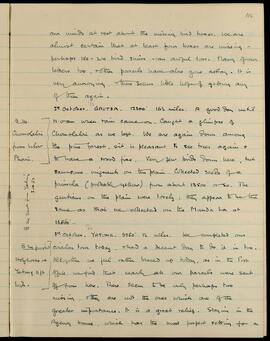
            Notes concern over missing bird boxes and parcels. Describes travel to Gautsa with rain, a view of Chomolhari, pine forest, few birds, and collecting primula seeds and observing gentians. Reaches Yatung, completes a circular tour, and learns at the Post Office that most parcels were sent, with only a few missing.

            CONTENT:
            104

            our minds at rest about the missing bird boxes. We are
            almost certain that at least four boxes are missing -
            perhaps 150 - 200 bird skins - an awful loss. Many of our
            letters too, and other parcels have also gone astray. It is
            very annoying, and there seems little hope of getting any
            of them again.

            2nd October. TO GAUTSA. 12300' 16½ miles. A good day until
            11.0 am when rain came on. Caught a glimpse of
            Chomolhari as we left. We are again down among
            the pine forest, and it is pleasant to see trees again and
            to have a wood fire. Very few birds down here, but
            saw some migrants on the plain. Collected seeds of a
            primula (probably yellow) from about 13500' or so. The
            gentians on the plain were lovely; they appear to be the
            same as that we collected on the Munda La at
            16500'.

            3rd October. TO YATUNG. 9950' 12 miles. We completed our
            circular tour today, and had a decent day to do it in too.
            Altogether we feel rather braced up today, as in the Post
            Office, we find that nearly all our parcels were sent
            off from here. There seem to be only perhaps two
            missing, and they are not the ones which are of the
            greater importance. It is a great relief.

            LSH/1/1/1/1/53 · Part · 1933-06-07
            Part of The Ludlow & Sherriff Collection

            SUMMARY:
            Notes include orchid records and a visit from Tobgye, who brought provisions and discussed concerns about a lama from Kham influencing the Maharaja. The party describes dense woods cleared for grazing by Bhutanese herders and hopes the lama will not be in Bumthang to avoid restrictions on shooting. They have been invited to Ha for lunch and tea on the 8th and plan to go.

            CONTENT:
            24

            Bletia palustris 60.
            Cephalanthera longifolia 58
            Pleione hookeriana 59.
            Tobgye brought presents of beer, cake, mangoes, vegetables.

            5th June. Fine till 10.0, then rain till 2.0 & fine in the evening. Tobgye arrived at midday, we gave him our very best tiffin. He went on again about 3.0pm. He is rather worried about the lama who is getting at the Maharaja. He comes from Kham & is a nephew of an old lama who used to be a great friend of Ugyen Wangchuck. This man is a hunchback; he gives out that he is collecting money for a monastery in Kham, & according to Tobgye he is doing pretty well: but he is also doing pretty well for himself, & is collecting a good deal of money & presents in kind. Tobgye dislikes him & mistrusts him, thinking him able to hypnotise. We all hope he will not be in Bumthang when we get there, or our shooting may be curtailed.

            Ha - 8 miles down valley.
            Ludlow
            The woods are very dense, in some cases impenetrable but here & there the Bhutanese have cleared open spaces, with fire & axe to provide grazing grounds for their numerous herds of zhos (said to be a cross between the yak & the common horned cow) yaks & cows. No sheep.

            We are asked to Ha to lunch & tea on 8th & have decided to go

            LSH/1/1/5/1/185 · Part · 1933-08-13 - 1933-08-14
            Part of The Ludlow & Sherriff Collection

            SUMMARY:
            The diarist notes receiving Wright-Smith's list of last year's primulas and describes relentless rain flooding the Thimbu Chu while marching 11 miles to Pyimitanka and then 10 miles to Paro. Local officials from Paro sent extra servants and a mule, which proves inconvenient, and a specimen of Ceratostigma is collected.

            CONTENT:
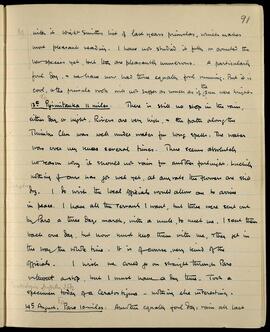
            91

            with it Wright-Smith's list of last year's primulas, which makes more pleasant reading. I have not studied it fully or counted the new species yet, but they are pleasantly numerous. A particularly foul day, and we have now had three equally foul running. But it is cool, and the primula roots will not suffer as much as if the sun were bright.

            13th To Pyimitanka 11 miles. There is still no stop in the rain, either day or night. Rivers are very high, and the path along the Thimbu Chu was well under water for long spells. The water was over my knees several times. There seems absolutely no reason why it should not rain for another fortnight. Luckily nothing of ours has got wet yet, at any rate the flowers are still dry. I do wish the local officials would allow one to arrive in peace. I have all the servants I want, but three were sent out by Paro a three days' march, with a mule, to meet me. I sent them back one day, but now must keep them with me, they get in the way the whole time. It is of course, very kind of the officials. I wish we could go on straight through Paro without a stop, but I must have a day there. Took a specimen today of a Ceratostigma - nothing else interesting.

            14th August. To Paro 10 miles. Another equally foul day: rain all last

            LSH/1/1/1/1/55 · Part · 1933-06-07 - 1933-06-08
            Part of The Ludlow & Sherriff Collection

            SUMMARY:
            Notes plans to go to Nagartse via Yamdrok Tso and hopes for work east of Bumthang, with Tibet possibly late for butterflies and flowers. Records weather, colour photography of flowers, scenes in the Ha valley, and a visit to Ha from Damthang including riding Tobgye’s ponies, playing football, and tea with the Zimpon.

            CONTENT:
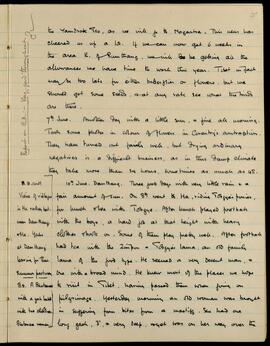
            Report on B.B.:- Very good throughout.

            the Yamdrok Tso, as we will go to Nagartse. This news has cheered us up a lot. If we can now get 6 weeks in the area E. of Bumthang, we will be getting all the collections we have time to work this year. Tibet in fact may be too late for either butterflies or flowers, but we should get some seeds, & at any rate see what the birds are there.

            7th June. Another day with a little sun, & fine all morning. Took some photos in colour of flowers in Coventry's contraption. They have turned out fairly well, but drying ordinary negatives is a difficult business, as in this damp climate they take more than 24 hours, sometimes as much as 48.

            B.B. contd.
            Views of villages in Ha valley bet. Damthang & Ha. Yaks at Damthang leaving for their summer pastures. B.G. A Bhutanese with a yak load with two children. Bhutanese women.

            10th June. Damthang. Three good days with very little rain & a fair amount of sun. On 8th went to Ha, riding Tobgye's ponies, for lunch & tea with Tobgye. After lunch played football with the boys, a hard job at that height with heavy clothes & boots on. Some of them play pretty well. After football had tea with the Zimpon - Tobgye's lama, an old family lama of the good type. He seemed a very decent

            LSH/1/1/10/1/10 · Part · 1949-09-14
            Part of The Ludlow & Sherriff Collection

            SUMMARY:
            The diarist halts in the Diruphuang valley amid heavy rain, notes a sense of the monsoon ending, and reaches a nearby pass without difficulty. Skimmia seed brought by Pasang is abundant and promising. Letters and plans are mentioned, including Tobgye writing from Kalimpong, Betty in Calcutta, and Hicks intending to be in Bumthang earlier than expected.

            CONTENT:
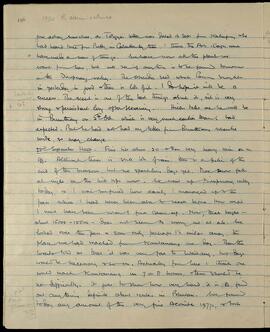
            146 19768 P. alboviana x brunosa

            gone astray somewhere, as Tobgye's letter was dated 4 Sept from Kalimpong, she had heard twice from Betty in Calcutta by then. I think the Arts & Crafts must have made a mess of things. We have now all the plants we want from here, but will see if another is to be found tomorrow in the Diruphuang valley. The Skimmia seed which Pasang brought in yesterday is good and there is lots of it. I do hope it will be a success. The scent is one of the best things about it, and it is very strong and persistent long after flowering. Hicks tells me he will be in Bumthang on 5th Oct. which is very much earlier than I had expected. But he had not had my letter from Bumthang when he wrote, so may change.

            23rd September Halt. Fine till about 2.0 and then very heavy rain on and off. Although there is still lots of rain, there is a feeling of the end of the monsoon, but no sparkling days yet. More snow falls at night on the hill tops now. We went up Diruphuang valley today, and I was surprised how easily I managed up to the pass which I had never been able to reach before. How unfit I must have been when I first came up. Now, that height - about 15000 - 15500 - does not seem to worry me at all. We looked over the pass and saw

            LSH/1/1/9/1/107 · Part · 1949-07-12
            Part of The Ludlow & Sherriff Collection

            SUMMARY:
            The writer reports finding a new lily and abundant Notholirion macrophyllum, and receives mail from Kalimpong with news that Branklyn is for sale and may be acquired. A letter from Taylor confirms P. umbratilis roots arrived safely and began to show growth after soaking. On 23rd July they marched to Dhur, noting an uninteresting, damp route where two rivers join.

            CONTENT:
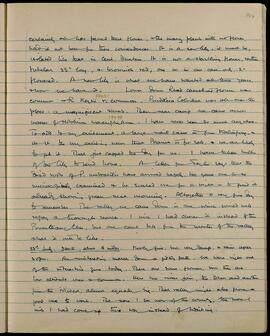
            certainly all has passed their flower, the many plants with no flower, had it not been for these coincidences. It is a new lily: it must be, isolated like that in Cent. Bhutan. It is not a startling flower, rather tubular 2 1/2" long, a brownish red, one or in one case only, 2-flowered. A new lily is what we have wanted all these years, now we have it. Lower down Rhododendron camelliiflorum was common. R. keysii v. common. Buddleja colvilei was all over the place - a magnificent shrub. Then near camp we came across masses of Notholirion macrophyllum. I have never seen so much anywhere. To add to my excitement, a large mail came in from Kalimpong, & in it, the very exciting news that Branklyn is for sale, & we are likely to get it. That just capped the day for us. I have taken bulbs of the lily to send home. A letter from Taylor says that the dried roots of P. umbratilis have arrived safely. He gave one to be microscopically examined & he soaked one for a night - to find it already showing green next morning. Altogether a very fine day to remember. The valley we came down is one which would well repay a thorough search. I wish I had chosen it instead of the Bumthang Chu, but one can't tell from the mouth of the valley what it will be like.

            23rd July. DHUR, about 4 miles. Mostly fine, but very damp, & rain after 2.0pm. An uninteresting march down a filthy path. We were right out of the interesting zone today. There are some flowers, but they are low altitude ones & common. Here two rivers join, the Dhur and another from the N-West, almost equal size. That valley might also prove a good one to work. The more I see now of the country, the more I wish I had come up this way instead of waiting.

            LSH/1/1/7/1/10 · Part · 1940-05-24
            Part of The Ludlow & Sherriff Collection

            SUMMARY:
            Notes indicate the western extremity for Mec. florindae and where P. caliantha begins, with P. elizabethae meeting it at this point and not occurring eastward. The writer first found these further west in Bari Tana or Umkumbala.

            CONTENT:
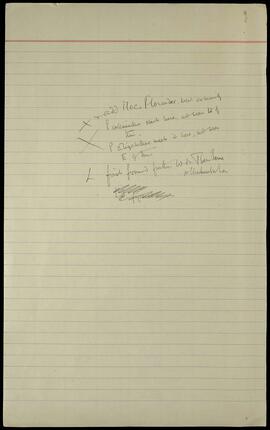
            add Mec. florindae, west extremity
            P. caliantha starts here, not seen W of
            this.
            P. elizabethae meets it here, not seen
            E of this
            I first found further W in Bari Tana
            or Umkumbala

            LSH/1/1/7/1/1 · Part · 1940-05-24
            Part of The Ludlow & Sherriff Collection

            SUMMARY:
            The expedition splits, with Ludlow and Taylor heading to passes east of Tsela Dzong while Sherriff works the Lanyong area and passes between Roro and Bela Dzong, departing Roro on 24 May. The page describes the Lanyong Chu valley, its isolated inhabitants and seasonal conditions, and notes early-season floral observations on high slopes, including Rhododendron repens and Primula species.

            CONTENT:
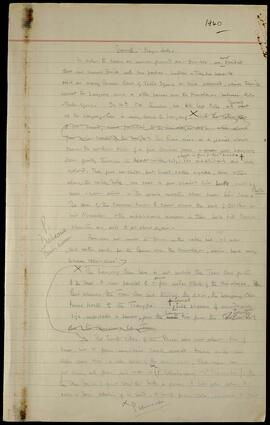
            1940.

            Sherriff - May - July -

            In order to cover as much ground as possible, we now decided that we should divide into two parties. Ludlow and Taylor were to visit as many passes East of Tsela Dzong as time allowed, while Sherriff worked the Lanyong area and other passes over the Himalayas between Roro and Bela Dzong. On 24th May therefore we all left Roro, and Sherriff went up the Lanyong Chu in easy stages to Lanyong.

            The Lanyong Chu here is not unlike the Tsari Chu further to the West. It runs parallel to and about four miles North of the Himalayas. But whereas the Tsari Chu cuts through the axis, the Lanyong Chu turns North to the Tsangpo. Several side streams of considerable size, unfordable in summer, join the Lanyong from the South.

            The valley, which is from 300-600 yards wide, flows gently through the valley bed. The inhabitants are very isolated. They grow no crops, but breed cattle and yaks. Here and there along the valley bed, one sees a few chalet-like huts, used by men and yaks alone in the winter months when snow lies deep. The rain of the summer turns to snow about the end of October or mid-November, and the inhabitants remain in their huts till March when they are able to get about again.

            There was not much in flower in the valley bed, as it was still rather early for the passes over the Himalayas, which here vary between 13,500 - 15,000'.

            The South sides of the passes were now almost free of snow, but North faces were still deeply covered. However on the open slopes about 14,000' a little North of the main axis, Rhododendron repens was just coming into flower, and with it (P. valentinianum and P. franchetii). On the same day as I first saw the latter in flower, I was also able to make a large collection of its seed. A north facing slope on which it grew P. vernicosa.

            LSH/1/1/5/1/174 · Part · 1933-07-21
            Part of The Ludlow & Sherriff Collection

            SUMMARY:
            The diarist reviews profit estimates for Bhutan based on Bakewell’s calculations and rejects small extraction offers, then receives numerous presents from H.H. before departing Domkhar, with Naku accompanying toward the Yuto La. The party marches in hot weather to Trongsa and then Tsanka, meets the Zimpon of Trongsa, and notes local magpies called OLA BOGA.

            CONTENT:
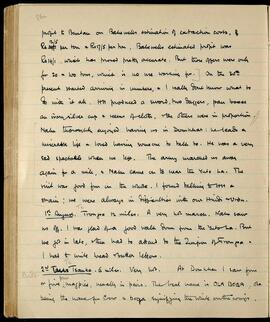
            profit to Buntan on Bakewell's estimation of extraction costs, and Rs 12/5 per ton and Rs 17/5 per ton. Bakewell's estimated profit was Rs 14/1, which has proved pretty accurate. But these offers were only for 20 or 100 tons, which is no use working for. On the 30th presents started arriving in numbers, and I really don't know what to do with it all. H.H. produced a sword, two daggers, pan boxes, an ivory silver cup and reams of cloth, the others were in proportion. Naku thoroughly enjoyed having us in Domkhar: he leads a miserable life and loved having someone to talk to. He was a very sad spectacle when we left. The army marched us away again for a mile, and Naku came on to near the Yuto La. The visit was good fun on the whole. I found talking to him a strain; we were always in difficulties with our Hindi and Urdu.

            1st August. To Trongsa 12 miles. A very hot march. Naku saw us off. I was glad of a good walk down from the Yuto La. But we got in late, then had to attend to the Zimpon of Trongsa. I had to write bread and butter letters.

            2nd To Tsanka. 6 miles. Very hot. At Domkhar I saw four or five pairs of magpies, usually in pairs. The local name is OLA BOGA, ola being the name for crow and boga signifying the white on the wings.