
Art

Elements area

Taxonomy

Code

Scope note(s)

    Source note(s)

      Display note(s)

        Hierarchical terms

        Equivalent terms

        Art

          Associated terms

          Art

            19 Archival description results for Art

            GB 235 FRG/1/1/3 · File · 1904-1905
            Part of George Forrest Collection

            Typed transcript of Forrest’s letters and notes.

            • Pages 1-28 describe Forrest's journey from Bhamo to Teng Yueh and corresponds closely with a handwritten letter to his fiancée Clementina Traill [GB 235 FRG/1/1/2].

            Pages 29-94 contain ‘extractions’ from letters written to Mrs Forrest [either his mother, or Clementina, as she would likely have been Mrs Forrest at the time the letters were transcribed], Edinburgh, from Yunnan and Tibet [1904]-1905. These deal more with descriptions of the country and people rather than botanical matters. The copy letters, which have been typed out of order, are detailed as follows:

            • Pages 29-42. G. Forrest to Mrs Forrest from China Inland Mission, Talifu, 24 March 1905. Describes the valley from Hsia Kuan to Shang Kuan, and gives detailed description of Tali [Dali], its chiefs, main buildings and commerce.

            • Pages 43-53. G. Forrest to Mrs Forrest from China Inland Mission, Talifu, 28 March 1905. Gives further detailed information about Tali. Description of marble quarrying, trades, city buildings, female foot binding, clothing, food, education and customs.

            • Pages 54-63. G. Forrest to Mrs Forrest, November 1904. Describes journey from Tali to Chong Ku on the Chung Tien plateau. ‘I left Tali on the 14th with the intention of going to Lichiang, and from there up to the top of the great Yangtse bend to work the base of the glacier there.’ Includes manuscript sketch of a kitchen or family room of a Tibetan house in which he spent two nights. Detailed description of the house and its use by the Tibetans in winter.

            • Pages 64-67. G. Forrest to Mrs Forrest, November/December 1904. Describes journey from Chung Tien back to Tali, with itinerary.

            • Pages 68-87. G. Forrest to Mrs Forrest, October 1904. Describes a 53-day journey from Tali north into Tibet, covering around 900 miles. Itinerary: Tali, Sha Kai, Shang Ying-pu, Tai Ho Tsun, Sung Kwei, Hoching, Chi Ho, Lichiang, Pei Sha, La Shi Pa, Mu Pi Wan, Na Le, Hsia So Yi, Ke Lo Wan, Mao Niu Chang, Hsia Chung Tien, Yong Ku, Chung Tien, Tang Tien, Chiao Tou, Pung Tzu-la, Kari Pass, Shi zo, Hsia zo, Shih Pa, Yeh Chih, Ba Ti, Tse Kou, Ba Ti, and again Yeh Chih, Ta Chiao, Hsiao Wei Hsi, Ka Ka, Wei Hsia, Lu Tien, Chu Tien, Tzu Ko, Shih Ku, Chia Ho, Chien Chuan-sho, Jiu Kai, Teng Chuan-sho and back to Tali.

            • Pages 88-94. g. Forrest to Mrs Forrest, from Mission Apostolique, Tsekou, Tibet, 28 April 1905. Describes journey from Talifu going north by Chien Chuan and ending at Tsekou. Gives news of a revolt among the lamas in the north, ‘Tsekou is practically in a state of siege.’

            Plants referenced:
            Bamboo (pp.1,5); Mango (p.1); Orchid (p.6); Rice (pp. 3,16, 20); Teak (p.1)
            Cotton (p.41)
            Apricot (p.52); Bean (p.52); Cabbage (p.52); Carrot (p.52); Fig (p.52); Filbert (p.52); Gladitschia (p.53); Grape (p.53); Lemon (p.52); Mandarin orange (p.52); Pea (p.52); Peach (p.52); Pear (p.52); Persimmon (p.52); Pomegranate (p.52); Potato (p.52); Rice (p.52); Sapindus (p.53); Turnip (p.52); Walnut (pp.44, 52)
            Allium (p.56); Azalea (pp.55, 56, 60); Gentian (pp.55, 56, 60); Lychnis (p.56); Lily (p.58); Paeonia (p.56); Pine (pp.54, 55, 56); Primula (p.60); Rhododendron (pp.55, 56, 60); Saxifrage (pp.56, 57, 60); Senecio (p.57)
            Pine (p.66)
            Azalea (pp. 77, 82, 85); Carduus (p.77); Clematis (p.80); Fritillaria (p.76); Gentian (pp.76, 77, 85, 87); Lily (p.85); Pine (pp.76, 77); Polygonum (p.77); Primula (pp.76, 82, 85, 86); Rhododendron (pp.77,82, 85); Rice (p.70); Saxifrage (pp.76, 77)
            Pine (pp.90, 91)
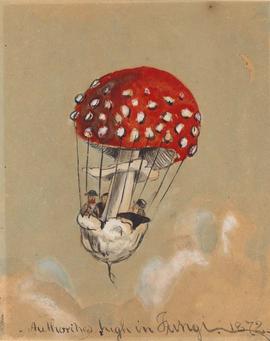
            Forrest, George
            Sadler caricature
            GB 235 RBG/2/SAD/3 · Item · 1872
            Part of Royal Botanic Garden Edinburgh Institutional Archives

            Watercolour and ink drawing of 3 mycologists flying high in a mushroon / toadstool shaped hot air balloon entitled "Authorities high in Fungi, 1872" in John Sadler's handwriting - image could very well have been painted by John Sadler. The figure in glasses is likely Miles Berkeley; the figure with red beard could be John Sadler, but more likely to be Mordecai Cooke, the third figure is too indistinct to identify.

            Sadler, John
            Pelargonium sp.
            GB 235 GBY/7/8/4 · Item · n.d.
            Part of Professor Mary Gibby Collection

            1 ink drawing by Margaret Tebbs.

            [Text on Back]
            Pelargonium sp.
            1 habitat x1
            2 tubers x 2
            3 exploded flower x3
            4 stamens x6
            5 ovary x10

            Tebbs, Margaret
            GB 235 HJH · Collection · 1949 - 1972

            •1 box of miscellaneous papers and glass plate negatives regarding Bhutan, 1949, also 3 reels of film, now converted to DVD:

            • Diary Materials 1, 1949
            • Diary Materials 2, 1949
            • Transcript of Diaries by David Shepherd - not for reproduction
            • letters, mainly from George and Betty Sherriff, Frank Ludlow and David Humphreys
            • Christmas cards, mainly from George and Betty Sherriff and Frank Ludlow, usually illustrated with photographs or Margaret Stones illustrations
            • small box of 12 glass lantern transparencies, mostly plant portraits - tape around slides very brittle; annotations in danger of being lost, so handle with extreme care
            • cine film x 3 - converted to dvd
            • 'misc' folder; contains LSH seed lists 1949 documents and key to the cine film
            • newspaper cuttings - mostly relating to Bhutan
            • 'misc' publications - mostly relating to Bhutan, some by Frank Ludlow
            Hicks, John Herbert
            GB 235 FRG/1/1/1/1905/20 · Item · 13/07/1905
            Part of George Forrest Collection

            Letter from George Forrest, Tsekou, to Isaac Bayley Balfour, M.D., 'Regius Keeper', Royal Botanic Garden, Edinburgh, dated 13 July 1905.
            Forrest writes to say he is pleased to learn that he has discovered one or two new species. Forrest describes where he collected new species of parnassia. He has just returned from a week in the valleys of the Mekong-Salween divide, with favourable results, although the higher peaks and passes were inaccessible owing to heavy snow. There were a surprising number of species in flower, some forcing their way through the snow. Forrest describes plants and habitats of meconopsis integrifolia, corydalis, rhododendrons, primulas and lilium: ‘If I am not the first to send home seed of this species [meconopsis integrifolia], I hope to be the first to send home photos of it taken in situ…’
            Regarding the trouble with the lamas, Forrest states: ‘… we have had bad news this week again. The report is that the Chinese have been defeated once more but I cannot vouch for the truth of this.’ ... ‘I am now well on in my sixth hundred of species over six hundred sheets. Got a big rise last week. Three more species of orchidaceae.’
            Forrest describes and sketches a peculiar kind of fern [p.12] and sketches a new primula with pendulous flowers [p.8].
            Plants referenced: Aspideum; Fern; Fritillaria; Corydalis; Lilium; Meconopsis; Nephrodium; Orchidaceae; Parnassia; Pine; Primula; Prunus; Rhododendron; Saxifrage
            Letter has been fire damaged with some loss, including text. The letter has also been damaged, presumably by a plant specimen inserted in the envelope.

            Forrest, George
            GB 235 FRG/1/1/1/1904/11 · Item · 08/11/1904
            Part of George Forrest Collection

            Letter from George Forrest, Talifu [Dali], to Isaac Bayley Balfour, RBGE, dated 08 November 1904, in which Forrest confirms the despatch of 380 plant specimens collected on his recent journey to Tzekou [Cigu]. Next trip will be to the north of the Lichiang [Lijiang] valley, working the range of mountains which cause the Yangtze bend and along the base of an immense glacier on the eastern slope of the Lichiang peak. If this proves unproductive he will go on again to the Chung Tien plateau which he and Litton were the first Europeans to visit. Believes the range forming the Mekong and Salween divide to be exceptionally rich in rhododendrons, azaleas, gentians, primulas and a five foot tall lilium with immense white bloom marked in red and highly perfumed. Specimens have been collected by the missionary fathers at Tzekou who will send bulbs to Balfour and Bulley via consul Litton. Describes journey north into Tibet with Litton, leaving Talifu [Dali] on 29 August, returning 53 days later, having covered around 1000 miles. On being mobbed at the horse fair at Sung Kwei they had to draw their revolvers in defence but had some horses and mules stolen. Gives details of their route to and from Tibet, describing plants and vegetation and a river crossing by sling bridge, illustrated by a sketch. Has felt depressed since returning to Tali, probably a reaction to so much travel and constant exposure to wet conditions and extremes of heat and cold. Regrets that all his photographs were spoiled by dampness and intends to ask Bulley for a supply of photographic plates. Confirms that there is a pine belt in Yunnan and part of Tibet, generally starting at about 9,500 feet and continuing to about 15,000 feet.

            GB 235 FRG/1/1/2/1 · Item · 1904
            Part of George Forrest Collection

            Letter in form of diary from George Forrest to Clementina Traill describing his journey from Bhamo to Teng Yueh [Tengchong], 13 July to 12 August 1904. Itinerary included Momauk, Namtubbi river, Kalichet, Khulongkha, Mamkha Kha, Namkhokha, Khulikha, Nam Sa Ho, Man Hsien, Lung Chang Kai, Chin Cheng, Lang Kwu Kwsi, Teng Yueh. 13-14 July – Difficulties with muleteers unwilling to set out in rain; encounter with whip snakes; cane huts at Momauk; insanitary conditions; rampant cholera; fireflies. 15 July – Description of scenery; sketch of mule panniers and box saddle. 16 July – Magnificent scenery but very dangerous steep road. Two ground orchids gathered at elevation of c.4,500 feet but unable to dry and press them owing to damp. 17 July – Long day in blazing sun and moist heat; jungle swarming with monkeys. 18 July – Heavy rain, river too full to cross; return to camp. 19 July – Soaking rain; wishes he had taken advice to postpone journey for a month. 20 July – Arrival at Chinese border; description of dress and weapons of frontier guards. Unable to cross river at Nam Sa Ho; building of bridge by 50 coolies; visit from local headmen and description of their dress. 25 July – Bad roads on way to Man Hsien; passed through village bazaar where ‘the filth and stench are completely beyond my powers of description’. 26 July – Description of rice terraces, villages, their houses and layout; slept overnight in temple. 27 July – Awakened around 4am by priest beating a tom-tom and ringing a bell; burning of joss sticks; people arriving to say prayers while Forrest was dressing and having breakfast. 30 July – His first meal of real Chinese food, heavily soaked in pork fat; kept awake by a theatrical performance ‘a sort of marionette show, with the shadows of the figures being cast on a screen … In fact a sort of glorified Punch and Judy business.’ 1 August – Men refuse to budge, owing to rain. Regrets missing Mr Litton, the Honorary Consul, who passed through very early en route to Man Hsien. 3 August – Arrival in Teng Yueh. 4-12 August –Resting in Teng Yueh. Hospitable reception by Mr Litton, Hon Cecil Napier, Chief Commissioner of Customs and his two assistants; description of the town and its market; although safe, it is always necessary to go armed and with an escort of Chinese soldiers ‘…the people in some quarters are very insulting still, although they are afraid to do much.’ Invited by Litton to go north with him to the borders of Tibet where the mountains range from 14,000 to 20,000 feet. No-one has worked so far north before and Forrest should get among the alpine plants.

            Forrest, George
            GB 235 FRG/1/1/2/5 · Item · 24/03/1905
            Part of George Forrest Collection

            Description of valley from Hsia Kuan [Xiaguan] to Shang Kuan [Shangguan] and city of Tali [Dali]. Hsia Kuan is a customs station and the most important business centre in Western Yunnan, with population of over 12,000, all of whom are engaged in trade; important centre of opium production, with some trade in Szechuanese, Cantonese and foreign goods; Litton advocates establishment of a Chinese agency at Hsia Kuan by some foreign firm. Tali plain narrow and fertile, densely populated mainly by Minchia people, very mixed with Chinese; description of their dress and customs, temple of the Goddess of Mercy and legend of the monster Yao Kwei. Principal officials and administration of city of Tali, its main buildings, walls towers and streets, insanitary conditions and prevalence of disease; population c.5,000; much of city in ruins following ‘the rebellion’ [Mohammedan [Muslim] rebellion]; rough sketch of earthen city wall with brick facing. Details of goods for sale include gold, some from Tibet but mainly obtained from the Yangtse.

            Forrest, George
            GB 235 SJS · Item · 1849

            Sanderson's Prize essay manuscript, ‘The Origin and Development of the Embryo in Phanerogamous Plants’, submitted in July 1849 as part of his Botany course for his Medical degree at the University of Edinburgh. Sanderson has illustrated the manuscript with pencil illustrations drawn from the microscope.
            Impressed by the content, Hutton Balfour deemed it worthy of a prize, with part of the content read at a meeting of the Botanical Society of Edinburgh in February 1850.

            Sanderson, Sir John Scott Burdon
            GB 235 FRG/1/1/2/6 · Item · 28/03/1905
            Part of George Forrest Collection

            Incomplete letter from George Forrest, China Inland Mission, Talifu, to Clementina Traill dated 28 March 1905.
            The letter is incomplete, comprising pages numbered 1-12, 13 and 15. Forrest continues his description of Tali [Dali] where marble is the main product; details of production process; wood for furniture mainly walnut and other trades include silversmiths, coppersmiths and horn workers. Description of house construction, method of brickmaking, ornamentation and arrangement of buildings; female clothing, make-up and footbinding, men’s dress and hairstyles. Education consists almost entirely of learning Confucian classics; parental power of life and death over children; prevalence of opium smoking and suicide; wide variety of food available. Includes rough sketch of a two-storey house and of a pouch for holding cash.
            Plants referred to: on pp.12-13: Apricot; Bean; Cabbage; Carrot; Filbert; Fig; Gleditschia; Grape; Lemon; Mandarin orange; Pea; Peach; Pear; Persimmon; Pomegranate; Potato; Rice; Sapindus; Sultana; Turnip; Walnut

            Forrest, George