
Identity area
Reference code
Title
Date(s)
- 1970 - 2024 (Creation)
Level of description
Extent and medium
correspondence, 35mm slides, glass microscope slides, photographs, photograph negatives, notebooks, loose paper, reprints, pressed & dried plant material
Context area
Name of creator
Biographical history
Mary Gibby was a remarkable person and a leading botanist of her generation. During her long and distinguished career, she focused on ferns, the genus Pelargonium, plant conservation, and supporting the next generation of botanical researchers. Equally at home in the laboratory with her microscope or in the hills of Scotland or mountains of Yunnan, Mary was also a sound strategic thinker and a talented manager of scientists. She was a former president of the British Pteridological Society and, until her death, editor of its international research journal, the Fern Gazette. For her many achievements Mary was elected Fellow of the Royal Society of Edinburgh in 2004 and was appointed an Officer of the Most Excellent Order of the British Empire (OBE) in 2010. Born on 27 February 1949, Mary died on 17 July 2024 during fieldwork in the Italian Alps with her husband, Professor Janis Antonovics, FRS.
Mary read botany at the University of Leeds under Professors Irene Manton and John Lovis, securing first-class honours in 1971. Under the supervision of Stanley Walker at the University of Liverpool, she studied for a Ph.D. on biosystematics and cytogenetics in the fern genus Dryopteris.
Mary made full use of the wide network of pteridologists of the Leeds and Liverpool schools, and of botanical garden collections and herbaria, and was able to hybridise diploid and tetraploid species to observe chromosome behaviour at meiosis. Knowing the origin of her artificially created hybrids, Mary understood that failure of chromosome pairing in triploids indicated that the diploid and tetraploid taxa were unrelated. Pairing in the triploid hybrid would confirm one of the ancestors of the tetraploid. The cytogenetic techniques involved had been developed and perfected by Irene Manton and her school in the 1940s, 50s and 60s, and represented state-of-the-art experimental taxonomy and biosystematics of the time. Given the difficulty of obtaining nuclear gene sequence data in these highly polyploid species, Mary’s results remain important today in the classification and identification of Dryopteris species.
As an undergraduate Mary spent a summer internship at the Natural History Museum, London (NHM), and in 1975, during the completion of her Ph.D., joined the staff of its botany department. At that time the NHM was still predominantly populated by male scientists (often without Ph.D.s) and focused on descriptive taxonomy and morphology.
Once at the NHM, and following her Leeds and Liverpool training, she chose to do much of her research at the Chelsea Physic Garden where, as a cytologist, she could be among a living collection of her ferns and other interesting plants. Her laboratory there gave the Physic Garden an active role in research at a time when it was not regularly open to the public, and Mary undoubtedly influenced the curatorial thinking and the development of its collections. Her work on Dryopteris of the northern hemisphere continued into the late eighties. At the same time, while she was embedded in the Chelsea Physic Garden community, her research interests diversified, and she started to work on the cytology of the flowering plant genus Pelargonium.
Inspired by attending a conference in the United States in 1991, Mary became interested in the application of newly emerging molecular methods to biosystematic, taxonomic and phylogeographical questions. Over subsequent years, her work focused on three groups: the genus Pelargonium, the filmy fern Trichomanes speciosum, and European/Macaronesian Asplenium.
In all three groups, her teams combined fieldwork, morphology, cytology and molecular methods, including enzyme electrophoresis and chloroplast DNA (cpDNA) sequencing.
At the NHM Mary’s fern team concentrated on two programmes: the genus Asplenium and the rare Trichomanes speciosum. The first phylogeny of Asplenium, the most speciose fern genus, was published in 2004. Under Mary’s leadership, the team became one the largest research groups on ferns worldwide
In addition to her prolific and diverse scientific career, Mary was also a distinguished scientific leader. Following her role as Associate Keeper of the NHM Botany Department, which started in 1997, she was appointed Director of Science at the Royal Botanic Garden Edinburgh (RBGE) in 2000.
The experience gained at the NHM and Chelsea Physic Garden stood Mary in good stead as she began the transformation of science at RBGE, careful at all times to foster close integration between scientists and horticulturists. Mary also strengthened institutional relationships with the University of Edinburgh, the Scottish Crop Research Institute (now part of the James Hutton Institute) and Scottish Natural Heritage (SNH, now NatureScot). As a member of the Action Plan and Science Group of SNH, she was much involved in developing early versions of Scotland’s Biodiversity Strategy and hosting the Scottish Biodiversity Forum conference, which on several occasions was held at RBGE.
Mary led the development of a programme to conserve Scottish rare plants, which brought threatened species into the public eye and began the restoration of several species into the wild. As Director of Science at RBGE Mary travelled widely, making official visits to strengthen collaborations in China, Belize, Bhutan, Indonesia, Singapore and Soqotra, among other places.
Mary was central to the restoration project for the Victorian fernery at Benmore Botanic Garden, part of RBGE, in western Scotland.
After retiring from RBGE in 2012, Mary continued to work as a research associate at the NHM London and RBGE in Edinburgh, active in editing, helping to curate collections, teaching, and helping students and colleagues.
Mary was a considerate and strong leader, an exemplary Ph.D. supervisor, and a great mentor. With an astute understanding of, and insights into, character, she knew her science and was respected as a member of the scientific community. She established large research teams and attracted substantial amounts of external funding.Outwith academia, Mary loved the outdoors and enjoyed regular collecting field trips in the UK, Europe and Africa. After the birth of her daughter, Jessica Barrett, these became family trips, Jess accompanying her mother from the age of six months on the island of Madeira and later in Africa. After retirement Mary continued fieldwork with her husband, fellow botanist and geneticist Janis Antonovics, on his annual fieldwork in the mountains in Italy.
In addition to nature and wild places, another of Mary’s major passions was for canals and narrowboats. Much time was spent aboard her beloved Swan, a working narrowboat built in 1933 that she owned and faithfully restored. She was a founding member of the Battlebridge Basin boat community at King’s Cross, London, and served as a Director of the London Narrow Boat Company Ltd from 2014 to 2020
Repository
Archival history
Material was transferred from Mary's home to RBGE in September 2025, additional material was added in the subsequent months.
Immediate source of acquisition or transfer
Donated by Jessica Barrett (daughter) via Janis Antonovics (husband) in September 2025.
Content and structure area
Scope and content
This collection features:
- correspondence
- notebooks
- photographs (prints & negatives)
- microscopic slides
- fern collections
- reprints
- miscellaneous papers
Appraisal, destruction and scheduling
Accruals
July 2026 - Printed photographs of chromosomes (many with collection numbers). Two letters. [donated by J. Antonovics on behalf of J.Barrett]
June 2026 - 4 printed photographs + 1 - 35mm slide. Portraits of I.Manton & S. Walker [donated by J.Antonovics on behalf of J.Barrett]
March 2026 - Original herbarium contents list of John Leigh (as mentioned in publication by Gibby & Antonovics in 2021) with email thread of the purchase. [donated by J.Antonovics on behalf of J.Barrett]
November 2025 - More notebooks & documents [donated by J.Antonovics on behalf of J.Barrett]
October 2025 - [Electronic] Scan of Mary Gibby obituary from Saturn Fly-Boat Newsletter, issue 93, Autumn 2024 [PDF] [donated by J.Antonovics on behalf of J.Barrett]
September 2025 - [Electronic] Mary Gibby Curriculum Vitae (without publication) [MS Word document] & Mary Gibby Obit with Pulbication List [PDF] [donated by J.Antonovics on behalf of J.Barrett]
System of arrangement
Material was arranged by Janis Antonovics, prior to arrival and further arranged by C.Kemnitz. Order is by type of objects and chronological where possible.
Conditions of access and use area
Conditions governing access
Collection is open to researchers by appointment, see (right click, open link in new tab:) https://www.rbge.org.uk/science-and-conservation/library-and-archives/visiting-the-library/
GDPR and copyright rules will apply to some of the items within this collection.
Conditions governing reproduction
GDPR and copyright rules will apply to some of the items within this collection.
Language of material
Afrikaans
English
Finnish
French
German
Script of material
Latin
Language and script notes
Physical characteristics and technical requirements
Finding aids
Uploaded finding aid
Allied materials area
Existence and location of originals
Existence and location of copies
Related units of description
Notes area
Note
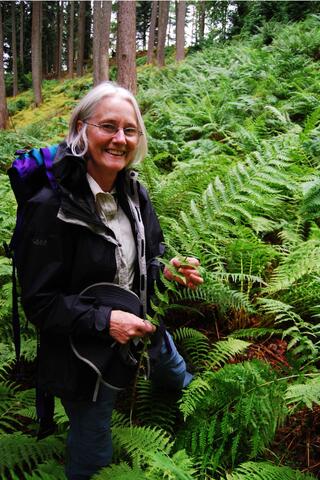
Image: Professor Gibby at Benmore Botanic Garden. Copyright: Royal Botanic Garden Edinburgh
Note
Throughout the collection, Mary Gibby has repurposed old papers to write notes on.
Alternative identifier(s)
Access points
Subject access points
Place access points
Name access points
Genre access points
Description control area
Description identifier
Institution identifier
Rules and/or conventions used
Status
Level of detail
Dates of creation revision deletion
Creation: Oct 2025- April 2026, C.Kemnitz
Revision: July 2026, C.Kemnitz
Language(s)
English
Script(s)
Latin