Zona de identificação
Código de referência
Título
Data(s)
- 1933-06-19 (Produção)
Nível de descrição
Dimensão e suporte
1 page
Zona do contexto
Nome do produtor
Entidade detentora
História do arquivo
Fonte imediata de aquisição ou transferência
Zona do conteúdo e estrutura
Âmbito e conteúdo
SUMMARY:
A halt day with damp conditions; the diarist photographed and tended drying flowers, and noted Tibetans trading salt, wool, and cloth at Pangstang with rice sent to Towa Dzong. On 20th June they crossed the river to inspect west-side cliffs, where few plants were in flower; Pasang collected P. muscoides, and P. strumosa was confirmed with notes on its hybridization with P. calderiana.
CONTENT:
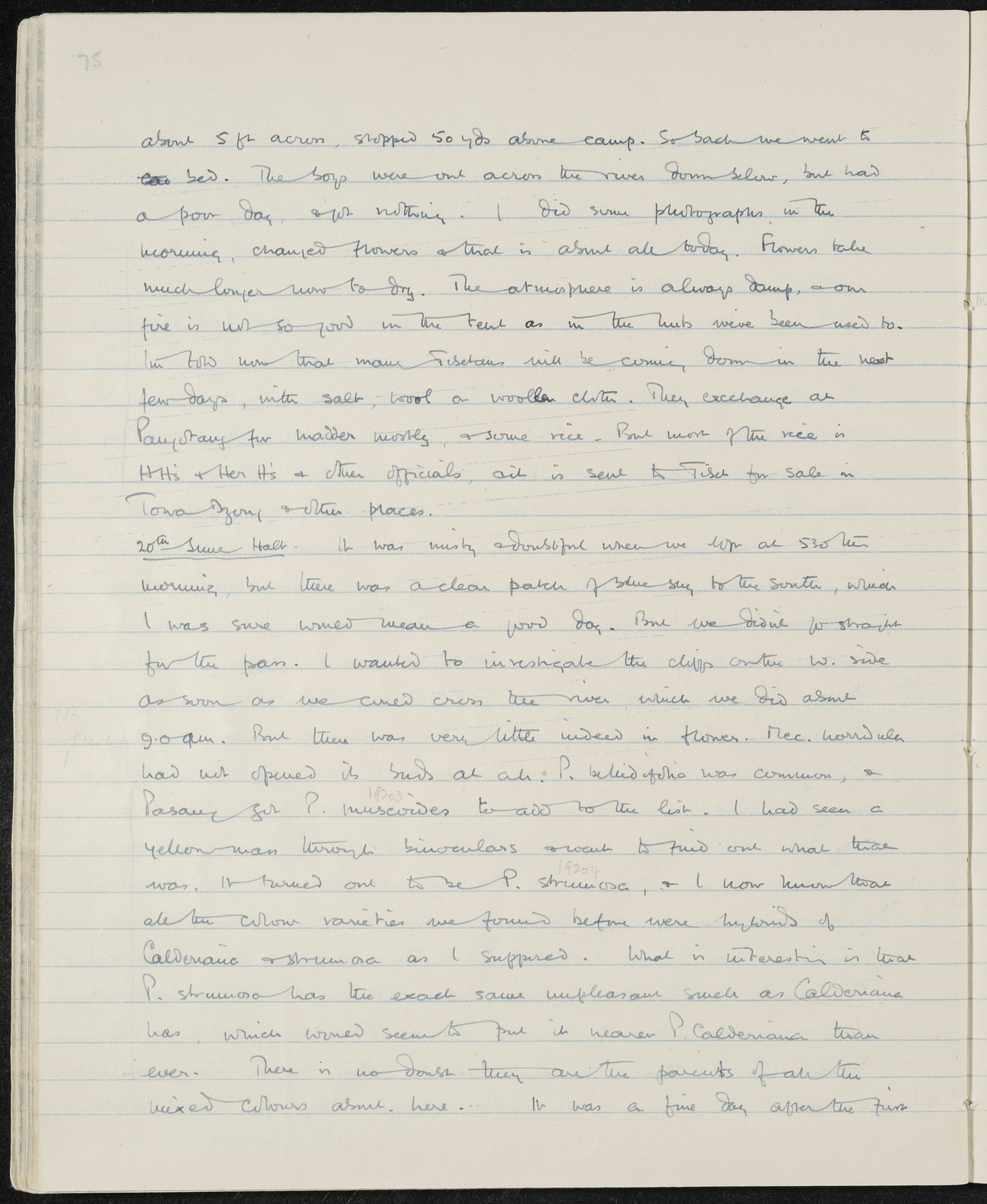
about 5 feet across, stopped 50 yards above camp. So back we went to bed. The boys were out across the river down below, but had a poor day, got nothing. I did some photographs in the morning, changed flowers and that is about all today. Flowers take much longer now to dry. The atmosphere is always damp, and our fire is not so good in the tent as in the huts we've been used to. I'm told now that many Tibetans will be coming down in the next few days, with salt, wool and woollen cloth. They exchange at Pangstang for madder mostly, and some rice. But more of the rice is H.H.'s and Her H.'s and other officials, all is sent to Tibet for sale in Towa Dzong and other places.
20th June Halt. It was misty and doubtful when we got up at 5:30 this morning, but there was a clear patch of blue sky to the south, which I was sure would mean a good day. But we didn't go straight for the pass. I wanted to investigate the cliffs on the West side as soon as we could cross the river which we did about 9:00 a.m. But there was very little indeed in flower. Mec. horridula had not opened its buds at all. P. bellidifolia was common, and Pasang got P. muscoides (19303) to add to the list. I had seen a yellow mass through binoculars and went to find out what that was. It turned out to be P. strumosa (19304), and I now know that all the colour varieties we found before were hybrids of Calderiana and strumosa as I supposed. What is interesting is that P. strumosa has the exact same unpleasant smell as Calderiana has, which would seem to put it nearer P. Calderiana than ever. There is no doubt they are the parents of all the mixed colours around here... It was a fine day after the first
Avaliação, seleção e eliminação
Incorporações
Sistema de arranjo
Zona de condições de acesso e utilização
Condições de acesso
Condiçoes de reprodução
Idioma do material
Sistema de escrita do material
Notas ao idioma e script
Características físicas e requisitos técnicos
Instrumentos de descrição
Zona de documentação associada
Existência e localização de originais
Existência e localização de cópias
Unidades de descrição relacionadas
Zona das notas
Identificador(es) alternativo(s)
Pontos de acesso
Pontos de acesso - Assuntos
Pontos de acesso - Nomes
- Pasang (Assunto)
- Mec. horridula (Assunto)
- P. bellidifolia (Assunto)
- P. calderiana (Assunto)
- P. muscoides (Assunto)
- P. strumosa (Assunto)