1881 Nottingham established its first civic college. In 1928, Sir Jesse Boot gifted 35 acres of land, now the main campus: University Park.
In 1948, a royal charter is granted and the University of Nottingham is established.
RBGE acknowledges that our collections contain historic materials which may contain, either in their content or catalogue descriptions, terminology which is inappropriate, outdated, offensive or distressing. Such information does not reflect the current views and values of RBGE.
We welcome feedback about the language in our catalogues. While we cannot change fixed attributes connected to items in the collection (e.g. published titles, names or contents) we will always consider requests for changes to be made to other aspects of the records in our catalogues. Please contact archives@rbge.org.uk
1881 Nottingham established its first civic college. In 1928, Sir Jesse Boot gifted 35 acres of land, now the main campus: University Park.
In 1948, a royal charter is granted and the University of Nottingham is established.
The University of Leeds was founded in 1904 as a public research university in Leeds, England.
Origins date back to Leeds School of Medicine (est. 1831) and the Yorkshire College of Science (est. 1874). University of Leeds was established with the merging of these two schools and the granting of a royal charter by King Edward VII.
Safety Officer at Natural History Museum, London.
[From NHM Archive]
Frank working at the Museum in the early 1970s in what was then known as the Palaeontology Laboratory. With a background of chemistry, Frank worked on conservation methodology and published numerous books and articles on the care and conservation of geological material.
He is well known for his early pioneering work on identification and treatment for pyrite as well as using thioglycolic acid to remove haematite from vertebrate specimens.
In 1984, Frank was appointed Safety Officer and helped establish the Museum’s first Health and Safety division. He continued his academic interests and published on aspects of safety in Museums and Galleries.
Frank retired to Cornwall in the early 2000s where his longstanding interest in natural sciences led him to become a member and later chair of Cornwall Geoconservation Group and he was appointed a Trustee of Cornwall Wildlife Trust. He had been actively working and preparing a publication on the recent geological history of Cornwall.
Accompanied G. Sherriff and F. Ludlow on their last expedition in 1949.
Studied medicine at Birmingham University, obtained his Fellowship in 1942
1942-1946, served as a ship’s surgeon in the Merchant Navy
During his time as surgical registrar and resident surgical officer at Birmingham General Hospital he worked with H. H. Sampson, B. T. Rose, R. Scott Mason and J. B. Leather, and obtained the MCh (Orth) from Liverpool in 1950.
1951, appointed surgeon to the Birmingham Accident Hospital
1955, married Dr Sheila C. S. Meux in 1955 and they had two sons and one daughter
MRCS 1940
FRCS 1942
MB ChB 1938
MCh (Orth) 1950
“His studies of the anatomy of the foot elucidated the function of the Plantar fascia and both simplified and clarified the movements of inversion and eversion: as a result, he lectured at anatomists meetings both in this country and in France and the United States. He also showed how inversion could cause the familiar lateral rotation injury of the ankle.”
Developed what is known as a Hicks bone plate - used in many countries for internal fixation of bone fractures
A friend and contemporary surgeon to Dr. John Herbert Hicks.
The following details are from Dr. Baines' obituary written by Royal College of Surgeons of England.
[Copyright (c) The Royal College of Surgeons of England, Brit med J 1985, 290, 405]
Guy Harrison Baines was born on 16 September 1911 at the Vicarage, St Helens, Lancashire, where his father Albert Baines, a Cambridge graduate, was a clerk in Holy Orders and later archdeacon of Halifax. His mother Mabel (née Harrison) came from Liverpool. After early education at Mostyn House, Parkgate, he went to Charterhouse where he became head of his house and represented his school at football, boxing, athletics and swimming. At St John's College, Cambridge, he secured an honours degree in natural sciences in 1932 and became demonstrator in anatomy and physiology. He was president of the University Medical Society and gained blues for boxing and swimming before becoming Hector Mackenzie Exhibitioner at St Thomas's Hospital in 1933. After qualifying in 1936 he held resident surgical posts at his teaching hospital and took the primary FRCS before moving in 1939 to the new Queen Elizabeth Hospital, Birmingham, where he was surgical registrar and resident surgical officer while completing the final Fellowship in 1939. He joined the RAMC in 1943, becoming a surgical specialist in the First Airborne Division with which he served in North Africa, Sicily and Italy and was then transferred to Burma. There, with a mobile surgical unit, he took part in the Arakan campaign before returning to hospital and field surgical units in NW Europe. After VE day he commanded hospitals at Sandbostel and Belsen concentration camps before becoming officer in charge of the surgical division at No 25 General Hospital. He there met Janet Douglas Ward, a physiotherapist, whom he married just after the war.
In December 1945, just before his demobilisation, Guy Baines was appointed assistant surgeon to the Queen Elizabeth and Children's Hospitals in Birmingham, and surgeon to the Guest Hospital, Dudley. He rapidly built up a large practice in general surgery, with a special interest in urology, and eventually devoted himself entirely to urology. He published valuable papers on ectopic ureter, nephrocalcinosis and abacterial pyuria and became an active and popular member of the British Association of Urological Surgeons. A man of strong and handsome appearance, a conservative but skilful surgeon, his courtesy, charm and kindly consideration for his patients caused him to be in constant demand. Shortly after their marriage he and his wife settled on a 100 acre farm in Worcestershire, where they raised a family of four children and kept a fine dairy herd. After suffering a myocardial infarct in 1970 he sold the farm but continued with his surgical work until normal retiring age in 1976 when he took up market gardening and served on medical tribunals. He loved the country life but later suffered increasing cardiac disability until his sudden death on 13 December 1985, aged 73. An unselfish and generous man of assertive character, his cheerful temperament and wide interests made him an excellent colleague and staunch friend. He was survived by his wife and by his two sons, Robert and Michael, and two daughters, Rachel-Claire and Julie-Anne.
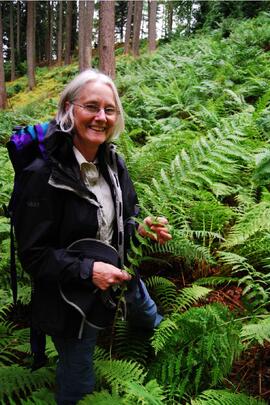
Mary Gibby was a remarkable person and a leading botanist of her generation. During her long and distinguished career, she focused on ferns, the genus Pelargonium, plant conservation, and supporting the next generation of botanical researchers. Equally at home in the laboratory with her microscope or in the hills of Scotland or mountains of Yunnan, Mary was also a sound strategic thinker and a talented manager of scientists. She was a former president of the British Pteridological Society and, until her death, editor of its international research journal, the Fern Gazette. For her many achievements Mary was elected Fellow of the Royal Society of Edinburgh in 2004 and was appointed an Officer of the Most Excellent Order of the British Empire (OBE) in 2010. Born on 27 February 1949, Mary died on 17 July 2024 during fieldwork in the Italian Alps with her husband, Professor Janis Antonovics, FRS.
Mary read botany at the University of Leeds under Professors Irene Manton and John Lovis, securing first-class honours in 1971. Under the supervision of Stanley Walker at the University of Liverpool, she studied for a Ph.D. on biosystematics and cytogenetics in the fern genus Dryopteris.
Mary made full use of the wide network of pteridologists of the Leeds and Liverpool schools, and of botanical garden collections and herbaria, and was able to hybridise diploid and tetraploid species to observe chromosome behaviour at meiosis. Knowing the origin of her artificially created hybrids, Mary understood that failure of chromosome pairing in triploids indicated that the diploid and tetraploid taxa were unrelated. Pairing in the triploid hybrid would confirm one of the ancestors of the tetraploid. The cytogenetic techniques involved had been developed and perfected by Irene Manton and her school in the 1940s, 50s and 60s, and represented state-of-the-art experimental taxonomy and biosystematics of the time. Given the difficulty of obtaining nuclear gene sequence data in these highly polyploid species, Mary’s results remain important today in the classification and identification of Dryopteris species.
As an undergraduate Mary spent a summer internship at the Natural History Museum, London (NHM), and in 1975, during the completion of her Ph.D., joined the staff of its botany department. At that time the NHM was still predominantly populated by male scientists (often without Ph.D.s) and focused on descriptive taxonomy and morphology.
Once at the NHM, and following her Leeds and Liverpool training, she chose to do much of her research at the Chelsea Physic Garden where, as a cytologist, she could be among a living collection of her ferns and other interesting plants. Her laboratory there gave the Physic Garden an active role in research at a time when it was not regularly open to the public, and Mary undoubtedly influenced the curatorial thinking and the development of its collections. Her work on Dryopteris of the northern hemisphere continued into the late eighties. At the same time, while she was embedded in the Chelsea Physic Garden community, her research interests diversified, and she started to work on the cytology of the flowering plant genus Pelargonium.
Inspired by attending a conference in the United States in 1991, Mary became interested in the application of newly emerging molecular methods to biosystematic, taxonomic and phylogeographical questions. Over subsequent years, her work focused on three groups: the genus Pelargonium, the filmy fern Trichomanes speciosum, and European/Macaronesian Asplenium.
In all three groups, her teams combined fieldwork, morphology, cytology and molecular methods, including enzyme electrophoresis and chloroplast DNA (cpDNA) sequencing.
At the NHM Mary’s fern team concentrated on two programmes: the genus Asplenium and the rare Trichomanes speciosum. The first phylogeny of Asplenium, the most speciose fern genus, was published in 2004. Under Mary’s leadership, the team became one the largest research groups on ferns worldwide
In addition to her prolific and diverse scientific career, Mary was also a distinguished scientific leader. Following her role as Associate Keeper of the NHM Botany Department, which started in 1997, she was appointed Director of Science at the Royal Botanic Garden Edinburgh (RBGE) in 2000.
The experience gained at the NHM and Chelsea Physic Garden stood Mary in good stead as she began the transformation of science at RBGE, careful at all times to foster close integration between scientists and horticulturists. Mary also strengthened institutional relationships with the University of Edinburgh, the Scottish Crop Research Institute (now part of the James Hutton Institute) and Scottish Natural Heritage (SNH, now NatureScot). As a member of the Action Plan and Science Group of SNH, she was much involved in developing early versions of Scotland’s Biodiversity Strategy and hosting the Scottish Biodiversity Forum conference, which on several occasions was held at RBGE.
Mary led the development of a programme to conserve Scottish rare plants, which brought threatened species into the public eye and began the restoration of several species into the wild. As Director of Science at RBGE Mary travelled widely, making official visits to strengthen collaborations in China, Belize, Bhutan, Indonesia, Singapore and Soqotra, among other places.
Mary was central to the restoration project for the Victorian fernery at Benmore Botanic Garden, part of RBGE, in western Scotland.
After retiring from RBGE in 2012, Mary continued to work as a research associate at the NHM London and RBGE in Edinburgh, active in editing, helping to curate collections, teaching, and helping students and colleagues.
Mary was a considerate and strong leader, an exemplary Ph.D. supervisor, and a great mentor. With an astute understanding of, and insights into, character, she knew her science and was respected as a member of the scientific community. She established large research teams and attracted substantial amounts of external funding.Outwith academia, Mary loved the outdoors and enjoyed regular collecting field trips in the UK, Europe and Africa. After the birth of her daughter, Jessica Barrett, these became family trips, Jess accompanying her mother from the age of six months on the island of Madeira and later in Africa. After retirement Mary continued fieldwork with her husband, fellow botanist and geneticist Janis Antonovics, on his annual fieldwork in the mountains in Italy.
In addition to nature and wild places, another of Mary’s major passions was for canals and narrowboats. Much time was spent aboard her beloved Swan, a working narrowboat built in 1933 that she owned and faithfully restored. She was a founding member of the Battlebridge Basin boat community at King’s Cross, London, and served as a Director of the London Narrow Boat Company Ltd from 2014 to 2020

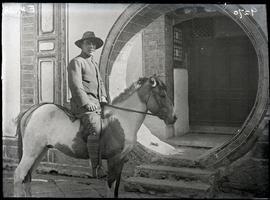
Born in Falkirk in 1873, George Forrest became one of Scotland's most prolific plant collectors, conducting seven expeditions in Yunnan province, S.W. China between 1904 and his death there in 1932.
London's oldest botanic garden. Established in 1673, by the Worshipful Society of Apothecaries of London, Chelsea Physic Garden is home to over 4,500 medicinal, edible and useful plants.
Mission:
To demonstrate the medicinal, economic, cultural and environmental importance of plants to the survival and well-being of humankind.