Identity area
Reference code
Title
Date(s)
- 1933-04-09 (Creation)
Level of description
Extent and medium
1 page
Context area
Name of creator
Repository
Archival history
Immediate source of acquisition or transfer
Content and structure area
Scope and content
SUMMARY:
Travelled about 9 miles down the valley near Tora under fine weather that later brought hail, noting Iris lactea in flower and likely matching K. Ward's 'Karta' iris, with poplars, willows, and buckthorn near a hillside monastery. Sheep were seen struggling for forage during lambing season, six partridges were shot, and a possible Ceratostigma was observed.
CONTENT:
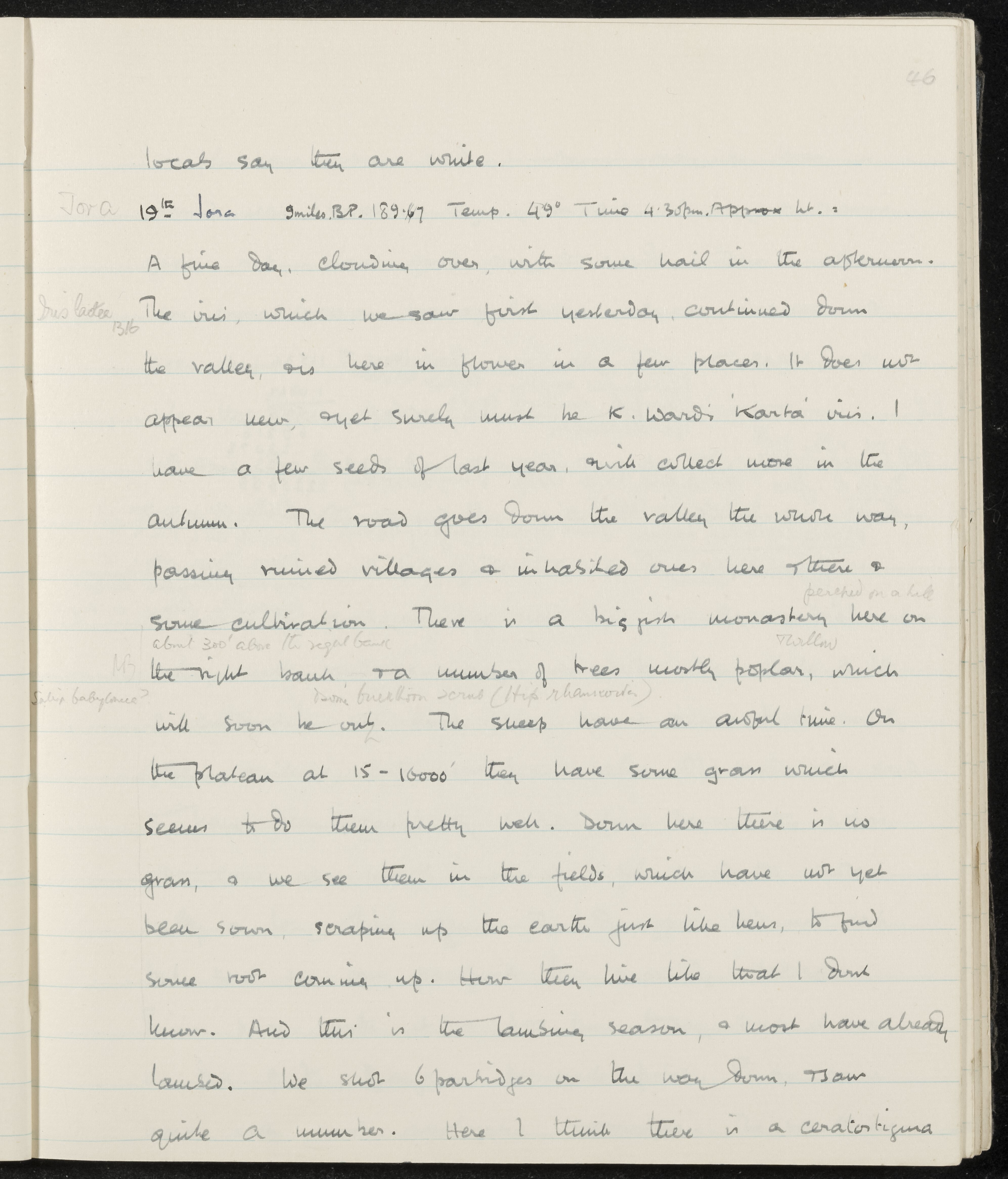
Locals say they are white.
Tora 19th Tora 9 miles B.P. 189.47 Temp. 49° Time 4.30pm. Approx ht. :
A fine day, clouding over, with some hail in the afternoon.
The iris (Iris lactea), which we saw first yesterday, continued down the valley, is here in flower in a few places. It does not appear new, and yet surely must be K. Ward's 'Karta' iris. I have a few seeds of last year, will collect more in the autumn. The road goes down the valley the whole way, passing ruined villages and inhabited ones here and there and some cultivation. There is a biggish monastery here, perched on a hill on the right bank about 300' above the bank, and a number of trees, mostly poplar and willow (Salix babylonica?), which will soon be out. There is also some buckthorn scrub (Hippophae rhamnoides). The sheep have an awful time. On the plateau at 15,000–16,000' they have some grass which seems to do them pretty well. Down here there is no grass, and we see them in the fields, which have not yet been sown, scraping up the earth just like hens, to find some roots coming up. How they live like that I don't know. And this is the lambing season, and most have already lambed. We shot 6 partridges on the way down, and saw quite a number. Here I think there is a Ceratostigma.
Appraisal, destruction and scheduling
Accruals
System of arrangement
Conditions of access and use area
Conditions governing access
Conditions governing reproduction
Language of material
Script of material
Language and script notes
Physical characteristics and technical requirements
Finding aids
Allied materials area
Existence and location of originals
Existence and location of copies
Related units of description
Notes area
Alternative identifier(s)
Access points
Subject access points
Place access points
Name access points
- K. Ward (Subject)
- Ceratostigma (Subject)
- Hippophae rhamnoides (Subject)
- Iris lactea (Subject)
- Salix babylonica (Subject)