Tibet

Elements area

Taxonomy

Code

Scope note(s)

    Source note(s)

      Display note(s)

        Hierarchical terms

        Tibet

          Equivalent terms

          Tibet

            Associated terms

            Tibet

              192 Archival description results for Tibet

              192 results directly related Exclude narrower terms
              LSH/1/1/2/1/237 · Part · 1969-04-29
              Part of The Ludlow & Sherriff Collection

              SUMMARY:
              Halted at Sahden in perfectly settled weather with plans for Nyit-sang La; Ludlow obtained a Tree Creeper. Two men returned from Tsona after six days, having taken a chair to Ragasha Kusho (absent to Lhasa); the Tsona Jongpen sent back Paraquilegia seed bags mixed with Meconopsis horridula pods, and the previously missing mail—found with the Tsona Jongpen—was recovered, while Damong mishandled arrangements for the man from Chukar.

              CONTENT:
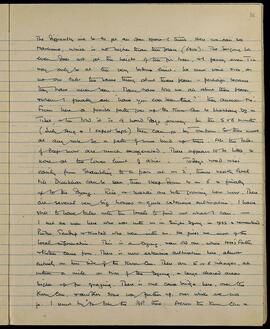
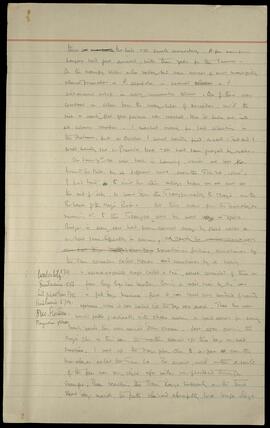
              117

              go far, but want one more day for the Nyit-sang La, which I last went to on a cloudy day. Weather absolutely settled at last, no fear of more than showers in future.

              24th October. Halt Sahden. [Ludlow gets a Tree Creeper] Another perfect day, the best we have ever had, but unfortunately I did not go up a pass. There was not a cloud to be seen all day. In the evening the two men sent to Tsona came back.

              [26th men back] They took six days for the 108 miles or so - pretty good over the passes they had to cross. They took the chair to Ragasha Kusho, but he had been called to Lhasa. I think the other Jongpen was surprised that we did what we said we would. He sent back the seed bags of Paraquilegia, but mixed up with mec. horridula pods. There are very few seeds indeed, I'm afraid, but it can't be helped. There now remains only the man from Chukar. Damong made rather a mess of the arrangements about him. When the Tsona people were talking to me I noticed a bag lying on the floor. This was the missing mail, found with the Tsona Jongpen after all. He had kept it, not knowing where we were, & expecting us to send for it from Sahden. Everything in it was in good condition, letters etc. all dry. The night temp.

              LSH/1/1/2/1/2 · Part
              Part of The Ludlow & Sherriff Collection

              SUMMARY:
              Overview page listing the 1934 expedition route across Bhutan and Tibet. The itinerary runs from Menoka Tea Estate to Rangiya via numerous villages, rivers, passes, valleys, and dzongs.

              CONTENT:
              BHUTAN and TIBET.
              1934

              Route: Menoka Tea Estate - Diwangiri - Trashigong -
              Gamri Chu - Sakden - Muktur - Tawang - Tsona - Tulung La -
              Nyuri - Lap - Mago area (Luguthang & Chigapnaga) - Tulung
              La - Tsona - Gonpo La - Dongkar Dzong - Cha La - Cho La -
              Me La - Trashiyangsi valley - Chorten Korra - Dib La - Chorten
              Korra - Sana - Trashiyangsi Dzong - Trashigong Dzong - Sakden -
              Trashigong - Pintsogong - Chunkar - Diwangiri - Rangiya.

              LSH/1/1/9/1/45 · Part · 1933-05-07
              Part of The Ludlow & Sherriff Collection

              SUMMARY:
              The diarist, ill with bronchitis, outlines a staged route through multiple settlements, then reaches Mashina and pushes the coolies on to Dunkhar, revising planned departure dates. Many people are sick, including a man of Wangmoo who was injured, and the writer discusses difficulties securing coolies due to local allegiances to H.H., Wangmoo, Ani Choden, and Pema Dechen, before deciding to move on.

              CONTENT:
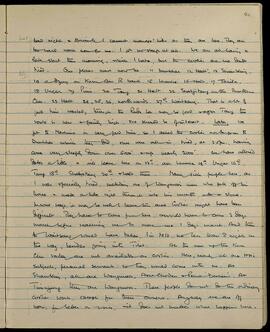
              Bad night & Bronchitis. I cannot manage hills as they are here. They are too hard work now for me. I got no sleep at all. We are all having a late start this morning, which I hate, but the coolies are so damn tired. Our plans must now be: 11 Dunkhar, 12 Halt, 13 Shambling, 14 a camp on Kuru Chu R bank, 15 Lhumbe, 16 Halt, 17 Takila, 18 Ungar, 19 Pimi, 20 Tang, 21 Halt, 22 Shabjetang on the Bumthang Chu, 23 Halt, 24, 25, 26 northwards, 27th Waitsang. That is a lot of good time wasted, though the Rudu La may be good via Tang; the route is new & fairly high, so should be of interest.

              Later. We got to Mashina in very good time, so I asked the coolies to go on to Dunkhar, which they did, but were all in, tired, at 3.0 p.m., having come very steeply down over 5000' & up nearly 2000'. We have altered dates a little, & will leave here on 12th, and Lhumbe 14th, Ungar 16th, Tang 18th, Shabjetang 20th & halt there. Many sick people here, as I was specially tired, including one of Wangmoo's men who fell off his horse & made a hole right through into his mouth with a stone.

              In some ways, it may be well to leave this area. Coolies might have been difficult. They have to come from here, & would have to come 3 days' march before reaching me to move me 1 day's march. And then to Waitsang would have taken, I'm told, no less than 8 nights on the way, besides going into Tibet. All the men up the Kuru Chu valley are not available as coolies. Here, nearly all are H.H.'s subjects, personal servants: so they would come with me. At Shambling, all are Wangmoo's, Ani Choden & Pema Dechen's. At Tungyang they are Wangmoo's. These people do not do the ordinary coolie work, except for their owners. Anyway we are off now, for better or worse; it does not matter what happens here.

              LSH/1/1/9/1/41 · Part · 1933-05-07
              Part of The Ludlow & Sherriff Collection

              SUMMARY:
              The diarist describes views of Hashina, a possible route up the Kuru Chu to Lhakhang Dz in Tibet (said to be a four-day journey in July–September by tom-tom), and a day's road from Shambling past a pass toward Diukkhar and a Dzong. Snow at the lower limit of Abies is minimal, rice and makai are growing, and the writer met a man who had been with them at Singhi Dzong in 1933.

              CONTENT:
              The difficulty will be to get an open space trunk. Here we can see
              Hashina, which is no higher than this place (6400'). The Serjong La
              even does not get the height of the fir trees, and fancy even Tin
              may only be at the very bottom limit. We must wait and see, as
              no one tells the same thing about these places - perhaps because
              they have never seen. Many have told me all about these places,
              and when I finally ask "have you ever seen them?" they answer "no".
              From here a possible path goes up the Kuru Chu to Lhakhang Dz in
              Tibet, and they told it is 4 hard days journey. In the 5 or 6 months
              (July Aug and I expect Sept) they can go by tom-tom. So there must
              at any rate be a path of some kind up there. All the tales
              of deep snow are much exaggerated. There appears to be little, or
              none at the lower limit of abies. Today's road rises
              easily from Shambling to a pass at m 2, thence nearly level
              till Diukkhar can be seen, then steep down to m 6 and finally
              up to the Dzong. Rice and makai are both growing here now. There
              are several very big houses and quite extensive cultivation. I have
              still to have talks with the locals to find out what I can. —
              I met a man here who was with us in Singhi Dzong in 1933 and

              LSH/1/1/6/1/73 · Part · 1938-06-09
              Part of The Ludlow & Sherriff Collection

              SUMMARY:
              A swollen river and damaged bridge near Lanjong thwart progress, with suspected interference by the ex-gyinpon. The party marches to Trashiyang in wet conditions and arranges with reluctant coolies to attempt a circuit via Tsari Sama. Tsari Sama is noted as a pilgrimage site founded by the lama Giaogama; nothing new was found except an interesting rhododendron.

              CONTENT:
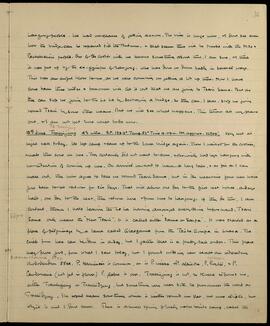
              Lanjong people. We had no chance of getting across. The river is huge now, and I don't see even how the bridge can be repaired till the Autumn, and that seems there will be trouble with the Moro and Pachakshiri people. One of the coolies with me knows something about this, I am sure, and thinks it was put up by the ex-gyinpon of Lanjong, who has done us down badly in several ways. This was an awful blow to me, as we were counting on getting a lot up there. Now I have come back three miles and tomorrow will let it out that we are going to Tsari Sama. But as they can stop us going to the Lo La by destroying a bridge, so they can, I fear, stop us going round Tsari by some other means. But we will see what happens. This throws all my plans out, and I am not yet sure what to do now.

              13th June To Trashiyang 4 1/2 miles. B.P. 189.3° Temp. 52° Time 4.0pm. Ht. approx. 12809'. Very wet at night and all today. We left camp and came up to the lower bridge again. There I waited for the coolies, and made them come on here. They certainly did not want to come, and obviously had left Lanjong with no intention of coming up here. On arrival we had to have a long talk, and as far as I can make out, they now agree to take me round Tsari Sama, but in the meantime four men have gone back to get rations for six days. That will allow one day to the first rest house, a day's halt, one day to the next, then return here and from here to Lanjong. If they do this, I am content, though I hate leaving the Lo La having arranged everything beforehand. Tsari Sama only means the "New Tsari". It is called either "Sama" or "Sarpa". It was started as a place of pilgrimage by a lama called Giaogama from the Tsübo Gompa in Lhasa. The circle from here can be done in a day, but I gather that is a pretty tall order. This place may prove good, from what I saw today, but I found nothing new except an interesting Rhododendron

              LSH/1/1/2/1/135 · Part · 1933-07-18
              Part of The Ludlow & Sherriff Collection

              SUMMARY:
              The writer explains the origin of the Cha La pass name and describes camping in the steep Rong Chu valley, planning to stay to collect flowers and arranging a local to watch bags until a man from Trashiyangsi can retrieve them in October. The mail finally arrived after 20 days via Mago, Dirang Dzong, Poshnig, and the Tse Las; the carriers were fed, paid 20/- each, and sent off.

              CONTENT:
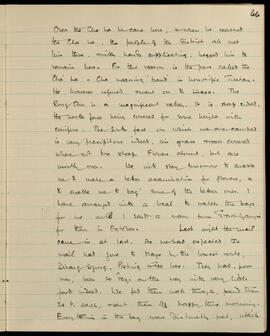
              Over the Cho La he came here, and when he reached the Cha La, the people of the District all met him there, with hands supplicating, begged him to remain here. For this reason is the pass called the 'Cha La'—Cha meaning 'hand' in honorific Tibetan. He however refused, and went on to Lhasa.

              The Rong Chu is a magnificent valley. It is steep-sided, the north face being covered for some height with conifers. The south face, on which we are camped, is very precipitous indeed, and grass and rock covered where not too steep. Flowers abound, but are mostly over. We will stay tomorrow to enable us to make a better examination for flowers, and to enable me to 'bag' some of the better ones. I have arranged with a local to watch the bags for me until I send a man from Trashiyangsi for them in October.

              Last night the mail came in at last. As we had expected, the mail had gone to Mago by the lowest route, Dirang Dzong, Poshnig and Tse Las. They had, poor men, been 20 days on the way with very little food indeed. We fed them well though, paid them 20/- each, and sent them off happy this morning.

              Everything in the bag was distinctly wet, which

              LSH/1/1/9/1/75 · Part · 1949-06-15
              Part of The Ludlow & Sherriff Collection

              SUMMARY:
              The diarist notes finding dormant roots of a Soldanelloid primula and discusses potential primula sightings mentioned by Pasang and Gyundon. After days of heavy rain that swelled the river and left rhododendrons mostly over, they describe trader activity, including Bhutanese and Tibetan caravans and a report about Tasho Pumbo Wangdi’s smallest son. On 14 June, during a local halt, they collected Primula umbratilis in full flower on a nearby cliff.

              CONTENT:
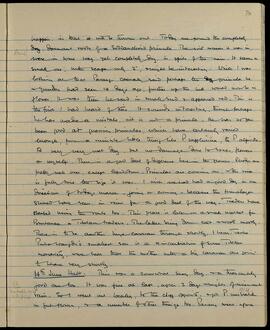
              happen, is that it will be known one. Today we found the completely dry, dormant roots of a Soldanelloid primula. The soil it was in was in some way yet completely dry, in spite of the rain. It seems a small one, with scape only 2", might be interesting. While I was looking at that Pasang casually said perhaps the primula he & Gyundon had seen 14 days ago, further up the hill would now be in flower. It was then he said in small bud & appeared red. This is the first I had heard of this. It sounds interesting, though perhaps he has made a mistake, and it is not a primula. He has so far been good at guessing primulas, which have certainly varied enough, from a minute little thing like P. sapphirina, to P. alpicola.

              A very very wet day, but no damage done to boxes, flowers or myself. There is a good deal of difference here in the flowers. Rhodos are pretty well over, except lepidotum. Primulas are coming on, the river is fully twice the size it was. I wish we had had a good day in one direction of today's march - going or coming - because the Himalayas should have been in view for a good deal of the way. Traders have started using the route too. This place is later on a small market for Bhutanese & Tibetan traders. The latter bring down salt & wool mostly. There is to be another huge caravan through shortly, I hear. Tasho Pumbo Wangdi's smallest son is a reincarnation from some Tibetan monastery, & we hear that the mother with a big caravan are going to Lhasa very shortly.

              14th June Halt. This was a somewhat sunny day, & a thoroughly good one too. It was fine at last, after 3 days & nights of ceaseless rain. So I went out locally, to the cliff opposite, & got P. umbratilis in full flower, & a number of other things too. Pasang went up a

              LSH/1/1/7/1/9 · Part · 1940-05-24
              Part of The Ludlow & Sherriff Collection

              SUMMARY:
              The diarist describes abundant Primula species on swampy valley slopes and notes that by October seed and leaves were scarce due to yak grazing. On June 19th they returned to Lanyong, then departed for Molo via the Tse La, later traveling down the Tsangpo valley to Mayu and making difficult river crossings (including by skin coracles and a log raft) before proceeding up the Nagu Chu valley toward the Tam La over the Himalayas.

              CONTENT:
              there are two huts & a small monastery. A few men
              from Lanyong had just arrived, with their yaks for the summer -
              On the swampy slopes in the valley bed were masses of most beautifully
              coloured primulas - P. alpicola in several and a P.
              sikkimensis subsp in every conceivable colour. One of these was
              constant in colour down the rocky sides of cascades, until the
              rich & marshy flat yak pasture was reached. Here it broke out into
              all colours & shades. I marked many for seed collecting in
              the Autumn, but in October I could hardly find a seed & indeed I
              could hardly see a Primula leaf - all had been grazed by yaks.
              On June 19th we were back in Lanyong, which we left then,
              bound for Molo, by a different route, over the Tse La, 15000'.
              I had time to visit two other valleys before we all met at
              the end of July, so went down the Tsangpo valley to Mayu on the
              R bank of the Nagu River - All these rivers from the Himalayas
              running N. to the Tsangpo were by now in spate.
              Bridges in every case had been carried away by flood water &
              we had some difficulty in crossing, clear days sometimes fording, sometimes by
              the skin coracles called Kowas and sometimes by a heavy

              Waterlily 5749 unmanageable craft called a 'tru', which consisted of three or
              Smilacina 5756 four long logs tied together. Crossing a rapid river by 'tru' was
              Lil. giganteum 5743 a full day's business: first it was towed some hundreds of yards
              Smilacina 5754 upstream, where it was loaded till the logs were awash. Then two men
              Rhod. floribunda would paddle frantically with sticks making a yard across for every
              Magnolia globosa twenty yards they were carried down stream. Just after crossing the
              Nagu Chu in this way, the weather cleared after three days we had
              sunshine. I went up the Nagu Chu valley to a pass at over the
              Himalayas called the Tam La. The ascent, until within a mile
              of the pass was very slight & for miles we plodded through
              swamps. Then reaching the Main Range suddenly on the third
              short day's march, the path climbed abruptly to a knife edge

              LSH/1/1/6/1/6 · Part · 1938-06-06
              Part of The Ludlow & Sherriff Collection

              SUMMARY:
              Notes record Primula gracilipes as common above and below Lingti and east of Jelep La at about 11,000 ft. Ludlow S. remarks that the Amo Chu River would make a wonderful trout stream and envisions the Chumbi valley as a fine hill station with a road through Bhutan up the Amo Chu.

              CONTENT:

              1. Primula gracilipes. Common above & below Lingti.

              3580 Prim. gracilipes. Common on E of Jelep La at about 11000 ft.

              Ludlow S.
              What a wonderful trout stream the Amo Chu River would make. I can see trout of prodigious size lurking in its beautiful pools.

              Ludlow S.
              What a magnificent hill station the Chumbi valley would make with a road through Bhutan up the Amo Chu.

              LSH/1/1/8/1/81 · Part · 1947-03-20
              Part of The Ludlow & Sherriff Collection

              SUMMARY:
              Mail is sent with Ludlow toward Lhasa via Tsela/Tsela Dzong amid uncertainty about Mohammed; the diarist writes Richardson for help and plans further dispatches to Tongkyuk Dzong to meet Henry on July 1. Entries for 21–24 March record letters from Richardson, Tsarong, Taring, and Fox, a large flock of migrating kites near Pemo, fair weather after heavy rain, and a route from Tongkyuk Chu past Pemo, Sishila valley, Parka and Parka Phu Chu toward Namla La, reaching Lokmo.

              CONTENT:
              We have sent our mail with Ludlow to Tsela to go to Lhasa as best he can arrange. It seems something has happened to Mohammed who hasn't made other arrangements for post. I have written Richardson to get our mail up at once from Gyantse & send it here by the man Ludlow sends to Lhasa. I have asked him again to get it to Lhasa by 1st August & 1st October & send to Tsela Dzong & to Tsetang. In the meantime I hope we will get news of Mohammed. We are to send our next lot of letters to Tongkyuk Dzong to meet Henry on July 1st. He will have to pack up & send off to Tsela Dzong.

              21 March Halt. We had some news from the outside world on 19 evening, as some men came back from Lhasa with letters from Richardson & Tsarong & Taring & Fox. It was nice to get news, but it did not clear up our mail business. No-one mentioned it, & we now doubt even if Rai Sahib got to Gyantse at all. I have asked Tsarong's boys in Lhasa to make enquiries. Today we walked up to Pemo. Just as we got there a large flock of kites arrived - about 100-120 of them. Many came down on the fields where wheat was just coming up. A local fired a shot at them, then all flew off & went on on their migration route.

              22nd March. Halt. Fine at last, after a night of very heavy rain, when snow fell low down to about 10000'.

              23rd March Halt. Another fine day, but clouded over very quickly indeed between 5.0 & 6.0 pm.

              24th March. Lokmo. About 10 miles. Path up the Tongkyuk Chu past PEMO at m 1 & so on past the entrance to the Sishila valley at m 4 1/2, and over the Parka Phu Chu at m 6, where the village of Parka lies. (about 20-25 houses & considerable cultivation). The Parka valley (called Shabra Lungba) lies due North from Parka. Beyond the village the path crosses a ridge & at m 7 passes the bridge which leads up another valley to the Namla La. Both rivers here are about the same size. The valley up which Lokmo lies is at a bearing of about 290°. Lokmo lies high up above the river, about 500'. There are some 30 houses & considerable cultivation. Another village is on...