Tibet

Elements area

Taxonomy

Code

Scope note(s)

    Source note(s)

      Display note(s)

        Hierarchical terms

        Tibet

          Equivalent terms

          Tibet

            Associated terms

            Tibet

              192 Archival description results for Tibet

              192 results directly related Exclude narrower terms
              LSH/1/1/3/3/78 · Part · 1936-03-10
              Part of The Ludlow & Sherriff Collection

              SUMMARY:
              Notes confirm the Tibetan Magpie occurs south of the main range, with records at Treno Dzong in the Nyam Jang Chu valley and earlier sightings by Ludlow, S., and W. Griffith; Rose Finches were common at Archpo. First-time localities are listed for Aegithaliscus concinnus talifuensis across SE Tibet with habitat and breeding remarks, alongside brief film stock references.

              CONTENT:
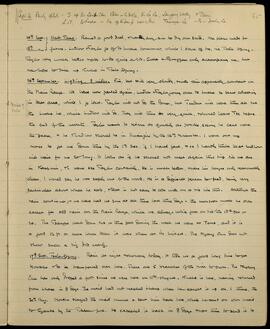
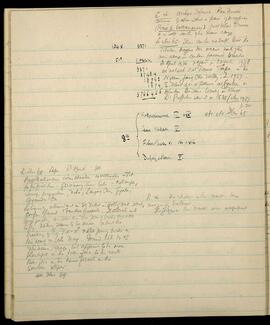
              L. 46. Archpo I found Rose Finches common. I also saw a pair of Magpies (Pica p. bottanensis) just below Treno & in well south of the main range.

              1945 9371
              510 10422
              9371
              37484
              18742
              1874
              9766.456

              L. Ibis 65. There can be no doubt that the Tibetan Magpie does occur south of the main range in certain favoured localities. In April 1936, Ludlow, in November 1938, we met with it at Treno Dzong in the Nyam Jang Chu valley. In 1937, S. saw 3 or 4 pairs at Gyetsa in Bhutan, the same locality in which W. Griffith saw it in 1838 (Ibis 1937 p. 20).

              8th
              Kodachrome III & IV etc. etc. Ibis 65
              Cine Kodak V.
              Film Pack VI, VII & VIII
              Dufaycolor V.

              L. Ibis 68. Lepo. 5th April 8th Aegithaliscus concinnus talifuensis - Tit.
              For the first time: Goshuany, Cine Cali - Natrampa, Seing, Migyitun, Molo, Langong Chu, Gyala, Gyanda Chu.

              Extremely abundant in SE Tibet in Holly Oak zone, conifer forest & bamboo thickets. It collects into large parties as soon as the young birds are able to fly. Nothing seems to be known about the breeding of this Tit. L. noted young birds on the wing in late May. Found both N & S of the main range, but appears to be more plentiful in the drier zone to the north than it is in the dense forests on the southern slopes.

              See Ibis 69.

              L. 46. The rhodos at this march were amazingly brilliant. The gorge in this march was magnificent.

              LSH/1/1/8/1/21 · Part · 1946-12-11
              Part of The Ludlow & Sherriff Collection

              SUMMARY:
              The diarist describes sparse official presence across Tibetan towns, then records halts and short marches with bullocks en route toward Tsela Dzong. A pony carrying Ludlow and Elliot’s bedding goes missing and is later recovered; Sandup returns to Kyindong, and difficult road conditions near Risho require manhandling loads, with mention of skin ferries.

              CONTENT:
              There can be no other country which runs itself like Tibet. Since we left Gangtok we have not come across many officials in their place of business. The T.T.A. Yatung is hardly ever anywhere but in Kalimpong. There was a dzongpon in Phari. There was one in Gyantse. But there were none in Nangkarbe, Pede or Gongkar. The Nethong Dzongpon was in residence, and we have seen none since then.

              3rd Dec. Halt. Very windy last evening, but clear and cold at night, with not a very low temp. No one appeared this morning early, but by 11.0 some 30 bullocks had come. The men are a pleasant friendly - several having been with us before both in 1933 and 1938 in Langong or beyond Kyindong Dzong. They remember us, apparently quite happily, and they even remember Jill. They are going to Tsela Dzong with us, and we should have no trouble when once away from here. The only troublesome people are the representatives of the Dzong. The village here is very poor, but they seem friendly enough.

              4th Dec. Kamchang. Bullocks got off in good time, last party leaving at 8.0. We were in at 11.30 - it is a short march. But bullocks take a very long time. One pony with Ludlow and Elliot's bedding never arrived in. Kamchang is the lower of two villages, each only with a few houses. Pollarded walnut trees are much in evidence.

              5th Dec. Halt. Again had to halt, this time owing to the lost pony. It strayed up a side valley 2 miles from here. Sandup has gone back to Kyindong. Pony came in late at night - or rather the bedding was brought in - the pony had fallen and hurt itself.

              6th Dec. Camp 2 m. beyond Chongrong on S. bank, left at 7.30: in with bullocks at 4.30pm. Road very bad for bullocks in 3 places, the worst being 1 1/2 m beyond Risho, where all loads had to be manhandled for 100 yds over a cliff. There are 'skin' ferries at 1 1/2 m above Risho, -

              GB 235 LSH · Collection · 1930 - 1952

              This collection consists of material created and gathered from the expeditions of F. Ludlow and G. Sherriff, thought their expeditions of Bhutan and Tibet during 1933-1949.

              The collection consists of 5 sub-series: plant documents, expedition documents, diaries, correspondence and visual material.

              [1] This series consists of a variety of material which includes plant and seed lists from their expedition with a large focus on Primula, Meconopsis and Rhododendrons, as well as publications gathered by Ludlow and Sherriff which cover their shared interest in the Himalayan region and it's flora and fauna. There is also a garden register donated by the Knox Finlay family detailing the progress of plants/seeds in their gardens acquired from various expeditions including Ludlow and Sherriff's between 1951-52.

              [2] This series consists of a variety of expedition documents ranging from itineraries and maps to administration lists and passports.

              [3] This series consists of originals and photocopies of the diaries of Sherriff and Ludlow during their expeditions.

              [4] This series consists of a variety of correspondence from and to Sherriff and Ludlow over the course of their expeditions.

              [5] This series consists of a variety of material including: photographic material, films and videos. Photographic material ranges from prints and negatives taken by Sherriff and Ludlow to prints of digital images taken as exhibition documentation in 2014. The films are..... There have been dvd surrogates made of the films to ensure continued accessibility.

              Ludlow, Frank
              LSH/1/1/2/1/115 · Part · 1933-07-18
              Part of The Ludlow & Sherriff Collection

              SUMMARY:
              Diary notes describe travel from Thang toward Tsona in clear weather with route bearings between passes, observations of gentians and parnassius, and a partridge shot by L. identified as the Kansu bird. The party returns to Tsona before a heavy storm and notes Delphinium grandiflora, Aconitum gymnandrum, and borage by fields, with remarks on re-entering the dry zone indicated by birds.

              CONTENT:
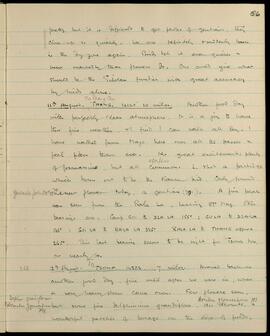
              56

              pretty, but it is difficult to get photos of gentians, they close up so quickly. We are definitely suddenly back in the dry zone again. Birds tell it even quicker and more markedly than flowers do. One could give what should be the Tibetan frontier with great accuracy by birds alone.

              11th August. THANG (To Thang Chu). 14120' 10 miles. Another good day with perfectly clear atmosphere. It is a joy to have this fine weather, I find I can walk all day. I have walked from Mago here over all the passes and feel fitter than ever. No great excitement: plenty of parnassius (epaphus), but all common. L. shot a partridge which turns out to be the Kansu bird. Only found one new flower today, a gentian (791) (Gentianella palustris 791). A fine peak was seen from the Rala La, bearing 87° Mag. Other bearings are: Camp GUI to DZA LA 155°; GULA to DZA LA 136°; GUI LA to RALA LA 325°; RALA LA to THANG approx 265°. This last bearing seems to be right for Tsona too, or nearly so.

              12th August. TSONA (10). 14282'. 7 miles. Arrived back on another good day, fine until after we were in, when a very heavy storm came over. Few flowers seen, but some fine Delphinium grandiflora (Delphin. grandiflorum), and an aconite (Aconitum gymnandrum 793). Wonderful patches of borage on the edge of fields.

              LSH/1/1/6/1/131 · Part · 1933-09-07
              Part of The Ludlow & Sherriff Collection

              SUMMARY:
              The party splits, with S. going up the Lando Chu towards Molo and Tsari while Ludlow and Taylor head to Lusha; the diarist travels via Tsela Dzong with Gulla and the Tsongpen, aiming to meet Kusho. Taylor is improving but will avoid the passes, with Tendrup assigned most passes and Ludlow to do Lusha La; notes mention continuing rain, river levels on the Tsangpo and Nyang Chu, and timelines to Dewangiri. Mail news: Kusho has returned from Lhasa, and Norbhu redirected the mail via Gyantse.

              CONTENT:
              Sept 16 Party splits - S. up the Lando Chu then on to Molo, the Do La, Langong Valley & Tsari
              L. & T. to Lusha - then up the Pan La across to Tsari. Tamnyen La - Po-Doshong La

              14th Sept. } Halt Temo. Rained a good deal, hardly any sun to dry our seeds. All plans made for
              15th " } future. Ludlow & Taylor go off to Lusha tomorrow, while I start off too, via Tsela Dzong - Taylor very much better & able to do quite a lot. Gulla & Tsongpen only accompany me, but we hope to pick up Kusho in Tsela Dzong.

              16th September. Ligding. 8 miles. Fine, but still very cloudy, with rain apparently constant on the Main Range. We have now parted again, Ludlow & Taylor going over to Lusha to start collecting in that area, while I go West. Taylor will not do the Passes, but Tendrup will work them all but the Lusha La, which Ludlow will do. They will thus be very quick, & should leave Tse before the end of the month. Taylor wants to return as quickly as possible, seeing he cannot work the passes, & he should & must be in Dewangiri by the 16th November. I work out my moves to get me down there by the 1st Dec. if I travel fast, & so I hardly think that Ludlow will wait for me so long. It looks as if we should not meet again this trip till we are in Kashmir, or won't see Taylor certainly. He is much better, & were his tongue only reasonably clean, I would say he was safely out of the wood. He is a difficult person to feed, being very particular about what he eats, & that is not easy to cope with on a trip like this. Although the rain continues, - we have had no sun at all these last three days - the monsoon must be over except for odd rain on the Main Range, which we always notice goes on till the 18th Oct or so. The Tsangpo went down two or three feet during the week we were at Temo, and it is a good 12 ft or more lower than it was when at its highest. The Nyang Chu does not show such a big drop nearly.

              17th Sept. Tsela Dzong. Rain at night & showery today. It took us a good long time to get ponies etc to be transported over here. There are 5 branches of the river to cross. The Nyang Chu has only dropped a foot since we were here on 10th August. Kusho is here, having returned from Lhasa in 8 days. The mail had not reached Lhasa when he caught it up on, I think, the 31st Aug. Norbhu stayed the mail runner & sent him back here, while he sent on our mail to Gyantse by the Tibetan post. He expected it back in 8 days & was then to send it to

              LSH/1/1/1/1/191 · Part · 1933-09-13
              Part of The Ludlow & Sherriff Collection

              SUMMARY:
              Notes a black‑necked crane near Talung and describes Talung’s monastery, village, and August fair, with showers and thunder in the evening. Describes the 13th September route toward Nangartse Dzong via Chö Dzong by Yamdrok Tso, noting high river levels preventing the lakeshore route and that the party is on the route the Williamsons took to Lhasa.

              CONTENT:
              94

              crane (Grus nigricollis) near Talung: Talung?
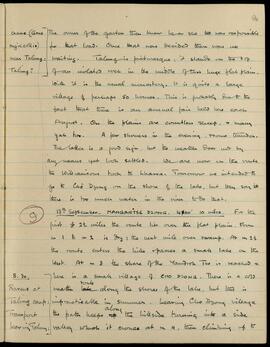
              The owner of the garden then knew he or she too was responsible for that load. Once that was decided there was no waiting. Talung is picturesque; it stands on the top of an isolated rock in the middle of this huge flat plain. With it is the usual monastery. It is quite a large village of perhaps 50 houses. This is probably due to the fact that there is an annual fair held here each August. On the plains are countless sheep, & many yak too. A few showers in the evening, some thunder. The latter is a good sign, but the weather does not by any means yet look settled. We are now on the route the Williamsons took to Lhasa. Tomorrow we intended to go to Chö Dzong on the shore of the lake, but they say there is too much water in the river to do that.

              (9)
              13th September. NANGARTSE DZONG. 14,500' 10 miles. For the first 2 1/2 miles the route lies over the flat plain. From m 1 to m 2 is dry; the next mile over swamp. At m 2 1/2 the route enters the hills & passes a small lake on the west. At m 3 the shore of the Yamdrok Tso is reached & here is a small village of CHO DZONG. There is a cold weather route along the shores of the lake, but this is impracticable in summer. Leaving Cho Dzong village the path keeps along the hillside turning into a side valley which it crosses at m 4, then climbing up to

              B. 30.
              Ravens at Talung camp:
              Transport leaving Talung:

              LSH/1/1/3/3/205 · Part · 1996-06-18
              Part of The Ludlow & Sherriff Collection

              SUMMARY:
              The diarist notes abundant P. rotundifolia near Taktsang and decides to cut across rather than go to Potrang. An officer in the Tibetan army from Lhasa, met at Tama La, initially questioned the diarist’s presence on the route but ultimately supported the party and reprimanded some coolies; he questioned Tenduk about the diarist and departed early for Potrang.

              CONTENT:
              ...been pretty hard at it since leaving Chienchar. The P. rotundifolia are in masses near here, and there are lots of bellidifolia too, but none of the red ones. I have decided not to go to Potrang but to cut across from here.

              22nd June. TAKTSANG. 4 miles. Approx 13,500'. Late in the evening an officer in the Tibetan army from Lhasa, who is on the pilgrimage, arrived at Tama La. I sent him tea and cake, and he came and called. At first he was a bit worried about my being on the 'kinglam' and thought I had no passport, and he asked my name. But eventually he was quite happy about everything. Some of the coolies - not the Chienchar ones, had been at him, so I heard. However he told them off pretty good and proper and said there was to be no nonsense, and that they were fairly to run over the pass with my stuff. He stayed till nearly dark, then I went and saw him, and came back to dinner at 7:30. He asked Tenduk all sorts of questions about me. One was, what were all those flowers for? Tenduk told him I took them home and put them up as decoration on the wall. He went on at 5:30 this morning to Potrang and we arranged to

              LSH/1/1/9/1/132 · Part · 1933-09-01
              Part of The Ludlow & Sherriff Collection

              SUMMARY:
              Heavy traffic on the route is attributed to HH’s fair in Bumthang beginning on the 7th, alongside plans for reforms such as cash payment for work. At Sumitang, the party had fine weather but a delayed start (likely due to Ngudup); the writer prefers Changchuk managing transport, and with most seed still unripe, Pasang will return in a month to collect target species from beyond Sharitang and around Bumthang/Kyikyi La, after noting a jelly-coated aquatic plant and cooler conditions than Bumthang.

              CONTENT:
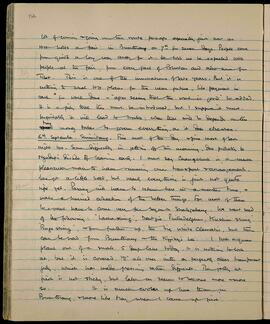
              Lot of coming and going on this route, perhaps especially just now as HH holds a fair in Bumthang on the 7th for seven days. People come from quite a long way away for it. He told me he expected 1,000 people at the fair, from every part of Bhutan and also some from Tibet. This is one of the innovations of late years. But it is nothing to what HH plans for the near future, like payment in cash for work done - "after seeing that the work is good" he added. It is a pity that this must be introduced, but I suppose it must. Inevitably it will lead to trouble; when that will be depends on the time money takes to govern everything, as it does elsewhere.

              6th September. Sumitang. Fine most of the day, and fine most of last night too. Some difficulty in getting off this morning, due probably to Ngudup's dislike of leaving early. I must say Changchuk is a much pleasanter man to have running one's transport arrangements. We got a little seed, but nearly everything is just not quite ripe yet. Pasang will have to return here in a month's time, and make a hurried collection of the better things. For most of these we would have to come very far beyond Sharitang. We want seed of the following: "Lachasung", Deutzia, Philadelphus, "Kushim sung", "Rugosung", and from further up, the big white Clematis, but this can be had from Bumthang or the Kyikyi La. I took a queer plant out of a small 5' deep lake today. It is nothing to look at, but it is covered, 1/8" all over with a perfectly clear transparent jelly, which has made pressing rather difficult. The jelly at first is not sticky, but later on seems to become more and more so. It is much cooler up here than in Bumthang, and more like May when I came up first.

              LSH/1/1/4/1/101 · Part · 1933-08-15
              Part of The Ludlow & Sherriff Collection

              SUMMARY:
              From Sumbatse, the diarist records seed collections and transport delays due to a troublesome headman, then stays overnight en route to Choram. Plans are outlined for a future trip to the Black Mountain in Bhutan and exploration of Pemako via Sadiya, and at Choram they meet Tsongpen, collect more Adonis seed, and note heavy showers and his reports from Tsari.

              CONTENT:
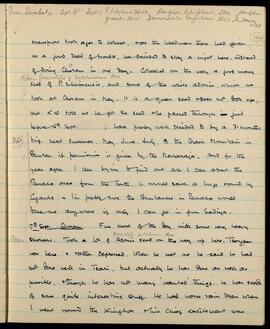
              From Sumbatse. Sept. 16th Seeds: Primula tibetica 2602, Adenophora liliifolia 2604, Adenophora gracilis 2605, Dracocephalum tanguticum 2607, Saussurea 2608.

              Transport took ages to collect, as the headman there had given us a good deal of trouble; we decided to stay a night here, instead of doing Choram in one day. Collected on the way a good many seeds of Primula sikkimensis, and some of the white Adonis (Adonis brevistyla var. dutchuensis 1600), which we took at Choram in May. It is a queer seed and does not look ripe, but K.W. told us he got the seed, and he passed through just before 15th Sept. I have pretty well decided to try a 3-month trip next summer, May, June, July, to the Black Mountain in Bhutan if permission is given by the Maharaja. And for the year after, I am trying to find out all I can about the Pemako area from the South. It would save a huge round by Gyantse, and I'm pretty sure the Bhutanese in Pemako would take me anywhere if only I can get in from Sadiya.

              17th Sept. Choram. Fine most of the day, with some very heavy showers. Took a lot of Adonis seed (Adonis brevistyla var. dutchuensis 1600) on the way up here. Tsongpen was here and rather depressed. When he met me he said he had not done well in Tsari, but actually he has done as well as possible; although he has not many 'wanted' things, he has seeds of some quite interesting stuff. He had worse rain than when I went round the Kingkor. His chief excitement was...

              LSH/1/1/1/1/120 · Part · 1933-08-03
              Part of The Ludlow & Sherriff Collection

              SUMMARY:
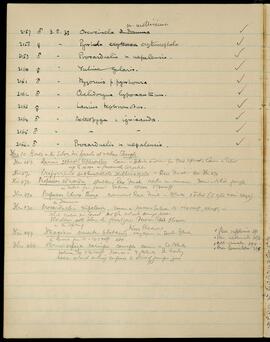
              Specimen entries 2157–2166 are listed with species identifications, one dated 3 August 1933. Notes reference Ibis on the occurrence and habitats of shrikes, rosefinches, and Blood Pheasant in silver fir and rhododendron forests at and above Shengbe, and across Bhutan and Tibet.

              CONTENT:
              m. mollissima
              2157 ♂ 3.8.33 Oreocincla dauma ✓
              2158 ♀ - Pyrrhula erythaca erythrocephala ✓
              2159 ♂ - Procarduelis n. nepalensis. ✓
              2160 ♀ - Yuhina gularis. ✓
              2161 ♂ - Myzornis p. pyrrhoura ✓
              2162 ♂ - Chelidorhynx hypoxanthum. ✓
              2163 ♀ - Lanius tephronotus. ✓
              2164 ♂ - Aethopyga i. ignicauda. ✓
              2165 ♂ - " - " - " ✓
              2166 ♂ - Procarduelis n. nepalensis. ✓

              Ibis 10. Birds in the Silver fir forests at & above Shengbe.
              Ibis 283. Lanius schach tephronotus. Common in Bhutan in summer from 9000 upwards. Common in Tibet up to 14000 in favourable localities.
              Ibis 470. Propyrrhula subhimachala subhimachala - Rose Finch. see Ibis 470
              Ibis 473. Propasser edwardsii. Skulking Rose Finch rather uncommon. Found in rhod. jungle in silver fir forest between 10000 & 13000 ft.
              Ibis 472. Propasser thura thura. Commonest Rose Finch in Bhutan & Tibet (S. of the main range) in summer.
              Ibis 474. Procarduelis nipalensis. Common in summer between 10 - 14000 ft, chiefly in rhod. & silver fir forest. One of the most active amongst rocks & boulders well above the forest zone. Feed on Rhod. blossom in the spring.
              Blood Pheasant
              Ibis 499. Ithaginis cruentus tibetanus. very common in Eastern Bhutan in summer from 11 - 14500 ft. etc.
              Ibis 468. Perissospiza carnipes carnipes common in W. Bhutan between 10 & 14000 ft. Scarcer in E. Bhutan. In breeding season almost entirely confined to dwarf juniper zone.

              ✓ Prim. sapphirina 391
              ✓ Prim. involucrata 393
              ✓ Mec. sinuata 394
              ✓ Prim. tenuiloba 395