Tibet

Elements area

Taxonomy

Code

Scope note(s)

    Source note(s)

      Display note(s)

        Hierarchical terms

        Tibet

          Equivalent terms

          Tibet

            Associated terms

            Tibet

              192 Archival description results for Tibet

              192 results directly related Exclude narrower terms
              LSH/1/1/3/3/178 · Part · 1983-05-05
              Part of The Ludlow & Sherriff Collection

              SUMMARY:
              Notes from Bimbi La in Tsari District, Tibet, list plant specimens and record a specimen of a new willow-warbler (Phylloscopus tibetanus). The page also notes gamebirds such as Sclater's Monal, Temminck's Tragopan, and Kuser's Blood-Pheasant near Migyitun, with a reference to Tetraophasis szechenyii seen on 31 May.

              CONTENT:
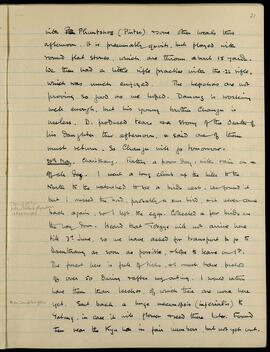
              Bimbi La June 6.
              Iris kumaonensis 1781.
              Gaultheria pyrifolia 1782.
              Pr. yargongensis 1783.
              Pedicularis diffusa 1784.

              Bimbi La - in Tsari Dist. 7 85 Tibet
              L. Ibis 47
              specimen of a new Willow-Warbler - Phylloscopus tibetanus.
              Ibis 198
              Bimbi La June 7
              Berberis telomaica var. atripala 1885.
              L. Ibis 47. Lonicera hispida 1786
              Sclater's Monal, Temminck's Tragopan Potentilla microphylla 1787
              Kuser's Blood-Pheasant are all to be found Rhod. paludosum 1788
              on the hills near Migyitun either Mec. horridula 1789
              here that we obtained our first specimen " simplicifolia 1790
              Prim. calosa 1791
              Tetraophasis szechenyii on 31 May where see
              Ibis 382.

              LSH/1/1/3/3/90 · Part · 1933-04-09
              Part of The Ludlow & Sherriff Collection

              SUMMARY:
              Notes describe Brahminy ducks inspecting nesting sites in cliff holes and deserted houses near the Dzong, with local reports that parents push chicks from nests while one waits below to break the fall. This account matches a story told to Ludlow at Gyantse ten years earlier. The page also includes various measurements and times.

              CONTENT:
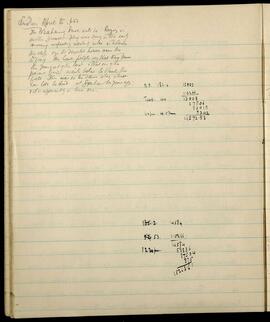
              Ludlow, April 15, p. 52
              The Brahminy duck will be laying in another 3 weeks. They were busy in the early morning inspecting nesting sites in holes in the cliffs or in the deserted houses near the Dzong. The local people say that they push the young out of the nest and that one of the parent birds waits below to break the fall. This is the same story which was told to Ludlow at Gyantse 10 years ago, and it is apparently a true one.

              B.P. 186.4 13903
              1.0266
              Temp. 44 13903
              27806
              83418
              4.0 pm 8342
              14272.82

              185.2 14584

              1. 1.0466
                14584
                12.30 pm. 58336
                87504
                875
                15263.61
              LSH/1/1/9/1/131 · Part · 1933-09-01
              Part of The Ludlow & Sherriff Collection

              SUMMARY:
              Halted in Bumthang, the diarist visited H.H., discussed plans regarding Paro and Chamurchi, local administrative matters including Tashi Drunyer, received reports from Lhasa about Kapsinpa Shape’s imprisonment, and noted heavy rain damage near Chenderi and the Ha–Chamurchi road area; Betty was expected in London, and Dorji was treated with penicillin and M&B 760. On 5th September they marched in rain to Shabjetang and observed a new Codonopsis common near the Dhur river, collecting tubers and another pressing.

              CONTENT:
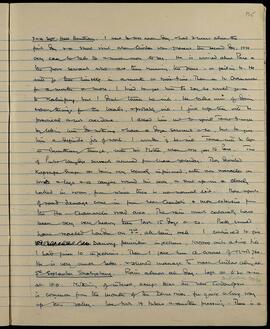
              3rd & 4th Sept. Halt Bumthang. I went to H.H. each day, had 3 hours alone the first day and a short visit, when Choden was present, the second day. H.H. was very easy to talk to and had much more to say. He is worried about Paro and the poor servants who are there running the place—or failing to. He will go there himself in a month or two's time. Then on to Chamurchi for a month or more. I tried to get him to say he would go on to Kalimpong, but I don't think he will. He talks now of doing many things for the locals, and probably will. I just hope they will be practical and not overdone. I asked him not to spoil Tashi Drunyer by letting him do nothing and have a dozen servants or so, but to give him a definite job of work. I wonder if he will. Tashi will be left in Bumthang though, with his brother, when H.H. goes to Paro. Two of Purbo Wangdi's servants returned from Lhasa yesterday. They described Kapsinpa Shape as being very securely imprisoned, with iron manacles on wrists and legs and a cangue round his neck, and shut up in a closely walled-in room, from which there is no normal exit. More reports of road damage come in from near Chenderi and more extensive from the Ha-Chamurchi road area. The rain must certainly have been very, very heavy these last 15 days or so. Betty should have reached London on the 3rd, all being well. I continued to give Dorji penicillin injections, 100,000 units at a time till I had given 10 injections. Then I gave him a course of M&B 760. He is very much better and should manage to reach Ludlow all right.

              5th September Shabjetang. Rain almost all day. Left at 6:30 and in at 10:00. Nothing of interest, except that the new Codonopsis (Convolvulaceae 19674) is common from the mouth of the Dhur river, for quite a long way up this valley. We took 14 tubers and another pressing. There is a...

              LSH/1/1/2/1/116 · Part · 1933-07-18
              Part of The Ludlow & Sherriff Collection

              SUMMARY:
              The diarist collected many butterflies before 11 a.m., while Sherriff dug Paraquilegia from rocky cliffs, though its survival seemed doubtful. Yak transport arrived from Meishang via a route west of Tsona, crossing the Nyap-La, passing Poppa Chu Tso lake, and ascending the Forke-La in the Donka Range with wide views over the Tibetan plateau.

              CONTENT:
              Ludlow p. 84. I caught a nice lot of butterflies in the morning before 11 a.m. including 16 Parnassius imperator. Sherriff was busy digging out a big batch of Paraquilegia from the rocks. The tap root of this plant is very long, worming its way downward through cliffs and cracks in the solid rock in a most astonishing way. I doubt very much whether the plant will survive.

              Ludlow p. 85. Yak transport arrived this morning. It has come all the way from Meishang, 2 marches away. The route led up the valley to the west of Tsona and entered undulating country with flat plains at intervals on which many yaks were grazing. Over the Nyap-La and past the Poppa Chu Tso lake then ascended the Forke-La, a pass in the Donka Range flanked to the north by a magnificent snow massif. At the summit of the pass we had a magnificent and extensive view of the Tibetan plateau stretching away to the East.

              LSH/1/1/6/1/101 · Part · 1933-07-05
              Part of The Ludlow & Sherriff Collection

              SUMMARY:
              The diarist camps west of Tsanang La amid continuous heavy rain, blocked by an unfordable river despite promising ground nearby. On 17 July, with Tsongpen and the coolies, they fell a fir to make a bridge, contend with sick porters and poor arrangements by Kusho (threatened with being sent back to Gyantse), note route timings between passes, and record several plant collections.

              CONTENT:
              Tsanang La

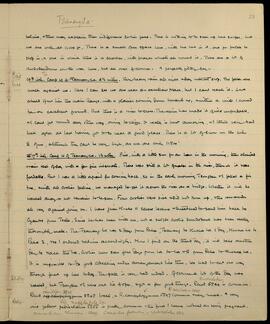
              believe, others may explain their indifference to his face. There is nothing to be seen up here so far, but we are only at 11,000 ft. There is a small open space here, with two huts in it, one for people to stop in and one in which there is a chorten, with prayer wheels all round it. There are a lot of rhododendrons on the way here, but all over of course. A perfectly filthy day—

              16th July. Camp W of Tsanang La. 4 1/2 miles. Very heavy rain all night and day without stop. The fates are much against us. Here I can see we are near an excellent place, but I can't reach it. Just ahead of us lies the main range, with a glacier coming down towards us, and within a mile I could be on excellent ground. But there is a river to cross. The rain has made it quite unfordable, and I can't get round any other way, owing to cliffs. It really is most annoying, and I think very bad luck after at last having got so near a good place. There is a lot of snow on the hills to the E of us, although they can't be very high, as we are only 11,800'.

              17th July. Camp W of Tsanang La. 1 1/2 miles. Fine, with a little sun for an hour in the morning, then clouded and rain rest of day with a few fine intervals. There was still a lot of water in the river, though it was fordable. But I was a little afraid for coming back, so in the early morning Tsongpen and I felled a fir tree, and with all coolies pulling, we managed to get it across the river as a bridge. Whether it will be washed away or not remains to be seen. Four coolies were sick and did not turn up, the remainder all very against going on. I have given Kusho a severe lecture and threatened to send him back to Gyantse from Tsola. Since he has been with me, not a single coolie bundobast has been really thoroughly made. The Tsanang La was 2 days from Paha, Tsanang to Kucha La 1 day, Kucha La to Paha 2, so I ordered rations accordingly. Now I find on the third day, it will take another day to reach the La. Coolies now say four days from La to La and 5 from Paha to Kucha La. It is impossible to do good collecting under arrangements like this. We had to cut our way through forest up here today. The path is very bad indeed. Of course a lot of the day was wasted, but Tsongpen and I were out till 4.0 pm, and got a few good things. Rhod 5844 (trichocladum) is common. Rhod aff charitope 5848 local, and R. campylogynum 5847 (R. calostrotum 3855) common very small. A very nice yellow Pedicularis 5858 (Ped. megalochila La) is pretty common—the first I have noticed as being fragrant. Cremanthodium thomsonii 5809. Cremanthod. palmatum v. rhodocephalum 5852.

              LSH/1/1/3/3/145 · Part · 1983-05-05
              Part of The Ludlow & Sherriff Collection

              SUMMARY:
              Notes plant specimens and habitats around Cha La, with route details toward Zimsathi and mention of the Takar La being snowbound. Records Lumsden treating a local woman and reports local news about the Rimpoche's daughter and proposed marriage ties with the Bhutan Maharani's family.

              CONTENT:
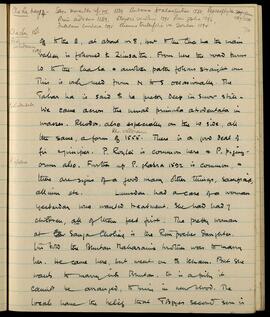
              Cha La May 14 - Saxifraga monantha sp. nov. 1584, Anemone brahmaputrae 1585, Pegophyton scapiflorum 1587, 1588, Primula advena 1589, Lloydia serotina 1591, Primula glabra 1592, Fritillaria cirrhosa 1595, Anemone trullifolia var. linearis 1594.

              Cha La 15th 70
              Rhododendron paludosum 1598
              Off to the E, at about N 8, but to the Cha La the main valley is followed to Zimsathi. From here the road turns W to the Cha La. Another path follows straight on. This is only used from N to S occasionally. The Takar La is said to be pretty deep in snow still.

              Primula atrodentata
              We came across the usual Primula atrodentata in masses. Rhododendrons also especially on the W side, all the same, a form of 1555 (Rhododendron vellereum). There is a good deal of fir and juniper. Primula roylei is common here and Primula pygmaeorum also. Further up Primula glabra 1592 is common, and there are signs of a good many other things, saxifrage, allium etc.

              Lumsden had a case of a woman yesterday who wanted treatment. She had had 7 children, all of them feet first. The pretty woman at Sangacholing is the Rimpoche's daughter. He told the Bhutan Maharani's mother was to marry her. He came here, but went on to Kham. But she wants to marry into Bhutan. It is a pity it cannot be arranged, to bring in new blood. The locals have the belief that Tobgye's second son is...

              LSH/1/1/4/1/114 · Part · 1933-09-24
              Part of The Ludlow & Sherriff Collection

              SUMMARY:
              Notes two records from Chame at 10,300 ft on 28 Sept: a female Turnix maculatus tanki flushed from dry tufts in the pebbly bed of the Cha Chu, and a male Hirundo rustica gutturalis. The quail's altitude is considered extraordinary, and the swallow is thought to be a migrant rather than breeding in Tibet.

              CONTENT:
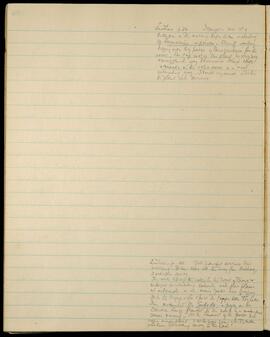
              L.

              L. Ibis 388 Turnix maculatus tanki. ♀ Chame 10,300 ft. 28 Sept.
              This seems an extraordinary altitude at which to obtain this Bustard Quail.
              Chame is in the dry zone, north of the main range. It was flushed amidst
              tufts of dry trifid in the pebbly bed of the Cha Chu. We saw no others.

              Ibis 361 Hirundo rustica gutturalis. ♂ Chame 10,300. 28 Sept.
              I do not think this swallow breeds anywhere in Tibet. It was no doubt
              passing from the north.

              LSH/1/1/1/1/25 · Part · 1933-05-11
              Part of The Ludlow & Sherriff Collection

              SUMMARY:
              French tourists arrived, forcing the party to clear half the bungalow while bird specimens were drying, and the author notes their early routine. At Changu Tsomgo on 11th May, coolies brought needed stores and mail, and Danong returned with news that his brother had gone to Yatung via the Jelep La. Two lamas lost two mules in deep snow, and help was requested from the Divisional Engineer as they arranged for their own mules and set off early.

              CONTENT:
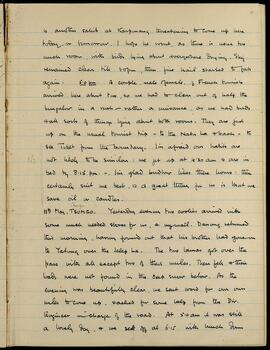
              is another sahib at Karponang threatening to come up here today or tomorrow. I hope he won't, as there is none too much room, with birds lying about everywhere drying. Sky remained clear till 1.0 p.m., then fine hail started to fall again. 5.0 p.m. A couple, male and female, of French tourists arrived here about two, so we had to clear out of half the bungalow in a rush — rather a nuisance, as we had birds and all sorts of things lying about both rooms. They are just up on the usual tourist trip — to the Natu La and back — to see Tibet from the boundary. I'm afraid our habits are not likely to be similar: we get up at 4.30 a.m. and are in bed by 8.15 p.m. I'm glad Ludlow likes these hours: they certainly suit me best, and a great thing for us is that we save oil or candles.

              11th May, Changu Tsomgo. Yesterday evening two coolies arrived with some much needed stores for us, and my mail. Danong returned this morning, having found out that his brother had gone on to Yatung over the Jelep La. The two lamas got over the pass with all except two of their mules. These fell and their loads were not found in the deep snow below. As the evening was beautifully clear, we sent word for our own mules to come up, and asked for some help from the Div. Engineer in charge of the road. At 5.0 a.m. it was still a lovely day, and we set off at 6.15 with much down

              LSH/1/1/3/3/102 · Part · 1933-04-09
              Part of The Ludlow & Sherriff Collection

              SUMMARY:
              Notes list characteristic birds of Chayal Dzong with distribution observations across the Tsangpo and nearby regions. Locality records include sightings at Trimo (April 1936) and Keupup, Sikkim (Feb. 1938), with mentions of areas such as Subansiri, Gyamda Chu, and Tsari.

              CONTENT:
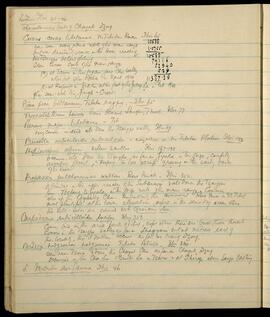
              Ludlow Ibis 45-46
              Characteristic birds of Chayal Dzong

              Corvus corax tibetanus The Tibetan Raven - Ibis 65
              Was seen everywhere north of the main range
              but was decidedly scarce in the lower reaches of
              the Tsangpo below Lilung.
              Seen twice south of the main range
              (a) at Trimo in the Nyam Jang Chu valley
              at the foot of the Poda in April 1936
              (b) at Keupup in Sikkim at the foot of the Jelep La in Feb. 1938
              Often seen with the Jungle-Crow.

              Pica pica bottanensis Tibetan Magpie. - Ibis 65

              Trochalopteron henrici Prince Henri's Laughing Thrush. Ibis 77

              Parus major tibetanus - Tit
              Very common indeed all down the Tsangpo valley. Ibis 67

              Prunella rubeculoides rubeculoides - everywhere on the Tibetan Plateau Ibis 192

              Phylloscopus affinis Willow Warbler. Ibis 197-198.
              Occurs all down the Tsangpo as far as Gyala in the Gorge, carefully
              avoiding forest, keeping to low scrub growing on the sandy banks
              of the river.

              Propasser pulcherrimus waltoni Rose Finch. Ibis 352.
              Abundant in the upper reaches of the Subansiri & all down the Tsangpo
              from Tsetang to Gyala in the Gorge north of the main range common
              also up the Gyamda Chu. Undoubtedly the commonest Rose Finch in SE Tibet
              most plentiful at the lower elevations especially in the semi-dry areas where
              the hill-sides are covered with Quercus ilex.

              Carpodacus rubicilloides lucifer Ibis 353
              Common bird in the arid parts of Tibet, especially where there are buckthorn thickets
              Common in the Tsangpo Valley as far as Lhagyari but not noticed east of
              this locality, though it doubtless occurs as far as Nang Dzong.

              Perdix hodgsoniae hodgsoniae Tibetan Partridge. Ibis 384.
              Seen near Tsong & down the Chayal Chu as far as Chayal Dzong.
              Occurred on the Cha La & Bimbi La in Tsari & at Shira above Sanga Chöling

              L Describe avifauna Ibis 46

              LSH/1/1/1/1/47 · Part · 1933-05-29
              Part of The Ludlow & Sherriff Collection

              SUMMARY:
              The writer describes playing a local stone-throwing game with Phuntshog (Pintso), some rifle practice, and issues with Lepcha assistants, deciding that Changu will return. On 29th May at Charithang they climbed to see a bird’s nest, collected a few birds, learned Tobgye will not arrive until 3rd June, planned to go to Damthang on the 1st, dealt with many ticks, and sent a large Meconopsis (imperialis) to Yatung after finding plants near the Kyu la not yet in flower.

              CONTENT:
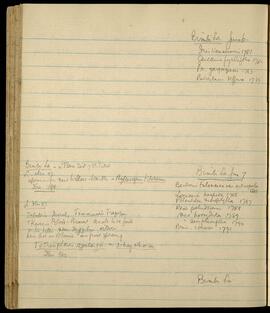
              21

              with Phuntshog (Pintso) and some other locals this afternoon. It is presumably quoits, but played with round flat stones, which are thrown about 15 yards. We then had a little rifle practice with the .22 rifle, which was much enjoyed. The Lepchas are not proving so good as we hoped. Danong is working well enough, but his young brother Changu is useless. D. produced tears and a story of the death of his daughter this afternoon, and said one of them must return. So Changu will go tomorrow.

              29th May. Charithang. Rather a poor day, with rain on and off all day. I went a long climb up the hills to the North to the watershed to see a bird's nest. We found it but I missed the bird, probably a sun bird, and it never came back again, so I left the eggs. Collected a few birds on the way down. Heard that Tobgye will not arrive here till 3rd June, so we have asked for transport to go to Damthang as soon as possible, and hope to leave on 1st. The forest here is full of ticks, and I must have picked off over 50 during my outing. I would rather have them than leeches, of which there are none here yet. Sent back a huge meconopsis (imperialis) to Yatung, in case it will flower and seed there later. Found them near the Kyu la in fair numbers, but not yet out.