Tibet

Elements area

Taxonomy

Code

Scope note(s)

    Source note(s)

      Display note(s)

        Hierarchical terms

        Tibet

          Equivalent terms

          Tibet

            Associated terms

            Tibet

              192 Archival description results for Tibet

              192 results directly related Exclude narrower terms
              LSH/1/1/1/1/12 · Part · 1933-05-01 - 1933-09-01
              Part of The Ludlow & Sherriff Collection

              SUMMARY:
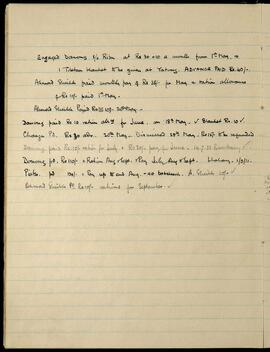
              Page records advances, monthly pay, and ration allowances for expedition staff, including a Tibetan blanket to be given at Yatung. Notes include multiple May payments, Changu’s dismissal and refund, and later disbursements at Bumthang and Phari.

              CONTENT:
              Engaged Danong son of Ribu at Rs 30 + 10 a month from 1st May, &
              1 Tibetan blanket to be given at Yatung. ADVANCE PAID Rs. 40/-.
              Ahmad Sheikh paid monthly pay of Rs 35/- for May & ration allowance
              of Rs 10/- paid 1st May.
              Ahmad Sheikh paid Rs 10/- 28th May.
              Danong paid Rs 10 ration allowance for June on 18th May. Blanket Rs. 10.
              Changu paid Rs 30 advance 20th May. Dismissed 29th May. Rs 15/- to be refunded.
              Danong paid Rs. 10/- ration for July & Rs 30/- pay for June - 14.7.33 Bumthang.
              Danong paid Rs 110/- = Ration Aug Sept. & Pay July Aug & Sept. Phari 1/9/33.
              Pintso paid 120/- = Pay up to end Aug. + 40 baksheesh. A. Sheikh 10/-
              Ahmad Sheikh paid Rs 10/- rations for September.

              LSH/1/1/7/1/8 · Part · 1940-05-24
              Part of The Ludlow & Sherriff Collection

              SUMMARY:
              Notes compare vegetation in the Tsangpo valley with that near Kyimdong Dz, highlighting distribution differences. Plants usually confined to south slopes are observed north of the Himalayas due to increased rainfall passing the barrier, with examples including Magnolia globosa, Lilium giganteum, and possibly Nymphaea.

              CONTENT:
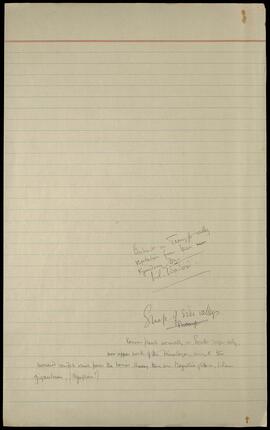
              Contrast in Tsangpo valley
              vegetation from that near
              Kyimdong Dz-
              Lil. Wardii.

              Shape of side valleys Swamp

              Various plants normally on South slopes only,
              now appear north of the Himalayas, owing to the
              increased rainfall which passes the barrier. Among these are Magnolia globosa, Lilium
              giganteum, (Nymphaea?)

              LSH/1/1/2/1/122 · Part · 1933-07-18
              Part of The Ludlow & Sherriff Collection

              SUMMARY:
              The party left Tsona for Dongkar via the Gorpo La, re-entering the Nyam Jang Chu valley in dry, sunny conditions and noting several bird records. They descended the Nyam Jang Chu, crossed the Cho La into the wetter Taree Rong Chu Valley, then on 22 Aug crossed the Me La to resume camp at Shengbe, with views over the Nyam Dzong Chu Valley from the Tibetan plateau. Notes reference related descriptions in Ludlow’s pages 89–92.

              CONTENT:
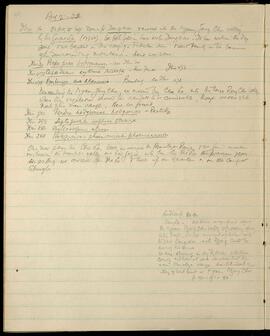
              Aug 15-22

              Hrs 16. On Aug 15 left Tsona for Dongkar, re-entered into the Nyam Jang Chu valley by the Gorpo La, (17,750). We both fell in love with Dongkar. It lies within the dry zone & we basked in the rays of a Tibetan sun & saw beauty in the bareness of the surrounding mountains. Here we saw
              Hrs 30 Pica pica bottanensis - see Hrs 30
              Hrs 473 Carpodacus erythrinus roseatus - Rose Finch Hrs 473
              Hrs 478 Emberiza cia khamensis - Bunting see Hrs 478

              Descending the Nyam Jang Chu, we crossed the Cho La into the Taree Rong Chu Valley, where the vegetation showed the rainfall to be considerable, though we were still north of the main range. Here we found
              Hrs 501. Perdix hodgsoniae hodgsoniae - Partridge
              Hrs 293 Leptopoecile sophiae obscura
              Hrs 386 Phylloscopus affinis
              Hrs 268 Hodgsonius phoenicuroides phoenicuroides

              Our new pass, the Cho La, took us across the Himalayan Range, & we overlooked the beautiful valley we had gazed into from the Me La the previous year. On 22 Aug we crossed the Me La & took up our quarters in our old camp at Shengbe.

              Ludlow p. 89-90
              Sangla - we had a magnificent view of
              the Nyam Dzong Chu Valley stretching away
              to the North, whilst immediately below us to
              the west Dongkar with Dzong could be
              easily discerned.
              We were standing on the Tibetan plateau
              country & it was at once realized that the
              main Himalayan range was to the south of us.
              Story of lost bird in Nyam Dzong Chu
              p. 90-91-92

              LSH/1/1/2/1/65 · Part · 1933-07-18
              Part of The Ludlow & Sherriff Collection

              SUMMARY:
              At Tsona, the party hiked above camp, photographed Paraquilegia grandiflora, collected butterflies, and shot a few birds, then spent the afternoon developing and packing, leaving a dump of 11 boxes. Mail arrived after a month; Kurtip recovered, and it is noted that permission to reach the area was hard-won in Lhasa, while Pintso had exaggerated the cost of gifts given earlier.

              CONTENT:
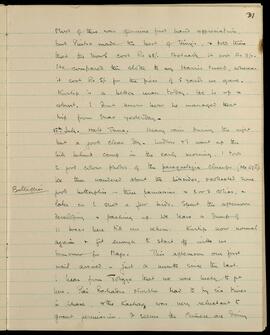
              31

              Most of this was genuine first-hand appreciation, but Pintso made the best of things, and told them that the bowl cost Rs 45/-. Actually it cost Rs 8/-. He compared the cloth to my Harris tweed, whereas it cost Rs 5/- for the piece of 5 yards we gave. Kurtip is a better man today. He is up and about. I don't know how he managed that trip from Shao yesterday.

              18th July. Halt Tsona. Heavy rain during the night, but a good clear day. Ludlow and I went up the hill behind camp in the early morning. I took 2 good colour photos of the Paraquilegia grandiflora (No 678). We then wandered about the hillsides, and collected some good butterflies - three Parnassius and 2 or 3 Colias, - later on I shot a few birds. Spent the afternoon developing and packing up. We leave a dump of 11 boxes here till our return. Kurtip now normal again and fit enough to start off with us tomorrow for Mago. This afternoon our first mail arrived - just a month since the last. I hear from Tsona that we were lucky to get here. Rai Bahadur Norbhu had to try six times in Lhasa, the Kashag was very reluctant to grant permission. It seems the Chinese are doing

              LSH/1/1/2/1/117 · Part · 1933-07-18
              Part of The Ludlow & Sherriff Collection

              SUMMARY:
              The diarist halts at Tsona, collects and packs Paraquilegia and catches Parnassius butterflies, while dealing with staff illness and asking the Dzongpen to arrange further collection and forwarding to Sahden amid rainy, snowy weather. Delays occur when yaks fail to arrive under the Tibetan 'Tao' system, with details of payments and origins from the Mago direction. The party then camps west of Gorpa La, noting barometric readings for nearby passes and Dongkar, and a route skirting Tsona hill.

              CONTENT:
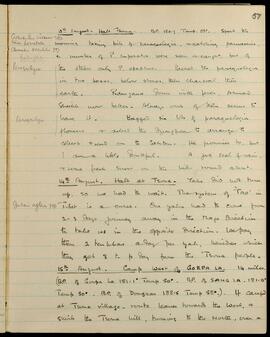
              57

              13th August - Halt Tsona. B.P. 186.7 Temp. 58°. Spent the morning taking bits of Paraquilegia, & catching parnassius, a number of P. imperator were seen & caught, but of the others only P. epaphus. Packed the Paraquilegia in two boxes, below stones, then charcoal, then earth. Ramzana down with fever. Ahmad Sheikh now better. Always one of them seems to have it. Bagged six lots of Paraquilegia flowers, & asked the Dzongpen to arrange to collect & send on to Sahden. He promises to, but I am a little doubtful. A good deal of rain, & some fresh snow on the hills round about.

              [Marginal notes: Cyananthus incanus 794, Meconopsis horridula, Clematis orientalis 797, Butterflies, Paraquilegia]

              14th August. Halt at Tsona. Yaks did not turn up, so we had to wait. The system of 'Tao' in Tibet is a curse. Our yaks had to come from 2-3 days journey away in the Mago direction to take us in the opposite direction. We pay them 2 tankas a day per yak, besides which they get 3 tankas per day from the Tsona people.

              [Marginal note: Gentiana aglaia 798]

              15th August. Camp West of GORPA LA. 14 miles. (B.P. of Gorpa La 181.1" Temp 50°. B.P. of SANG LA. 181.9" Temp 50°. B.P. of Dongkar 188.5 Temp 58°.). If camped at Tsona village, route leaves towards the West, & skirts the Tsona hill, turning to the North, over a

              LSH/1/1/2/1/54 · Part · 1933-07-08
              Part of The Ludlow & Sherriff Collection

              SUMMARY:
              Notes from Tsona and the ascent to the Kechar La describe entry into true Tibetan plateau country, with ravens, horned larks, mountain finches, and stunted flowers characteristic of the region. Observations include abundant plateau species and marshland birds such as Melanocorypha maxima, Montifringilla ruficollis, Grus nigricollis, and Sterna hirundo tibetana around Tsona and nearby marshes.

              CONTENT:
              13733
              54932
              14282

              Tsona
              BP = 186.7° Temp. 13733

              Ibis 15.
              July 15.
              The Kechar La seems to be on the main range, for here we saw 104 =

              Ibis 481 Otocorys alpestris elwesi — abundant Tibetan plateau.
              Ibis 478 Fringalauda brandti haematopygia — common in suitable localities on the Tibetan Plateau.
              Whilst a few miles to the north brought us to Plateau country on which
              Melanocorypha maxima, Montifringilla ruficollis etc. were abundant.
              Ibis 481 Melanocorypha maxima Lark — Ibis 481
              Ibis 477 Montifringilla ruficollis abundant Tibetan Plateau.
              On the Tsona marshes several waders were noted as well as
              Ibis 503 Grus nigricollis
              Ibis 502 Sterna hirundo tibetana — frequently seen — lakes & marshes of the Tibetan Plateau.

              Ludlow p. 47
              On the ascent to the Kechar La
              we passed into true Tibetan country.
              Ravens, horned larks, mountain
              finches as well as numerous
              stunted flowers all proclaimed the
              fact that we were now in true
              Tibetan plateau country.

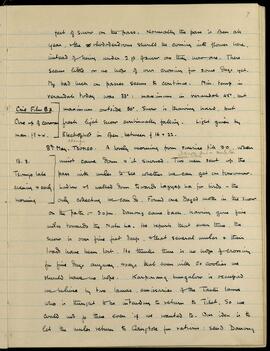
              LSH/1/1/1/1/19 · Part · 1933-05-08
              Part of The Ludlow & Sherriff Collection

              SUMMARY:
              Heavy snow has closed the pass near Tsomgo, with temperatures around freezing and ongoing snowfall; film and exposure notes are recorded. On 8th May, Danong scouted towards the Natu La and reported over five feet of snow and lost mule loads, leading to plans to send mules back to Gangtok for rations. Karponang bungalow is reportedly occupied by two lamas, emissaries of the Tashi Lama, preventing use of that stop.

              CONTENT:
              7

              feet of snow on the pass. Normally the pass is open all
              year, the rhododendrons should be coming into flower here,
              instead of being under 2 ft of snow as they now are. There
              seems little or no hope of our crossing for some days yet.
              My bad luck on passes seems to continue. Min. temp in
              verandah today was 33°: maximum in verandah 45°, but
              maximum outside 50°. Snow is thawing hard, but
              fresh light snow continually falling. Light given by
              Electrophot in open, between f 16 & 22.

              Cine Film B3.
              Close up of caravan man. f 8 & x.

              8th May. TSOMGO. A lovely morning from sunrise till 9.0, when
              mist came down and it snowed. Two men (Danong and a muleteer,
              Lepcha Coleen) sent up the pass with mules to see whether we can get on tomorrow.
              Ludlow and I walked down towards Lagyap La for birds - the
              only collecting we can do. Found one dazed moth in the snow
              on the path. 3.0 pm. Danong came back, having gone five
              miles towards the Natu La. He reports that even there, the
              snow is over five feet deep, and that several mules and their
              loads have been lost. He thinks there is no hope of crossing
              for five days anyway, and says that even with 50 coolies we
              should have no hope. Karponang bungalow is occupied
              we believe by two lamas, emissaries of the Tashi Lama
              who is thought to be intending to return to Tibet. So we
              could not go there even if we wanted to. Our idea is to
              let the mules return to Gangtok for rations: send Danong

              B. 3.
              Tsomgo lake evening and early morning

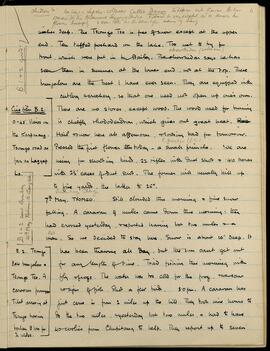
              LSH/1/1/1/1/17 · Part · 1933-05-06
              Part of The Ludlow & Sherriff Collection

              SUMMARY:
              Notes describe hiring a Lepcha collector named Danon, severe snow and hail at Tsomgo Tso, attempts at fishing and bird collecting, and excellent bungalow provisions. Mentions cine film of the Karponang–Tsomgo road, pressing a primula, caravans struggling in deep snow with losses, and arrangements involving Bombay and a return to Gangtok.

              CONTENT:
              Ludlow 6. We have a Lepcha-collector called Danon to help us with flowers. He has worked for the Botanical Survey of India and should be very helpful as he knows his flowers thoroughly and even tells us the scientific names of many.

              B.1 & 2 good

              inches deep. The Tsomgo Tso is free of snow except at the upper end. Ten tufted pochard on the lake. Too wet to try for trout, which were put in by Bailey. The chowkidar (watchman) says he has seen them in summer at the lower end, not at the top. These bungalows are the best I have ever seen. They are equipped with cutlery and crockery, so that one need not open up one's own.

              Cine film B.2. 0-45'. Views on the Karponang-Tsomgo road as far as Lagyap La.

              There are no stores, except wood. The wood used for burning is chiefly rhododendron, which gives out great heat. Hail and snow here all afternoon, looking bad for tomorrow. Pressed the first flower today - a small primula (P. gracilipes (L & S)). We are using for shooting birds, .22 rifles with dust shot and .410 bores with 2 1/2" cases of dust shot. The former will usually kill up to five yards, the latter to 25".

              B.1 & 2 sent Bombay 10th May. Return to Gangtok.

              7th May. TSOMGO. Still clouded this morning and fine snow falling. A caravan of mules came down this morning: they had crossed yesterday, and reported having lost two mules and a man. So we decided to stay here. Snow is about 10" deep. It has been thawing all day, but the sun can't get out for any length of time. Tried fishing this morning with fly and frogs. The water was too cold for the frog, and we saw no signs of fish. Shot a few birds. 3.0 pm. A caravan has just come in from 2 miles up the hill. They took nine hours to do the two miles, and yesterday lost two mules, and had to have 40 coolies from Chupitang to help. They report up to seven

              B.2. Tsomgo dak bungalow. Tsomgo Tso. A caravan from Tibet arriving at Tsomgo having taken 9 hrs for 2 miles.

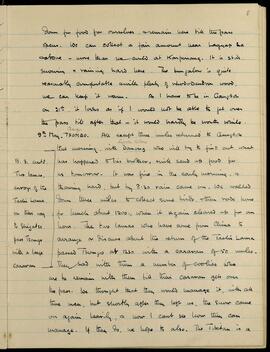
              LSH/1/1/1/1/21 · Part · 1933-05-09
              Part of The Ludlow & Sherriff Collection

              SUMMARY:
              The party remains near Tsomgo waiting for the pass to open, collecting near Lagyap La, with the diarist noting a likely delay in reaching Gangtok by the 21st. On 9 May at Tsomgo (Changu), most mules returned to Gangtok with Danong to seek his brother and send food; after collecting birds during a brief clear spell, two lamas—envoys of the Tashi Lama—passed with a 50‑mule caravan bound for Shigatse despite heavy snow.

              CONTENT:
              8
              down for food for ourselves, and remain here till the pass
              opens. We can collect a fair amount near Lagyap La
              above - more than we could at Karponang. It is still
              snowing and raining hard here. The bungalow is quite
              reasonably comfortable and with plenty of rhododendron wood,
              we can keep it warm. As I have to be in Gangtok
              on 21st, it looks as if I would not be able to get over
              the pass till after that - it would hardly be worth while.

              9th May. TSOMGO (Changu). All except three mules returned to Gangtok
              this morning, with Danong (Lepcha Collector) who will try to find out what
              has happened to his brother, and will send up food for
              us tomorrow. It was fine in the early morning, and
              thawing hard, but by 8:30 rain came on. We walked
              down three miles to collect some birds, and then rode home
              for lunch about 12:00, when it again cleared up for an
              hour. The two lamas who have come from China to
              arrange or discuss about the return of the Tashi Lama
              passed Tsomgo at 12:30 with a caravan of 50 mules.
              They had with them a number of coolies who
              are to remain with them till their caravan gets over
              the pass. We thought that they would manage it, with all
              these men, but shortly after they left us, the snow came
              on again heavily, and now I can't see how they can
              manage. If they do, we hope to also. The Tibetan is a

              B. 3. contd. Two lamas, envoys of the Tashi Lama, on their way to Shigatse, pass Tsomgo with a large caravan.

              LSH/1/1/1/1/27 · Part · 1933-05-11
              Part of The Ludlow & Sherriff Collection

              SUMMARY:
              The diary notes collecting near Lagyap la with birds feeding on blooming rhododendrons amid rain and snow. At Tsomgo (Changu), snow was melting, coolies reported the pass fair, and a lost mule returned, though their own mules were delayed. The party moved toward Chumbi Valley to Chumpithang, disputing a bill from a Gangtok Kazi while en route to Yatung.

              CONTENT:
              towards Lagyap la, to collect. There is not so much snow
              there also more birds are to be found. A few rhododendrons
              were in bloom, & various birds - finches & sun birds were
              feeding on the flowers & fertilising them. It came on to rain
              & later snow at 10.15 & cleared up more or less at
              2.30 pm. Since we left Calcutta on 22nd April, there has
              not yet been one day wholly fine & usually part of the
              day has been very wet indeed.

              12th May. TSOMGO. (CHANGU). Another fine night, & snow
              melting hard all day although sky overcast. A few coolies
              came over the pass from Chubitang, & report road fair.
              One of the mules which fell off the road seven days ago
              was brought in today - very thin, but otherwise alright.
              Our mules did not arrive, as they should have done. We did
              little all day but pack up.

              To Chumbi Valley.
              13th May. CHUMPITHANG. 12600'. 10 miles. Last night was a lovely
              night again, but there was no sign of the mules when we got
              up at 4.30. However they arrived about 6.30 in time to let
              us get away at last. The Kazi who owns the mules sent
              them up late, & had the audacity to send with them a
              bill for Rs. 90/-. We will of course refuse to pay, as the
              contract was to take us from Gangtok to Yatung. If the
              pass can't be crossed, that is none of our fault. All the
              Gangtok Kazis are stinkers, but I'm afraid I will have some