Tibet

Elements area

Taxonomy

Code

Scope note(s)

    Source note(s)

      Display note(s)

        Hierarchical terms

        Tibet

          Equivalent terms

          Tibet

            Associated terms

            Tibet

              192 Archival description results for Tibet

              192 results directly related Exclude narrower terms
              LSH/1/1/8/1/15 · Part · 1946-11-14
              Part of The Ludlow & Sherriff Collection

              SUMMARY:
              The diary records a march from Rapdang to Tromda, followed by several halt days due to missing transport and delays, during which repairs were made and a cold bath taken in the Tsangpo. Samduprup was sent to Guru Namgyel Dz. and returned with orders to wait three days, and the Dzongpon’s envoy asked for the lamyig. A report is noted about an earlier plane crash near Langong (Langong Phu Chu), including details of four deceased men and insignia on the aircraft.

              CONTENT:
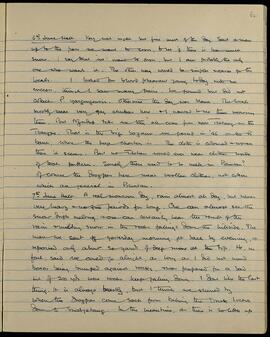
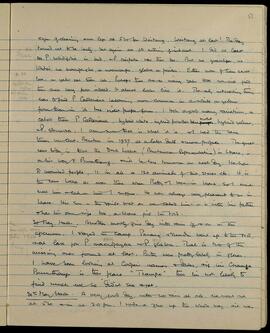
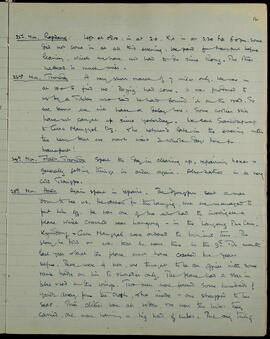
              22nd Nov. Rapdang. Left at 0800: in at 2.0. Kit in at 2.30 till 6.0pm: some did not come in at all this evening. We paid for transport before leaving, which we have not had to do since Rong. The other method is much nicer.

              23rd Nov. Tromda. A very short march of 7 miles only. We were in at 10.0 to find no 'dayig' had come. It was produced to us by a Tibetan who said he had found it on the road. So we know we will have a delay here. Some coolies still have not caught up since yesterday. We sent Samduprup to Guru Namgyel Dz. He returned late in the evening with the news that we must wait 3 whole days here for transport!

              24th Nov. Halt. Tromda. Spent the day in clearing up, repairing boxes & generally getting things in order again. Also bathed in a very cold Tsangpo.

              25th Nov. Halt. Again spent in repairs. The Dzongpon sent a man down to see us. He asked for the lamyig, but we managed to put him off. He was one of two who had to investigate a plane which crashed near Langong - in the 'Langong Phu Chu'. Kyindong & Guru Namgyel were ordered to look into this. The story he told us was that he went there in the 9th Tib month last year & that the plane must have crashed two years before. There were 4 men, one thought to be an officer with some rank badge on his R shoulder only. The plane had a star in blue & red on the wings. Two men were found some hundreds of yards away from the crash, two inside - one strapped to his seat. Their clothes were all rotten, so were the notes they carried, one man having a big wad of notes. The only thing...
              LSH/1/1/9/1/33 · Part · 1949-05-06
              Part of The Ludlow & Sherriff Collection

              SUMMARY:
              A local messenger is sent over the Sebri La to Charkakora to arrange a meeting at Pangkar. After heavy rain, the Kuomo Chu bridge is washed away; two Tibetans visit from Tsari Chikchar, Pasang departs for Julu to collect mice, and Ngudup recounts a recent landslip that killed 11 people. The following day brings more rain, little of botanical interest, and hopes for a letter from Betty.

              CONTENT:
              by sending a local over the Sebri La to Charkakora. I said then back in four days, so as to meet me at Pangkar. A man agreed at the great cost of Rs 7/- + the chance of a tip! So off he goes early tomorrow.

              28th April. Halt. We had an absolute deluge of rain last night till a late hour, & that finished the rain for a little, as today has been perfect. But the bridge over the Kuomo Chu was washed away early this morning. It is as well we did our tour on the other side yesterday. The bridge even then was very shaky, & I knew it would soon go. Got nothing of interest today. Two Tibetans came into camp, & one recognized me. They had come from Tsari Chikchar, & one had been a coolie with me round the "Kingkor". They remembered our last visit quite well. Pasang goes off tomorrow to Julu, for the mice there, & back on 30th. We tried up a very steep side valley to the west today. I thought Ngudup was nervous all the time, & he told me this afternoon that that valley had come down in a landslip only 5 or 6 years ago, smashed all the houses & killed 11 people. After last night's rain he expected a repetition it seems.

              29th April. Halt. A fine morning, suddenly clouding over, & raining by 1.0 pm. Pasang went off at 6.0 & I went up more than half way with him. There was hardly anything to be seen, certainly other than we had already collected. Rhod. Lindleyi very common everywhere, as is Magnolia Campbellii. I fear Pasang will get very little. Betty should by now have got my letter, & I hope will send one back tomorrow. It will be interesting to hear how they got on. While

              LSH/1/1/1/1/153 · Part · 1933-08-29
              Part of The Ludlow & Sherriff Collection

              SUMMARY:
              Notes on collecting a different Primula near a pass and on labelling flowers and preparing bird skeletons. On 28 August they packed, received final mail including a letter from Tobgye, and could not send replies until reaching Gyantse. On 29 August they traveled from Menchu Mu over Kang La to a shelter at Mencheman, describing the route, elevations, scarce fuel, and an 8-hour march for the coolies.

              CONTENT:
              75

              same place - 16 small & 6 big. Today bagged seven of a different primula near the pass, not in flower (No. 489). Very cold misty afternoon, spent labelling flowers & making skeletons of birds.

              28th August. Fine most of the morning low down. Mist & rain later. Packed up & discarded what we could. We should have a number of loads less now. A final mail arrived yesterday evening with a home mail & letter from Tobgye. But it was sent by 'dak' so we cannot send any letters back. We need now write no more letters till reaching Gyantse.

              29th August. MENCHU MU. 15300'. 4 miles. There is one hut at Narim Thang, occupied during the summer months. It is situated at the South end of the plain. Leaving this the path crosses the wet plain, then climbs steeply to a lake, which is passed on the West side at m 1. Path then ascends very steeply to the West up a rocky gorge to the pass (Kang La (16300')), which is crossed at m 2. The pass is a rocky knife edge. Immediately on the north side is a small glacier & the path descends steeply over this gradually working to the R side, when it ends at m 3. Thence pretty steep down through rhododendron scrub to a valley running from E to West, where a shelter is situated, called Mencheman, at m 4. The only fuel is growing rhododendron. Coolies took 8 hours

              LSH/1/1/9/1/67 · Part · 1949-06-15
              Part of The Ludlow & Sherriff Collection

              SUMMARY:
              The diarist halted due to weather, sent a man to reconnoitre a pass for snow conditions, searched unsuccessfully for blood pheasant young, and noted finding but not collecting P. yargonensis. They record local clothing said to come from near Tsetang on the Tsangpo and report heavy monsoon rain, with the scout later advising the pass is feasible but risky due to falling rocks; plans hinge on the Drogpas’ return from taking the Drok Locha to Shasjetang.

              CONTENT:
              6th June Halt. Very wet night, but fine most of the day. Sent a man up to the pass we want to cross, to see if there is too much snow. I say that 'we' want to cross, but I am probably the only one who wants it. The other way would be simpler & easier for the locals. I looked for blood pheasant young today with no success, though I saw many pairs. We found but did not collect P. yargonensis. Otherwise the day was blank. The locals mostly wear very gay chubas here, & I wanted to see them wearing them. But Ngudup tells me they all come from near Tsetang on the Tsangpo. That is the big bazaar we passed in '46 on the R bank, where the huge chorten is. The cloth is coloured & woven there it seems. But no Tibetan would ever wear clothes made of that pattern. Surely these used to be made in Bhutan? Of course the Drogpas here wear woollen clothes, not cotton which are general in Bhutan.

              7th June Halt. A real monsoon day, rain almost all day, but never very heavy & no fine periods for long. One can almost see the snow drifts melting, & one can certainly hear the result of the rain & melting snow in the rocks falling down the hillside. The man we sent off yesterday morning got back by evening, & reported only about 30 yards of deep snow at the top. He, in fact, said we could go alright, as long as I did not mind boxes being bumped against rocks, & was prepared for a bad bit of 200 yds where rocks keep falling down. I don't like the last thing. It is always beastly, but I think we should try when the Drogpas come back from taking the Drok Locha down to Shasjetang. In the meantime, as there is so little up

              LSH/1/1/10/1/29 · Part · 1933-10-10
              Part of The Ludlow & Sherriff Collection

              SUMMARY:
              A detailed description of a cataract operation performed without anaesthetic by a Khampa eye surgeon, outlining her instruments, technique, and successful outcome. She explains her background: attacked by bandits in Kham, her father blinding a bandit, then training under the Lhasa Menzipa; she practiced on 60 sheep and has completed 87 cataract operations, 66 in Kham.

              CONTENT:
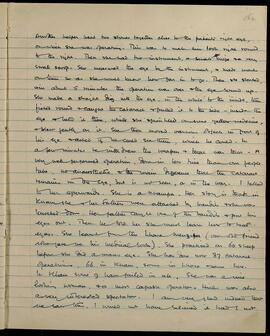
              Another helper beat two stones together close to the patient's right eye, on which she was operating. This was to make him look right round to the right. Then she had two instruments, a small knife and a very small scoop. She measured the eye by the instruments, and made marks on them so as she would know how far in to go. Then she started, in about 5 minutes the operation was over and the eye bound up. She made a straight dig into the eye, in the white to the inside, then fished round and caught the cataract and pulled it to the side - inside the eye and held it there, while she sprinkled on some yellow medicine, and blew gently on it. She then moved various objects in front of his eye and asked if he could see them, which he could. In a few minutes she withdrew the weapon and that was that - A very well performed operation, done in less time than our people take, no anaesthetic, and the main difference that the cataract remains in the eye, but is not seen, or in the way. I talked to her afterwards. She is a Khampa. Her story is that in Kham she and her father were attacked by bandits and she was knocked down. Her father caught one of the bandits and put his eyes out. Then he told her she must learn how to heal eyes. She learnt from the Lhasa Menzipa (our old friend who gave me his medical book). She practised on 60 sheep before she did a man's eye. She has done now 87 cataract operations, 66 in Kham

              LSH/1/1/6/1/180 · Part · 1938-11-24
              Part of The Ludlow & Sherriff Collection

              SUMMARY:
              Itemized expenses for supplies and freight from Calcutta and R'Pindi to Kalimpong, including purchases from Spencers and Harrods. Records advances and payments for mule transport from Phari to Gyantse, Tuna, Dochen, Kala, and Samoda.

              CONTENT:
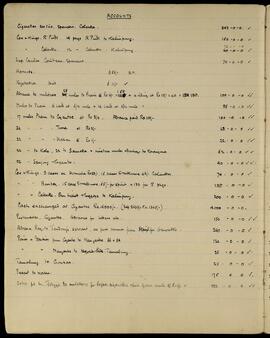
              ACCOUNTS.

              Cigarettes 200 tins. Spencers. Calcutta. 243 - 0 - 0. ✓
              Cox & Kings. R'Pindi 14 pkgs R'Pindi to Kalimpong. 150 - 0 - 0 ✓
              " Calcutta. 12 " Calcutta - Kalimpong. 76 - 1 - 0
              Soap. Candles. Cointreau. Spencers. 70 - 0 - 0 ✓
              Harrods. £ 53/- B.M.
              Vegetables. Dried £ 11/- ✓
              Advance to muleteers 25 mules to Phari @ Rs 6/- = 150 + 4 riding at Rs 10/- = 40 = 190. 100 - 0 - 0 ✓✓
              Mules to Phari 16 loads at 6/12 mule & 14 loads at 5/12 mule : 95 - 0 - 0 ✓✓
              17 mules Phari to Gyantse at Rs 8/4. Advance paid Rs. 100/- 100 - 0 - 0 ✓✓
              24 " " Tuna at Rs 2/- 48 - 0 - 0 ✓✓
              22 " " Dochen @ Rs 1/- 22 - 0 - 0 ✓✓
              22 " to Kala, 22 to Samoda + mixture mules

              LSH/1/1/1/1/179 · Part · 1933-09-05
              Part of The Ludlow & Sherriff Collection

              SUMMARY:
              The writer describes Tibetan superstitions, particularly the aversion to shooting hares due to their donkey-like ears. After delays at Lala and slow transport with yaks and donkeys, they arrived late at Towa, where a curry made overly hot by Ahmad Sheikh left Ludlow unable to eat, though strawberries and cream from H.H. were excellent.

              CONTENT:
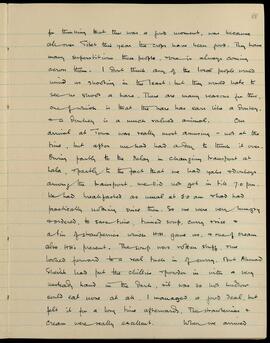
              for thinking that this was a good moment, was because
              all over Tibet this year the crops have been good. They have
              many superstitions these people, one is always coming
              across them. I don't think any of the local people would
              mind us shooting in the least: but they would hate to
              see us shoot a hare. There are many reasons for this,
              one of which is that the hare has ears like a donkey,
              and a donkey is a much valued animal. Our
              arrival at Towa was really most amusing - not at the
              time, but after we had had a day to think it over.
              Owing partly to the delay in changing transport at
              Lala, and partly to the fact that we had yaks and donkeys
              among the transport, we did not get in till 7.0 pm.
              We had breakfasted as usual at 5.0 am and had had
              practically nothing since then. So we were very hungry
              and ordered, to save time, tinned soup, curry and rice and
              a tin of strawberries which H.H. gave us, and one of cream
              also H.H.'s present. The soup was rotten stuff, and we
              looked forward to a real tuck in of curry. But Ahmad
              Sheikh had put the chillies and powder in with a very
              unsteady hand in the dark, and it was so hot Ludlow
              could eat none at all. I managed a good deal, but
              felt it for a long time afterwards. The strawberries and
              cream were really excellent. When we arrived

              LSH/1/1/9/1/61 · Part · 1949-06-01
              Part of The Ludlow & Sherriff Collection

              SUMMARY:
              After an early start the party reached Weitang, noting Primula bellidifolia in bud, P. crispata, and particularly P. calderiana in white, yellow, and hybrid forms, while other expected species were absent, possibly due to heavy yak grazing. News arrived that the Druk Locha (Bumthang Representative) from Lhasa is en route to Bumthang and expected shortly; the diarist recalls meeting him previously in Lhasa with Betty.

              CONTENT:
              Signs of clearing and we left at 5:30 for Weitang. Weitang at last! The day turned out to be lovely, but again we saw nothing of interest. I did at last see P. bellidifolia in bud, and P. crispata was there too. But no gracilipes, no whitei, no macrophylla, or macrocarpa, glabra or puella. Either none of them exist here, or yaks eat them all. Perhaps there are so many yaks that we will find this area very poor indeed. It almost looks like it. The only interesting thing was to find P. Calderiana becoming more common in a white or yellow form than in its true violet purple form. I took a good many variations, and called them P. Calderiana, hybrid white, hybrid powder blue violet, hybrid yellow, and P. strumosa. I am sure that is what it is, and had the same times in central Bhutan in 1937 at a later date and more profuse. The great news today is that the Druk Locha (Bumthang Representative) in Lhasa, is on his way to Bumthang, will be here tomorrow or next day. He has 8 mounted people, 11 in all and 120 animals of kit, stores etc. It is the same Locha as was there when Betty and I were in Lhasa, so I must meet him and talk to him I suppose. He was always very pleasant to us in Lhasa. His son—the spoilt brat as we called

              LSH/1/1/2/1/175 · Part · 1933-09-08
              Part of The Ludlow & Sherriff Collection

              SUMMARY:
              A steep climb from the Trashiyangsi valley up to the Dib La passed through oak, bamboo, and rhododendron, with 21 birds collected and the possibility of new species noted. After crossing the frontier pass with Tibet and proceeding along the ridge, a waterlogged camp was made beyond the pass amid torrential rain and severe midges.

              CONTENT:
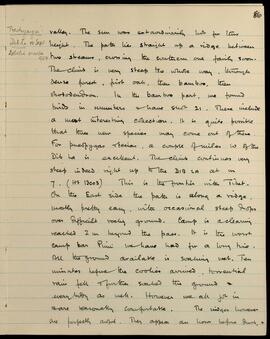
              86

              Trashiyangsi: valley. The sun was extraordinarily hot for this
              Dib La 10 Sept height. The path lies straight up a ridge between
              Lobelia erecta 954 two streams, crossing the southern one fairly soon.
              The climb is very steep the whole way, through
              dense forest, first oak, then bamboo, then
              rhododendron. In the bamboo part, we found
              birds in numbers & have shot 21. These include
              a most interesting collection. It is quite possible
              that three new species may come out of these.
              For Pnoepyga & Tesia, a couple of miles W of the
              Dib La is excellent. The climb continues very
              steep indeed right up to the DIB LA at m

              1. (Ht 13003) This is the frontier with Tibet.
                On the East side the path is along a ridge,
                mostly pretty easy, with occasional steep drops
                over difficult rocky ground. Camp is a clearing
                reached 2 m beyond the pass. It is the worst
                camp bar Pimi we have had for a long time.
                All the ground available is soaking wet. Ten
                minutes before the coolies arrived, torrential
                rain fell & further soaked the ground &
                everybody as well. However we all got in
                and are reasonably comfortable. The midges however
                are perfectly awful. They appear an hour before dusk, &
              LSH/1/1/9/1/35 · Part · 1949-05-06
              Part of The Ludlow & Sherriff Collection

              SUMMARY:
              The diarist walks alone while Ngundup asks about Delhi, London, and the King; the writer reflects on the Maharaja’s authority in Bhutan and warns of leeches on routes toward Tobrang and between Denchume and Jula. During halts on 30 April and 1 May near Sulu, Pasang returns with few specimens (no primulas) and a possible Rhododendron magnificum, and the diarist notes the scarcity of dogs and consults 1937 field notes.

              CONTENT:
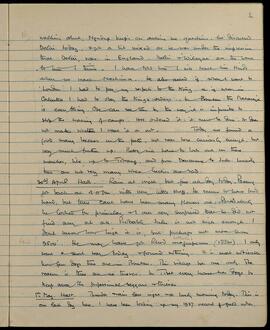
              Walking alone, Ngundup keeps on asking me questions. We discussed Delhi today, and got a bit mixed as he was under the impression that Delhi was in England. Delhi and 'Wilayat' are the same to him I think. I have told him I will teach him Hindi when we reach Nashima. He also asked if when I went to 'London' I had to pay my respects to the King, and if when in Calcutta I had to obey the King's orders. In Bhutan the Maharaja is everything. One can see this by the way it is impossible to stop the making of camps. H.H. ordered it: it must be done. It does not matter whether I want it or not. Today we found a good many leeches on the path, not near here curiously enough, but very much further up. Betty will have to look out on these marches, like up to Tobrang, and from Denchume to Jula. Luckily there are not very many where leeches are bad.

              30th April Halt. Rain at night, but fine all day today. Pasang got back at 4.0 pm, with very little stuff. He seems to have tried hard, but there can't have been many flowers out. Particularly he looked for primulas, and I am very surprised that he did not find any at all. Probably Sulu is not high enough. I don't know how high it is, but perhaps not more than 9500'. He may have got Rhod. magnificum (18801). I only went a short way today, and found nothing. It is most noticeable how few dogs there are in Bhutan. This village has one only. The reason is there are no thieves. In Tibet every house has dogs to keep away the professional beggars and thieves.

              1st May. Halt. Thunder and rain last night, a lovely morning today. This is our last day here. I have been looking up my 1937 record of field notes,