Tibet

Elements area

Taxonomy

Code

Scope note(s)

    Source note(s)

      Display note(s)

        Hierarchical terms

        Tibet

          Equivalent terms

          Tibet

            Associated terms

            Tibet

              192 Archival description results for Tibet

              192 results directly related Exclude narrower terms
              LSH/1/1/7/1/8 · Part · 1940-05-24
              Part of The Ludlow & Sherriff Collection

              SUMMARY:
              Notes compare vegetation in the Tsangpo valley with that near Kyimdong Dz, highlighting distribution differences. Plants usually confined to south slopes are observed north of the Himalayas due to increased rainfall passing the barrier, with examples including Magnolia globosa, Lilium giganteum, and possibly Nymphaea.

              CONTENT:
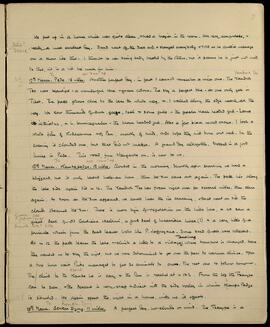
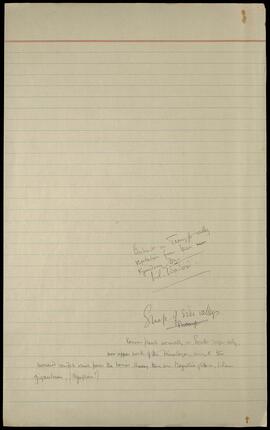
              Contrast in Tsangpo valley
              vegetation from that near
              Kyimdong Dz-
              Lil. Wardii.

              Shape of side valleys Swamp

              Various plants normally on South slopes only,
              now appear north of the Himalayas, owing to the
              increased rainfall which passes the barrier. Among these are Magnolia globosa, Lilium
              giganteum, (Nymphaea?)

              LSH/1/1/1/1/12 · Part · 1933-05-01 - 1933-09-01
              Part of The Ludlow & Sherriff Collection

              SUMMARY:
              Page records advances, monthly pay, and ration allowances for expedition staff, including a Tibetan blanket to be given at Yatung. Notes include multiple May payments, Changu’s dismissal and refund, and later disbursements at Bumthang and Phari.

              CONTENT:
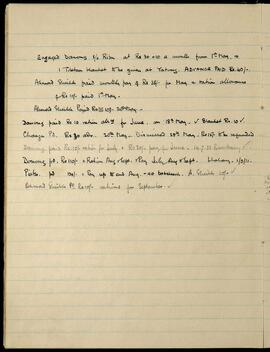
              Engaged Danong son of Ribu at Rs 30 + 10 a month from 1st May, &
              1 Tibetan blanket to be given at Yatung. ADVANCE PAID Rs. 40/-.
              Ahmad Sheikh paid monthly pay of Rs 35/- for May & ration allowance
              of Rs 10/- paid 1st May.
              Ahmad Sheikh paid Rs 10/- 28th May.
              Danong paid Rs 10 ration allowance for June on 18th May. Blanket Rs. 10.
              Changu paid Rs 30 advance 20th May. Dismissed 29th May. Rs 15/- to be refunded.
              Danong paid Rs. 10/- ration for July & Rs 30/- pay for June - 14.7.33 Bumthang.
              Danong paid Rs 110/- = Ration Aug Sept. & Pay July Aug & Sept. Phari 1/9/33.
              Pintso paid 120/- = Pay up to end Aug. + 40 baksheesh. A. Sheikh 10/-
              Ahmad Sheikh paid Rs 10/- rations for September.

              LSH/1/1/9/1/89 · Part · 1933-06-11
              Part of The Ludlow & Sherriff Collection

              SUMMARY:
              The diarist reflects on rainfall patterns across SE Tibet and suggests a rain-gauge transect from Sikkim to the Tsangpo Gorge. On 30 June heavy rain hampers collecting, with Meconopsis bella absent and only M. simplicifolia common; seed of P. atrodentata is ripe, and plans are made to try Marlung, Waitang, and Trompa-lun. On 1 July, despite very wet conditions, the diarist and one Bhutanese assistant go via the Chachhu La to a large high-altitude lake.

              CONTENT:
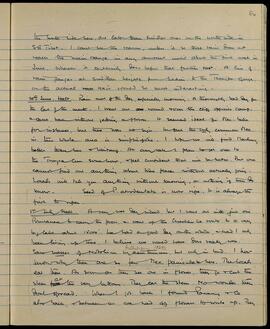
              the south side here, are lower than similar ones on the north side in SE Tibet. I can't see the reason, unless it be that rain does not reach the main range in any amount until about the first week in June, whereas it certainly does before that further east. A line of rain gauges at similar heights from Sikkim to the Tsangpo Gorge, on the actual rain axis would be most interesting.

              30th June. Halt. Rain most of the day, especially morning. A thoroughly bad day for the last of the month. I went out round over the cliffs opposite camp & came back without getting a flower. It seemed ideal for Mec. bella for instance, but there was no sign. In fact the only common Mec. in this whole area is simplicifolia. I hope we will find Marlung better than here or Waitang. At any rate I plan to get over to the Trompa-lun somehow, & feel confident that will be better. But one cannot find out anything about these places without actually going. Locals will tell you anything without knowing, or nothing if they do know. Seed of P. atrodentata is now ripe. It is always the first to ripen.

              1st July. Halt. A very wet day indeed, but I went out with just one Bhutanese to carry the press, & went up the Chachhu La route to a very big lake about 15000'. We had a good day on the whole, & had I only been living up there, I believe we would have done really well. Saw masses of

              LSH/1/1/8/1/62 · Part · 1947-02-20
              Part of The Ludlow & Sherriff Collection

              SUMMARY:
              Daily weather notes for 19–23 Feb are followed by a detailed route from Tangdong to Lubong via Domuong, Pemadem, and Chashing Dingka, with altitude and terrain described. Photographic and field notes mention a headman of lower Tangdong, a Poba girl talking to Betty, panoramas from Karma La toward Namcha Barwa and Gyala Peri, and bird observations at Lubong.

              CONTENT:
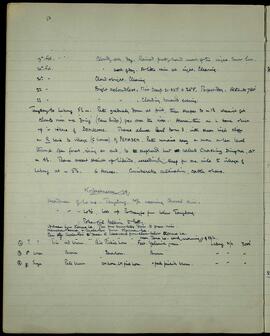
              50

              19th Feb. Cloudy all day. Rained pretty hard most of the night. Snow low.
              20th Feb. Most of day. A little rain at night. Clearing.
              21st - Cloud at night. Clearing.
              22nd - Bright and cloudless. Min temp 21-22° = 26°F. Perfect day. Altitude 7500'
              23rd - " " . Clouding towards evening.

              Tangdong to Lubong 5 1/2 m. Path gradually down at first, then steeper to m 1 1/2 where it gets close to river and a 'zhing' (cane bridge) goes over the river. Above this on L bank high up is village of DOMUONG. Thence almost level to m 3, with sheer high cliffs on R bank to village (5 houses) of PEMADEM. Path remains easy and more or less level through open forest, rising at end, to a shepherd's hut called Chashing Dingka, at m 4 1/2. Thence ascent straight up hillside, exceedingly steep for one mile to village of Lubong at m 5 1/2. 6 Houses. Considerable cultivation, cattle there.

              Kodachrome 14.
              Headman of lower Tangdong. 20/2 wearing Goral skin.
              -- Loto, look up Tsangpo from below Tangdong.
              -- Poba girl talking to Betty.
              Upstream from Karma La. Pan from snow hills down to green river.
              Namcha Barwa & Gyala Peri from Karma La.
              Pan from Gyala Peri & peaks to westward from close below Karma La.
              near Tana La. early morning // of 23/2.

              (2) ? ? Iris red brown. Bill pinkish horn. Feet yellowish green. Lubong 21/2 7000'
              (3) ♂ Wren Brown Dark horn. Brown - - -
              (4) ♀ Sunya Pale brown UM horn. LM pink horn. v pale pinkish brown. - - -

              LSH/1/1/8/1/72 · Part · 1947-02-20
              Part of The Ludlow & Sherriff Collection

              SUMMARY:
              Daily weather notes from 26 February to 6 March are recorded, followed by a note on the impassable road to Gompo Ne and the limited supplies available in villages. The writer lists staple foods and remarks on numerous large and small landslides in the lower Po Tsangpo valley.

              CONTENT:
              66.

              26-27th Feb: Cleared at night. 27th sparklingly bright.
              27-28th Feb: Rain at night. 28th cloudy with sunny patches.
              28-1st March: Little rain at night. 1st a clear bright day.
              1-2nd March: - - - 2nd mostly clear sky.
              2-3rd March: Min 41°. Lightly clouded night. Sun clouded day. Hot. Max about 78°.
              3-4th March: Min 46°. Some rain at night. Cloudy day.
              4-5th March: Min 46°. Rain all night, rained hard all day 5th.
              5-6th March: ? Rain all night + rain all 6th.

              Note about road to Gompo Ne ship line.
              Road is impassable everywhere for ponies. Supplies in very limited quantities are available at nearly every village, and consist of barley, wheat, maize, millet, fowls, barking deer + takin meat, milk. In summer to these could be added eggs. Some turnips + radishes, probably dried, are also available. The road is not easy: 1st + 2nd days could be made into one march perhaps, but the others are long in time + effort. A most noticeable thing about the lower Po Tsangpo valley is the number of very large landslides + small ones too, on both sides. Some of them have come down 2000 or

              LSH/1/1/1/1/199 · Part · 1933-09-15
              Part of The Ludlow & Sherriff Collection

              SUMMARY:
              Notes describe difficulties using yaks for transport, observations of the green Tibetan plateau with abundant sheep and yaks, and that Bailey had found the area interesting for flowers though the party seems too late. On 16th September they marched 12 miles to GOBSHI (14,000'), after snow and cold, reaching what is described as their last camp before the route with dak bungalows to Kalimpong.

              CONTENT:
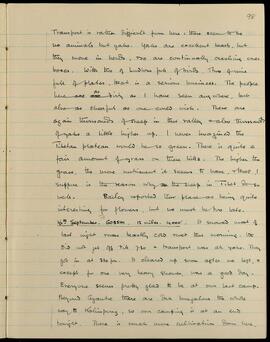
              Transport is rather difficult from here: there seem to be no animals but yaks. Yaks are excellent beasts, but they move in herds, and so are continually crashing one's boxes. With two of Ludlow's full of birds, and two of mine full of plates, that is a serious business. The people here are as dirty as I have seen anywhere, but also as cheerful as one could wish. There are again thousands of sheep in this valley and also thousands of yaks a little higher up. I never imagined the Tibetan plateau would be so green. There is quite a fair amount of grass on these hills. The higher the grass, the more nutriment it seems to have, and that, I suppose is the reason why the sheep in Tibet do so well. Bailey reported this place as being quite interesting for flowers, but we must be too late.

              16th September. GOBSHI. 12 miles. 14,000'. It snowed most of last night and was beastly cold and wet this morning. We did not get off till 7:30 and transport was all yaks. They got in at 3:30 pm. It cleared up soon after we left, and except for one very heavy shower, was a good day. Everyone seems pretty glad to be at our last camp. Beyond Gyantse there are dak bungalows the whole way to Kalimpong, so our camping is at an end tonight. There is much more cultivation down here,

              LSH/1/1/6/1/15 · Part · 1938-03-21
              Part of The Ludlow & Sherriff Collection

              SUMMARY:
              The party travels along the Yamdrok Tso via Pede toward Kamba Padze and on to Gorkar Dzong, enjoying mostly fine weather, abundant birdlife, and striking lake and mountain scenery. They change transport at Tamalung, collect seeds of several plants, and cross the Khamba La after a brief blizzard; Daud struggles with the rigors of the journey while Puitro secures animals for the pass.

              CONTENT:
              We put up in a house which was quite clean, and had a brazier in the room. All very comfortable, and really a most excellent day. Daud went off the deep end, and staggered everybody; he told us he couldn't manage on a show like this. I thought he was being badly treated by the others, but it seems he is just not used to this, and it is a bit too much for him.

              17th March. Pede. 15 miles. To alt 14400' ap. Another perfect day: in fact I cannot remember a nicer one. The Yamdrok Tso was beautiful—a wonderful blue-green colour. The sky a perfect blue—as one only gets in Tibet. The path follows close to the lake the whole way, and I walked along the edge nearly all the way. We saw thousands of duck, geese, teal & some gulls—the greater black-headed gull, Larus ichthyaetus, & L. brunnicephalus, the brown-headed gull. Also a few black-necked cranes. I took a whole film of Kodachrome for Pan, mostly of birds, and hope they will turn out well. In the evening it clouded over, but that did not matter. A grand day altogether. Stopped in a poor house in Pede. This road, from Nangartse on, is new to us.

              18th March. Kamba Padze. 18 miles. To alt 12000' ap. Clouded in the morning. Shortly after starting we had a blizzard, but it only lasted half an hour, then the sun came out again. The path lies along the lake side again till 12. The Yamdrok Tso was frozen right over for several miles, then clear again. As soon as the sun appeared, we could hear the ice cracking, and that went on till the clouds obscured the sun. There is more sign of vegetation on the hills here, & we saw a great deal of Gentiana waltonii, a good deal of Incarvillea lutea (?) & a very little of a primula which from the dead leaves looks like P. jaffreyana. Some seed of all were collected. At 12 the path leaves the lake & climbs a little to a village, Tamalung, where transport is changed. Here they wanted us to stay the night, but we were determined to get over the pass to warmer climes. After a two hour wait Puitro managed to get 20 animals to cross. The rest are to follow tomorrow. The climb to the Khamba La is easy & the Pass is reached at 13 1/2. From the top the Tsangpo can be seen, the descent is very steep & direct into the side valley in which Kampa Padze is situated. We again spent the night in a house, with no ill effects.

              19th March. Gorkar Dzong. 11 miles. To Kongka Dzong. A perfect day, no clouds or wind. The Tsangpo is a

              LSH/1/1/1/1/193 · Part · 1933-09-24
              Part of The Ludlow & Sherriff Collection

              SUMMARY:
              Notes describe passing Yamdrok Tso at Talung with views from Cho Dzong, an easy ascent and descent over the Ta La pass to the plain and Nangartse, and fording the Karo Chu, with fine weather and filming tame ravens. From camp at Nangartse they mention the monastery of Dorji Phamo, report failed telephone contact with Williamson in Lhasa and that they will not meet at Gyantse; the item was sent from Gyantse to Calcutta on 24/09/1933.

              CONTENT:
              95

              B. 30.
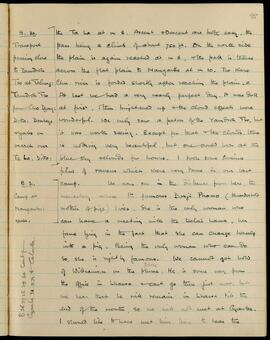
              Transport passing close to Yamdrok Tso at Talung:
              Yamdrok Tso from Cho Dzong:
              Ditto: Donkeys & yaks on march over Ta La. Ditto:

              the Ta La at m 5. Ascent & descent are both easy, the pass being a climb of about 750 ft. On the north side the plain is again reached at m 6, & the path is thence across the flat plain to Nangartse at m 10. The Karo Chu river is forded shortly after reaching the plain.

              At last we had a very nearly perfect day. It was dull at first, then brightened up & the cloud effects were wonderful. We only saw a patch of the Yamdrok Tso, but it was worth seeing. Except for that & the clouds, there is nothing very beautiful, but one could look at the blue sky & clouds for hours. I took some Cinema films of ravens which were very tame in our last camp.

              B. 31.
              Camp at Nangartse:
              raven.

              We can see in the distance from here, the monastery where the famous Dorji Phamo (thunderbolt mother of pigs) lives. She is the only woman who can have a meeting with the Dalai Lama, her fame lying in the fact that she can change herself into a pig. Being the only woman who can do so, she is rightly famous. We cannot get hold of Williamson on the phone. He is some way from the office in Lhasa & can't go there just now, but we hear that he will remain in Lhasa till the end of the month, so we will not meet at Gyantse. I should like to have met him there to hear the

              B 26 27 28 29 30 Sent from Gyantse 24.9.33 to Calcutta.

              LSH/1/1/6/1/159 · Part · 1936-11-05 - 1936-11-07
              Part of The Ludlow & Sherriff Collection

              SUMMARY:
              Diary entries describe travel from Yar Shika to Loro Tö, including a visit with the Dzongpen (gifted silk and saffron) and discussion of missing photographs from Sanga Chöling, scenic views, and lost/damaged film rolls previously entrusted to Bhutanese couriers. Subsequent days note severe transport disruptions with drunk porters fighting, the Dzongpen demanding a passport, Kusho struggling to arrange transport, strong valley winds, and observations of hares and the absence of partridges.

              CONTENT:
              this morning, & quite a number still in flower. Clouded at night & early morning, fine & bright all day.

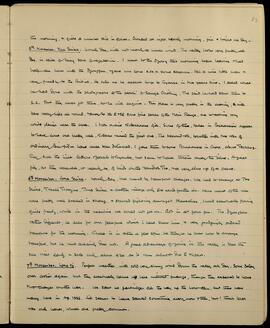
              5th November. Yar Shika. Lovely day, with not nearly so much wind. The valley looks very pretty all day, in spite of being bare of vegetation. I went to the Dzong this morning before leaving & had half an hour with the Dzongpen, & gave him some silk & some saffron. He's a nice little man & very friendly to the British. He tells me he expects to go to Gyantse in two years time. I asked what he had done with the photographs of the 'peach' of Sanga Chöling. He said he had sent them to S.C. But they never got there, so he will enquire. This place is very pretty in the evening, with bare rocky hills all round, & away to the ESE some fine peaks of the Main Range, & a retreating very white glacier near the crest. I took a few Kodachrome of it. Some of these, taken in Pachakshiri appear to have come out pretty well. Kodak ruined the first one. The second roll, together with two rolls of ordinary Pan film have never been delivered. I gave them to some Bhutanese in Chura, above Tsetang. They took the line letters & parcels to Gyantse, but seem to have thrown away the films. A great pity, as they were all, or nearly so, of birds on the Yamdrok Tso, & a very close up of a crane.

              6th November. Jora Shika. Lovely day, but ruined by transport changes. We had to change at Tro Shika, Trashi Trongme, Timp Shika & another village only 500 yards further on. Here most of the men were pretty well soaked in chang, & started fighting amongst themselves, blood eventually flowing quite freely, while in the meantime we cursed our fate. Got in at four p.m. The Dzongpen rather difficult; he asks for our passport which I can't show him, & very grudgingly ordered transport for the morning. Kusho is in rather a flat spin. He thought he knew how to arrange transport, but he most certainly does not. A great advantage of going in this valley is that the sun rises early & sets only about 4.30, as it runs almost due E & West.

              7th November. Loro Tö. Perfect weather, with cold very strong wind down the valley all day. Some delay over coolies again, but they eventually came up here without change, though they expected to have two changes on the way. We saw no partridges all the way up the Loro chu, but there were many here in Ap. 1936. Jill seems to have scented something every now & then, but I think that was only hares, which are pretty common.

              LSH/1/1/1/1/31 · Part · 1933-05-15
              Part of The Ludlow & Sherriff Collection

              SUMMARY:
              An easy downhill march to Yatung through fir, larch, and rhododendron is described, with few flowers seen and notes on birds and scenes such as Kargiu monastery. The party visits the Depen of Pipithang with Pema translating, rides along the Amo Chu, meets telegraph clerk Rosemeier, and decides to skip Lingmathang due to late flowers, with plans for Ludlow to go to Sharithang while the writer returns.

              CONTENT:
              13

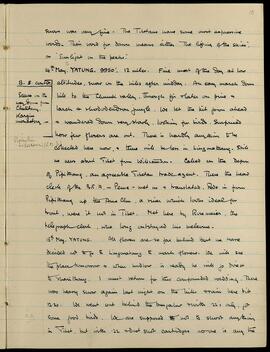
              snow was very fine. The Tibetans have some most expressive words. Their word for dawn means either "The lifting of the skies", or "Sunlight on the peaks."

              to
              14th May. YATUNG. 9950'. 12 miles. Fine most of the day at low

              B. S. contd
              Scenes on the way down from Chusitang.
              Kargiu monastery -
              Piptanthus nepalensis (no. 3)

              altitudes, snow on the hills after midday. An easy march down hill to the Chumbi valley, through fir rather than pine & larch & rhododendron jungle. We let the kit go on ahead & wandered down very slowly, looking for birds. Surprised how few flowers are out. There is hardly anything to be collected here now, & there will be less in Lingmathang. Still no news about Tibet from Williamson. Called on the Depen of Pipithang, an agreeable Tibetan trade agent. There the head clerk of the B.T.A. - Pema - met us & translated. Rode in from Pipithang up the Amo Chu, a river which looks ideal for trout, were it not in Tibet. Met here by Rosemeier, the telegraph clerk, who long outstayed his welcome.

              15th May. YATUNG. All flowers are so far behind that we have decided not to go to Lingmathang to seek flowers. We will see the place tomorrow & when Ludlow is ready he will go direct to Sharithang. I must return