Tibet

Elements area

Taxonomy

Code

Scope note(s)

    Source note(s)

      Display note(s)

        Hierarchical terms

        Tibet

          Equivalent terms

          Tibet

            Associated terms

            Tibet

              192 Archival description results for Tibet

              192 results directly related Exclude narrower terms
              LSH/1/1/8/1/21 · Part · 1946-12-11
              Part of The Ludlow & Sherriff Collection

              SUMMARY:
              The diarist describes sparse official presence across Tibetan towns, then records halts and short marches with bullocks en route toward Tsela Dzong. A pony carrying Ludlow and Elliot’s bedding goes missing and is later recovered; Sandup returns to Kyindong, and difficult road conditions near Risho require manhandling loads, with mention of skin ferries.

              CONTENT:
              There can be no other country which runs itself like Tibet. Since we left Gangtok we have not come across many officials in their place of business. The T.T.A. Yatung is hardly ever anywhere but in Kalimpong. There was a dzongpon in Phari. There was one in Gyantse. But there were none in Nangkarbe, Pede or Gongkar. The Nethong Dzongpon was in residence, and we have seen none since then.

              3rd Dec. Halt. Very windy last evening, but clear and cold at night, with not a very low temp. No one appeared this morning early, but by 11.0 some 30 bullocks had come. The men are a pleasant friendly - several having been with us before both in 1933 and 1938 in Langong or beyond Kyindong Dzong. They remember us, apparently quite happily, and they even remember Jill. They are going to Tsela Dzong with us, and we should have no trouble when once away from here. The only troublesome people are the representatives of the Dzong. The village here is very poor, but they seem friendly enough.

              4th Dec. Kamchang. Bullocks got off in good time, last party leaving at 8.0. We were in at 11.30 - it is a short march. But bullocks take a very long time. One pony with Ludlow and Elliot's bedding never arrived in. Kamchang is the lower of two villages, each only with a few houses. Pollarded walnut trees are much in evidence.

              5th Dec. Halt. Again had to halt, this time owing to the lost pony. It strayed up a side valley 2 miles from here. Sandup has gone back to Kyindong. Pony came in late at night - or rather the bedding was brought in - the pony had fallen and hurt itself.

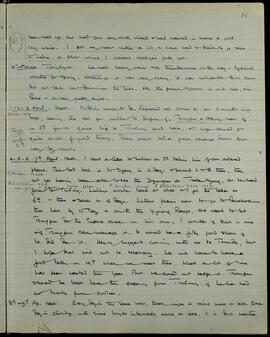
              6th Dec. Camp 2 m. beyond Chongrong on S. bank, left at 7.30: in with bullocks at 4.30pm. Road very bad for bullocks in 3 places, the worst being 1 1/2 m beyond Risho, where all loads had to be manhandled for 100 yds over a cliff. There are 'skin' ferries at 1 1/2 m above Risho, -
              LSH/1/1/3/3/78 · Part · 1936-03-10
              Part of The Ludlow & Sherriff Collection

              SUMMARY:
              Notes confirm the Tibetan Magpie occurs south of the main range, with records at Treno Dzong in the Nyam Jang Chu valley and earlier sightings by Ludlow, S., and W. Griffith; Rose Finches were common at Archpo. First-time localities are listed for Aegithaliscus concinnus talifuensis across SE Tibet with habitat and breeding remarks, alongside brief film stock references.

              CONTENT:
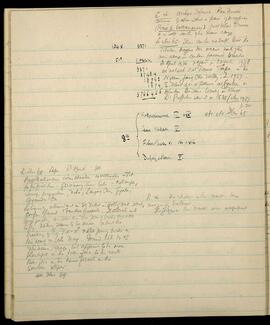
              L. 46. Archpo I found Rose Finches common. I also saw a pair of Magpies (Pica p. bottanensis) just below Treno & in well south of the main range.

              1945 9371
              510 10422
              9371
              37484
              18742
              1874
              9766.456

              L. Ibis 65. There can be no doubt that the Tibetan Magpie does occur south of the main range in certain favoured localities. In April 1936, Ludlow, in November 1938, we met with it at Treno Dzong in the Nyam Jang Chu valley. In 1937, S. saw 3 or 4 pairs at Gyetsa in Bhutan, the same locality in which W. Griffith saw it in 1838 (Ibis 1937 p. 20).

              8th
              Kodachrome III & IV etc. etc. Ibis 65
              Cine Kodak V.
              Film Pack VI, VII & VIII
              Dufaycolor V.

              L. Ibis 68. Lepo. 5th April 8th Aegithaliscus concinnus talifuensis - Tit.
              For the first time: Goshuany, Cine Cali - Natrampa, Seing, Migyitun, Molo, Langong Chu, Gyala, Gyanda Chu.

              Extremely abundant in SE Tibet in Holly Oak zone, conifer forest & bamboo thickets. It collects into large parties as soon as the young birds are able to fly. Nothing seems to be known about the breeding of this Tit. L. noted young birds on the wing in late May. Found both N & S of the main range, but appears to be more plentiful in the drier zone to the north than it is in the dense forests on the southern slopes.

              See Ibis 69.

              L. 46. The rhodos at this march were amazingly brilliant. The gorge in this march was magnificent.

              LSH/1/1/6/1/12 · Part · 1933-03-02
              Part of The Ludlow & Sherriff Collection

              SUMMARY:
              He saw young Tibetan partridges on the road to Tsangpo and shot one with a catapult. They did not take their guns out as it is not advisable to shoot on the main Lhasa highway, and an altitude of approximately 14,400 ft is recorded.

              CONTENT:
              Ludlow 12. He saw young Tibetan partridges on the road to Tsangpo. Shot one with his catapult. We did not take our guns out of our cases. It is not advisable to shoot on the main Lhasa highway.

              Ludlow 13 alt. 14,400 ft approx

              LSH/1/1/2/1/123 · Part · 1933-07-18
              Part of The Ludlow & Sherriff Collection

              SUMMARY:
              The writer describes a difficult return to camp after gear failures, arriving after dark to Ludlow’s camp in snow and thick mist, and notes splendid views around Gorpo La and the Tibetan plateau. On 16 August they traveled to Dongkar Dzong via the Sang La, collecting gentians and butterflies and viewing the Nyamjang Chu and nearby hills toward the Cho La.

              CONTENT:
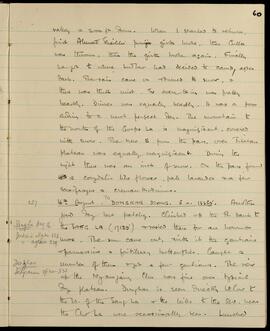
              60

              valley and 2000 ft down. When I started to return, first Ahmad Sheikh's pony's girth broke, then Culla was thrown, then the girth broke again. Finally we got to where Ludlow had decided to camp, after dark. The rain came on and turned to snow, and there was thick mist. So everything was pretty beastly. Dinner was equally beastly. It was a poor ending to a most perfect day. The mountain to the north of the Gorpo La is magnificent, covered with snow. The view E from the pass, over Tibetan plateau was equally magnificent. During the night there was an inch of snow. On the pass found a Corydalis like flower, pale lavender and a few saxifrages and cremanthodiums.

              287 16th August. TO DONGKAR DZONG. 5 m. 13350'. Another
              good day but patchy. Climbed up the R. bank to
              Sang La Aug. 16. the SANG LA (17129') and rested there for an hour or
              Gentiana algida 828. more. The sun came out, with it the gentians,
              " " algida 829. parnassius and fritillary butterflies. Caught a
              Donkhar number of them and got a few gentians. The view
              Hedysarum sp. nov. 832 up the Nyamjang Chu was fine over typical
              dry plateau. Dongkar is seen directly below to
              the W. of the Sang La and the hills to the SW. near
              the Cho La were occasionally seen. Lunched

              LSH/1/1/2/1/169 · Part · 1933-08-30
              Part of The Ludlow & Sherriff Collection

              SUMMARY:
              Field notes describe bird collecting in dense jungle near Tobrang, with birds proving shy; Ludlow shot a 'whistling schoolboy' thought to be the Burma form or possibly new, and there is still no sign of Puitso or the missing dak. On the 6th they moved to SHAPANG (6584') over 6 miles in hot weather after heavy overnight rain, with BP 200.6 and temperature 75°, and recorded plant specimens 935–938.

              CONTENT:
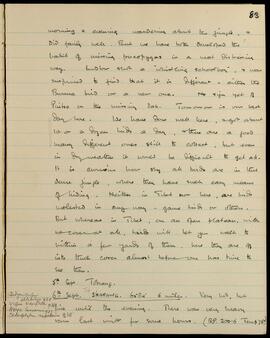
              83

              morning and evening wandering about the jungle, and did fairly well. But we have both developed the habit of missing Pucopygas in a most distressing way. Ludlow shot a "whistling schoolboy", and was surprised to find that it is different - either the Burma bird or a new one. No sign yet of Puitso or the missing dak. Tomorrow is our last day here. We have done well here, and got about 10 or a dozen birds a day, others are a good many different ones still to collect, but even in dry weather it would be difficult to get all. It is curious how shy all birds are in this dense jungle, where they have such easy means of hiding. Neither in Tibet nor here, are birds molested in any way - game birds or others. But whereas in Tibet, on an open plateau, with no cover at all, birds will let you walk to within a few yards of them, here they are off into thick cover almost before one has time to see them.

              5th Sept. Tobrang.

              6th Sept. To SHAPANG. 6584' 6 miles. Very hot, but fine until the evening. There was very heavy rain last night for some hours. (BP. 200.6 Temp 75°)

              Didymocarpus albitubus 935
              Vigna vexillata 936
              Hoya linearis 937
              Chlorophytum nepalense 938

              LSH/1/1/8/1/86 · Part · 1938-04-09
              Part of The Ludlow & Sherriff Collection

              SUMMARY:
              Diary entries record weather from the end of March through mid-April at Tonghyuk Dz, with frequent rain and snow reaching elevations of 11,500 feet, including 1 inch at Amnyina and 9 inches at Lumang. Notes also document payments to Mohammed and possible amounts related to Tsetang and Gyantse, clarifying pay, advance, and pony fodder expenses.

              CONTENT:
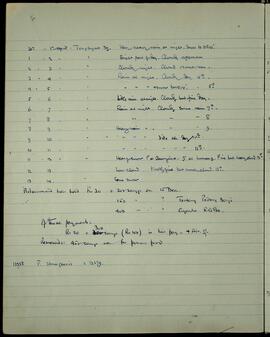
              31st - 1st April. Tonghyuk Dz. Very heavy rain at night. Snow to 11500'.
              1 - 2 - " Bright part of day. Cloudy afternoon.
              2 - 3 - " Cloudy night. Cloud some sun.
              3 - 4 - " Rain at night. Cloudy day 4th.
              4 - 5 - " " " " & snow to 11500'. 5th.
              5 - 6 - " Little rain at night. Cloudy but fine day.
              6 - 7 - " Rain at night. Cloudy some rain 7th.
              7 - 8 - " " " " - 8
              8 - 9 - " Heavy rain " " - 9.
              9 - 10 - " " " " Ditto all day 10th.
              10 - 11 - " " " " " 11th.
              11 - 12 - " Heavy snow 1" at Amnyina. 9" at Lumang. Fine but heavy cloud 12th.
              12 - 13. Low cloud. Mostly fine but much cloud. 13th.
              13 - 14. Some snow.

              Mohammed has had Rs 20 + 200 sangp on 15 Dec.
              150 " ? Tsetang Pedong Dorji
              400 " ? Gyantse R.B.B.

              Of these payments:-
              Rs 20 + 300 sangp (Rs 100) is his pay - + Adv. 5/-
              Remainder 450 sangp was for ponies' food.

              12338 P. chungensis = 12279.

              LSH/1/1/8/1/41 · Part · 1947-01-01 - 1947-01-04
              Part of The Ludlow & Sherriff Collection

              SUMMARY:
              From Tongkyuk Dzong, the party reconnoitred toward the Soshe La but was turned back by deep snow, placed a thermograph, and noted views of Gyala Peri. Botanical observations included Meconopsis and Nomocharis, abundant capsules on Lilium wardii, and a noteworthy Lonicera; weather was cold with light snow. The old Dzongpon prepared to depart for Lhasa, and local peaks including Rangzen Karpo were discussed.

              CONTENT:
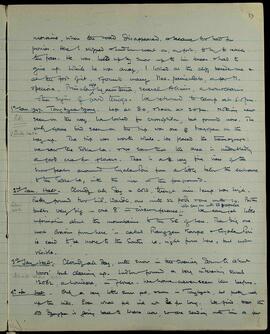
              moraine, when the road disappeared, & became too bad for ponies. Here I stopped and Ludlow went on, on foot, to try to reach the pass. He was held up by snow up to his knees & had to give up. While he was away, I looked at the cliff beside me & at the foot of it, & found many Mec. paniculata, a few M. speciosa, Primula aff. hyacinthina, several Allium, a Nomocharis & other signs of good things. We returned to camp at 6.0 pm.

              1st Jan. 1947. Tongkyuk Dzong. Left at 8.0, & back at 2.0 pm. Nothing new seen on the way. We looked for Cremanthodium, but found none. The only game bird seen on the trip was one ♀ tragopan on the way up. The trip was worth while - we placed the thermograph: we saw the Soshe La: & saw that the area is undoubtedly a good one for flowers. There is a very fine view of the snow peaks around Gyala Peri from a little below the entrance to the Soshe La, with the river in the foreground.

              2nd Jan. Halt. - Cloudy all day + cold, though min. temp. was high. Ludlow found two Lil. Wardii, one with 22 pods & one with 14. Both bulbs very big — one 8" in circumference. (Later saw one with 28 capsules). We can get little information about the mountains to the SE of here. The big one most obvious from here is called Rangzen Karpo & Gyala Peri is said to be more to the South i.e. right from here, but not visible.

              3rd Jan Halt. - Cloudy all day, with snow in the evening down to about 10,000' but clearing up. Ludlow found a very interesting shrub 12062, a Lonicera, in flower. We have never seen this before.

              4th Jan. Halt. - Only a very little snow fell, none in Tongkyuk, but pretty well up the hills. Even what fell will not last for long. We find that the old Dzongpon is going back to Lhasa now, so are sending with him a few

              LSH/1/1/8/1/85 · Part · 1938-03-31 - 1938-04-09
              Part of The Ludlow & Sherriff Collection

              SUMMARY:
              Heavy spring rain at Tongkyun with peach blossom in Pasha; several halt days used to repack for a two‑month return journey while letters were exchanged rapidly with Ludlow via Dzeng. Tsungpen and Akong visited Trulung; plans were made for Ludlow to go to Pemakochung and the Yigrong Range, possibly leaving Suowa to Tsungpen, and Henry may accompany the diarist to Tromda. The writer, feeling heart trouble, decides to return to India amid persistently dull, rainy weather.

              CONTENT:
              been held up, but had gone very slowly indeed & had waited in Lhasa a very long while. I felt my heart rather a lot, & have had to decide to go back to India, a blow which I haven't realized fully yet.

              31st March. Tongkyun. We had heavy rain & a thunderstorm on the way - typical weather for spring. Although it was very heavy, it was noticeable that snow did not fall low down on the hills. All the peach blossom is out here, in Pasha - a very pretty sight.

              1-2-3 April. Halt. Nothing much to do. Repacked all stores for our 2 months trip back, leaving the rest for Ludlow to dispose of. Tsungpen & Akong went to Trulung on 3rd for a quick trip to Trulung and back, & hope secured for quite a lot of good things. There must be a great change down that way by now.

              4-5-6-7th April. Halt. I sent a letter to Ludlow on 3rd telling him of our altered plans. The lad took it to Dzeng in 2 days & found L & S there, they not yet having been able to see the Dzongpen at Tsola Dzong, as he had gone to Trulung. Ludlow wrote back at once & I got the letter on 6th - there & back in 4 days. Ludlow plans now to go to Pemakochung, then here by 15 May & on to the Yigrong Range. He wants to let Tsungpen do the Suowa area on his own. I wonder if that is wise & if Tsungpen can manage it. It would be a jolly good show if he did do it. Henry suggests coming with me to Tromda, but I hope that will not be necessary. We will have to have a good talk on 14th when we meet there. What a lot of time has been wasted this year. But we could not help it. Tsungpen should be back here this evening from Trulung, if he has had no trouble from coolies.

              8th & 9th Ap. Halt. Every day is the same now. Each night it rains more or less. Each day is cloudy, with some bright intervals, more or less. It is dull weather,

              LSH/1/1/1/1/175 · Part · 1933-09-05
              Part of The Ludlow & Sherriff Collection

              SUMMARY:
              The party halts at Towa, where the Jongpen, newly returned from Lhasa, invites them to stay another day for dinner. They plan to travel to Nangartse by the route between Pomo and the Yamdrok Tsos, arrange transport changes at Lalung, Monda La, Ling, and Nangartse, and note local transport rates between Singhi Dzong, Lala, and Towa.

              CONTENT:
              local serai, a filthy yard and much filthier hovel of a home. But Ludlow soon stirred him up, and we were taken to this camping ground, which we recognize from White's book as the place he was meant to camp.

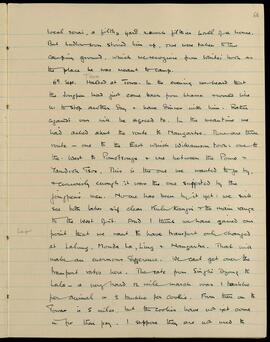
              6th Sept. Halted at Towa. In the evening we heard that the Jongpen had just come back from Lhasa and would like us to stop another day and have dinner with him. Rather against our will we agreed to. In the meantime we had asked about the route to Nangartse. There are three routes — one to the East which Williamson took: one to the West to Pomotsongo and one between the Pomo and Yamdrok Tsos. This is the one we wanted to go by, and curiously enough it was the one suggested by the Jongpen's men. No one has been by it yet: we will see both lakes and if clear Kulu Kangri and the main range to the West of it. And I think we have gained our point that we want to have transport only changed at Lalung, Monda La, Ling and Nangartse. That will make an enormous difference. We can't get over the transport rates here. The rate from Singhi Dzong to Lala — a very hard 12 mile march was 1 tanka per animal or 1/2 tanka per coolie. From there on to Towa is 5 miles, but the coolies have not yet come in for their pay. I suppose they are not used to

              LSH/1/1/1/1/112 · Part · 1933-07-29 - 1933-08-04
              Part of The Ludlow & Sherriff Collection

              SUMMARY:
              Notes describe reaching Trashiyangsi and traveling north up the Kulong Chu River to the Me La on the Tibetan frontier, with dates in late July and early August. The page lists numerous bird species observed around Trashiyangsi with remarks on abundance and elevation, and includes specimen entries for Seicercus xanthoschistos (dated) and Molpastes cafer bengalensis.

              CONTENT:
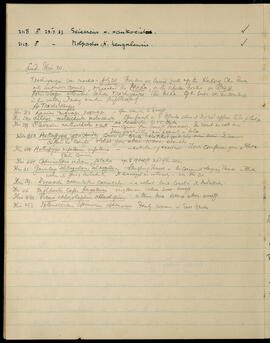
              2118 ♂ 29.7.33 Seicercus x. xanthoschistos.
              2119 ♂ - Molpastes c. bengalensis.

              Lud. Ibis 20.

              Trashiyangsi was reached on July 26. From here we turned north up the Kulong Chu River, into unknown country, & reached the Me La, on the Tibetan frontier, on Aug 4. Four stages intervene between Trashiyangsi & the Me La. Of the birds we encountered in the valley I may mention the following:
              At Trashiyangsi

              Ibis 283 Lanius nigriceps nigriceps - Open country to 6000ft.
              Ibis 284 Lalage melaschista melaschista. Open forests in E. Bhutan where it did not appear to be plentiful.
              Ibis 287. Seicercus xanthoschistos xanthoschistos - no records from W. & C. Bhutan. Common from 6000ft downwards. In scrub as well as in dense forest - the most frequent in Bhutan.
              Ibis 483 Aethopyga ignicauda. Common in Bhutan & S.E. Tibet south of the main axis. In deciduous & coniferous forests. In this zone above 10,000, etc etc.
              Ibis 484 Aethopyga nipalensis nipalensis - inhabitant of deciduous & lower coniferous zone in Bhutan. Quite common.
              Ibis 285. Caprimulgus indicus jotaka. up to 9000ft. Not often seen.
              Ibis 31. Garrulax albogularis albogularis. - Laughing Thrush - the commonest Laughing Thrush in Bhutan within its zone of distribution. It occurs in colonies - see Ibis 31.
              Ibis 29. Dryonastes caerulatus caerulatus - a silent bird local in its distribution.
              Ibis 46. Molpastes cafer bengalensis very common below 5000-6000ft.
              Ibis 485. Picus chlorolophus chlorolophus a tame bird scarce above 4000ft.
              Ibis 493 Sphenocercus sphenurus sphenurus Fairly common in East Bhutan.