Tibet

Elements area

Taxonomy

Code

Scope note(s)

    Source note(s)

      Display note(s)

        Hierarchical terms

        Tibet

          Equivalent terms

          Tibet

            Associated terms

            Tibet

              192 Archival description results for Tibet

              192 results directly related Exclude narrower terms
              LSH/1/1/2/1/2 · Part
              Part of The Ludlow & Sherriff Collection

              SUMMARY:
              Overview page listing the 1934 expedition route across Bhutan and Tibet. The itinerary runs from Menoka Tea Estate to Rangiya via numerous villages, rivers, passes, valleys, and dzongs.

              CONTENT:
              BHUTAN and TIBET.
              1934

              Route: Menoka Tea Estate - Diwangiri - Trashigong -
              Gamri Chu - Sakden - Muktur - Tawang - Tsona - Tulung La -
              Nyuri - Lap - Mago area (Luguthang & Chigapnaga) - Tulung
              La - Tsona - Gonpo La - Dongkar Dzong - Cha La - Cho La -
              Me La - Trashiyangsi valley - Chorten Korra - Dib La - Chorten
              Korra - Sana - Trashiyangsi Dzong - Trashigong Dzong - Sakden -
              Trashigong - Pintsogong - Chunkar - Diwangiri - Rangiya.

              LSH/1/1/2/1/237 · Part · 1969-04-29
              Part of The Ludlow & Sherriff Collection

              SUMMARY:
              Halted at Sahden in perfectly settled weather with plans for Nyit-sang La; Ludlow obtained a Tree Creeper. Two men returned from Tsona after six days, having taken a chair to Ragasha Kusho (absent to Lhasa); the Tsona Jongpen sent back Paraquilegia seed bags mixed with Meconopsis horridula pods, and the previously missing mail—found with the Tsona Jongpen—was recovered, while Damong mishandled arrangements for the man from Chukar.

              CONTENT:
              117

              go far, but want one more day for the Nyit-sang La, which I last went to on a cloudy day. Weather absolutely settled at last, no fear of more than showers in future.

              24th October. Halt Sahden. [Ludlow gets a Tree Creeper] Another perfect day, the best we have ever had, but unfortunately I did not go up a pass. There was not a cloud to be seen all day. In the evening the two men sent to Tsona came back.

              [26th men back] They took six days for the 108 miles or so - pretty good over the passes they had to cross. They took the chair to Ragasha Kusho, but he had been called to Lhasa. I think the other Jongpen was surprised that we did what we said we would. He sent back the seed bags of Paraquilegia, but mixed up with mec. horridula pods. There are very few seeds indeed, I'm afraid, but it can't be helped. There now remains only the man from Chukar. Damong made rather a mess of the arrangements about him. When the Tsona people were talking to me I noticed a bag lying on the floor. This was the missing mail, found with the Tsona Jongpen after all. He had kept it, not knowing where we were, & expecting us to send for it from Sahden. Everything in it was in good condition, letters etc. all dry. The night temp.

              LSH/1/1/4/1/109 · Part · 1933-09-23 - 1933-09-24
              Part of The Ludlow & Sherriff Collection

              SUMMARY:
              The diarists halt at Sanga Choling, receiving hospitality from a local mother and later sending mail via a young lama to Chague. The head lama visits and speaks of a recent scare in Lhasa involving Russians or Chinese Communists; Tsongpen returns with seeds from Karpo and the Trakan la, though the sought red Primula nivalis was not found.

              CONTENT:
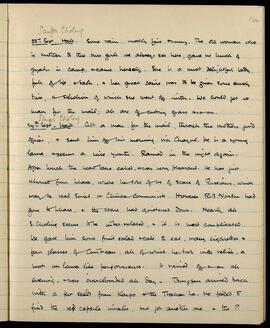
              Sanga Choling
              23rd Sept. Halt. Some rain, mostly fine and sunny. The old woman who is mother to the two girls we always see here, gave us lunch of guatu in camp, and came herself. She is a most delightful lady, full of life and talk, and her great desire was to be given some embroidery silk, a selection of which she went off with. We could get no man for the mail; all are off cutting grass and so on.

              Sanga Choling
              24th Sept. Halt. Got a man for the mail, through the mother's good offices, and sent him off this morning via Chague. He is a young lama and seems a nice youth. Rained in the night again. After lunch the head lama called, and was very pleasant. He has just returned from Lhasa, where he told us of scare of Russians, which may be real Soviet or Chinese Communists. However R.B. Norbu had gone to Lhasa, and the scare had quietened down. Nearly all S. Choling seems to be inter-related, and it is most complicated. We gave him some fruit salad and cake to eat, many cigarettes and four glasses of Cointreau, all of which he took with relish, a most un-lama like performance. It rained off and on all evening, and was overclouded all day. Tsongpen arrived back with a few seeds from Karpo and the Trakan la. He failed to find the red Primula nivalis, but got another one, and the P.

              LSH/1/1/3/3/201 · Part · 1996-06-18
              Part of The Ludlow & Sherriff Collection

              SUMMARY:
              Notes from Shagam La (next to Tame La) describe heavy snow and a difficult descent, with several primulas and gentians collected (nos. 2184–2189), including Meconopsis var. lutea noted as from Mipa rather than the Tawang district. Mentions a previous sighting of Pyrrhocorax at 16,000 ft and that a 'big bug' from Lhasa is expected tomorrow.

              CONTENT:
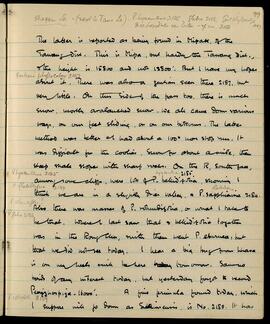
              Shagam La - (next to Tame La). P. hyacinthina 2185, Glabra 2186, Gent. phyllocalyx 2187
              Meconopsis var. lutea - of no. 2188

              The latter is reported as being found in Mipak, of the Tawang dist. This is Mipa, but hardly the Tawang dist., the height is 15800 and not 13800'. But I have my hopes about it. There was also a gentian seen there 2187, but very little. On this side of the pass too, there is much snow, mostly avalanched snow. We all came down various ways, on our feet sliding, or on our bottoms. The latter method was better and had about a 100' non stop run. It was difficult for the coolies. Snow for about a mile, then steep shale slopes with sharp rocks. On the R, South face, among some cliffs, were lots of P. bellidifolia, showing I think we are in a slightly drier valley, a P. sapphirina 2184.

              Also there were masses of P. rotundifolia, or what I take to be that. Where I last saw that & bellidifolia together was in the Rong Chu, with them went P. eburnea, but that we did not see today. I hear a big bug from Lhasa is on my heels and will be here tomorrow. Saw no birds of any interest today, but yesterday forgot to record Pyrrhocorax - 16000'. A fine primula found today, which I suppose will go down as sikkimensis, is No. 2189. It has...

              Sherriff Diaries
              LSH/1/1 · Subseries · 1933 - 1949
              Part of The Ludlow & Sherriff Collection

              Contains the original diaries of G. Sherriff, detailing his expeditions with Frank Ludlow in Bhutan and Tibet (1933-1934, 1936-1938, 1940, 1949). There are loose leaf sheets interleaved between the pages of some of the diaries. These contain a variety of letters, clippings, itineraries, plant lists and cost lists.

              Some diaries contained notes left in place by Dr. HR Fletcher when researching for his book 'A Quest Of Flowers: The Plant Explorations of Frank Ludlow and George Sherriff" (1976).

              Sherriff, George
              LSH/1/1/8/1/61 · Part · 1947-02-20
              Part of The Ludlow & Sherriff Collection

              SUMMARY:
              At Shingcha Woma hot springs the party noted strong sulphur fumes and found a single tree of the so-called 'Carmine Cherry' just coming into bloom. On 19 Feb a halt day, Ludlow asked locals about the Tongkyuk Chu flood that dammed the Po Tsangpo for three days, with no local damage. On 20 Feb the diarist and Betty set out with Tsompen, Kancha, and Akong toward a Gompa at the confluence of the Po Tsangpo and Kongbo Tsangpo, after overnight rain and snow down to Trulung, starting about 8 and needing to cross the Dring.

              CONTENT:
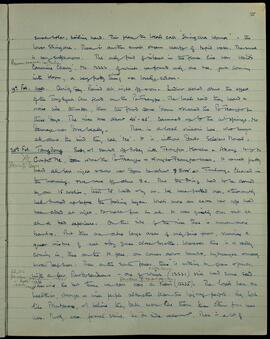
              small holes, boiling hard. This place the locals call 'Shingcha Woma' - the lower Shingcha. There is another small stream nearby of tepid water. The smell is very sulphurous. The only find of interest in the flower line was Ward's 'Carmine Cherry' (Prunus cerasoides var. rubra), No. 12222, of which we found only one tree, just coming into bloom, a very pretty thing & a lovely colour.

              19th Feb. Halt. Cloudy day. Rained all night off & on. Ludlow asked about the effect of the Tongkyuk Chu flood on the Po Tsangpo. The locals said they heard a noise like thunder, then the flood came down & blocked the Po Tsangpo for three days. The river rose about 40'-45', dammed up to the hot springs. No damage was done locally. There is a local shikari here, who knows all about the bird they call 'tse'. It is, in the south, Sclater's Monal.

              20th Feb. Tangdong. Betty & I started off today with Tsompen, Kancha & Akong to go to a Gompa where the Po Tsangpo & Kongbo Tsangpo meet. It rained pretty hard all last night & snow was down to about 8000' at Trulung. Cleared in the morning, & we were off about 8.0. But the Dring had to be crossed by our 15

              LSH/1/1/8/1/25 · Part · 1946-12-11
              Part of The Ludlow & Sherriff Collection

              SUMMARY:
              Travel from Shoka to Tse via Milung in fine but windy weather with striking views of Gyala Peri and observations of waterfowl along the Tsangpo. A halt from the 13th to 17th included courteous dealings with the Dzongpon’s acting representative, with visits exchanged by Ludlow and Elliot and mention of the real Dzongpon, Shasur Taiji.

              CONTENT:
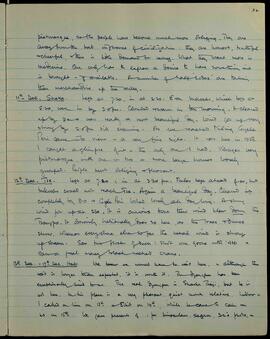
              picturesque, so the people have become much more obliging. They are away from the bad influence of civilization: they are honest, truthful and cheerful, there is little demand for money. What they want more is medicine. One only has to express a desire to have something and it is brought - if available. A number of 'half-Lobas' are taking their merchandise up the valley.

              11th Dec. Shoka. Left at 7.30, in at 2.30. Even bullocks, which left at 5.30, were in by 3.0 pm. Clouded over in the morning. It cleared up by 9.0 and was really a most beautiful day. Wind got up very strong by 2.0 pm till evening. As we reached Milung, Gyala Peri came into view - a very fine sight. It was here in 1938 I caught a glimpse of it - the only one I had. Villages very picturesque, with one or two or more large houses loosely grouped. People most obliging and pleasant.

              12th Dec. Tse. Left at 7.20: in at 3.30 pm. Mules kept ahead of us, but bullocks could not reach Tse. Again a beautiful day. Cleared up completely by 8.0 and Gyala Peri looked lovely all day long. A strong wind got up at 2.30. It is curious that this wind blew down the Tsangpo. It obviously habitually does so here, as the trees and dunes show, whereas everywhere else so far the usual wind is strong upstream. Saw two flocks of duck: shot one goose with .410 and saw a great many black-necked crane.

              13th Dec. - 17th Dec. Halt. We knew we would have to wait here, and although the wait is longer than expected, it is worth it. The Dzongpon has been exceptionally kind to us. The real Dzongpon is Shasur Taiji, but he is not here. In his place is a very pleasant, quiet monk relative. Ludlow and I called on him on 13th and Elliot on 14th, while he came to call on us on 15th. We gave presents of 1 pr binoculars, saffron, D's photo, and

              LSH/1/1/1/1/203 · Part · 1933-09-25
              Part of The Ludlow & Sherriff Collection

              SUMMARY:
              The diarist recounts a shooting outing near Gyantse with Henlin and Worth, marked by mishaps and a listed bag. At SAKANG, they describe comfortable staged travel, leaving Kusho behind and continuing with two servants and Tenduk, with clear weather, views of Gyantse, and harvest scenes en route to O. Sowgon.

              CONTENT:
              a game again. We were much amused to see Henlin & Worth together. Worth, although kind to us, is a fool, & a very typical I.C.S. man. He has most annoying ways, which are bound to get up against people in an out of the way place like Gyantse, at 13000 ft. Yesterday we induced all of them to go out shooting with us, we having got permission from the Kengchung. It was great fun really, & the fun was added to by Worth, who knew neither the country nor anything about shooting, & by Henlin, who has done no shooting before, letting off his gun & peppering the syces, & thereby making Worth furious - all very funny. Henlin is an enormous man 6' 4" & very broad indeed. He has a voice & a laugh you can hear a mile away. - Bag. 6 snipe 5 golden plover. 2 garganey, 1 black necked crane.

              25th September. SAKANG. 13400' 15 1/2 miles. To O. Sowgon. Travel here is the acme of luxury with a bungalow at each stage, where everything is kept. We therefore left Kusho behind, & now only have with us our two servants & Tenduk. Today was a bright clear morning, clouding over at midday, & Gyantse looked very pretty when we left early this morning. The crops have ripened very quickly since we arrived, & now harvest is in full swing. It is an unexpected sight to see men & women, all strapped to the waist, cutting the barley. One doesn't somehow imagine a place this

              B. 32. Gyantse from the bridge: A woman carrying water

              LSH/1/1/1/1/173 · Part · 1933-09-05
              Part of The Ludlow & Sherriff Collection

              SUMMARY:
              Notes describe views of Singhi Dzong and the Kuru Chu gorge, photographing types and views at Lala, and local reactions to camp gear and flowers (including delphinium used as a 'louse killer'). The Jongpen has gone to Lhasa with Williamson, affecting transport, while the party camps in a sheltered field and tends seedlings amid wind and impending frost.

              CONTENT:
              B 27.
              View up side valley - Singhi Dzong: from bridge over Kuru Chu looking up: from ridge above looking down gorge.
              Types & views at Lala.
              Petunias

              Their name for the delphinium is "louse killer". I suppose they imagine we carry it about for that purpose. They make it into a paste & put it in their clothes. The box of flowers also causes great amusement. But when we arrive in camp, the greatest attraction is seeing a camp bed & chair put together. Everyone will close round & just stand & gaze at it. The scenery yesterday was fine - the gorge of the Kuru Chu, the little villages we passed through; and the people themselves - all were interesting. The Jongpen here has gone to Lhasa with Williamson, so has his steward, so I don't know how we will fare for transport. His wife acts in his place. The Dzong is a fine building on a rock in the valley, with a gompa below it. Our camp is in a lovely green field, surrounded by trees & out of the strong wind. The seedlings seem to have lasted well so far, but the wind will be a trial to them here. It is so dry & different to what they are used to. I water them twice a day, with that perhaps all will be well. There will soon be frost, then presumably I can let them dry off. Last night we were both pretty ill-tempered for a while. When we reached here in the dark, we found that the man responsible had sent all our kit to the

              LSH/1/1/1/1/210 · Part · 1933-10-02
              Part of The Ludlow & Sherriff Collection

              SUMMARY:
              Three female bird specimens are recorded: Anthus richardi godlewskii, Alauda arvensis gulgula, and Falco tinnunculus. The Anthus was taken in the upper portion of the Chumbi Valley near Gautsa on 2 October 1933.

              CONTENT:
              2371 ♀ 2.10.33 Anthus richardi godlewskii.
              2372 ♀ - Alauda arvensis gulgula
              2373 ♀ - Falco tinnunculus.

              L. 119. Anthus taken in the
              upper portion of the Chumbi Valley
              near Gautsa.